

CRISPR-Based Diagnostic Startup Files IPO Amid Breakthrough in Amplification-Free Genetic Testing
CRISPR gene-editing technology has already spawned startups aimed at developing new therapies using this tool; now, we introduce another less crowded avenue for its application: diagnostic testing.
A research team in California, United States, has developed a new technology. The team includes researchers from the University of California, Berkeley; Keck Graduate Institute; Scripps College; Claremont McKenna College; and two biotechnology startups, Cardea Biosciences and Nanosens Innovations.
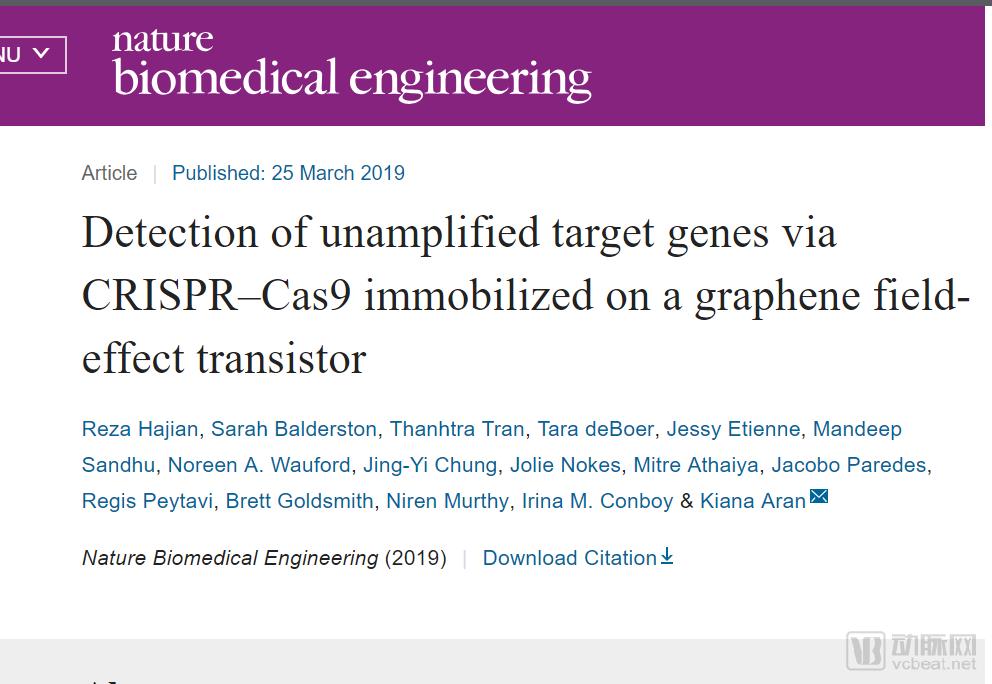
Research findings on the CRISPR-Chip were published in Nature Biomedical Engineering on March 25, further demonstrating the practicality of CRISPR-Cas technology in the diagnostic field. Researchers have developed a novel graphene-based handheld device, named “CRISPR-Chip,” which enables digital detection of specific gene mutations from patient DNA samples without the need for amplification or sequencing.
A More Convenient, Simpler, and Faster Approach to Disease Detection
Most nucleic acid detection methods require numerous reagents and expensive equipment. In contrast, this handheld device leverages the gene-targeting capability of CRISPR by combining a partially inactivated Cas9 protein with specific single-guide RNA (sgRNA) and integrating the complex onto graphene-based transistors to achieve nucleic acid detection.
“We collaborated with our partners to develop the first device that uses CRISPR to scan the genome for potential mutations,” said Dr. Kiana Aran, Assistant Professor in the Department of Bioengineering at the University of California, Berkeley, and Keck Graduate Institute. “You simply place a purified DNA sample on the chip, allow CRISPR to perform the search, and the graphene transistors report the results within 15 minutes.”
The CRISPR-Chip prototype features thousands of CRISPR-Cas complexes immobilized on graphene transistors. These proteins bind to specific sites on the DNA without cleaving it. If the CRISPR-Cas molecules fail to detect the target gene in the sample, the DNA is released without binding. However, upon perfect sequence matching, the proteins bind to the DNA, inducing additional surface charges on the graphene. This alters the conductivity of the graphene transistor, which is detected by the CRISPR-Chip and read out as an electrical signal.
In their paper, Aran’s team used CRISPR-Chip to analyze DNA samples collected from an HEK293T cell line expressing the blue fluorescent protein (BFP) gene, a reporter gene commonly employed to validate CRISPR-Cas genome editing. They also examined clinical samples from patients with Duchenne muscular dystrophy (DMD) caused by mutations in the dystrophin gene. Although mutations can occur in any of the gene’s 79 exons, the most common deletions are found in exons 2–10 and exons 45–55. Using CRISPR-Chip, the team targeted mutations in two of these frequently deleted exons (exon 3 or exon 51) and was able to specifically detect the deletions without any prior amplification.
“We only need about one-tenth of the DNA from a buccal swab,” said Aran. “This technology is very exciting because we are bypassing most of the laboratory processing steps typically required for these DNA samples.” The required hardware is comparable in size to a large smartphone and can run on a laptop, offering strong portability.
“The device has a sensitivity of 3.3 nanograms per microliter,” said Aran. “Of course, the sensitivity and specificity of diagnostic tests for different individuals need to be measured in clinical trials, and we have not yet reached that stage.”
“This platform is ‘very smart,’” commented Stuart Lindsay, Director of the Center for Single Molecule Biophysics at the Biodesign Institute of Arizona State University, who was not involved in the study. “The novelty here lies in using CRISPR for genomic search. Detecting target genes via DNA hybridization on chemical surfaces, such as the graphene used here, is straightforward and fairly routine. However, the search capability of CRISPR allows it to locate targets within the genome, which is why unamplified DNA can also be used.”
Additionally, some experts in DNA molecular electronics have pointed out that the article’s experimental data are relatively scarce, raising doubts about the reproducibility of the results. However, Dr. Brett Goldsmith, Chief Technology Officer at Cardea and a co-author of the study, asserted, “The test data are among the best and most reproducible I have ever seen from nanoelectronic sensors.”
Goldsmith pointed out, “Other technologies require DNA amplification, and any DNA amplification process introduces the same background interference issues. Few people can achieve DNA detection without amplification.” PCR amplification of DNA should only be used when absolutely necessary, as there are many practical challenges associated with using amplification outside research laboratories.
In the future, once this device enters clinical trials, it can be used for rapid disease diagnosis, helping physicians develop personalized treatment plans for patients through rapid genetic testing. Meanwhile, it can also be employed in laboratory settings to monitor whether CRISPR binds to specific DNA sequences, thereby assessing the accuracy of CRISPR-based gene editing technologies. According to Aran, the laboratory will be ready this year to begin using Cardea’s production equipment in collaboration with Keck Graduate Institute; however, there are still complex procedures to complete before entering clinical trials.
Two CRISPR Technology Platform Testing Companies Already Exist
Jennifer A. Doudna, an early CRISPR technology expert at the University of California, Berkeley, founded Mammoth Biosciences in 2017. The company holds a technology license from the University of California and leverages CRISPR technology to enable rapid diagnostics for infectious diseases, oncology, and genetic mutations. On March 22 of this year, Sherlock Biosciences, co-founded by Feng Zhang, was officially established and secured $35 million in financing. Licensed through the Broad Institute, the company also utilizes CRISPR technology for rapid diagnostic applications.
Numerous scientists are engaged in advancing CRISPR-Cas technology in the field of diagnostics, addressing a multitude of challenges. Obtaining results for many disease and genetic mutation tests can be time-consuming, and such testing may be unavailable in low-resource settings, such as those in developing countries. If scientists can develop new diagnostic testing technologies, they could significantly reduce costs, enhance convenience, and expand accessibility, thereby resolving the longstanding dilemma of the "impossible triangle" in healthcare.
References:
https://www.genengnews.com/insights/fishing-for-mutations-using-crispr-chip/
https://www.nature.com/articles/s41551-019-0371-x?_ga=2.66237870.1055437075.1553821161-1102980628.1553140428