

Qie Doctor Unveils Four Smart Health Products, Pioneering the 'Intelligent+' Era in Healthcare with Its Future Clinic Concept
On March 27, Penguin Almond Group unveiled four smart health products at its flagship Beijing Penguin Clinic, including the Smart Health Kiosk, Health Terminal, Smart Body Composition Analysis Mirror, and Future Specialist Consultation Room. This launch comprehensively established the new concept of the “Penguin Doctor Future Clinic” and marked the first product release since the merger of Penguin Doctor and Almond Doctor on August 8 last year.
Group CEO Wang Shirui delivered a speech, stating that Penguin Doctor, as part of Tencent’s strategic layout in healthcare, is committed to providing users with a one-stop health consumption platform. Meanwhile, as a partner to hundreds of thousands of outstanding physicians and China’s largest primary care service provider, it has established an integrated online-offline one-stop medical and healthcare service system.
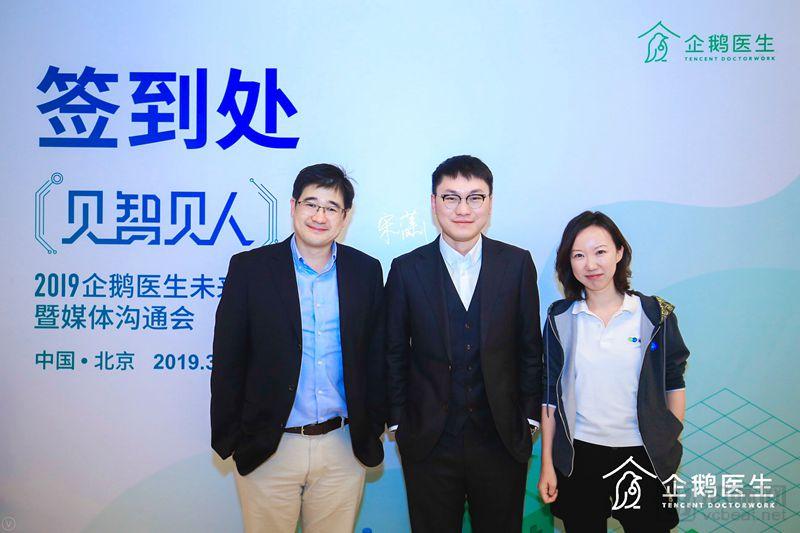 (Penguin Almond Group President Martin, CEO Wang Shirui, COO Xu Lin)
In the 2019 Government Work Report, Premier Li Keqiang repeatedly mentioned the term “Smart+.” He pointed out that it is essential to build industrial internet platforms, expand the application of “Smart+,” and empower the transformation and upgrading of the manufacturing sector. This marks the first appearance of “Smart+” in the report since “Internet+” was included in previous years. It also signifies that “Smart+” has become a core focus across various industries. The simultaneous launch of four smart health products by Penguin Doctor aptly demonstrates its strategic layout and dominant position in the “Smart+” healthcare sector.
4 Smart Health Products: Leveraging Technology to Make High-Quality Healthcare and Medical Services Accessible to All
The four smart health products unveiled each boast unique highlights, spanning areas such as medical consultations, travel, and basic health screenings. Wang Shirui stated that these four products represent Penguin Doctor’s foray and exploration into the intelligent healthcare sector, driven by the original commitment to enhancing health experiences with efficiency and convenience.
Health Kiosk—By integrating the internet with smart devices, this solution combines new retail health products, health screenings, remote consultations, online e-prescriptions, and relaxation oxygen bars into a unified “smart micro-clinic.” These kiosks are deployed within a 5-kilometer walking radius of users’ work and living areas. Furthermore, the kiosk offers up to 15 types of daily personal care products and over-the-counter medications, covering 90% of common health-related scenarios, thereby ensuring that high-quality healthcare services are accessible 24/7.
Smart Health Terminals—As a novel approach to health screening and testing, these terminals enable users to undergo professional-grade health screenings within their daily work and living environments. They offer a variety of convenient, non-invasive self-testing products, such as urinalysis, early pregnancy tests, ovulation tests, and even genetic testing, alongside personal care items like sanitary pads and condoms to meet occasional needs.
Health Micro-Assessment Magic Mirror—A Smart Healthcare Experience Wall. By scanning a QR code with WeChat, users can self-complete measurements of basic vital signs in just 1–2 minutes. The analysis report is automatically synced to their mobile phones within 5 seconds, covering health metrics such as body weight, BMI, ECG, blood oxygen saturation, muscle mass, and basal metabolic rate. This provides scientific and effective support for weight management, body shaping, muscle training, nutritional balance, and disease diagnosis. Additionally, the self-service triage screen based on facial recognition assists patients with intelligent triage. In the Premium Hardware Display Area, various smart devices are available to help physicians manage patient health.
The three aforementioned products were launched last year and have already achieved initial market success. Over 1,000 smart terminal devices have been deployed across four first-tier cities, empowering numerous well-known real estate companies with health solutions. The Health Micro-Assessment Magic Mirror has also been installed in major urban transportation hubs and, through collaboration with scenic area governments, was the first to be deployed in Lijiang, a renowned tourist destination, at the beginning of the year to safeguard the health of local tourists. Currently, all three products are continuing to expand their market presence.
The Future Expert Clinic—Penguin Doctors’ vision and realization of the future healthcare model. The medical assistant team pre-organizes the patient’s medical records and matches them with suitable specialists from Penguin Doctors’ nationwide network of 440,000 physicians. General practitioners (GPs) are responsible for on-site physical examinations and assistance. During the face-to-face consultation between the patient and the GP, remote specialists and family members join the consultation via video link through two separate intelligent robots. In the Future Expert Clinic, Penguin Doctors leverages AI to empower every step of the diagnostic and treatment process, not only providing patients with more authoritative treatment recommendations but also allowing patients and their families to truly experience Penguin Doctors’ firm commitment to delivering compassionate care. Currently, five Penguin Clinics in Shenzhen offer the Future Expert Clinic experience.
While the future has yet to arrive, Penguin Doctor boldly envisions the appearance of future clinics and even gains early insight into the entire landscape of future healthcare. By leveraging cutting-edge technology to break conventions, it focuses on helping users identify health issues anytime and anywhere. In the near future, these aesthetically pleasing and user-friendly smart medical products will become infrastructure integrated into our daily lives, appearing in communities, shopping malls, office buildings, gyms, and many other places.
Wang Shirui, CEO of Penguin Almond Group, further stated that over the next three to five years, the company will build a unique pyramid-shaped competitive moat through three tiers. The first tier will establish the initial point of contact for user health and medical services by steadfastly continuing to deploy widely accessible smart health devices and integrating pharmacy-clinics and community outpatient centers at the grassroots level. The second tier will address more advanced healthcare needs of the general public through the development and acquisition of day surgery centers and specialized outpatient clinics. The third tier will complete the final closed loop by deeply collaborating with tertiary hospitals (Grade 3A) and specialized hospitals to integrate high-quality medical resources. The establishment of these three pyramid-like tiers will solidify Penguin Almond Group’s leading market position.
Since joining Penguin Almond Group last November, this marks Yu Ying’s first public appearance and speech in her capacity as the Group’s Chief Medical Operations Officer. In this role, she shared her insights on safeguarding the quality of intelligent medical services, stating that technology will serve as the cornerstone and guarantee for the implementation of healthcare services in the future. First, Penguin Almond Group is committed to building a chained network of over one hundred outpatient clinics in the future, with technology empowering the scaled management and standardization of services across these clinic networks. Second, technology can help physicians comprehensively enhance their clinical and managerial capabilities, thereby supporting the development of a high-quality talent pipeline.
In the new concept of the future clinic created by Penguin Doctor, we see that Penguin Doctor’s journey toward smart healthcare has branched out into more avenues, further demonstrating its capability to build a high-quality health service system. There is good reason to expect that Penguin Doctor’s blueprint for an integrated online-to-offline one-stop service system will be rapidly implemented, continuing to bring users unprecedented surprises and unlocking greater possibilities for the future of intelligent healthcare.