

Meinian Onehealth and Xinhua China Economic Information Service Launch China Resident Health Screening Index to Support National Preventive Healthcare Strategy

health 100
Medical Examination Service Provider
VCBeat (WeChat ID: vcbeat) has learned that the “Chinese Residents’ Physical Examination Health Index” project was officially launched in Beijing on the afternoon of March 29. The index was jointly compiled and released by Xinhua News Agency’s China Economic Information Service and Meinian Onehealth (Health 100), with professional academic guidance provided by the Meinian Public Health Research Institute of Peking University Health Science Center. It aims to quantitatively assess the overall health status and health trends of Chinese residents, facilitating the transformation of China’s health ecosystem from a “disease-centered” to a “health-centered” model.
It is reported that the index will focus on assessing the major types of chronic diseases in China, as well as the health status of residents across various provinces and cities. This initiative will not only facilitate the early identification of the distribution, current status, and trends of chronic diseases among residents in different regions, but also play a positive guiding role in improving and innovating China’s overall disease prevention system. Furthermore, it will provide an evidence base for regulatory authorities to support decision-making, thereby continuously enhancing the national health level.
“Currently, the Global Health Index is published by the World Health Organization (WHO), and all major countries around the world have compiled and released their own national health indices.” Han Jisheng, an academician of the Chinese Academy of Sciences and a professor at Peking University Health Science Center, stated at the signing ceremony: “As the most populous country in the world, China should undoubtedly release its own Resident Health Index to help the world understand the health status of the Chinese people and enable every individual to understand their own health status.”
“With rapid economic development, China’s demographic structure, people’s production and lifestyle patterns, disease spectrum, and natural environment have undergone tremendous changes. The health challenges and disease burden among Chinese residents have become increasingly severe—marked by prominent population aging, a heavy burden of chronic diseases among residents, widespread suboptimal health status, and growing concerns about adolescent health.” Zhang Boli, Academician of the Chinese Academy of Engineering and President of Tianjin University of Traditional Chinese Medicine, pointed out: “In response to the increasingly serious health issues facing residents, it is essential to strengthen analysis, guidance, and education, and to implement comprehensive health management. In this context, it is particularly important to establish a Chinese Resident Health Index that integrates both the external health environment and individuals’ own health behaviors.”
The report to the 19th National Congress of the Communist Party of China explicitly stated that we should implement the Healthy China strategy, deepen the reform of the medical and healthcare system, and adhere to a prevention-first approach. The Outline of the “Healthy China 2030” Plan proposed “promoting the development of personalized health management services and cultivating a batch of distinctive health management service industries.” This year’s Government Work Report also called for “adhering to a prevention-first approach and doing a good job in the prevention and control of common chronic diseases.”
As the market entity for Xinhua News Agency’s economic information services, China Economic Information Service (CEIS) centrally manages and operates these services. Its “Xinhua Index” brand provides end-to-end industry chain services—including index development, publication, promotion, and maintenance—to various entities.
Yu Rong, Chairman of Meinian Onehealth, stated that “data + technology” serves as a critical pillar driving the development of the medical and health industry. The company actively responds to the directives from the “Two Sessions” to adhere to prevention-first principles and strengthen the prevention and control of major diseases. It remains committed to leveraging large-scale user traffic to generate precise data, using data to drive technological innovation, and employing such innovation to build a comprehensive healthcare ecosystem. In doing so, Meinian Onehealth aims to serve as a vital supplement to the national healthcare system, fulfilling its significant mission of safeguarding public health and advancing life science and technology innovation.
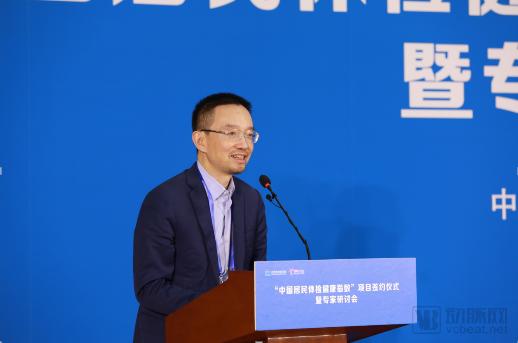
Speech by Yu Rong, Chairman of Health 100
Yu Rong further stated, “We will take this collaboration as an opportunity to fully leverage Health 100’s unique advantages in medical big data, better meet the public’s health needs, and support the healthy development of the industrial ecosystem. This aligns with Health 100’s long-standing business logic of ‘professional health checkups – precise data – high-risk screening – risk assessment – health management.’” It is understood that Health 100 currently covers 32 provinces, municipalities, and autonomous regions across China, with a presence in 215 core cities and over 600 medical and health examination centers. In 2018, Health 100 provided health checkup services to more than 30 million people, a figure expected to exceed 40 million this year.
This collaboration will facilitate the full integration of both parties’ resources, achieving complementary advantages. Health 100 possesses unique strengths in medical big data; its proprietary big data systems, survey reports from authoritative institutions, and market-oriented professional databases will serve as the core data for the index compilation. Building on this foundation, the collaboration will leverage China Economic Information Service’s professional R&D team and expert specialists in index development to compile and release the index in a phased and tiered manner, gradually enhancing its guiding role in the market.
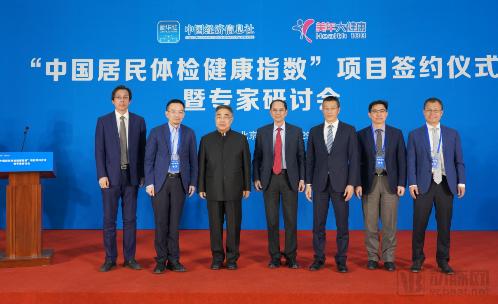
Group Photo of Guests at the Event
Also attending the project signing ceremony were Xu Yuchang, Party Secretary, Chairman, and President of China Economic Information Service; Pan Haiping, Deputy General Manager of the General Office and Deputy Director of the News and Information Center of Xinhua News Agency; Cao Wenzhong, Member of the Party Committee, Director, and Vice President of China Economic Information Service; Xu Shousong, Editor-in-Chief of China Securities Journal; Ning Yi, Vice President and Chief Scientist of Meinian Onehealth (Health 100); as well as more than ten professors and experts from universities and research institutions, including Tsinghua University, Renmin University of China, Beijing University of Chinese Medicine, Capital Medical University, the Chinese Academy of Social Sciences, the National Center for Chronic and Noncommunicable Disease Control and Prevention of the Chinese Center for Disease Control and Prevention, and the Chinese Health Education Center.