

2019's Hottest Aesthetic Procedures and the Rise of Two Single-Service Clinic Chains Filing IPOs
In March, the latest 2018 aesthetic medicine data released by the American Society of Plastic Surgeons (ASPS) showed that there were nearly 250,000 more cosmetic surgical procedures in 2018 than in 2017, with trends indicating a steady rise in the number of people undergoing aesthetic medical procedures over the past five years.
According to ASPS data, 1.8 million cosmetic surgical procedures were performed in 2018. The top five procedures were breast augmentation (up 4% year-over-year from 2017), liposuction (up 5%), rhinoplasty (down 2%), blepharoplasty (down 1%), and abdominoplasty (unchanged).
Meanwhile, 15.9 million minimally invasive procedures were performed in 2018. The most popular procedures, in descending order, were botulinum toxin injections (a 3% year-on-year increase from 2017), hyaluronic acid fillers (up 2%), chemical peels (up 1%), laser hair removal (down 1%), and microdermabrasion (down 4%).
Technological advancements, heightened consumer awareness, more flexible payment options, and the tangible benefits of medical aesthetic procedures for patients have driven the sustained upward growth of the medical aesthetics industry.
Data from RealSelf, a leading U.S. medical aesthetics platform, also shows that one-third of American adults (33%) are considering non-surgical treatments, and 22% are considering undergoing surgical procedures in 2019, with Millennials aged 18–34 and parents of children under 18 being the most likely to consider these options.
Below is the ranking of medical aesthetic procedures on the platform, summarized based on review data, along with the most highly recommended treatments in 2019. VCBeat (WeChat ID: vcbeat) has compiled this information, revealing several interesting trends. In terms of procedures, non-invasive cosmetic treatments are easily standardized and tend to generate chain effects in skin management and body contouring. Meanwhile, upstream device and consumable manufacturers are actively pursuing “downstream” integration, which may offer valuable insights for domestic medical aesthetic clinics in China.
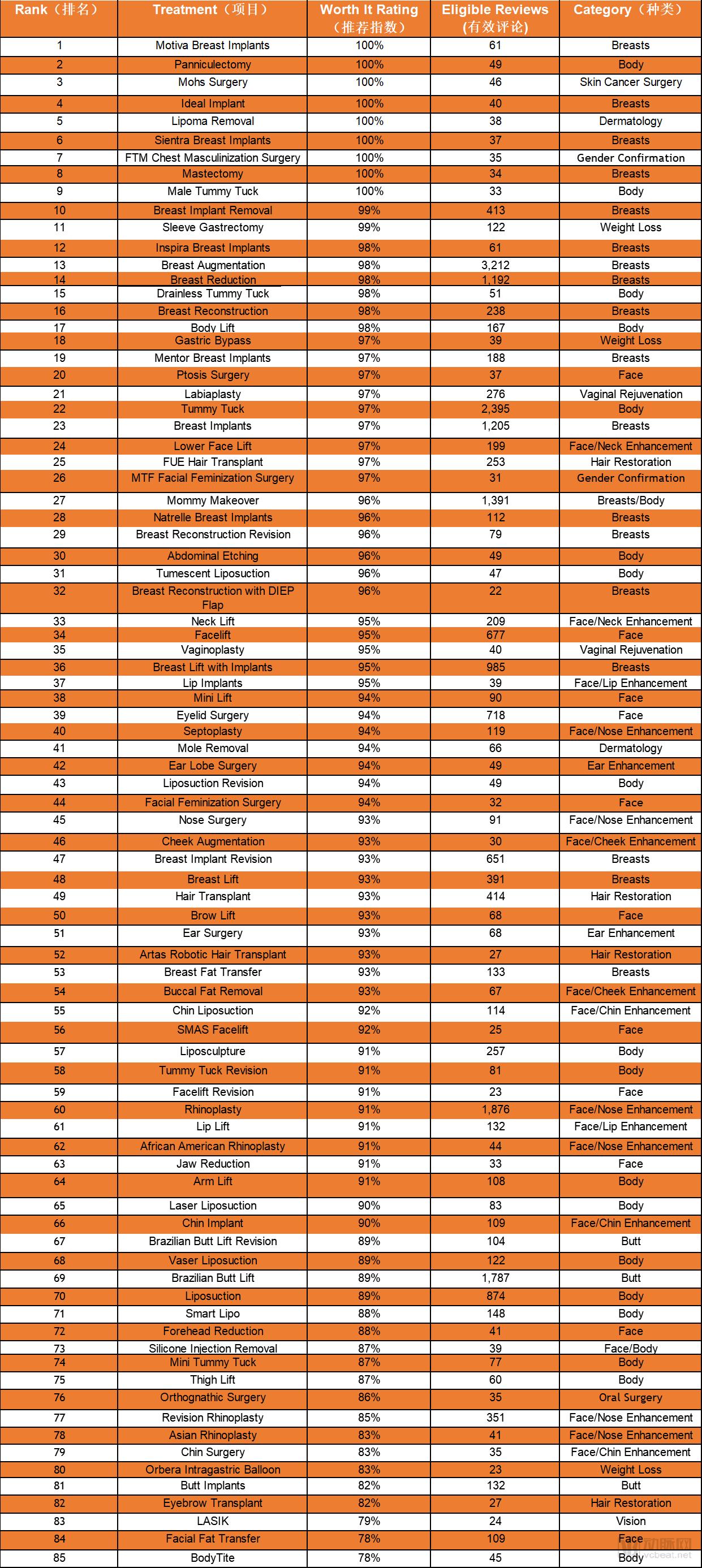
RealSelf Plastic Surgery Rankings
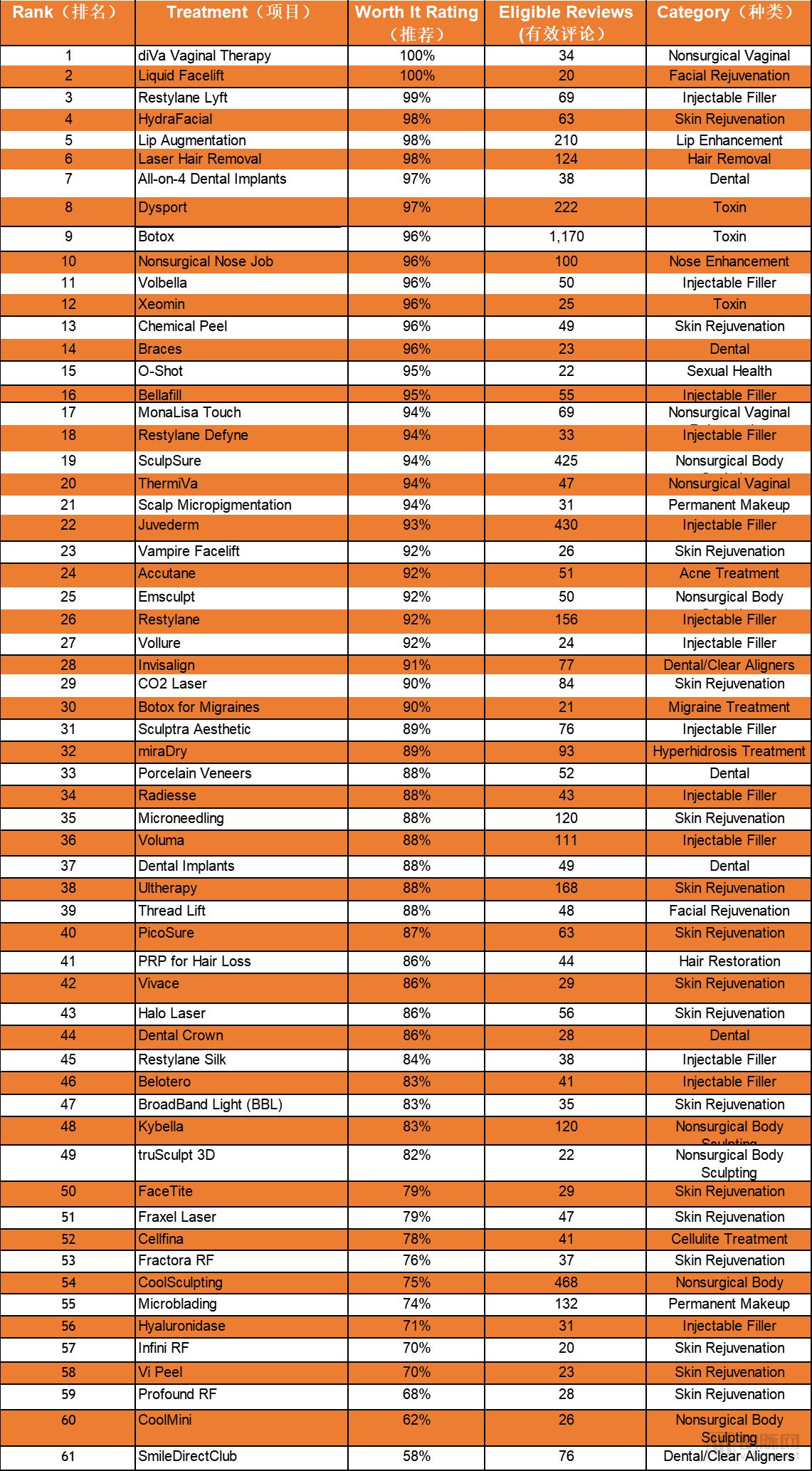
RealSelf Non-Invasive Procedure Rankings
From the above information, it is evident that there is a significant gap between Western countries and China. In foreign markets, botulinum toxin injections remain the predominant treatment, as Caucasians are more prone to wrinkles and thus have a high demand for wrinkle reduction. While acne or acne scars may be common concerns in these populations, they do not exhibit the high prevalence of melasma and sensitive skin seen among Chinese consumers. The high incidence of these conditions in China is attributed partly to ethnic characteristics and partly to lifestyle habits and environmental pollution.
Certainly, compared to the medical aesthetics environment in the United States, it is more difficult to apply for medical beauty services in China. It is even more challenging to establish dermatology clinics that can be covered by national health insurance and social security. Commercial insurance in China is also not well developed, whereas in the United States, it is common for dermatologists to open clinics that accept both national health insurance and commercial insurance.
In the United States, most institutions remain private practices operated by individual physicians, and these clinics primarily address essential medical needs. In addition to the aforementioned demand for wrinkle reduction, the high incidence of skin cancer involves a different level of medical consideration.
From the clinic perspective, Western countries also rarely have large-scale, true medical aesthetics chains. The few existing medical aesthetics chains mainly fall into two categories:
1. The first category focuses primarily on body contouring or hair removal. For instance, SonoBello, a leading chain brand in the United States, mainly offers three core services—TriSculpt™ laser liposuction, Venus Freeze™, and excess skin removal—to achieve body shaping and aesthetic goals. This approach is particularly suitable for cases where diet and exercise fail to deliver effective results. Leveraging standardized management, a team of physicians, and a chain-store model, SonoBello has established itself as a top-tier brand. Moreover, body-contouring-centric services are highly amenable to standardization.
2. The second category comprises non-invasive medical aesthetic procedures led by skincare companies. Compared with other medical aesthetic treatments, these procedures offer a high level of comfort and are virtually painless. A prime example is the medical-grade skincare treatment Hydrafacial. Globally, one person undergoes the Hydrafacial treatment every 15 seconds. In 2017, more than 2 million treatments were performed, surpassing the number of botulinum toxin injections in the United States. In RealSelf’s 2019 procedure recommendation index, Hydrafacial achieved a rating as high as 98%, ranking second. Similarly, by offering standardized finished products, it is easy to establish a standard system. Furthermore, partnerships with certified clinics can expand channel reach.
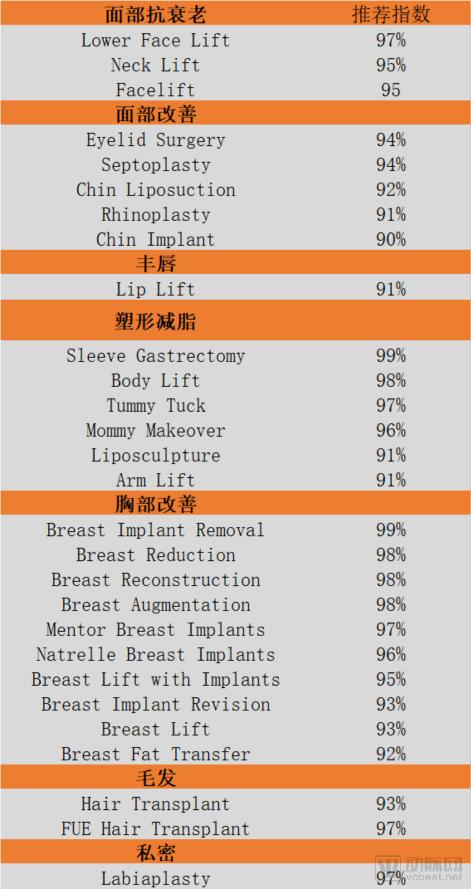
RealSelf’s Most Recommended Plastic Surgeries of 2019
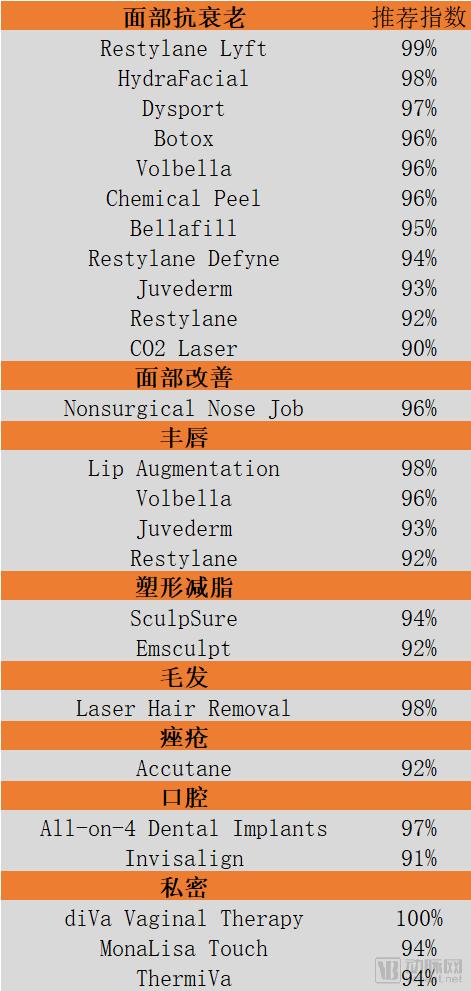
RealSelf’s Top Recommended Non-Invasive Procedures of 2019
HydraFacial (Hai Fei Xiu)
Originating from the United States and featuring proprietary patented technology, this non-invasive, painless, safe, and effective skin rejuvenation and resurfacing treatment is suitable for all skin types, with a session duration of 30 minutes.
As a non-invasive skincare treatment, HydraFacial is well-suited for long-term daily care and is suitable for all skin types. Centered on advanced “black” technology that rapidly repairs the skin barrier, it combines professional vortex-based devices to exfoliate dead skin cells and infuse essential serum ingredients. With zero pain and zero downtime, it delivers deep cleansing and healthy nourishment, quickly restoring radiant, healthy skin. The treatment primarily follows three standardized steps: Cleanse + Rejuvenate, Extract + Revitalize, and Nourish + Repair.
Purification + Revitalization: Utilizes lactic acid to soften and remove aged keratin, cleanse pores, and enhance skin hydration. Primarily helps the skin adapt to the treatment while performing superficial skin cleansing;
Deep Cleansing + Skin Rejuvenation: Helps soften comedones and extract excess sebum and impurities from pores. Patients will distinctly feel the device drawing out debris from the deeper layers of the skin.
Nourish + Repair: Infuses the skin with hyaluronic acid and other active serum ingredients to provide hydration and replenish nutrients. Antioxidants and peptide essences help restore the skin’s hydrated and repaired state.
Partner clinics selected for collaboration utilize disposable tips in their skincare protocols, completely eliminating concerns about cross-infection. Regarding efficacy, Dr. Ellen Marmur, a clinical authority at the Icahn School of Medicine at Mount Sinai in New York, has stated: “HydraFacial treatments are suitable for all age groups—whether young people troubled by acne, adults plagued by closed comedones, or mature individuals affected by sun damage.”
Since its entry into the Chinese market, Hydrafacial has engaged in in-depth research and collaboration with clinical experts in China to better tailor its treatments to Asian skin types. These collaborators include Dr. Zhang Yingrui, known as the “Father of Botulinum Toxin Cosmetic Injections” in China, and Director Xiang Leihong from Huashan Hospital Affiliated to Fudan University, among others.
Of course, Hydrafacial is primarily a maintenance treatment focused on cleansing, hydration, and brightening. For Asian skin types, it is recommended to undergo a Hydrafacial treatment every 2–3 weeks. This frequency can effectively prevent the formation of comedones and excess keratin buildup. When combined with the infusion of serums tailored to your specific skin type, it helps maintain long-lasting skin hydration. For anti-wrinkle and lifting effects, at least radiofrequency (RF) treatment is required. Among anti-aging procedures, Thermage remains an excellent therapeutic option.
SkinCeuticals (修丽可)
SkinCeuticals is a professional, science-backed skincare brand from the United States, established in 1997, though its origins trace back even further. As early as the 1980s, Professor Sheldon Pinnell, the leading dermatological scientist at Duke University in the United States, embarked on a series of studies in skin science.
As the founder and chief scientific advisor of SkinCeuticals, Dr. Pinnell redefined antioxidant science through his 40-plus years of dedicated dermatological research and scientific achievements. Recognized as a leading authority on antioxidants within the professional community, he laid the foundation for the brand’s creation. Under his leadership, SkinCeuticals has become a pioneer in the field of antioxidant and anti-aging skincare.
The history of SkinCeuticals is deeply rooted in the evolution of antioxidant science. In the late 1980s, founder Professor Sheldon Pinnell identified the precise formulation parameters required to stabilize pure vitamin C (L-ascorbic acid) during his research, laying the foundation for the brand’s establishment. Subsequent breakthroughs further cemented SkinCeuticals’ leadership in the fields of antioxidant protection and anti-aging. Thanks to the brand’s unwavering commitment to innovation, antioxidants have increasingly become the preferred skincare solution for combating skin aging and maintaining a healthy, radiant complexion.
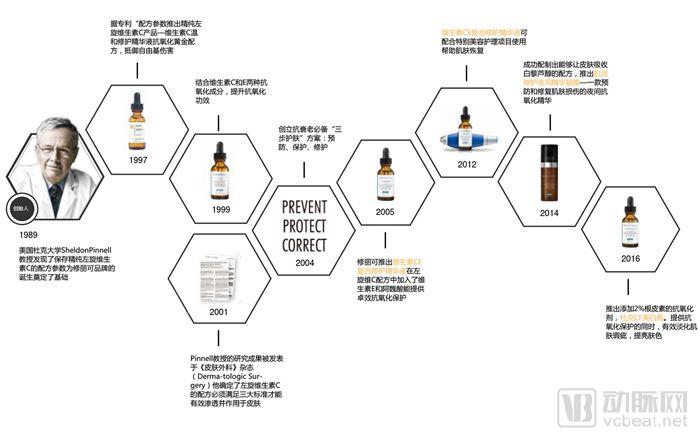
Main Product Lines
The company’s core philosophy centers on professional institutions, leveraging SkinCeuticals’ professional skincare solutions to integrate “professional treatment protocols,” “advanced at-home care,” and “professional aesthetic procedures.” This holistic approach promotes skin health and radiance from multiple angles, enhancing overall efficacy. SkinCeuticals boutiques have now launched in Beijing, Shanghai, Nanjing, Hangzhou, and other cities, allowing patients to conveniently experience the products and the SKINSCOPE skin analysis service. Exclusively developed by SkinCeuticals, SKINSCOPE provides a six-dimensional profiling and professional scoring system to decode skin concerns, with reports instantly sent to users’ mobile devices.
Beyond Hydrafacial and SkinCeuticals, upstream players in the medical aesthetics supply chain, such as Bloomage Biotech and Filorga, have already expanded into offline clinics or physical entities. By leveraging rapidly standardized products and service systems to establish boutique clinics, these upstream device and consumable manufacturers may well become the future competitors of chained clinic operators.