

National Standards Set for Grassroots Medical Institution Informatization in China Over the Next 5–10 Years
On April 28, the National Health Commission and the National Administration of Traditional Chinese Medicine issued the Notice on Printing and Distributing the Standards and Specifications for Information Technology Construction in Primary Healthcare Institutions Nationwide (Trial).
According to VCBeat, the Department of Planning, Development and Informatization of the National Health Commission (NHC), in consultation with the Department of Planning and Finance of the National Administration of Traditional Chinese Medicine, and in conjunction with the NHC’s Department of Primary Healthcare, National Disease Control and Prevention Administration, Department of Maternal and Child Health, Emergency Response Office, Bureau of Medical Administration and Hospital Management, Bureau of Supervision, Statistical Information Center, and Chinese Center for Disease Control and Prevention, with full participation from the divisions of planning and informatization of the health commissions of five provinces—Jiangsu, Zhejiang, Fujian, Shandong, and Sichuan—organized more than 60 experts and technical personnel from relevant domestic institutions. The group held over 20 working meetings and solicited feedback on the draft document from all 31 provinces (autonomous regions and municipalities directly under the central government) across China, ultimately researching and compiling the “Standards and Specifications for Informatization Construction of Primary Healthcare Institutions Nationwide (Trial)” (hereinafter referred to as the “Construction Standards and Specifications”).
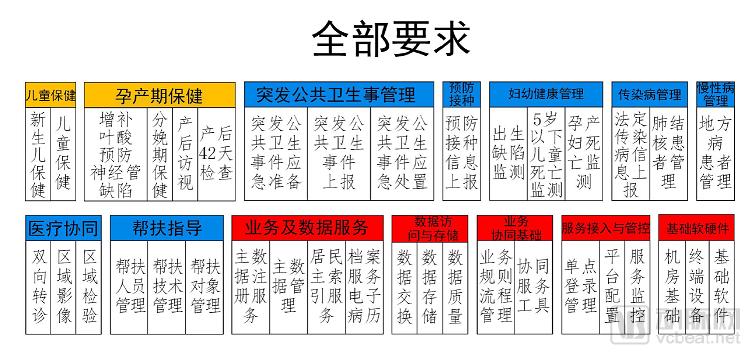
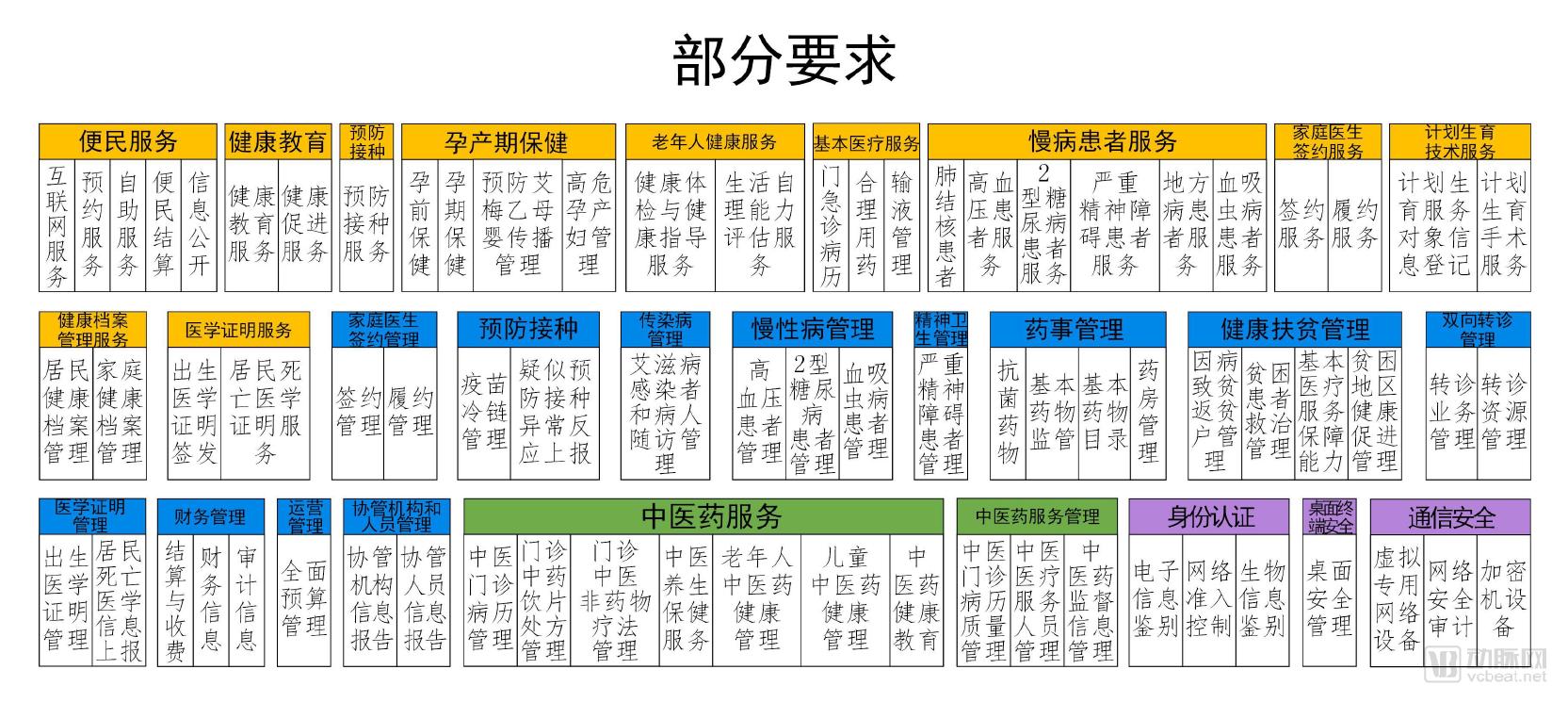
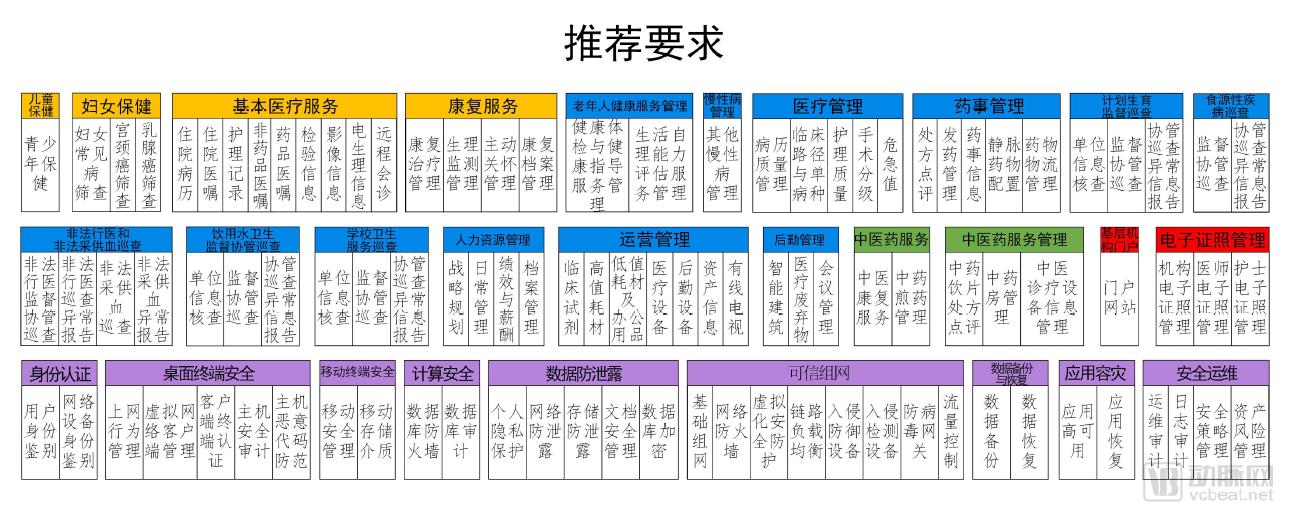
“Construction Standards and Specifications” is divided into four sections—service operations, management operations, platform services, and information security—comprising 58 categories and a total of 212 construction items and requirements.
Part I: Service Operations. This includes 15 service categories: convenient public services, health education, immunization, child healthcare, women’s healthcare, maternal and perinatal care, elderly health services, basic medical services, chronic disease management, rehabilitation services, traditional Chinese medicine (TCM) services, family doctor contract services, family planning technical services, health record management, and issuance of medical certificates.
Part II: Management Operations. This includes 26 items such as family doctor contract management, public health emergency management, health service management for the elderly, vaccination management, maternal and child health management, infectious disease management, chronic disease management, mental health management, medical care management, pharmaceutical affairs management, traditional Chinese medicine (TCM) service management, health poverty alleviation management, two-way referral management, medical collaboration management, and assistance and guidance management.
Part III: Platform Services. This includes seven components: grassroots institution portals, business and data services, data access and storage, foundational business collaboration infrastructure, service integration and control, electronic license management, and basic hardware and software.
Part IV: Information Security. This section covers ten areas, including identity authentication, desktop endpoint security, mobile endpoint security, computing security, communication security, data loss prevention (DLP), trusted networking, data backup and recovery, application disaster recovery, and security operations and maintenance.
“Construction Standards and Specifications” also sets forth specific construction requirements for community health service centers (stations) and township health centers (village clinics), comprising 37 mandatory requirements, 75 partial requirements, and 100 recommended requirements.
In addition, the National Health Commission has not only required primary healthcare institutions across China to carry out informatization in accordance with these Construction Standards and Specifications, but also pointed out that information systems for primary healthcare institutions are recommended to be deployed on county-level or higher population health information platforms. Primary healthcare institutions are encouraged to actively promote implementation based on their specific circumstances.Application of Emerging Technologies such as Cloud Computing, Big Data, and Artificial Intelligence, explore innovative development to better serve the general public.
The details are as follows:
Standards and Specifications for the Construction of Information Systems in Primary Healthcare Institutions Nationwide
For detailed information, please refer to the official website of the National Health Commission:http://www.nhc.gov.cn/cms-search/xxgk/getManuscriptXxgk.htm?id=9d346a5ef0134e6a82c79c5c9ab96b77