

Hybrid Mass Spectrometry and Biomaterials: GenoCap BioTech Pioneers a New Direction in Liquid Biopsy
Liquid biopsy is no longer an unfamiliar concept to most people. While mass spectrometry may not be widely understood, it is generally a well-known term. However, the idea of using mass spectrometry for liquid biopsy sounds quite intriguing, doesn’t it? This is precisely what Hangzhou Huijian Technology Co., Ltd., based in Hangzhou, is doing. In February 2019, more than two years after its establishment, Huijian completed its Pre-A financing round and will continue to deepen the development of mass spectrometry applications in the healthcare industry.

Professor Wu Jianmin, Founder of Huijian Technology
Professor Wu Jianmin, the founder of Huijian Technology, began researching biosensor technologies during his master’s studies, with applications focused on medical diagnostics. He later earned a Ph.D. in environmental biology. From 2007 to 2008, he served as a senior visiting scholar at the University of California, San Diego (UCSD), where he was exposed to cutting-edge international semiconductor nanomaterial technologies. At that time, mass spectrometry, like gene sequencing, was an instrument dedicated solely to scientific research. However, with his keen scientific insight, Professor Wu quickly recognized the potential applications of mass spectrometry in the field of medical diagnostics. Upon returning to China, he initiated relevant research, attempting to integrate semiconductor nanomaterial technologies with mass spectrometry for clinical diagnostic applications—a pursuit he continued for ten years. In late 2016, Professor Wu founded Huijian Technology, dedicated to the application of mass spectrometry in clinical analysis and health screening.
Ren Liang, General Manager of Hangzhou Huijian Technology Co., Ltd.
Another key figure at Huijian Technology is General Manager Ren Liang, who holds a graduate degree in molecular biology. Prior to joining Huijian Technology, Mr. Ren accumulated many years of work experience at both biopharmaceutical companies and investment institutions. During his tenure at investment firms, he primarily focused on drug development and the in vitro diagnostics (IVD) sector.
In addition to the two individuals, Dr. Yu Jiekai from the Cancer Institute of Zhejiang University School of Medicine, whom Professor Wu met during his research period, also joined Huijian Technology as Vice President, leading the medical and bioinformatics teams. In the early stages of the startup, Dr. Luan Chunyan, a graduate in Materials Science from City University of Hong Kong, also joined the company to oversee the R&D department at Huijian Technology. With this, the core founding team of Huijian Technology was initially established.
Speaking of how they met, Professor Wu and Mr. Ren Liang both broke into spontaneous smiles. Let’s turn the clock back to 2017, when Hangzhou Huijian Technology Co., Ltd. had just officially commenced operations. To secure successful financing for the company, Professor Wu frequently engaged with investment institutions. By chance, he met Ren Liang, who was then working at an investment firm, during a roadshow in Shanghai. Ren Liang’s dual background in both industry and investment immediately impressed Professor Wu, while Professor Wu’s vision of applying mass spectrometry technology to the healthcare sector deeply attracted Mr. Ren. Ultimately, Ren Liang decided to resign from his well-compensated position at his beloved investment firm to join Huijian Technology as General Manager, embarking on an entrepreneurial journey alongside the team. Mr. Ren’s arrival enhanced the company’s capabilities in business development and capital operations, resulting in a more robust and well-rounded team structure.
Many successful pharmaceutical companies have originated from founding teams composed of scientists and managers. Such startup teams feature clear division of labor, allowing each member to fully leverage their respective expertise. Within the core founding team of Hangzhou Huijian Technology Co., Ltd., Professor Wu oversees overall technological innovation, Ren Liang manages operations, Dr. Yu leads medical affairs and bioinformatics, and Dr. Luan directs industrialization R&D. For key decisions, Ren Liang and other team members provide decision-making basis without reservation, while major strategic choices are ultimately made by Professor Wu. The team members possess complementary backgrounds and clearly defined responsibilities, combining distinct roles with effective collaboration and mutual support. This positive atmosphere has generated a magnetic effect, attracting a cohort of key talents to join the entrepreneurial team at Hangzhou Huijian Technology Co., Ltd.
Liquid biopsy has gained increasing prominence in recent years. Particularly in oncology, many genetic testing companies have attempted to assess tumor molecular subtyping and progression by detecting circulating tumor cells (CTCs) and circulating tumor DNA (ctDNA) in the blood. Mass spectrometry is characterized as a multi-omics technology capable of detecting diverse targets, including nucleic acids, peptides, and cellular metabolites. The primary advantage of applying mass spectrometry to liquid biopsy lies in its ability to simultaneously detect multiple disease-related targets. This approach offers significantly higher sensitivity, specificity, and accuracy compared to single-marker assays. Internationally, there are a few relatively mature examples of companies utilizing mass spectrometry for multi-target detection. For instance, Biodesix, a US-based company, has developed a lung cancer diagnostic product that employs mass spectrometry to simultaneously detect multiple peptide biomarkers in the blood.
In fact, mass spectrometry has begun to emerge as a promising technology in medical testing. Liquid chromatography-mass spectrometry (LC-MS), used for detecting neonatal inherited metabolic disorders, drug metabolites, or vitamins, has gradually gained acceptance within laboratory medicine, and some third-party medical testing laboratories have already launched related services. However, the complex workflow and low throughput of LC-MS make it difficult to implement on a large scale in clinical laboratory departments. Consequently, despite nearly a century of development, mass spectrometry has not yet been widely adopted in clinical laboratory testing.
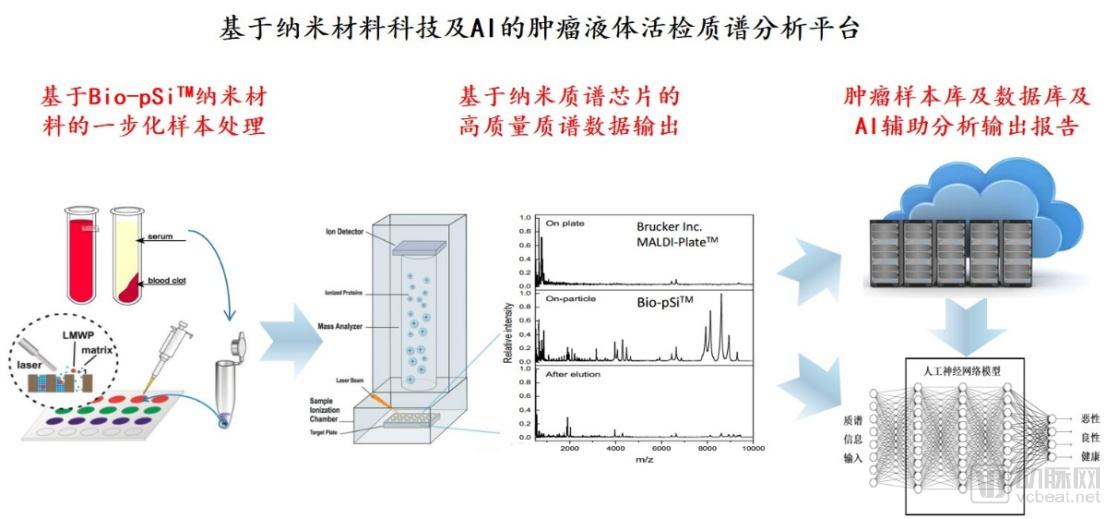
Figure: Mass Spectrometry Analysis Workflow
Huijian Technology has integrated its nanomaterial technology with mass spectrometry, significantly enhancing the convenience, throughput, and signal sensitivity of detection. By incorporating artificial intelligence algorithms for mass spectrometry data analysis, the company achieves rapid and highly accurate diagnostic results, thereby establishing a robust technical barrier. The mass spectrometry platform employed by Huijian Technology is MALDI-TOF-MS (Matrix-Assisted Laser Desorption/Ionization Time-of-Flight Mass Spectrometry), a novel technique with high detection capability for biological macromolecules. Instruments of this type have already been introduced into clinical laboratory departments for microbial testing. Leveraging the momentum of MALDI-TOF’s entry into clinical diagnostics, Huijian Technology has developed Bio-pSi mass spectrometry consumables and chips for serum peptidome profiling, nucleic acid analysis, and microbial analysis, along with corresponding mass spectrometry analysis software, thereby expanding the clinical application scenarios of MALDI-TOF.
Although MALDI-TOF technology offers rapid detection and high throughput for peptides, the absence of a liquid chromatography separation step makes mutual interference among sample components a challenging issue. Therefore, the key to directly applying MALDI-TOF for serum peptidome analysis lies in effectively removing interference from high-abundance proteins. In blood, 99% of proteins are conventional ones, such as plasma proteins, hemoglobin, and immunoglobulins, which have no clear association with tumor progression. Relying solely on existing sample pretreatment techniques not only incurs high costs and leads to loss of analytes but also fails to prevent serum peptide degradation, thereby causing distortion in mass spectrometry results. Furthermore, complex operational procedures reduce the reliability of experimental outcomes, making it difficult to meet medical standards.
A flagship product under development by Huijian Technology is a serum peptidome profiling kit and analysis software designed for mass spectrometry-based liquid biopsy. The Bio-pSi nanochips within this kit are primarily engineered to capture peptides present in the blood. These peptides generally have molecular weights below 20 kDa, making them significantly smaller and far less abundant than the background proteins found in plasma. For instance, tumor progression is often accompanied by changes in the expression of proteases (such as MMPs). The core function of proteases is to degrade various protein components in both intracellular and extracellular environments. Consequently, disease-induced alterations in protease expression inevitably affect the peptide composition in the blood.
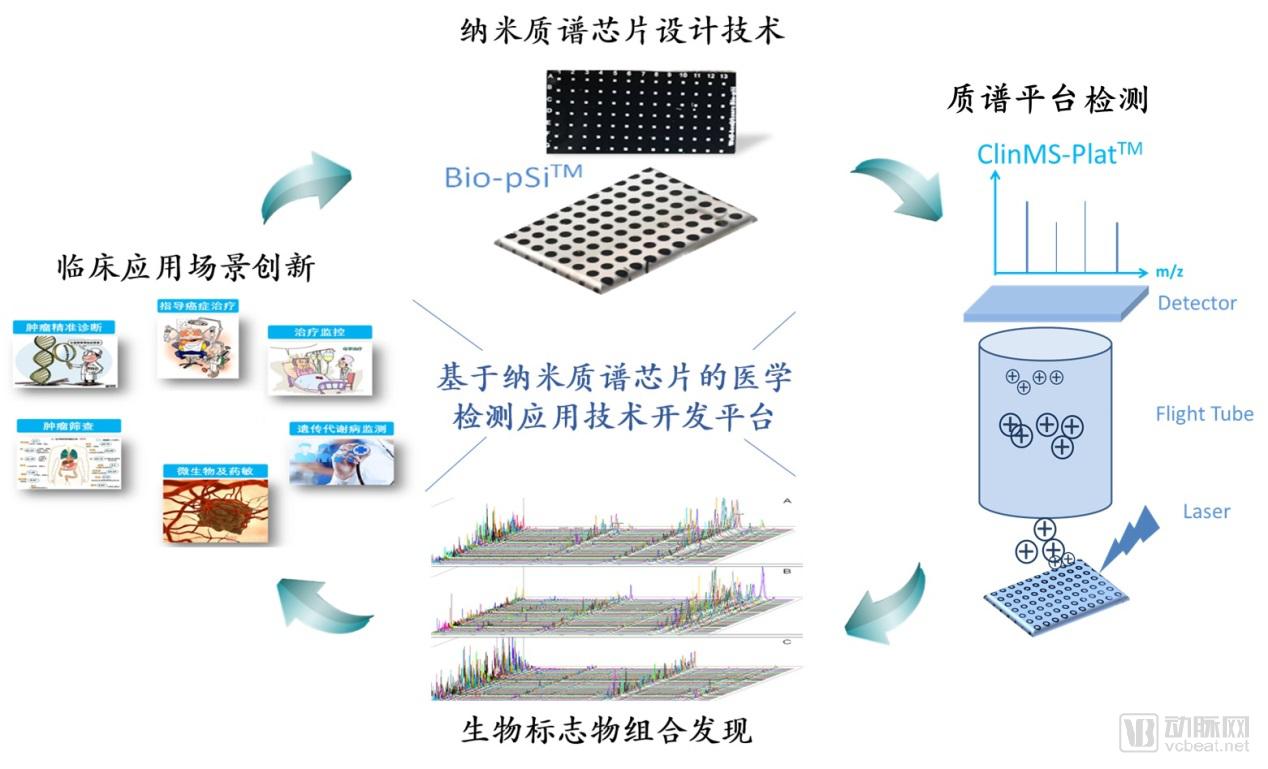
Figure: Bio-pSi Mass Spectrometry Chip
Huijian Technology’s Bio-pSi nanoparticles can enrich low-abundance peptides from complex serum samples. The polypeptide molecules captured within the nanopores can be easily concentrated and enriched, while effectively preventing peptide degradation by proteases in the blood. Subsequently, rapid analysis of serum peptide profiles can be achieved on a MALDI-TOF-MS platform using the company’s proprietary On-Particle Mass Detection (OPMD) technology. By combining characteristic mass spectral peaks with prediction models generated by artificial neural network software, this approach enables tumor diagnosis, monitoring of recurrence and metastasis, and evaluation of drug efficacy. The integration of materials science with mass spectrometry technology represents the core differentiator that sets Huijian Technology apart from the traditional mass spectrometry-based medical testing industry.
Furthermore, Huijian Technology has developed multiple Bio-pSi mass spectrometry chips, enhancing the detection capabilities of MALDI-TOF for nucleic acids, microorganisms, small-molecule metabolites, and other bioactive substances, thereby significantly expanding the application of such mass spectrometers in clinical diagnostics and scientific research.
At first glance, the official website of Hangzhou Huijian Technology Co., Ltd. (Huijian Tech) may give the impression of a complex product portfolio. In reality, however, these products share a common underlying technology, differing only in their specific application directions during development. When describing the product pipeline, General Manager Ren Liang stated, “Huijian Tech has developed various clinical application scenarios based on a single platform technology. We strategically deploy different product types according to the varying development cycles of our products and the different stages of corporate growth.” There are even interconnections among these products; for instance, the Bio-pSi mass spectrometry chip serves as a key consumable for future mass spectrometry-based medical diagnostics. From a long-term perspective, however, Huijian Tech remains centered on its oncology products. Given that the R&D cycle and regulatory approval process for oncology products are both time-intensive, the company leverages other product lines during this period to enhance its technological capabilities and recoup part of its capital investment.
Huijian Technology’s product portfolio for early cancer screening in healthy populations fully demonstrates the advantages of integrating mass spectrometry with materials technology. First, the high sensitivity of mass spectrometry offers excellent application prospects in early cancer screening. Second, mass spectrometry-based testing can not only assess the progression of tumors but also pinpoint the affected organs, facilitating subsequent follow-up monitoring for patients. Furthermore, by applying new materials technology to mass spectrometry, Huijian achieves precise detection while effectively controlling costs.
Regarding the market launch planning for its early cancer screening products, Hangzhou Huijian Technology Co., Ltd. has already established a clear roadmap. Service-oriented products can be rapidly commercialized once the underlying detection technologies and algorithms reach maturity. For standardized products, the company plans to commence construction of its GMP-compliant manufacturing facility this year, followed by stability studies and corresponding clinical trials, with the aim of entering the regulatory approval process as soon as possible.
In addition to liquid biopsy, Hangzhou Huijian Technology Co., Ltd. is also exploring the application of mass spectrometry in tissue biopsy. By rapidly acquiring metabolites from the surface of tumor tissues using nanomaterials and then analyzing the composition and spatial distribution of these metabolites via mass spectrometry, effective tumor subtyping and medication guidance can be achieved. Hangzhou Huijian Technology has successfully differentiated hepatocellular carcinoma from cholangiocarcinoma by detecting tumor metabolites using mass spectrometry, and has also successfully distinguished three subtypes of renal cell carcinoma. In clinical sample testing conducted to date, both sensitivity and specificity have exceeded 90%.
According to Shenzhen Miracle Light Venture Capital, an investor in Hangzhou Huijian Technology Co., Ltd., the rise of domestically produced MALDI-TOF mass spectrometry instruments and the expansion of their clinical applications will trigger explosive demand for low-cost, high-quality functional target plates. Currently, the upstream consumables market for mass spectrometry is monopolized by a few international giants, presenting significant opportunities for import substitution. In the field of liquid biopsy, existing technologies have yet to adequately meet the growing market demand. Innovations in mass spectrometry methodologies will provide greater potential for the large-scale application of this technology in the sector.
Zhao Weiwen, a partner at the BGI Miracle Light Fund, stated that Huijian Technology is an interdisciplinary team that leverages material technology innovation as the core platform to empower mass spectrometry detection. Huijian’s technology enables the MALDI-TOF-MS platform to detect various types of biomarkers—including proteins, peptides, nucleic acids and their methylation, and even small-molecule metabolites—more efficiently and extensively. This makes multi-analyte testing on a single platform possible. The high-throughput and low-cost characteristics of the Huijian platform will give it a significant competitive advantage in liquid biopsy applications involving the combined detection of diverse biomarkers.