

Huiying Medical Invited to World Bank IFC Health Summit: CEO Chai Xiangfei Shares China's AI in Healthcare Experience

HY Medical
Provider of Medical Imaging and Oncology Radiotherapy Platforms
The “IFC Global Private Health Conference 2019,” organized by the International Finance Corporation (IFC), a member of the World Bank Group, was recently held in Miami, United States. Themed “Disrupting the Present, Building the Future,” the conference brought together representatives from private enterprises in the healthcare sector across both developed and emerging economies worldwide. Two Chinese healthcare companies, HY Medical and BGI Genomics, were invited to attend. As the only Chinese medical AI company invited, Chai Xiangfei, Founder and CEO of HY Medical, shared insights on the development of medical AI in China.
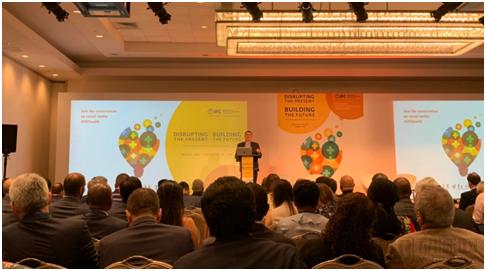
The convening of this conference is set against a distinct contemporary backdrop: as an increasing number of governments commit to providing “universal healthcare” to their citizens, their domestic healthcare systems are facing significant challenges, making deep-seated reforms indispensable. Consequently, this conference places particular emphasis on “how to deliver ‘value-for-money’ services to the broader population through technological and digital means,” while attaching great importance to the role played by innovative private enterprises in this endeavor.
“I believe that medical AI will be one of the most important tools for us to address challenges,” said Chai Xiangfei, Founder and CEO of HY Medical, who was invited to attend the conference. “The application of artificial intelligence will largely resolve issues related to the accessibility and affordability of scarce medical resources.”
Given the current state of primary healthcare in China, the imbalance between a large patient population and a shortage of physicians is a significant cause and concrete manifestation of scarce medical resources. HY Medical’s solutions, such as AI-based medical image recognition and imaging-assisted diagnosis, will greatly empower primary care physicians to make more efficient and accurate diagnoses. Meanwhile, hospitals can establish databases via cloud platforms to reduce deployment and operational costs.“China is one of the countries with the most abundant medical big data resources, and artificial intelligence has vast application potential in China,” analyzed Chai Xiangfei. “We are confident in sharing the development of medical AI in China with our international peers, and we look forward to learning about their latest technological advancements on the global stage.”
To better align with the industry’s heightened interest in hot topics such as “medical big data” and “medical artificial intelligence,” this year’s conference has even dedicated a specific forum segment to in-depth discussions on “Digital Health and Big Data: Unlocking Solutions for Better Outcomes and Access.”
“The forum’s agenda included the medical applications of big data, patient-centric care, precision medicine, and medical AI,” an industry insider remarked. “There is widespread interest in whether artificial intelligence can truly deliver value for money to both patients and investors.”
The forum was moderated by Monique Mrazek, Senior Investment Officer at the IFC. In addition to Chai Xiangfei, CEO of HY Medical, the panelists included Joel Krikston, Managing Director of Merck Global Health Innovation Fund; Ariel Beery, Founder of MobileOTD; Paul Edwards, Executive at ILUM Health Solutions; and Viren Shetty, Chief Operating Officer of India’s Narayana Health Group.
“As you can see, even at such a globalized forum, there is significant attention focused on China,” described one attendee. “Whether HY Medical’s development in China is replicable was a question repeatedly raised by the moderator.”
“Regarding the replication and expansion of digital health technologies,” Chai Xiangfei responded at the forum, “the key lies in whether they can be easily implemented and how to achieve win-win cooperation.” He cited the 2018 case of Intel Capital investing in HY Medical as an example, noting that the technology provided by Intel could accelerate AI computing power, enabling rapid upgrades of existing equipment without additional GPUs, thereby reducing deployment difficulties.
“We are also actively bundling our solutions with CT and X-ray equipment manufacturers, leveraging their distribution channels for collaboration,” Chai Xiangfei further explained. “In addition, we have established a deep partnership with the Alibaba Cloud platform to help primary care hospitals build cloud-based PACS and comprehensive intelligent diagnostic solutions.”
The discussions at the conference conveyed a clear and unequivocal message: digital healthcare, including artificial intelligence technologies, is undoubtedly a critical means and inevitable pathway for enhancing existing medical standards and expanding access to healthcare resources in developing countries. “Among these applications, medical imaging boasts the highest feasibility and the greatest potential for widespread implementation,” noted industry analysts. “Innovative enterprises such as HY Medical will play a pivotal role in empowering healthcare capabilities in developing nations.”
It is worth noting that the conference organizer, the International Finance Corporation (IFC), one of the two affiliated institutions of the World Bank, became a specialized agency of the United Nations in 1957. Its mission is to promote economic development in member countries by providing funding to private enterprises, particularly those in developing nations. Its investment portfolio spans numerous sectors, including financial markets, manufacturing, infrastructure, energy, healthcare, and education. In recent years, with accelerating technological breakthroughs in biology and healthcare, the IFC has placed increasing emphasis on investments in the broader health sector. In China, it has successively invested in projects such as Fosun Pharma, Aier Eye Hospital, and Shandong Weigao.