

Amid Post '4+7' and Prescription Diversion Trends, Hospital-Adjacent Pharmacies, County-Level Chains, and Primary Care Markets Emerge as High-Potential Segments
AKangHealth
Prescription Drug Operation Service Provider
Recently, at the “West Lake Forum,” Wang Lijue, CEO of Guangdong Akang Health Technology Group Co., Ltd., delivered a speech titled “Development Opportunities for the Transformation and Upgrading of Hospital-Adjacent Pharmacies in the Post-‘4+7’ Era and Against the Backdrop of Prescription Outflow.” He pointed out that in the post-“4+7” era characterized by prescription outflow, hospital-adjacent pharmacies serve as the primary frontline for absorbing outsourced prescriptions, while primary healthcare institutions and county-level chain pharmacies are key venues for meeting the integrated “medical care + pharmaceutical” service needs of patients under the tiered diagnosis and treatment system. All three sectors are poised to seize significant development opportunities.
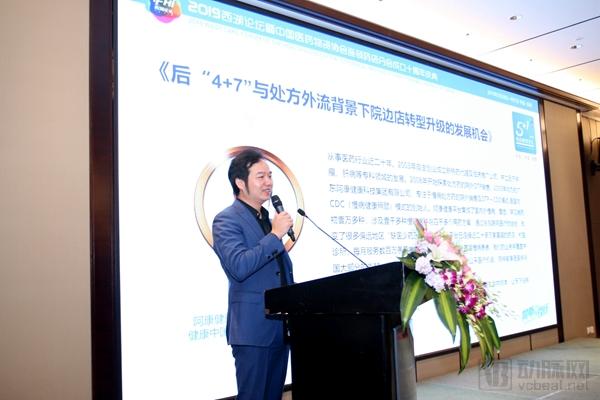
Wang Lijue, CEO of Guangdong Akang Health Technology Group Co., Ltd., delivered a speech titled “Development Opportunities for the Transformation and Upgrading of Hospital-Adjacent Pharmacies in the Post-‘4+7’ Era and Against the Backdrop of Prescription Outflow” at the West Lake Forum.
Faced with the significant opportunities presented by policy changes, pharmacies adjacent to hospitals, primary healthcare institutions, and county-level pharmacy chains need to enhance their operational standards and service capabilities. Guided by value-based healthcare and centered on patient interests, they should return to the essence of medical care and provide more specialized services.
Prescription outflow and tiered diagnosis and treatment are two key policy focuses in the pharmaceutical sector in recent years. As an effective solution to address the issue of “funding healthcare through drug sales,” prescription outflow has received strong policy support and encouragement. The national government has also introduced a series of supportive policies, such as controlling the proportion of drug costs, eliminating zero-markup pricing on drugs, and curbing the growth rate of medical expenses, thereby indirectly promoting the outflow of prescriptions from hospitals. Local governments in cities such as Xi’an, Chengdu, Chongqing, and Beijing have also issued regional policies to accelerate the implementation of prescription outflow.
The goal of tiered diagnosis and treatment is to optimize the allocation of medical resources, enabling effective division of labor and collaboration among healthcare providers at different levels, thereby alleviating the current shortage of medical service supply. Specifically, common and chronic diseases that are easy to treat and have high incidence rates should be managed at the primary care level. For difficult-to-treat specialized conditions, patients should receive initial diagnosis at primary care facilities, which will then facilitate referrals to higher-level hospitals. Primary care institutions serve as health gatekeepers, implementing a model characterized by initial diagnosis at the primary level, two-way referrals, separate management of acute and chronic conditions, and coordinated interaction between upper- and lower-level healthcare providers.
Additionally, the recent “4+7” policy is another significant variable in the industry. Following the volume-based procurement under the “4+7” initiative, foreign pharmaceutical companies whose original drugs failed to win bids and domestic manufacturers of high-quality generics are motivated to explore out-of-hospital markets. Meanwhile, generic drugs that have not passed the consistency evaluation may increase their investment in retail pharmacy channels to offset sales losses due to restricted hospital access. Measures such as the re-evaluation of traditional Chinese medicine injections, restrictions on adjuvant medications, and the implementation of Diagnosis Related Groups (DRG) may further intensify pressure on the in-hospital sales of non-first-line clinical treatments, forcing these products to shift their focus to the retail market.
In summary, policy changes have created significant opportunities. PwC believes that the key drivers boosting prescription drug retail volume include: influenced by policies such as the zero-markup on drugs, hospital pharmacies have shifted from profit centers to cost centers, giving hospitals an incentive to divest outpatient pharmacies and objectively facilitating the outflow of prescriptions; continuous deregulation of internet hospitals and private clinics may become new sources of prescriptions for retail pharmacies; while the review process for new drugs has been accelerated, high-value innovative and specialty drugs face difficulties entering hospitals due to policies such as drug-to-revenue ratios and medical insurance reimbursement. Therefore, pharmaceutical companies need to establish DTP (Direct To Patient) pharmacies to capture hospital prescriptions and achieve sales volume growth.
The outflow of prescriptions will drive structural adjustments in pharmaceutical distribution channels, representing both a reallocation of existing market share and a new growth engine for the industry. Prescriptions for chronic disease medications, novel and specialty drugs, and oncology therapies will be among the first to shift outward. This transition not only enhances convenience for patients, particularly those with chronic conditions, but also helps hospitals control the proportion of pharmaceutical revenue in their total income and alleviate operational pressures on hospital pharmacies.
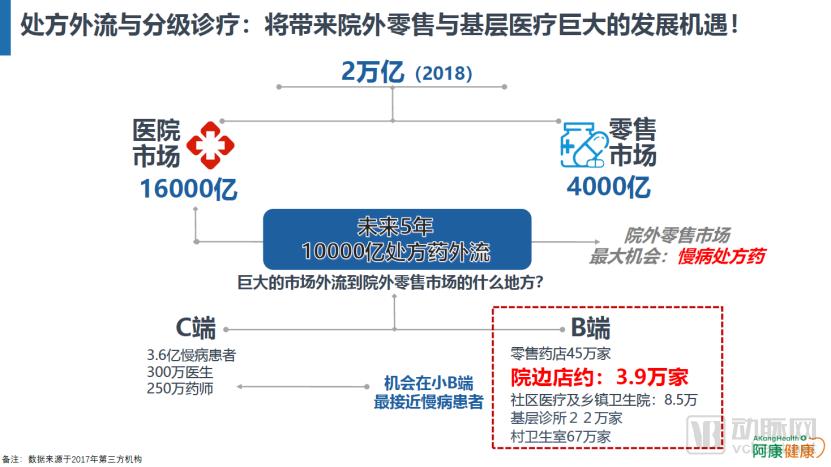
Where will the massive volume of prescriptions flowing out of hospitals be directed? Mr. Wang Lijue stated that a portion will flow to e-commerce platforms and internet-based medical institutions, while another portion will go to business-to-business (B2B) channels, particularly small-scale business entities closer to grassroots patients—namely, China’s vast county-level markets. Home to nearly 900 million people, these areas are where most patients with chronic diseases, severe conditions, and rare diseases live; however, there remains a certain gap in medical and pharmaceutical service levels compared to major cities.
Source: AKangHealth
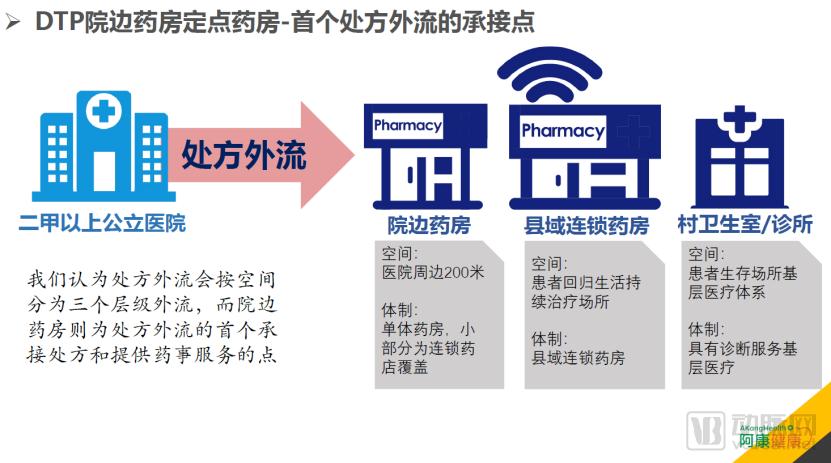
Wang Lijue stated that against the backdrop of prescription outflow, following the patient journey from disease onset to diagnosis, treatment, and recovery, the primary beneficiaries are independent pharmacies located adjacent to the nearly 13,000 public hospitals at or above the secondary Grade A level across China (“hospital-adjacent pharmacies”). These entities serve as the initial points for prescription fulfillment and pharmaceutical care services. As patients return to their daily lives, county-level chain pharmacies will assume responsibility for supplying medications required for rehabilitation and providing professional pharmaceutical services, thereby alleviating the burden on patients who previously had to make repeated trips to hospitals for prescriptions and reducing overall treatment costs (including significant boundary costs such as time, effort, and travel). Meanwhile, medical follow-up service institutions, village doctors, and clinics will play a substantial role in delivering specialized medical services for chronic disease management and rehabilitation to patients at the grassroots level.
Source: AKangHealth
PwC points out that to accommodate the demand for prescription outflow medications and services, retail pharmacies must be capable of providing professional patient education and medication guidance. However, China currently faces a shortage of pharmacists, and pharmacies have limited willingness and capacity to offer professional services, resulting in a significant gap between supply and patient demand.
Furthermore, the capacity of primary healthcare institutions to guarantee drug supply remains concerning. While the industry remark that “the National Essential Medicines List leaves primary care facilities with no drugs available” may be an exaggeration, it is an undeniable fact that rural primary care institutions suffer from low procurement volumes, inefficient drug distribution channels, and shortages of certain drug varieties. Addressing the “inverted pyramid” dilemma in the healthcare system requires strengthening primary care, shifting focus and policy support downward, and encouraging patients to return to grassroots facilities. This constitutes a critical task for the next phase of healthcare reform.
AKangHealth’s vision is to “build a health pathway reaching China’s grassroots level,” empowering primary care institutions and achieving the goal of making medications accessible to all. Founded in 2005, AKangHealth has over 13 years of experience in prescription drug distribution. By closely aligning with national policies and staying at the forefront of industry innovation, the company has continuously expanded its business scope from in-hospital prescription drugs to out-of-hospital and consumer-to-consumer (2C) markets. Its business model has evolved from a B2B pharmaceutical distribution platform to an integrated supply chain system centered on specific diseases, combining Direct-to-Patient (DTP) services with Chronic Disease Care (CDC), and integrating B2B with 2C as well as online with offline channels. This approach aims to create a closed-loop ecosystem encompassing “healthcare + disease management + pharmaceuticals + insurance.”
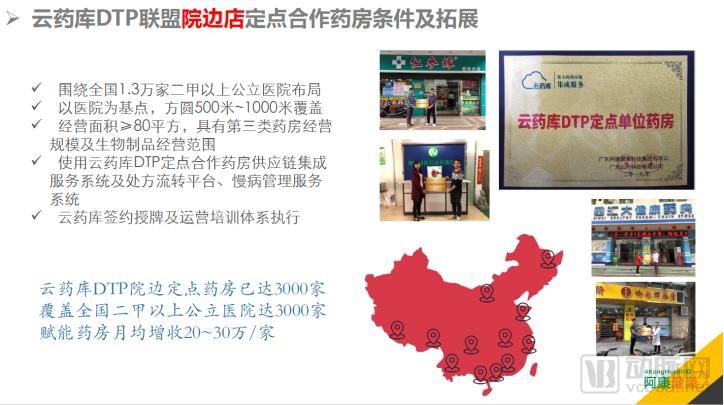
In its strategy for pharmacies adjacent to hospitals, AKangHealth selects high-quality independent pharmacies within a 500–1,000 meter radius of more than 13,000 public tier-2 and above hospitals across China for collaboration under the “Cloud Pharmacy DTP Designated Pharmacy” project. By providing integrated supply chain services for prescription drugs, AKangHealth enables these hospital-adjacent pharmacies to offer integrated services for over 12,000 prescription medications, thereby addressing drug availability issues.
By integrating industrial resource prescriptions and internet medical prescriptions, patients can access services immediately upon arriving at hospital-adjacent pharmacies (addressing prescription accessibility). To enhance the professional service capabilities of staff at these pharmacies, specialized training based on clinical treatment pathways is provided, in collaboration with pharmaceutical manufacturers, to elevate service standards and transform pharmacy staff into specialized clinical pharmacists (addressing professional competency). Furthermore, chronic disease management at hospital-adjacent pharmacies is standardized through project systems and platforms to deliver patient rehabilitation and care services (addressing standardization).
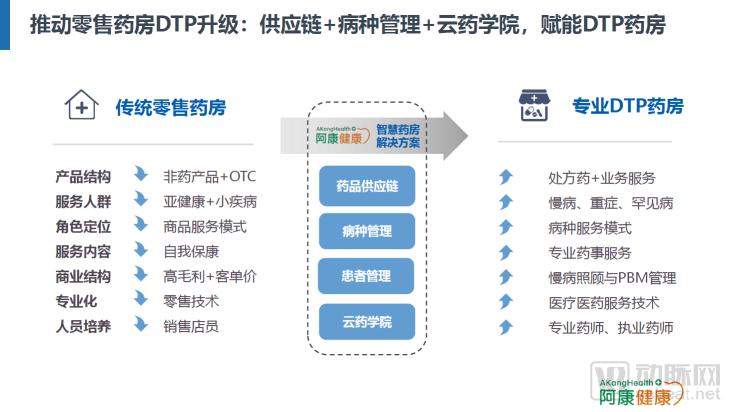
In its county-level chain layout, AKangHealth Group has built a county-level DTP (Direct-to-Patient) designated pharmacy network centered on the “one county, one designated chain” model. The group’s platform provides five key services to county-level chain pharmacies: integrated supply chain services for prescription drugs, internet medical entry points for patient follow-up consultations, prescription dispensing and supply, patient rehabilitation care, and enhancement of pharmacists’ professional capabilities. These initiatives stimulate the initiative of store managers and staff, enable customer-proxy medication ordering services for county residents, and allow patients to receive diagnosis and treatment at large hospitals while picking up medications at designated pharmacies, thereby enhancing the regional specialization and profitability of county-level DTP designated pharmacies. Currently, AKangHealth has established collaborative partnerships with more than 1,500 county-level chain pharmacies.
In terms of village doctors and clinic services in primary healthcare, AKangHealth is committed to promoting the "Primary Chronic Disease Rehabilitation Project" and recruiting "Healthy China Rural Partners." Through the chronic disease rehabilitation project services, we provide training for village doctors and clinic physicians, offering technical skills training that is easy to learn and immediately applicable. We provide a prescription drug supply chain service exceeding Grade 3A hospital standards, addressing the difficulty of accessing medications in rural areas and resolving the dilemma of village doctors being "unable to cook without rice." We facilitate follow-up visits for patients within the region. For patients discharged from hospitals, we provide process management through our system, enabling more effective monitoring of disease progression. By ensuring high-quality rehabilitation, we help reduce medical costs and lower patient expenditures.
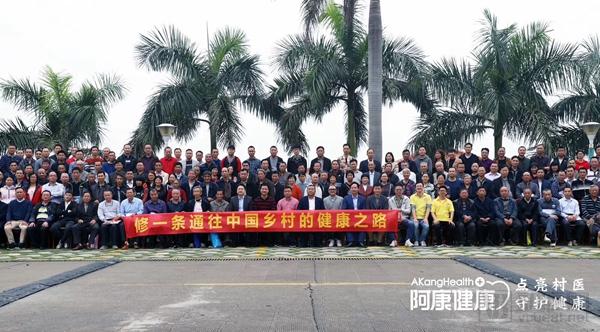
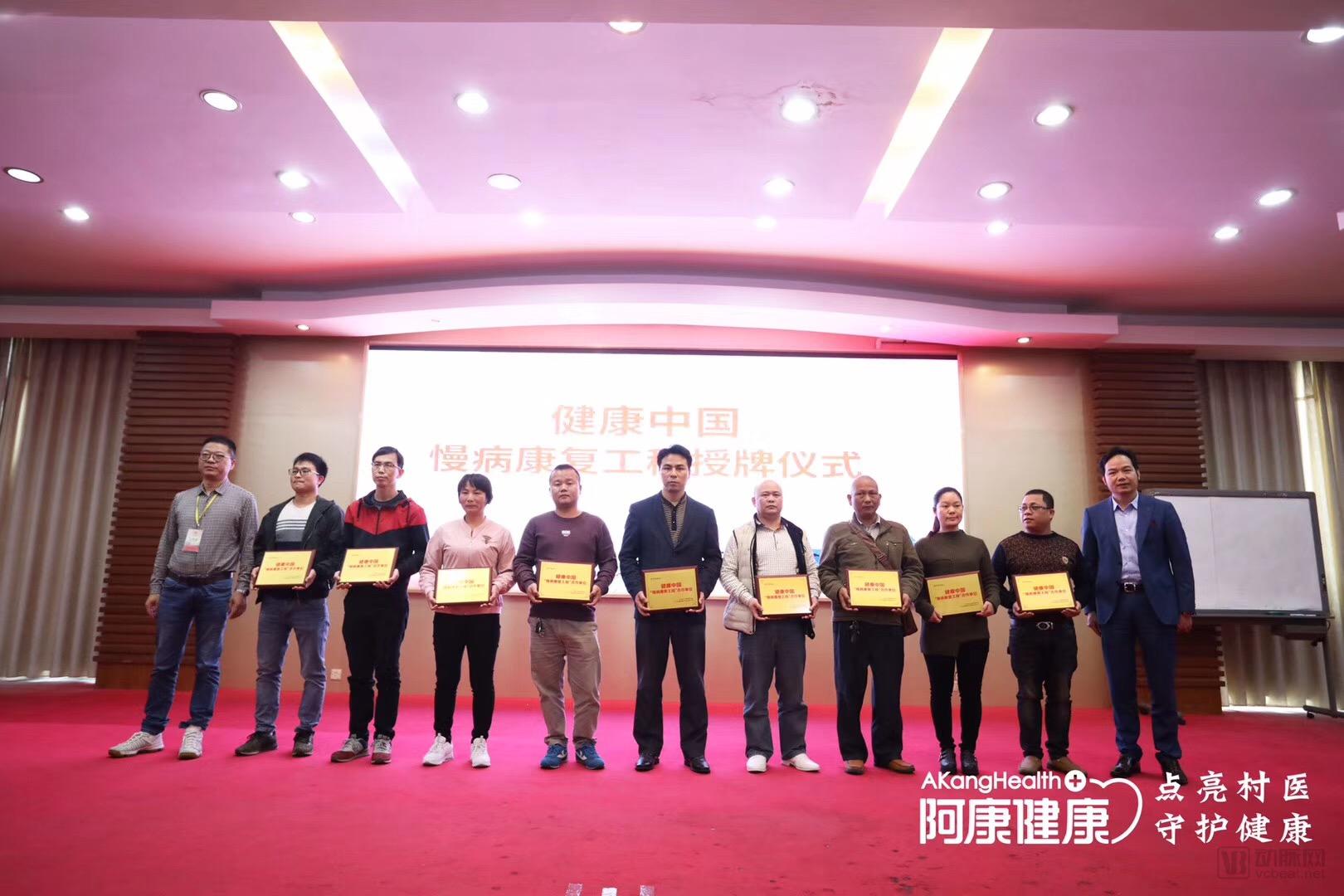
Recently, the National Village Doctor Training and Chronic Disease Rehabilitation Program was launched in Guangdong Province. The Chronic Disease Rehabilitation Program is an initiative spearheaded by AKangHealth, in collaboration with the Tongxinyuan Charity Foundation, Langzhi Pharmaceutical, and other partners, to support rural healthcare. The photo shows the group picture and plaque-awarding ceremony following the village doctor training in Zhaoqing City, Guangdong Province.
Wang Lijue concluded that in the era of tiered diagnosis and treatment, the post-"4+7" period, and prescription outflow, hospital-adjacent pharmacies, county-level chains, and grassroots village doctors and clinics will enter a golden age of development. Transformation and upgrading are the key factors determining whether these institutions can seize this opportunity. AKangHealth will focus on providing upgrade and empowerment services for hospital-adjacent pharmacies, county-level chains, village doctors, and clinics in county markets, aligning with healthcare reforms to enhance the level of social medical services.