

Comper Health Technologies Files for IPO: Pioneering Femtech Through Intelligent Hardware and Data-Driven Women's Health Solutions

Comper
Intelligent Health Management Product R&D and Manufacturer
“Femtech” (Female Technology) emerged as a buzzword in 2016. Femtech companies primarily address women's health issues, with a focus on fertility, pregnancy and postpartum care, women's sexual health, and reproductive system healthcare, often supplemented by related applications for outcome tracking.
According to data from the research firm Frost & Sullivan, 80% of household healthcare expenditures are made by women. Economic trends have enabled women not only to play an increasingly important role across the entire healthcare sector but also to wield greater purchasing power.
Since 2016, a wave of wearable and biotech companies focused on female fertility has emerged, suggesting that the field of women’s health may be reaching a tipping point.
Targeting Niche Markets, Femtech May Have Become a New Growth Driver
Over the past five years, Femtech has evolved into both a concept and a movement. One of its pioneers is Danish entrepreneur Ida Tin, who launched the ovulation-tracking app Clue in 2013 and is widely credited with coining the term “Femtech.”
At CES, hailed as a pilgrimage for consumer electronics, women’s health devices have also emerged as a highly anticipated highlight. In January 2016, Comper (hereinafter referred to as “Comper”), a company founded in Silicon Valley, showcased its products—the preconception care device and fetal heart monitor—at CES for the first time.
Du Han, founder of Comper, told reporters that during the first three years of its startup journey, Comper initially entered the maternal and infant market, developing products such as smart fetal heart rate monitors and smart preconception care devices.

Comper Founder Du Han (Photo provided by the company)
Du Han candidly stated, “The products in the first phase targeted a relatively niche segment of the maternal and infant market, particularly mothers having their second child, making the sales ceiling easily apparent.”
After launching a series of products tailored for mothers expecting their second child in the maternal and infant care sector, Comper has begun to expand into a broader demographic—young women.
Du Han stated, “Within the second category of consumers, we have a deeper understanding of women. Therefore, we have begun developing single products targeting the medical aesthetics market, which is ten times larger than the temperature screening market. The current market size is estimated to be between RMB 10 billion and RMB 20 billion.”
As she noted, since 2018, the CES has drawn the most attention to major players such as Apple and Amazon, as tech giants build comprehensive, closed-loop ecosystems centered on smart hardware. For smaller startups, the surge in consumer electronics from these brands—leveraging out-of-hospital monitoring as a strategic “weapon” in the health sector—poses a significant challenge.
Major tech companies typically pursue a strategy centered on high-volume single products, such as Apple’s entry into dynamic single-lead ECG monitoring and Amazon’s use of smart speakers to identify anxiety disorders. In contrast, startups generally adopt a strategy of offering a diverse range of products in smaller quantities. Between 2017 and 2018, Comper sequentially launched smart scales, smart forehead thermometers, and smart beauty devices, gradually moving closer to the broader consumer healthcare market.
In fact, whether it was the initial maternal and infant care market, the temperature monitoring market, or the current medical aesthetics market, Comper’s product line has always been tailored to meet the needs of specific niche segments.

Although Femtech appears to be a niche market targeting a specific demographic, VentureBeat argues that those who view it as merely niche completely overlook one key statistic: women constitute 49.5% of the global population.
In terms of capital, investment enthusiasm for Femtech is also on the rise, with institutions and incubators such as KPCB and Y Combinator (YC) beginning to focus on this emerging digital health sector. Notably, the renowned Silicon Valley-based incubator YC has already supported female health startups including iSono Health, Flex, and Nurx. According to Frost & Sullivan, total Femtech investment exceeded $400 million in 2018 and is projected to reach $50 billion by 2025.
Like Du Han, the founder of Comper, many entrepreneurs in the maternal and infant sector—closely tied to women’s health—have identified business opportunities in providing digital tools for pregnancy, infant monitoring, breastfeeding, and related health services.
Owlet, the company behind the development of smart baby socks and a companion app, completed its Series B funding round in May 2018, raising $24 million. Owlet’s product is a compact sock specifically designed for infants during sleep. It monitors heart rate, skin temperature, blood oxygen levels, and sleep data. Once uploaded to cloud servers, these data can be accessed by parents via iOS or Android apps on their smartphones, or through any other device by logging into the web portal.
Women’s Health in China Remains a Blue Ocean; Smart Hardware Must Emphasize Data Value
Regarding the technological approach to products, Du Han believes that the core lies in effectively telling the “data story.” The human body itself is a vast repository of health data, and the data services integrated into smart hardware enable users to gain a deeper understanding of their own bodies.
This aligns with the insights presented in EY’s Life Sciences 4.0 report, released in April 2018. The report highlights that advancements in new technologies and devices have strengthened people’s willingness to view and share their health data, as consumers strive to have a voice in their lifelong health journeys. These demands will not only reshape the interaction between patients and physicians but also encourage patients to take a more proactive role in managing their own healthcare.
All stakeholders urgently need to integrate existing disease data and solutions into a sufficiently comprehensive, data-driven platform. As seamless data sharing invisibly raises consumer expectations for healthcare quality, the healthcare services sector is undergoing a significant transformation.
In January 2019, at the Consumer Electronics Show (CES) held in Las Vegas, USA, Comper, a company specializing in medical devices for young women and lifestyle-oriented health products, made its third consecutive appearance. At this year’s event, Comper showcased a range of smart home products, including beauty devices, fetal heart rate monitors, preconception care devices, smart scales, and forehead thermometers. Beyond hardware, all these products can connect via Bluetooth to the Comper Health app for data collection and analysis.
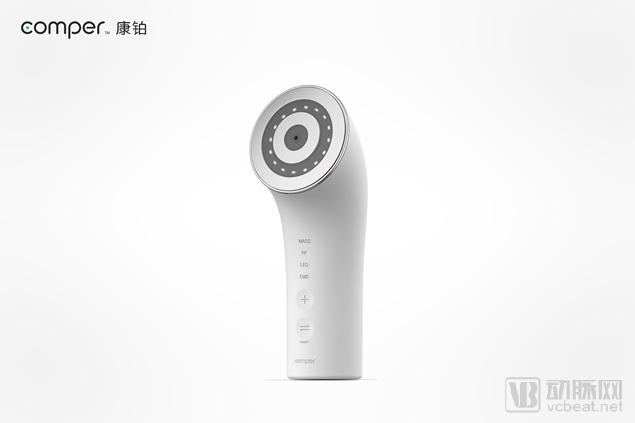
Comper Beauty Device (Photo provided by the company)
Taking the Comper smart beauty device as an example, this product integrates radiofrequency, microcurrent, LED light therapy, and vibration technologies, leveraging efficient collaborative algorithms among these multiple technologies and a larger probe working area. Compared with traditional beauty devices on the market, Du Han believes that the advantage of the Comper smart beauty device lies in its “intelligence.” Through the Comper Health App, users can customize their preferred skincare regimens in various ways. The treatment process can be easily completed under video and voice guidance. Moreover, users can precisely monitor and share post-treatment skin changes through detailed data insights.
“For traditional smart hardware, the service essentially ends once the data is obtained. We innovate at the hardware level to attract consumers, recognizing that health management requires time and commitment. After acquiring the data, we proceed to provide personalized analysis and leverage artificial intelligence to deliver tailored recommendations.”
Regarding business models for data monetization, Du Han identified four potential avenues. The first is consumers’ willingness to pay, as data generated during use effectively feeds back to benefit individuals. Additional avenues include collaborations with insurance companies, pharmaceutical manufacturers and technology firms, and public health institutions. Currently, Comper has reached the stage of implementing both individual out-of-pocket payments and insurance-based reimbursement.
Currently, digital health devices for women also face certain challenges, such as data privacy, data accuracy, and clinical application, which require further in-depth development. Du Han stated that this is a long-term process, and Comper will remain committed to rigorous research and development while continuously expanding its market presence.
In terms of qualifications, all of Comper’s products have obtained U.S. FDA certification, with its smart fetal heart rate monitor, smart preconception care device, and forehead thermometer also certified by China’s CFDA and the European Union’s CE.
“The first three years focused on maternal and infant care, the second three years on women’s health, and the third three years on family health management.” This is how Du Han described her three “three-year plans” to reporters. The company has evolved from initially targeting women of childbearing age and children aged 0–6 years to continuously enriching and innovating its hardware and data services, thereby providing comprehensive digital health management solutions for women and their families.
As she noted, any product that achieves significant depth within a specific domain will always find an audience, no matter how niche the market; indeed, smaller markets are even more conducive to fostering “market leaders.”
In the markets for women’s health, maternal and infant health, and even overall family health, who exactly are Comper’s competitors? Du Han responded as follows: “After careful consideration, I have never viewed any single manufacturer as Comper’s competitor. If a company aspires to greatness, its competitors must likewise be great. What drives our hard work and keeps every member of the Comper team focused on daily incremental innovations and improvements is neither money nor power, but rather the opportunity to compete on equal footing with esteemed traditional companies such as Braun and Omron. Even more exciting is the fact that, with Comper’s presence in China, we will not be dependent on foreign entities in the field of smart home medical devices. Through quiet product innovation and brand building, we continue to strengthen our position in the battlefield of consumer mindshare.”