Chinese Scientist's Pioneering Breast Cancer Early Screening Technology Wrongfully Appropriated by Heidelberg University, Truth Emerges Two Years Later
Advances in medical technology stem from the diligent efforts of scientists behind the scenes. From research and development to clinical application and eventual commercialization, progress in pharmaceuticals, diagnostic technologies, and treatment regimens relies on close collaboration among scientists, research institutions, investors, and other stakeholders.
In February 2019, the official website of Heidelberg University Hospital and multiple media outlets, including Germany’s Bild newspaper, announced that Heidelberg University Medical Faculty had developed HeiScreen, a blood test capable of diagnosing early-stage breast cancer, sparking considerable sensation. However, the HeiScreen technology soon triggered widespread debate in Germany, and its project team came under investigation by German media such as Der Spiegel and Rhein-Neckar-Zeitung. This unfolded a complex narrative involving scientists, research institutions, and investors. VCBeat New Medicine interviewed Dr. Yang Rongxi, one of the central figures in this story and a former researcher at Heidelberg University, to reconstruct the events from her perspective.
On February 21, 2019, Heidelberg University announced the HeiScreen breast cancer screening project, led by Professor Sarah Schott and Professor Christof Sohn of Heidelberg University. HeiScreen claims to be the first liquid biopsy technology applicable to breast cancer, analyzing subjects’ breast cancer status by detecting 15 different blood biomarkers (methylation markers and miRNA). According to disclosures from Heidelberg University, the project completed a cohort study of 900 individuals over the past 12 months, including 500 breast cancer patients and 400 healthy women. Current results indicate that the overall sensitivity among the 500 breast cancer patients reached 75%.
Under normal circumstances, a major breakthrough in tumor screening would become headline news in the liquid biopsy industry and spread rapidly. Heidelberg University, which stands behind this project, would naturally gain both fame and financial benefits as the news disseminates. Heidelberg University has even jointly registered and established a company named HeiScreen GmbH with other investors, specifically to handle the market promotion of this project.
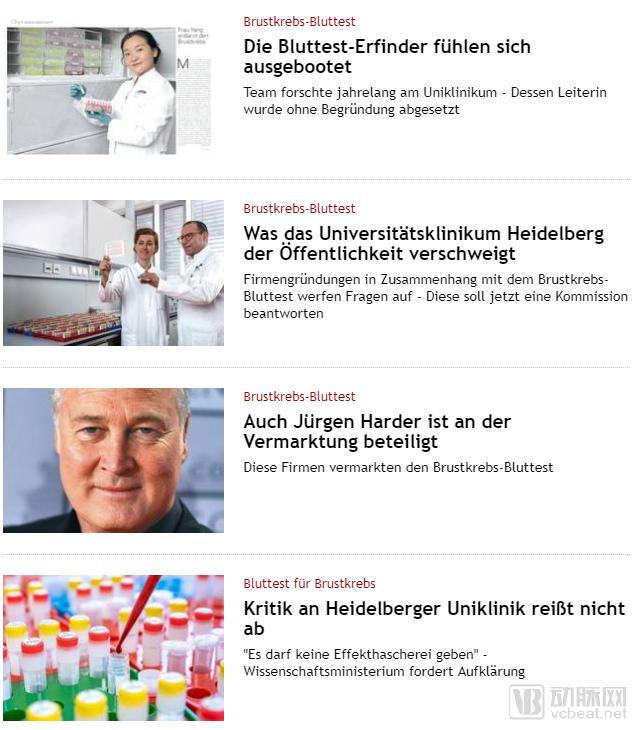
Figure: Selected related articles published by Rhein-Neckar-Zeitung
The Rhein-Neckar-Zeitung also reported on this project in February 2019. Due to its location in Heidelberg, the newspaper enjoyed a geographic advantage that enabled its journalists to conduct continuous follow-up coverage. However, unexpectedly, during communications with industry professionals, the Rhein-Neckar-Zeitung learned that no peer-reviewed scientific papers had been published regarding the HeiScreen project announced by Heidelberg University. Most professionals find it difficult to endorse clinical projects lacking peer review. Heidelberg University explained that the research findings for HeiScreen had not yet been publicly disclosed because related studies and patent applications were still incomplete. Nevertheless, this explanation clearly failed to convince the academic community. Under mounting external pressure, Heidelberg University subsequently issued an apology statement for this public relations campaign.
During this period, the Rhein-Neckar-Zeitung provided follow-up coverage and conducted investigations into the relevant events, publishing a series of critical articles, including “Controversial Breast Cancer Screening PR: University Hospital Apologizes,” “Criticism of Heidelberg University Hospital Has Not Ceased,” and “What Is Heidelberg University Hospital Hiding from the Public?” As the investigation deepened, more truths came to light. On March 26, the Rhein-Neckar-Zeitung published an article titled “Inventor of Blood Test Feels Completely Sidelined.” During their investigation, reporters uncovered a former project at Heidelberg University called “MammaScreen,” which is closely linked to the current HeiScreen project. Through media scrutiny, the dispute between Heidelberg University and Dr. Yang Rongxi has gradually come to light.
Dr. Yang Rongxi has been studying at Heidelberg University in Germany since 2006, where she earned her master’s and doctoral degrees in cell biology. During her studies in Germany, Dr. Yang’s mother was diagnosed with breast cancer. Although her mother recovered safely after treatment, the experience of witnessing a loved one’s suffering further solidified Dr. Yang’s resolve to dedicate herself to the field of tumor biology.
In 2010, after earning her Ph.D., Dr. Yang Rongxi remained at Heidelberg University to conduct postdoctoral research. During this period, Dr. Yang focused on liquid biopsy for breast cancer and achieved breakthrough progress. Recognizing the clinical value of Dr. Yang’s research findings, Heidelberg University promptly established the MammaScreen research group, appointing Dr. Yang as an independent Principal Investigator (PI) to lead the clinical translation of these studies.
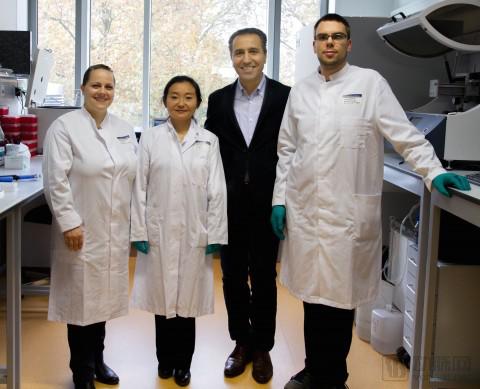
MammaScreen Team: Dr. Ruth Merkle, Dr. Rongxi Yang, Dr. Hamid Emminger, and Dr. Patrick R. Merz (from left to right)
Upon its establishment in 2015, the project team swiftly secured a high-tech startup grant of €866,000 from the German Federal Ministry for Economic Affairs and Energy. This marked the first time the fund had been awarded to Chinese scholars. As a result, MammaScreen began to gain prominence within the German startup ecosystem, attracting successive coverage from numerous domestic and international media outlets as a rising star. With the support of the startup grant, the MammaScreen team advanced its research while simultaneously initiating the industrialization of the project. In 2016, MammaScreen’s visibility continued to grow, earning it the “Biotechnology” award at the ETI Health Summit and the “Young Talent Award for Breast Cancer Research” from the Claudia von Schilling Foundation. By the end of 2016, MammaScreen had disclosed a detection accuracy rate of 95%, significantly surpassing that of mammography.
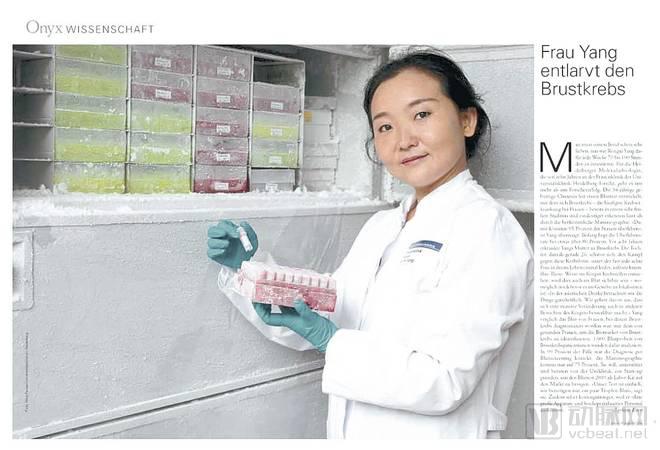
Figure: Related reports on the MammaScreen project at the end of 2016
MammaScreen, which had enjoyed a smooth journey thus far, was poised to continue its translation and productization efforts, enter clinical practice, and serve more women. However, despite being at the peak of its popularity in late 2016, MammaScreen rapidly faded from public view in 2017. Team members departed one by one. Dr. Yang Rongxi, who led the MammaScreen project team, resigned from Heidelberg University in mid-2017 and has since returned to China to launch her own venture. Amidst growing scrutiny of HeiScreen and the escalating fallout from related incidents, Dr. Yang Rongxi has revealed to us the full story behind these events.
According to Dr. Yang Rongxi, the MammaScreen project team initially envisioned the simultaneous development of MammaScreen in both China and Germany, and thus engaged with relevant domestic investment institutions at the outset of the project. Negotiations with these domestic entities proceeded smoothly, with the investment amount and equity allocation largely agreed upon. However, the project’s progress stalled during negotiations with the Technology Transfer Office of Heidelberg University Hospital. As Dr. Yang conducted her research at Heidelberg University, the resulting innovations are classified as service inventions, and their commercialization requires authorization from Heidelberg University.
“At that time, negotiations were nearly reaching an agreement, but during the final round, they abruptly declared the talks broken on untenable grounds and subsequently quoted an exorbitant price—nearly ten times the market rate. Such a pricing was certainly unacceptable to us, making it impossible to proceed with the project,” described Dr. Yang Rongxi regarding the breakdown of negotiations. According to Dr. Yang, the patent management department of Heidelberg University’s Medical Faculty adopted an aggressive stance from the outset, demanding more than 10% equity in the new company. As negotiations progressed, this figure continued to rise, eventually exceeding 20% and even reaching 30%. At one point, Dr. Yang even secured the full-time commitment of Roche Diagnostics’ Global Vice President to join the project. However, all efforts invested in this initiative rapidly collapsed following the failure of the negotiations.
After the negotiations broke down, the project situation deteriorated rapidly: “Following the breakdown of negotiations, they announced the removal of my title as Project Lead for MammaScreen and employed various tactics to force my resignation, such as deactivating my employee badge to prevent me from entering the laboratory and requiring daily reports to the dean on my working hours and lunch breaks. Meanwhile, they also exerted pressure on our entire team. By May 2017, all other members of my team had resigned. I resigned in June 2017 and returned to China at the end of 2017.”
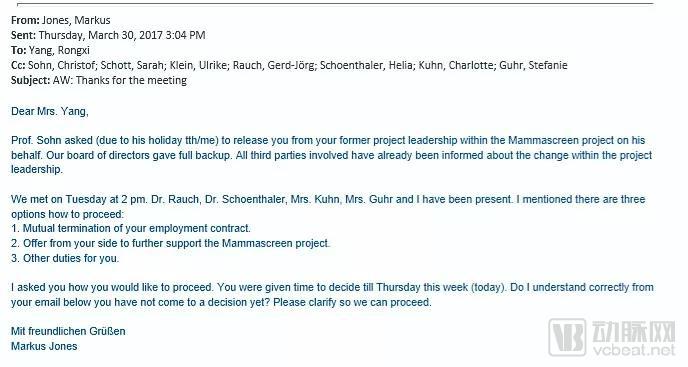
Figure: Screenshot of the email received by Dr. Yang Rongxi
The screenshot of the email provided to us by Dr. Yang Rongxi was from Markus Jones, Head of the Legal Department at Heidelberg University Medical Faculty, who also serves as one of the heads of the Medical Faculty’s Patent Management Office. The email stated that Dr. Yang Rongxi’s title as Project Lead for MammaScreen had been revoked, without providing any explanation. Additionally, Markus Jones presented Dr. Yang with three options, implicitly urging her to resign voluntarily.
We have not yet been able to contact Heidelberg University for an interview, so it would be inappropriate to speculate on the university’s true intentions. Although the above account represents only Dr. Yang Rongxi’s perspective, these details were also reported in the Rhein-Neckar-Zeitung following investigations by German journalists. Subsequently, the Rhein-Neckar-Zeitung published another article titled “Is Heidelberg University Hospital Acting Illegally?” which directly addressed the patent issue. The article cited interviews with Dr. Yang Rongxi and Barbara Burwinkel, co-inventors of the patent, who stated that they had not received any compensation as patent inventors and had not even been notified by Heidelberg University. In response to these allegations, Heidelberg University has remained evasive.
In fact, a comparison of the disclosed information on HeiScreen and MammaScreen reveals numerous clues pointing to a close connection between the two. Both projects were established at Heidelberg University, target breast cancer, and focus on the same types of biomarkers. Even the domestic investors previously approached by Dr. Yang Rongxi have continued their investment in the HeiScreen project. MammaScreen is built upon the relevant findings from Dr. Yang’s postdoctoral research conducted between 2010 and 2015. Although HeiScreen has not specified the underlying basic research papers, Christof Sohn stated in an interview that related studies began to be published gradually starting in 2011, which coincides with the publication timeline of Dr. Yang’s research outcomes.
The core components of the two projects are strikingly similar, yet subtle differences exist. None of the personnel involved in the MammaScreen project participated in the HeiScreen project, which is now led by an entirely different team. Under this new leadership, HeiScreen has failed to achieve the 95% accuracy rate previously attained by MammaScreen. Regarding the disparity in detection performance, Dr. Yang Rongxi stated, “Our original team did not participate in their new project. Consequently, the progress of their project has undoubtedly been significantly impacted.”
Despite the various unpleasant experiences with Heidelberg University, Dr. Yang Rongxi remained confident in the clinical value of her research findings. Upon returning to China, she chose to embark on an entrepreneurial venture, restarting the clinical translation of her research outcomes.
In March 2018, Dr. Yang Rongxi registered and established Tengchen Biotechnology. Shortly thereafter, in May 2018, the company secured investment from Legend Star. Building on Dr. Yang’s prior research achievements, Tengchen Biotechnology embarked on the ground-up development of liquid biopsy products for oncology. Addressing patent concerns, Dr. Yang stated that there would be no intellectual property conflicts with Heidelberg University: “Our core technology lies in the original development of molecular biomarkers, so our future products will not entail any intellectual property disputes with the German side.”
Tengchen Biotech has completed the establishment of its laboratory and forged clinical collaborations with multiple benchmark hospitals across China, extending its reach to Beijing, Shanghai, Sichuan, Jiangsu, and other provinces and municipalities. In the field of lung cancer detection, the company has largely completed early-stage data accumulation and R&D, and is poised to commence small-scale and pilot-scale product development. Dr. Yang Rongxi stated that Tengchen Biotech has adopted novel technological approaches, which will facilitate effective cost control for its future products.
Regarding the product’s market launch, Dr. Yang Rongxi stated that haste should be avoided: “Our product requires a Class III IVD certification, and the overall approval process is indeed quite lengthy. However, high-quality products do require such an extended period for refinement. This may also represent one of the gaps between China and other countries. Overseas investors tend to be more patient. Abroad, a 4–5 year timeline to market is not considered long.”
In accordance with standard practice, the equity stake held by a university’s patent management department generally does not exceed 5%, and one must choose either equity or licensing fees, but not both. In the United States, as compensation for service invention patents, academic institutions are typically limited to holding 2%–5% equity in a company; even for highly mature projects with products ready for immediate market entry, the equity stake never exceeds 15%. Heidelberg University’s demands in this matter have exceeded the scope of benefits reasonably due to a university.
We have also encountered numerous cases of scholars launching startups, yet most entrepreneurs speak highly of the technology transfer policies at Chinese universities. To our knowledge, the majority of domestic institutions are supportive of faculty members leveraging their research findings to drive further commercialization, thereby accelerating the translation of scientific achievements into clinical practice. In terms of patent assignment and licensing, the process generally proceeds smoothly provided that formal transfer procedures are properly followed.
We are willing to believe that the dispute between Heidelberg University and Dr. Yang Rongxi is an isolated case. However, if Dr. Yang’s allegations are indeed true, then the three years wasted from the launch of the MammaScreen project in 2015 until Dr. Yang resumed her research in China in 2018 merely delayed the market debut of an excellent early cancer screening product.
In the aftermath of such disputes, no party benefits; only patients bear the losses.