XtalPi and JinkoSolar Establish Joint Venture to Advance Photovoltaic Efficiency Limits with AI
XtalPi
Computation-Driven Innovative Drug R&D Provider
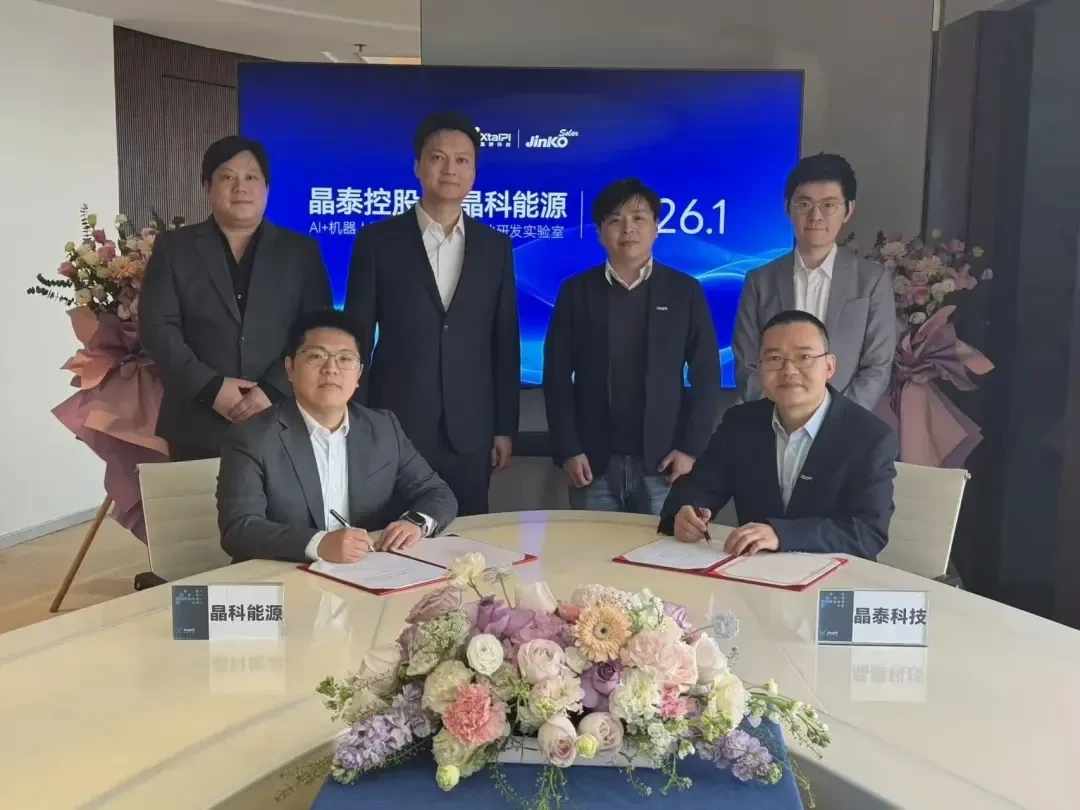
XtalPi Holdings ("XtalPi", "XtalPi")2228.HK) Recently announced the signing of a strategic cooperation agreement for the research and development of artificial intelligence (AI) + automation high-throughput tandem solar cells with a subsidiary of JinkoSolar Holding Co., Ltd. (688223.SH). Both parties will jointly establish a joint venture to build the world’s first fully closed-loop tandem cell intelligent manufacturing line featuring “AI decision-making - robotic execution - data feedback,” developing highly efficient and stable solar cell products for various application scenarios. This move marks the collaboration of two leaders in different technological fields, officially initiating deep synergy in next-generation photovoltaic technologies such as perovskite tandem cells. The joint laboratory will achieve breakthroughs by encoding key parameters such as material structure, formulation, process, characterization results, and device performance (tokenization), realizing an iterative cycle based on large language models (LLM) and multi-modal AI reasoning and evolution, reshaping the photovoltaic R&D paradigm, and accelerating the industrialization of disruptive technologies.

XtalPi:
The Game-Changer Empowering Material Innovation with AI
Since its establishment in 2015, XtalPi has consistently focused on the cross-innovation of AI and materials science, creating an industry-leading AI for Science R&D platform. By integrating quantum physics algorithms, AI predictive models, and large-scale robotic automated experiments, the platform achieves cross-scale innovation from microscopic mechanisms to macroscopic experiments, breaking through the barriers between virtual algorithms and real-world experiments. Its intelligent autonomous experimentation platform operates over 200 automated robots, boasting a globally leading scale, and continuously collects high-precision, industry-scarce R&D data at 40 times the efficiency of traditional laboratories. XtalPi has also developed more than 200 AI algorithms and domain-specific models that enable high-precision rational design, development, and process optimization of molecules, crystals, and polymers based on the required physical and chemical properties for specific functions. The platform serves 17 of the top 20 global pharmaceutical companies and has successfully transferred its deep technological expertise from drug discovery to new materials R&D, earning recognition from top enterprises and research institutions worldwide. This establishes its cross-industry foundational technology leadership.
In terms of algorithms, XtalPi has developed a dual-driven algorithm engine powered by quantum physics and AI, which can optimize perovskite materials and interfaces at the molecular and atomic levels. It predicts with high precision the band structure, carrier mobility, and interface defect states of materials, enabling the design of more efficient and stable material systems. Combined with large models in vertical fields, it can lock the optimal solution from hundreds of complex experimental parameters related to materials, compositions, and processes without the need for physical experiments.
XtalPi has also independently developed an automated robotic data infrastructure designed specifically for AI algorithm engines. Its high-throughput, modular intelligent production line can cover the entire chain process loop in photovoltaic material R&D, from precursor synthesis, device preparation, in-situ characterization, laser processing, vacuum evaporation to aging tests, replacing traditional manual experiments. It collects high-precision R&D data quickly 24/7 and provides real-time feedback to AI algorithms, forming an iterative closed loop.
In this collaboration, XtalPi will leverage its PatSight literature data mining platform along with robotic automated experimentation and in-situ characterization capabilities to create a dedicated structured experimental database for perovskite-silicon tandem solar cells. By integrating an AI R&D engine that combines quantum physics models with large language models specialized in vertical domains, a closed-loop workflow encompassing database-algorithm prediction-automated experimentation will be established. This approach aims to efficiently address key challenges in the R&D design of perovskite solar cells, such as data scarcity and non-structurization, vast experimental parameter variable spaces, and predictions of interfacial stability and material lifespan across layers.

Jinko Energy: Photovoltaic Technology Innovation
Pioneers and Leaders in Implementation
JinkoSolar, as a technology leader in the photovoltaic industry, excels in research and development and technological innovation. In recent years, the company has invested over 20 billion yuan in cumulative R&D, with a research team of nearly 2,000 people. It owns more than 5,500 patents, of which over 3,100 have been authorized, making it one of the companies with the highest number of patent applications and authorizations in the industry. It is particularly prominent in the N-type TOPCon technology field, holding 731 related patents and driving this technology to become the industry mainstream.

Powerful Combination:
AI Reconstructs the Next-Generation Stacked Battery R&D Paradigm

Industry Outlook:
The Innovative Revolution in the Era of Grid Parity for Photovoltaics
In this collaboration, XtalPi and JinkoSolar will adopt"Technology Introduction + Joint Development" Model, and Jointly Establish a Joint Venture, the intellectual property generated in the perovskite field will be commercialized by Jinko-led and XtalPi jointly. Based on the solid technical foundation and cooperation planning of both parties,JinkoEnergy Expects Perovskite Tandem Solar Cells to Move Towards Large-Scale Mass Production in About Three Years。
In today's era of AI empowering various industries, the foundation of technological development lies in energy. As a new generation of energy material, perovskite has the potential to significantly expand the application scenarios of photovoltaic cells.This collaboration represents not only a breakthrough in a single technology but also heralds a new era where AI and automated robotics replace the traditional "trial-and-error" approach, redefining the pace and boundaries of innovation across the photovoltaic industry and initiating a paradigm shift in PV research and development.XtalPi andThe collaboration with Jinko Power is writing the latest chapter of this transformation, promoting the deep integration of AI computing power and energy technology.