

Pharnext Leverages AI to Repurpose Existing Drugs, Achieves Pivotal Phase 3 Success with PXT3003 for CMT1A
Dr. Daniel Cohen is a world-renowned geneticist and a pioneer in modern genetics. His work at the Généthon laboratory in France made outstanding contributions to the publication of the human genome map. Subsequently, he introduced big data and automation into genomics research, and he and his team were the first to demonstrate that ultra-fast computing could accelerate the analysis of DNA samples.

▲Dr. Daniel Cohen, CEO of Pharnext (Image source: Pharnext official website)
Yet, 25 years after the advent of genomics, the revolutionary medical breakthroughs it has brought to the world have fallen short of many people’s expectations. Today, Dr. Cohen is the CEO of Pharnext, a French pharmaceutical company. In his view, pleiotropy is one of the reasons why drug developers have been at a loss in tackling the world’s intractable diseases. “Every protein in the body has multiple functions,” he says. “It is like how you, as an individual, perform many roles in society.”
Dr. Cohen not only recognizes the importance of genetic pleiotropy, but he also believes that, with the aid of artificial intelligence (AI), Pharnext and other pharmaceutical companies will be able to leverage it in the near future to develop innovative drug combinations for treating multiple diseases.
At Pharnext, Dr. Cohen and his team have redefined “drug repurposing” through the use of AI. They identify innovative drug combinations from existing medications, enabling combination therapies to achieve therapeutic effects unattainable by individual components alone. Their long-term goal is to leverage machine learning to streamline the drug development process and build a more efficient R&D pipeline.

Image source: Pharnext official website
Companies sharing the same philosophy as Pharnext include tech giants such as Google and IBM, as well as startups like Insilico Medicine, Recursion Pharmaceuticals, and BenevolentAI. All of these entities have made substantial investments in AI tools, leveraging them to analyze millions of drug samples and patient data to uncover significant patterns.
Pharnext’s decade-long efforts to apply AI to medical challenges have reached a significant milestone. Last October, PXT3003, a combination therapy developed by Pharnext, yielded positive results in Phase 3 clinical trials for the treatment of Charcot-Marie-Tooth disease type 1A (CMT1A). CMT1A is a neurodegenerative disorder primarily caused by duplication of the PMP22 gene, which leads to elevated levels of the PMP22 protein. This results in damage to the myelin sheath that protects nerves, progressive neuronal death, and subsequent muscle atrophy.

Phase 3 clinical trial results demonstrated that PXT3003 not only stabilizes the condition of patients with Charcot-Marie-Tooth disease (CMT) but also promotes cellular regeneration. Two disability assessment metrics showed statistically significant improvements in patients, whereas existing therapies can only slow the rate of decline. Based on these findings, the U.S. Food and Drug Administration (FDA) granted Fast Track designation to this therapy in February of this year. This innovative combination therapy is expected to reach the market in 2020. Notably, this investigational new drug has already received priority review status in China, which is anticipated to accelerate its entry into the Chinese market and benefit patients with CMT1A.
This is not only a significant step forward in the treatment of Charcot-Marie-Tooth disease (CMT), but the ability of artificial intelligence to shorten the drug development pathway also has far-reaching implications. Preclinical testing and clinical trials typically take 8–10 years, and developing an innovative drug from scratch can add more than seven years to this process. In contrast, the development of PXT3003 was much more streamlined. AI helped Pharnext select three existing drugs to form a new combination: baclofen, a muscle relaxant; naltrexone, used to treat opioid dependence; and sorbitol, commonly used as a laxative. Because these drugs are already widely used, Pharnext was able to skip Phase I clinical trials for safety assessment and eliminate the "from-scratch" drug development stage.
In addition to this R&D project, Pharnext will also conduct Phase II clinical trials for Alzheimer’s disease and amyotrophic lateral sclerosis (ALS). The investigational therapies for both conditions are novel combination regimens developed by using AI to repurpose existing drugs. If these trials prove successful, this drug development model could spark a wave of interest in “drug repurposing.”
In the early stages of modern genetic research, few anticipated the immense complexity inherent in the biology of disease. When the human genome map was first completed, it was believed that we had obtained an instruction manual for how the human body works. Based on this genomic map, it was thought that we could identify the specific gene responsible for a particular disease and thereby facilitate the discovery of curative therapies.
To a certain extent, these studies have indeed bestowed upon us an invaluable treasure. For instance, by investigating the family histories of Huntington’s disease patients in Venezuela, geneticist Dr. Nancy Wexler ultimately discovered that a mutation in a single gene could predict whether an individual would develop the disease.
However, scientists soon discovered that the link between genes and diseases is not always so straightforward; complex diseases such as cancer and Alzheimer’s disease do not arise from a mutation in a single gene. Today, Dr. Cohen and other thought leaders believe there is a significant connection between the “oversimplification” approach in scientific research and the declining efficiency of drug development. This decline in efficiency has resulted in only a 10% success rate for new therapies to gain FDA approval, while drug development costs have risen rapidly.

▲Dr. Albert-László Barabási (Image source: Official website of Dr. Albert-László Barabási's Laboratory)
In recent years, scientists have begun to address the problem of biological complexity with the aid of network theory. Dr. Albert-László Barabási of Northeastern University, a prominent scientist in network theory, posits that disease resembles a faulty signal propagating through a network—from genes to proteins, and then to cells and tissues—until all disruptions to the network ultimately manifest as the disease symptoms we commonly recognize.
Complex diseases are the cumulative result of countless influences, as genetic pleiotropy implies that any given protein may function in different parts of the body. Startups like Pharnext operate on the hypothesis that drugs can also exhibit pleiotropic effects, interacting with multiple proteins and producing diverse actions within the body. To discover drug combinations capable of addressing complex diseases, we must organically integrate the powerful ability of machine learning to uncover patterns from massive datasets with the structured mechanisms underlying disease pathogenesis.
This necessitates an evolution in the collaborative relationship between computer scientists and biologists. New-generation machine learning techniques are capable of ingesting vast amounts of data and uncovering insights that go beyond mere correlations. However, harnessing these “deep learning” neural networks to generate predictive capabilities still requires the construction of sophisticated algorithmic systems.

Colin Hill, founder and CEO of GNS Healthcare, is one of the engineers who built these algorithmic systems. His company, based in Cambridge, Massachusetts, has spent 18 years developing a computer system called REFS. GNS has raised $38 million from Amgen’s venture capital arm, Celgene, and other investors to build and refine computational models of disease. In a series of recently published studies, GNS detailed the potential of the REFS system to simulate complex diseases such as Parkinson’s disease.
Parkinson’s disease is a highly complex neurodegenerative disorder. Its complexity and the pleiotropic factors contributing to its pathogenesis result in highly variable efficacy of existing therapies. However, in Parkinson’s disease, the network interactions driven by genetic defects exhibit distinct characteristics, and motor impairment serves as the most reliable indicator of disease progression. By inputting genetic information from patients with Parkinson’s disease and healthy controls into the REFS system, GNS can generate over 100 computational models to predict the mechanisms underlying the deterioration of motor function. These models can help identify previously unknown genetic mutations that may accelerate disease progression.

This represents only the initial application of the model. Leveraging these findings, GNS enables computers to simulate 5,000 different randomized controlled clinical trials, each designed to predict disease progression under various treatment regimens. This rapid screening process is significantly faster than obtaining comparable results through actual human randomized controlled trials. GNS has established collaborations with other pharmaceutical companies to apply similar approaches in screening potential therapies for diseases such as diabetes, amyotrophic lateral sclerosis (ALS), multiple myeloma, and breast cancer.
“We now have the ability to create surrogate models of human patients and diseases on computers. We can use them to test every drug and predict which therapies will be effective for which patients,” said Mr. Colin Hill.
This type of simulation goes beyond merely identifying correlations; it addresses questions of causality. What would happen if we administered Drug A to a specific patient instead of Drug B? The ability to simulate and answer such hypothetical questions represents a recent advancement in the field of AI. According to Dr. Judea Pearl, a technology advisor at GNS Healthcare, a computer science professor at the University of California, Los Angeles (UCLA), and a senior AI researcher, true intelligence requires moving beyond the mere discovery of patterns to analyzing them and inferring what would occur under hypothetical scenarios. Data alone, if disconnected from any mechanistic understanding, cannot provide genuine insights.
Returning to the case of Pharnext, Dr. Cohen is highly optimistic about the company’s prospects. At the same time, he clearly recognizes the limitations of AI technology. Google’s artificial intelligence system, AlphaZero, can defeat the world’s top human Go players without relying on any human game records. However, Dr. Cohen points out that the rules of Go are not complex, allowing AlphaZero to fully master them. In contrast, in the field of biology, due to the presence of pleiotropy, we do not yet understand—and may never fully understand—all the underlying rules.
However, a carefully designed AI system enables Pharnext to build models based on known rules and rely on them to make decisions. From 10,000 known drugs, the drug development model selected 2,000 off-patent, already marketed drugs that have been deemed effective and safe by regulatory authorities.
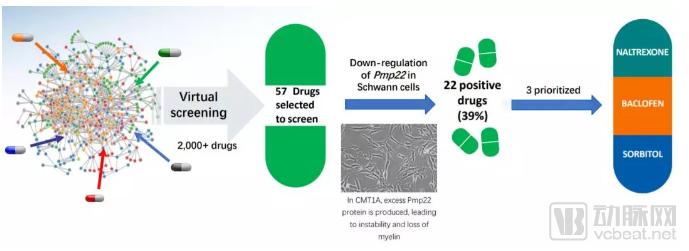
▲ Screening process of PXT3003 (Image source: Pharnext’s official website)
To develop therapies for CMT, Pharnext first spent a year constructing a network model of the disease. Similar to GNS’s Parkinson’s disease model, this network model illustrates how gene mutations lead to neurological and muscular disorders through various cascade reactions. Based on this model, computational analysis identified 57 candidate drugs targeting different nodes within the cascade. Pharnext then evaluated these drugs in vitro, selecting 22 for animal studies, and ultimately identified a combination of three drugs for clinical trials. Recent positive Phase III clinical trial results have confirmed that PXT3003, this combination therapy, indeed acts on multiple nodes of the cascade reaction.
Pharnext completed the preclinical development of PXT3003 in just three years. Without the aid of AI models, preclinical testing would have taken significantly longer. Dr. Cohen noted that 2,000 drugs can generate billions of combinations, and screening these combinations using in vitro assays would result in countless false positives and failures.
The progress made by Pharnext and GNS Healthcare demonstrates that AI technology is continuously evolving, driving advancements in pharmacology as well. A significant milestone in the development of artificial intelligence is the ability to infer causality and apply it to explore answers to hypothetical questions. The computer models developed by these companies are advancing in this direction.
In an era where the cost of developing new drugs often exceeds hundreds of millions of dollars, AI-driven “drug repurposing” may help pharmaceutical companies extract greater value from medications that have already required hundreds of billions of dollars in R&D investment. “You don’t necessarily need to design new drugs,” Cohen asserts. “My sense is that just 50 drugs, configured in different combinations, could treat all diseases.” This would mean we need to redefine the concept of “drug discovery.”
References:
[1] Adding Artificial Intelligence to Drug Discovery. Retrieved April 2, 2019, from https://www.genengnews.com/insights/adding-artificial-intelligence-to-drug-discovery/
[2] How A.I. Is Finding New Cures in Old Drugs. Retrieved April 2, 2019, from http://fortune.com/longform/ai-drugs-pharma-pharnext-cmt/