

FDA Approves Pfizer’s Ibrance for Male Breast Cancer Based on Real-World Evidence in Regulatory Milestone
This article is reprinted from PharmCube, with reprint authorization granted to VCBeat.
On April 4, Pfizer announced that the FDA had approved a supplemental application for a new indication of Ibrance (palbociclib), in combination with an aromatase inhibitor or fulvestrant, for the treatment of male patients with HR-positive, HER2-negative advanced or metastatic breast cancer.
The FDA’s approval was primarily based on U.S. electronic health record data, as well as real-world post-marketing medication data for male patients with cancer from the IQVIA insurance database, Flatiron Health’s breast cancer database, and Pfizer’s global safety database.
Dr. Chris Boshoff, Global Head of Product Development and Chief Development Officer for Oncology at Pfizer, stated, “Treatment options for male breast cancer patients are limited, and the approval of this new indication provides them with access to innovative anticancer therapies. We also greatly appreciate the FDA’s close communication and open approach, which allowed us to submit a marketing application based on real-world evidence and bring this innovative medicine to the patients who need it most.”
Ibrance is the first CDK4/6 inhibitor launched globally. On February 3, 2015, it received accelerated approval from the U.S. Food and Drug Administration (FDA) for use in combination with letrozole as first-line treatment for postmenopausal women with ER+/HER2- advanced breast cancer. On February 19, 2016, the FDA approved Ibrance in combination with fulvestrant as second-line therapy for ER+/HER2- advanced or metastatic breast cancer in patients who had experienced disease progression following prior endocrine therapy. On March 31, 2017, the FDA granted full approval for Ibrance in combination with an aromatase inhibitor as first-line treatment for postmenopausal women with ER+/HER2- advanced or metastatic breast cancer; this approval also converted the previous accelerated approval from 2015 into full approval.
Today, Ibrance in combination with aromatase inhibitors can be used as a first-line therapy for both female and male ER+/HER2- breast cancer. Ibrance is also the first CDK4/6 inhibitor approved globally for the treatment of male breast cancer.
Bret Miller, founder of the Male Breast Cancer Coalition, stated that treatment options for male breast cancer are very limited, and the availability of Ibrance is highly significant for patients. We greatly appreciate the FDA’s innovative approval approach, which utilizes real-world data to approve new drugs for market entry.
Real-world data is playing an increasingly significant role in expanding the indications of approved innovative drugs. Due to the extreme rarity of male breast cancer, it is challenging to enroll male patients in clinical trials for breast cancer, which has resulted in few new drugs being approved specifically for male breast cancer. It is estimated that in 2019, there were approximately 2,670 newly diagnosed cases of male breast cancer and 500 deaths in the United States.
The 21st Century Cures Act, enacted in the United States in 2016, aims to accelerate the research and development of innovative drugs and facilitate more efficient delivery of novel therapeutics and advanced treatments to patients. Additionally, the Act places particular emphasis on the FDA’s use of real-world data as a basis for its regulatory approval decisions.
Detailed dosing data for Ibrance in male patients with ER+/HER2- advanced or metastatic breast cancer will be presented at an upcoming academic conference. Based on very limited post-marketing reports and electronic health record data, the safety profile of Ibrance in male breast cancer patients is consistent with that observed in female breast cancer patients.
CDK4/6 are key regulators of the cell cycle, capable of triggering the transition from the growth phase (G1 phase) to the DNA synthesis phase (S phase). CDK4/6 inhibitors arrest the cell cycle at the G1 phase, thereby inhibiting tumor cell proliferation.
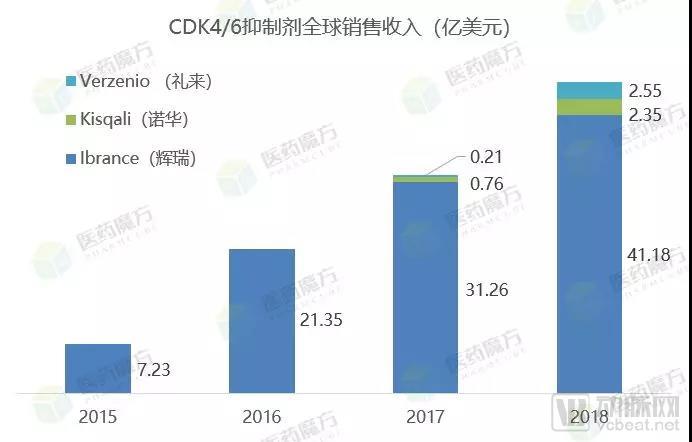
Currently, three CDK4/6 inhibitors have been approved for marketing worldwide. The market size reached USD 4.608 billion in 2018, with Pfizer’s Ibrance accounting for nearly 90%, demonstrating the commercial prowess of a small-molecule drug comparable to that of monoclonal antibodies. Although Eli Lilly’s Verzenio was launched six months later than Novartis’s Kisqali, it has achieved stronger market performance and surpassed Kisqali to become the second-largest player. Given that the most advanced other CDK4/6 candidates in development are still only in Phase II clinical trials, the competitive landscape for new drugs in this field is relatively clear.