

Earendil Labs Files for IPO Following $4.4B Strategic Partnerships with Sanofi Within One Year

Earendil Labs
AI-Powered Innovative Biopharmaceutical R&D Company
Sanofi
Pharmaceutical Manufacturer
Helixon
AI Technology New Drug Developer
January 5, 2026Earendil Labs (Overseas Company of Helixon)Announced a new cooperation agreement with the multinational pharmaceutical company Sanofi.AroundAIDriven drug discovery platform to further collaborate on multiple autoimmune and inflammatory disease projectsAccording to publicly disclosed information, Sanofi will be responsible for the global clinical development and commercialization of the bispecific antibody (Bispecific Antibody) candidate drugs resulting from the collaboration, while Earendil Labs will receive an upfront payment of $160 million and milestone payments related to early-stage projects. If all specified milestones are achieved during subsequent development and the market launch process, the potential total transaction value under the agreement could reach up to $2.56 billion. Additionally, Earendil Labs will also be entitled to tiered royalties in the high single-digit to low double-digit percentage range based on future product sales.
This is not the first collaboration between the two companies. Back in April 17, 2025, Sanofi had already acquired the global exclusive rights to two bispecific antibodies from Helixon—HXN-1002 (targeting α4β7/TL1A) and HXN-1003 (targeting TL1A/IL-23)—with a prepayment of $125 million. The total transaction value could reach up to $1.845 billion.
01.
Helixon: AI Compresses Bispecific Antibody R&D Cycle, Secures Over $4.4 Billion Collaboration with Sanofi in 2 Years
Helixon, Less Than a Year Twice Reached Licensing Cooperation with Sanofi, the Core of Industry Attention is Not a Single Candidate Drug, but the Mature Antibody Discovery and Optimization Platform Capability Behind It. This Company, Incubated by Tsinghua University's Artificial Intelligence Industry Research Institute in 2021 and Founded by Computational Biology Expert Jian Peng, Has Clearly Defined Its Position as an AI-Driven Antibody Drug Discovery Platform Enterprise from the Beginning.
In terms of technical pathways, the companyFocus on the Bispecific Antibody FieldIn autoimmune and inflammatory diseases, the inhibition of a single signaling pathway is difficult to cover the complex immune imbalance mechanisms, and some patients have limited response rates to single-target biologics. Dual-target intervention is considered promising for enhancing the integrity of inflammation control. However, the development of bispecific antibodies has long faced challenges such as difficult cooperative design of targets, long screening cycles, and high failure rates. The process from molecular design to preclinical validation usually takes 3–5 years.
Helixon PassedAICombined with high-throughput experiments, attempt to compress this process.The core logic is that, before the experiment, deep learning models are used to predict antibody-antigen interactions, locking in potential effective target combinations and antibody sequences; then high-throughput technology is employed to rapidly complete large-scale property testing, optimizing the developability and stability of molecules through multiple iterations. This system does not replace experiments but reduces ineffective trial and error, improving the efficiency of early screening, and has been validated through externally licensed projects.
HXN-1002, licensed to Sanofi in 2025, simultaneously targets α4β7 integrin and TL1A (TNF-like ligand 1A). The former is involved in the migration of immune cells to the intestinal mucosa, while the latter regulates intestinal inflammation. In the treatment of ulcerative colitis (UC) and Crohn's disease (CD), the dual-target design improves inflammatory regulation stability through synergistic inhibition, with mechanistic synergy already observed in preclinical models. Another candidate, HXN-1003, targets TL1A and IL-23 (Interleukin-23), both of which are involved in the inflammatory cascade of autoimmune diseases. This combination design strengthens overall intervention in the inflammatory network while avoiding uncertainties associated with entirely novel targets.Currently, both molecules areEarly Development Stage, with value concentrated in target combination logic and molecular discovery methods.
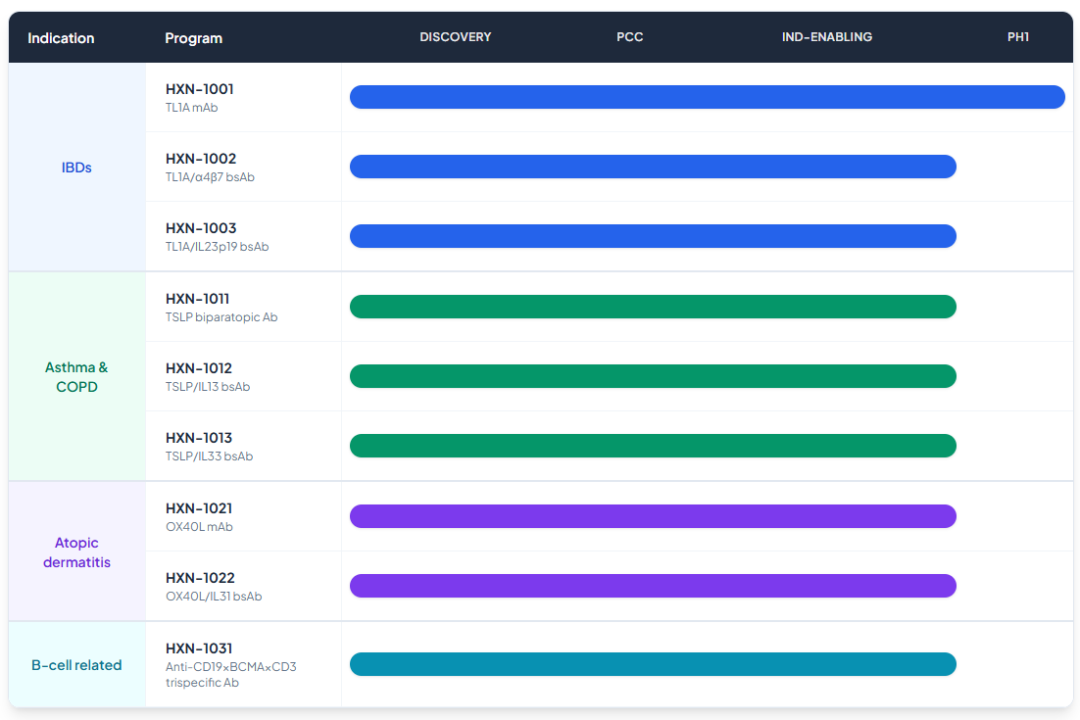
Earendil Labs Pipeline in Immunology and Inflammation
In summary, Helixon has not relied on a single project to gain global attention but has instead provided a more efficient early-stage research and development pathway in the specialized field of bispecific antibodies through its AI-driven antibody discovery platform. This is the core foundation for its ongoing collaboration with the same multinational pharmaceutical company in a short period.
02.
Sanofi: €13 Billion Product Supports Autoimmune Business, External Collaborations Boost Bispecific Antibody Pipeline
From Sanofi's perspective, the two collaborations with Helixon are more specific measures to continuously complete its pipeline in the autoimmune field. Sanofi, founded in 1973 and headquartered in Paris, France, operates in segments including prescription drugs, vaccines, and consumer health. In 2024, the company achieved sales revenue of 41.081 billion euros (a year-on-year increase of 11.3% at constant exchange rates), of which Dupilumab (trade name Dupixent), a core product in the autoimmune field, generated standalone sales of 13.072 billion euros, becoming one of its most important performance pillars.
In recent years, Sanofi has been continuously narrowing its R&D focus. Since 2019, it has gradually exited innovative R&D in fields such as diabetes and cardiovascular diseases, concentrating resources on areas like autoimmune diseases, oncology, and vaccines.In the field of autoimmune diseases, despite the availability of established products such as Dupilumab, in inflammatory bowel disease (IBD), psoriasis and other indications, existing single-target biologics still have problems such as insufficient efficacy and drug resistance.Against this backdrop, Sanofi has started to supplement new molecular formats such as bispecific antibodies through external collaborations.
03.
40% Growth Rate + Billion-Dollar Market: AI-Driven Bispecific Antibodies May Become the New Breakthrough in Autoimmune Diseases
The value of AI in drug research and development is evolving from an efficiency tool to an innovative capability that can be systematically procured by multinational pharmaceutical companies. The field of complex molecules, represented by bispecific antibodies, is one of the typical scenarios where this transformation is taking place.
Changes at the market level have sent a clear signal: according to Global Industry Analysts data, in 2024 the global dualThe market size of specific antibodies is approximately $14.8 billion and is expected to reach the $100 billion level by 2030, with an annual compound growth rate exceeding 40%.In the autoimmune track, traditionalTNF-α、IL-23As the pathways have become highly crowded, the efficacy ceiling and drug resistance issues are becoming increasingly prominent.Bispecific antibodies are regarded as the next-generation solution, but their engineering complexity is high and screening costs are substantial. The involvement of AI significantly compresses the early R&D cycle of bispecific antibodies, which is precisely the core reason why multinational pharmaceutical companies are willing to lock in assets at an earlier stage.
Helixon is not an isolated case. In recent years, multiple Chinese Biotechs have integrated AI capabilities into the design and optimization of bispecific antibodies. WuXi Biologics, relying on its self-developed generative AI platform WuXi ProDesign, generated 30 candidate molecules in just about two months for the design of PD-L1/CTLA-4 bispecific antibodies. Three of these were validated through wet lab experiments, with some advancing to the preclinical stage—far surpassing the traditional discovery cycle of over six months. Additionally, XtalPi's AI platform entered a $345 million strategic collaboration with Eli Lilly in 2025, focusing on AI-driven discovery and development of bispecific antibodies.
The resonance of technological breakthroughs and market demands has not only driven profound changes in cooperation models but also brought about value reconstruction.In terms of cooperation modelsCompared to the early-stage transaction structures mainly focused on late-clinical pipeline licensing, multinational pharmaceutical companies nowadays tend to engage in collaborations during the drug discovery or preclinical stages. Chinese Biotech firms are responsible for rapidly generating differentiated lead assets, which are then handed over to MNCs for subsequent global development and commercialization.Value EmbodimentAccording to the EASY Capital "2025 White Paper on China's Health Industry," in 2024, the average amount of external licensing deals by Chinese Biotech companies was approximately US$420 million. However, in the past year, the potential deal sizes of multiple AI-driven innovative collaborations have surged to over US$1 billion—such as the collaboration between CSPC Pharmaceutical Group's AI drug discovery platform and AstraZeneca, valued at up to US$5.33 billion, and the partnership between Harbour BioMed's AI multispecific antibody platform and BMS, reaching US$1.035 billion.
It is not difficult to see that the two collaborations between Sanofi and Helixon are not isolated incidents, but rather a microcosm of the restructuring of the global drug research and development chain:Technological innovation is advancing, and cooperation is deepening., while Chinese Biotech is breaking out of the "pipeline output" framework and becoming an early core collaborator in the global R&D system.
Disclaimer:
The content of the article is for reference only and does not constitute investment advice. Investors who take action based on this information do so at their own risk. The article maintains a neutral stance on the statements and viewpoints expressed, and does not provide any explicit or implicit guarantees regarding the accuracy, reliability, or completeness of the content. Readers are advised to use it solely as a reference and assume full responsibility for their actions.

ABC 2026
Booths are booking up fast!
Scan to consult immediately
Phone: 13816031174
(Same as WeChat)
Sponsorship forms include but are not limited toSpeaking slots, exhibition booths, color pages in conference brochures, dinner sponsorship, promotional materials for conference supplies, etc.