

Maturing Internet-Based Pharmaceutical Services Position Health Insurance as a Key Payer
On April 8, the inaugural World Health Expo opened in Wuhan. The 111 Group, a leading enterprise in internet-based pharmaceuticals and healthcare, jointly organized the “Internet + Pharmaceutical Development Summit Forum” with the Huangpi District People’s Government to explore new trends, models, and business formats in the field of internet-based pharmaceuticals and healthcare.
VCBeat (WeChat ID: vcbeat) learned at the conference that internet-based pharmaceutical service models are becoming increasingly mature, and their integration and collaboration with various stakeholders across the industry chain, such as commercial health insurance providers, have emerged as a key agenda for future development.
Data from the China Banking and Insurance Regulatory Commission (CBIRC) shows that the annual new premium volume in the health insurance market has grown rapidly. In 2018, the original insurance premium income from health insurance business reached RMB 544.813 billion, a year-on-year increase of 24.12%. From 2013 to 2018, the compound annual growth rate (CAGR) of new premiums in the health insurance market reached 35.95%.
Dr. Yu Gang, Co-founder and Executive Chairman of 111 Group, told VCBeat that he is highly optimistic about the future development of the health insurance market. He pointed out that China’s basic medical insurance system (social security) remains highly regionalized, making it impossible to achieve comprehensive cross-regional pooling and coverage at present; meanwhile, national medical insurance funds are limited. However, as there is rigid demand for health insurance, this provides fertile ground for the growth of commercial health insurance. Experience from Europe and the United States shows that commercial health insurance accounts for a significant proportion of their healthcare security systems.
Dr. Yu Gang also serves as a director of Taikang Online, giving him considerable expertise in the development of health insurance in China. Liu Dawei, CEO of Taikang Online, also participated in the forum that day, with both parties discussing potential collaboration.
The development of internet-based pharmaceutical and healthcare services has introduced new approaches for health insurance to acquire traffic, gather data, and deliver healthcare services. First, internet health platforms serve as traffic gateways; for instance, internet insurance platforms have generated hundreds of billions in incremental growth for the health insurance market. Second, user data from online consultations, medical diagnoses, and medication purchases on internet health platforms can provide a basis for health insurance actuarial calculations and product design. Furthermore, offering online consultations, prescription services, and health management through internet medical platforms constitutes an important value-added service for health insurance.
Since its inception around 2014, China’s internet pharmaceutical service sector has developed numerous mature business models. These include online pharmacies, with platforms such as 1YaoWang (1 Drug Network), Ali Health, and Jianke emerging as key players; and internet hospitals, represented by platforms like WeDoctor, Haodf, and Youdeyi. Internet pharmaceutical companies provide services that align closely with the service demands of commercial health insurance, creating a natural synergy. In practice, many health insurers have already explored integrating services through internet pharmaceutical platforms. Notable examples include Ping An Good Doctor serving Ping An Health Insurance, and Taikang Online providing internet pharmaceutical services to its users.
How Internet Healthcare Platforms Connect with Health Insurance: 111 Group as a Prime Case StudyIn October 2018, 111 Group entered into a deep strategic partnership with Manulife-Sinochem Life Insurance Co., Ltd. (“Manulife-Sinochem”), the first Sino-foreign joint venture life insurer in China. Manulife-Sinochem became the first insurance company to engage in long-term, in-depth collaboration with 111 Group. Together, the two parties explored the development of an integrated “big health” ecosystem offering a closed-loop service system encompassing prevention, medical consultations, medication purchases, and Pharmacy Benefit Management (PBM).
111 Group is a leading internet-based healthcare enterprise in China, committed to transforming the status quo of “difficulty in accessing medical care and high medication costs” for the Chinese public through internet-driven models and mindsets. By leveraging innovative internet and IT technologies, 111 Group provides online consultation, medication purchasing, and health management services, streamlining intermediaries and optimizing the supply chain to deliver comprehensive, affordable, and convenient healthcare and pharmaceutical solutions to the Chinese population.
111 Group’s business is driven by its “three pillars”: the B2C pharmaceutical platform “1 Drug Network,” the internet hospital “1 Diagnosis,” and the B2B pharmaceutical platform “1 Drug City.” Through an innovative T2B2C model, the company comprehensively achieves integrated development across B-side and C-side operations, online and offline channels, self-operated and platform-based services, and medical care and pharmaceuticals. It aims to build China’s largest technology-driven healthcare platform that seamlessly integrates online and offline services, empowering doctors, pharmacies, hospitals, pharmaceutical manufacturers, and drug distributors. In September 2018, 111 Group listed on the NASDAQ, becoming the first Chinese internet healthcare company to go public in the United States.
111 Group’s business and performance continued to grow steadily. The quarterly report showed that 111 Group’s net revenue in the fourth quarter of 2018 was RMB 560 million, a year-on-year increase of 102.1%. Among this, the core B2B segment demonstrated strong growth, achieving operating revenue of RMB 330 million, a year-on-year increase of 424.7%. For the full year 2018, net revenue reached RMB 1.79 billion, representing a year-on-year increase of 86.1%.
In the interview, Dr. Yu Gang introduced the concept of an “ecosystem,” whereby 111 Group implements a T2B2C model to empower every link in the healthcare industry chain with technology, enabling it to better serve the public. For insurance companies, 111 Group’s technologies and services aim to help insurers effectively manage medical costs, reduce expenditures, and increase pharmaceutical revenues, as well as develop new products and formulate product strategies based on insights and analysis of user data.
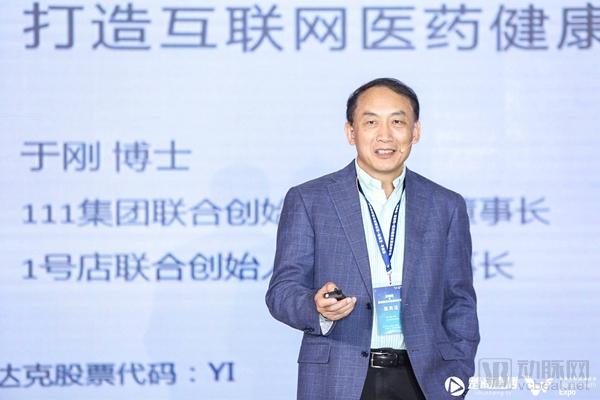
Speech by Dr. Yu Gang, Co-Founder and Executive Chairman of 111 Group
“We formed a strategic partnership with Manulife-Sinochem Life Insurance last year. How does it work? The insurance industry needs data, which can be used to design specialized insurance products for chronic diseases. By leveraging customer behavior and medication purchase records, we can develop targeted, distinctive insurance offerings. As the designated medication purchasing platform, we have significantly reduced drug costs and can also help insurers control expenses. Furthermore, we interact with users through our platform by reminding them to take their medications, seek medical care when necessary, and maintain healthy exercise and dietary habits, thereby promoting healthier lifestyles and creating a win-win-win situation. I believe this new business model will inevitably transform the industry in the future,” stated Dr. Yu Gang.
From the perspective of favorable factors driving the development of health insurance, there are generally the following categories: First, demand-driven growth. As Dr. Yu Gang pointed out, health insurance is increasingly becoming a basic necessity for many people. Since social medical insurance serves to “cover basic needs,” it maintains strict drug and medical service catalogs. With advances in medicine, numerous innovative therapies and products have emerged that are difficult for basic medical insurance to cover. Commercial health insurance, however, can include these products and services in its reimbursement coverage. As residents’ income levels rise, their willingness to allocate resources toward medical services and health insurance has grown stronger. Purchasing commercial insurance has become one of the hallmarks of the middle class.
From a policy perspective, the Chinese government has issued numerous policies in recent years to encourage the development of commercial health insurance, aiming to build a “multi-tiered and diversified” medical security system. For instance, the “Several Opinions of the State Council on Accelerating the Development of Modern Insurance Services” points out that commercial insurance should gradually become the primary provider of personal and family commercial protection plans, an important provider of enterprise-initiated pension and health security plans, and an active participant in the market-oriented operation of social insurance.
From the supply side, commercial health insurance in China has developed for nearly 15 years since the approval of the first specialized health insurance company in 2005. It has achieved certain accomplishments in product systems, regulatory frameworks, and service systems, while actively drawing on international experiences in managed care and technology empowerment, thereby offering a relatively rich array of health insurance products and services.
Since the subject matter of insurance is human health, health insurance cannot be viewed as a simple insurance product; rather, it is closely intertwined with individuals’ health status. Disease incidence rates, disease progression, and the selection of medical care pathways all impact the operational performance and profitability of health insurance. For the health insurance market to achieve sound and sustainable development, its integration with medical services is crucial.
“The integrated development of ‘insurance + healthcare services’ has become an industry consensus. As stated in Research on Commercial Health Insurance in China, published by the China Development Research Foundation, with the gradual improvement of living standards and health awareness, demand for health management, preventive care, chronic disease management, and rehabilitation maintenance will become increasingly prominent. Fully integrating health insurance with health services in these areas, and transitioning from post-event expense reimbursement to a comprehensive, end-to-end service model that combines pre-event prevention, in-process management, and post-event reimbursement, has become an inevitable requirement for the development of commercial health insurance.”
In recent years, companies operating commercial health insurance in developed countries have generally integrated health insurance services with health management services. In addition to providing traditional health insurance, they offer comprehensive health protection services—including health consultations, expedited access to medical care (green channels), and health fund management—to meet customers’ multi-layered health protection needs.
Internet-based pharmaceutical services represent an innovative model of healthcare delivery, dismantling the fragmented, opaque, and highly hierarchical legacy system while improving access to high-quality medical care. However, this model also requires robust support from strong payers. In the short term, it is impractical for basic medical insurance to fully open its coverage to internet-based pharmaceutical services. In contrast, the commercial health insurance system offers greater flexibility and continues to expand in market scale, having already become a significant payer in the healthcare sector. Internet pharmaceutical service enterprises can seize this opportunity to create value for health insurers, thereby generating returns and achieving long-term, sustainable development. We believe that more cases similar to 111 Group’s proactive collaborations with health insurance companies will emerge in the future.