

Bioknow Leverages AI to Empower Full-Cycle Drug Lifecycle Management, Completing Months of Work in Seconds

bioknow
Innovative Pharmaceutical Digital Intelligence Solution Provider
At the 4th Chinese Medical Affairs Annual Conference in Beijing, Zhuang Yonglong, Chairman of bioknow, and Jiang Xueqing, Vice President of the MedAI Business Unit, were invited to deliver speeches, discussing how AI automation helps solve complex problems and accelerates drug launch cycles in the digital era.
Jiang Xueqing presented a MedAI application case on-site: “Psoriasis is an autoimmune disease, and its pathogenesis remains to be further investigated. Through cross-validation using multi-marker detection algorithms, we identified markers with superior performance and significant biological relevance, and constructed a precise diagnostic model. This model also secured third place in the International Health Big Data Competition.”
Underpinning this is bioknow’s MedAI Intelligent Pharmaceutical Research Cloud Platform. The MedAI Intelligent Pharmaceutical Research Cloud Platform offers three core solutions: the MedAI Intelligent Academic Network Solution, the MedAI Intelligent Topic Selection Solution, and the MedAI Intelligent Data Analysis Solution.
VCBeat (WeChat ID: vcbeat) Unveils bioknow’s Secret to Shortening Drug Development Cycles from Keynote Speeches by Two Executives
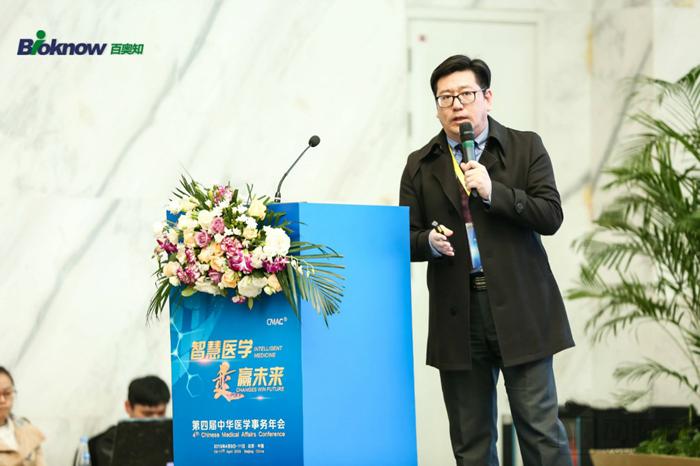
Jiang Xueqing, Vice President of the MedAI Division at bioknow, Delivers an On-Site Presentation
With the introduction of policies such as the “4+7” volume-based procurement program and the accelerated approval of new drugs, the academic transformation of pharmaceutical companies has become inevitable. This signals the end of the era of traditional pharmaceutical sales representatives, while the role of Medical Science Liaisons (MSLs) has become increasingly prominent.
Medical Science Liaisons (MSLs) are professionals across various therapeutic areas who have undergone advanced scientific training. Their work is independent of sales, and they are primarily responsible for communicating product information prior to launch. They excel at conveying complex scientific and medical information to diverse stakeholders, with their primary objective being to maintain close relationships with key opinion leaders (KOLs) in the same therapeutic areas, such as oncology, central nervous system disorders, and cardiovascular diseases.
A medical affairs head at a top-10 pharmaceutical company summarized the role as follows: “Medical affairs professionals serve as two bridges: one connecting R&D to the market, and the other linking the company with the academic community, conveying the drug’s key features, safety, and efficacy to key opinion leaders (KOLs). Therefore, they must possess R&D expertise, business acumen, and strategic vision.”
Jiang Xueqing also stated at the conference, “The core of a Medical Science Liaison’s role lies in KOL management and communication of post-marketing clinical evidence. Currently, the scope of medical affairs is increasingly shifting toward scientific research collaboration with KOLs.”
To bridge the various stakeholders involved in a drug’s journey from R&D to market launch, Medical Science Liaisons (MSLs) must possess a diverse skill set. They are required not only to review extensive literature daily and stay abreast of research hotspots across various fields, but also to master clinical data, organize academic materials, identify high-potential Key Opinion Leaders (KOLs), and support KOLs in conducting clinical studies.
To accomplish these tasks, bioknow, a domestic company specializing in integrated cloud platform solutions for the life sciences, has launched a new eMSL tool for this market: a clinical research assistance tool based on the MedAI intelligent academic network.
By leveraging the MedAI Intelligent Pharmaceutical Research Cloud Platform, Medical Science Liaisons (MSLs) can implement quantitative management of Key Opinion Leaders (KOLs). MedAI extracts data on KOLs’ research capabilities from public literature and conducts further data mining, enabling MSLs to better understand the research hotspots and topics of interest to KOLs, thereby facilitating targeted and precise information dissemination. MedAI categorizes and displays KOLs’ research fields, automatically extracting publication counts and citation metrics for each field, and performs analysis of related research themes. Additionally, MedAI provides intelligent recommendations of investigators for clinical drug trials.
In brief, the aforementioned features of MedAI enable Medical Science Liaisons (MSLs) to efficiently manage Key Opinion Leaders (KOLs), identify potential KOLs, and support clinical research. Additionally, MedAI facilitates post-marketing evidence collection and education on clinical concepts for healthcare professionals. By integrating MedAI’s drug target discovery and drug repurposing analysis capabilities, the platform supports comprehensive lifecycle management of pharmaceutical products.
How much value can this generate? For example, when advancing drug clinical trials to Phase II and III, pharmaceutical companies need to make substantial investments. If suitable key opinion leaders (KOLs) can be engaged to participate in the trials and ensure their efficient and high-quality completion, it will effectively accelerate the drug’s market launch.
In assisting with the resolution of clinical research challenges, MedAI offers panoramic, multi-dimensional intelligent topic recommendation; intelligent clinical research protocol design; intelligent patient follow-up and management; intelligent statistical data analysis; and finally, intelligent journal submission recommendations.
Furthermore, it is worth noting that Bioknow PV, the pharmacovigilance management system within Bioknow’s eClinical suite, effectively assists pharmaceutical companies in managing pharmacovigilance (PV) activities. Leveraging technologies such as natural language processing (NLP), machine learning, and semantic recognition, Bioknow PV conducts large-scale data mining for drug safety, automatically detects literature data from existing knowledge bases, analyzes drug safety profiles, and supports high-quality clinical trials and post-marketing adverse drug reaction monitoring.
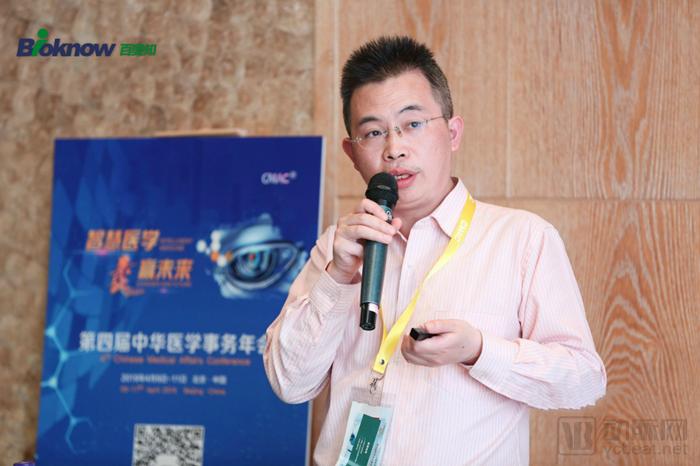
Zhuang Yonglong, President of bioknow, Delivers a Speech at the Conference
MedAI Empowers Medical Affairs, Addressing Numerous Challenges from Drug Development to Market Launch. Whether in drug target discovery, intelligent topic recommendation, intelligent protocol design, or intelligent follow-up and data analysis, these capabilities can be rapidly integrated into the workflows of researchers and medical professionals.
Real-world evidence (RWE) is becoming increasingly important; the FDA has already approved a new indication for Pfizer’s Ibrance based on real-world medication data.
Real-world studies require relatively large sample sizes and involve highly heterogeneous data. Researchers are not yet fully prepared to handle such massive volumes of data. Statistical data analysis is a key determinant of the success or failure of clinical research. Achieving high-quality data analysis in clinical trials requires researchers to possess statistical knowledge, proficiency in statistical software, and even computer programming skills. This poses a significant challenge for most researchers.
Currently, existing statistical software packages such as SPSS and SAS not only have high barriers to entry and stringent professional prerequisites, but also focus primarily on statistical analysis, lacking comprehensive research solutions.
Jiang Xueqing stated, “MedAI’s intelligent analysis empowers those lacking analytical skills to perform analyses, saves time for those already proficient in analysis, and equips individuals skilled in one analytical method with the capability to utilize multiple analytical approaches.”
MedAI leverages established statistical analysis workflows validated in the literature to generate data analysis reports with a single click, starting from statistical application scenarios. The MedAI intelligent data analysis pipeline currently covers seven major fields: oncology, immune-mediated diseases, cardiovascular and cerebrovascular diseases, endocrinology, infectious diseases, traditional Chinese medicine research, and surgery and medical devices.
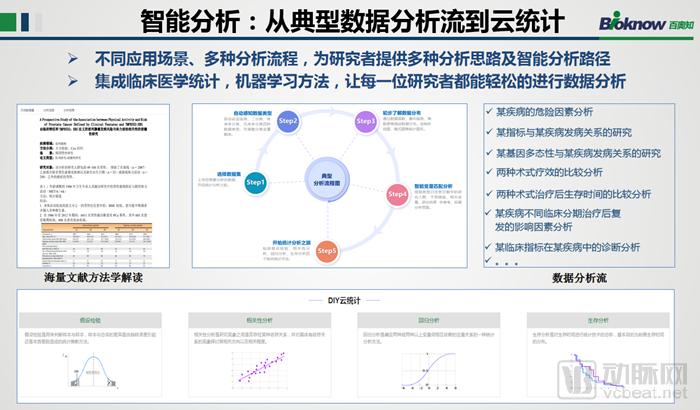
In terms of application scenarios, MedAI’s powerful analytical capabilities enable it to serve pharmaceutical companies, hospitals, CROs, and researchers. It reduces literature reviews that would typically take at least a month to just one second, empowers ordinary researchers with top-tier topic design capabilities, and completes high-threshold statistical data analysis within one minute, thereby significantly lowering overall costs for enterprises.
As the saying goes, “To do a good job, one must first sharpen one’s tools.” MedAI traces the entire drug lifecycle and centers on the people involved at each stage, freeing researchers from sifting through vast amounts of data and literature by completing research topic analysis and paper information summarization within seconds; it liberates researchers from the challenge of low statistical quality by generating analytical result reports with a single click; and it enables Medical Science Liaisons to efficiently quantify and manage Key Opinion Leaders (KOLs).
On the question of whether AI will replace humans, Jiang Xueqing also shared his views at the conference: “AI will enhance human capabilities and help people work more efficiently. AI will not make humans obsolete, but those who use AI will certainly outcompete those who do not.”