Biopharma Venture Investment in Q1 2019: Evaluate Pharma Reports Continued Slowdown Amid Shifting Capital Concentration
Q1 2019 has concluded. Evaluate Pharma released data on biopharmaceutical financing events compiled from its database, revealing a continued slowdown in venture capital investment. VBInsight (Arterial New Medicine) supplemented this analysis with records from the VCBeat database to examine trends in the biopharmaceutical sector during Q1 2019; however, our assessment of these trends differs from that of Evaluate Pharma.
Interpretation of the Evaluate Pharma Report
Evaluate Pharma’s financing and investment data show that global biopharmaceutical investment sentiment declined again in Q1 2019, with the slowdown in funding that began in late 2018 continuing. This indicates that it is becoming increasingly difficult for biopharmaceutical startups to secure capital through venture capital channels. However, it is premature to worry about a drying up of venture capital funds. Evaluate Pharma believes there is no need to panic over the slowdown observed in Q1 2019.
Even though the record-breaking total financing volume of 2018 is difficult to replicate, it is believed that the biopharmaceutical industry will still secure substantial total financing in 2019. Assuming that the global biopharmaceutical sector maintains the same level of venture capital financing activity in the remaining three quarters of 2019 as seen in Q1, the annual total financing would reach $14 billion, a figure second only to the remarkable peak in 2018. However, if venture capital funding continues to decline at a more significant pace in the future, this trend would warrant caution.
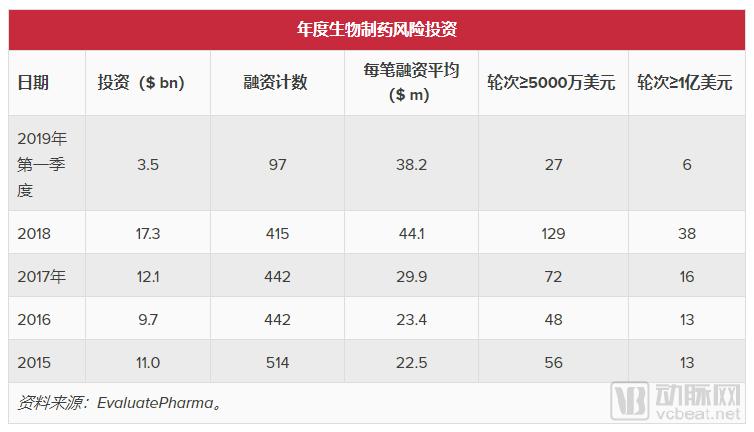
Evaluate Pharma pointed out that a truly concerning sign revealed by the venture capital financing data for Q1 2019 was the relatively low number of financing deals: if the current pace continues, the total number of financing transactions for the full year 2019 is projected to decline to 388, a figure significantly lower than in previous years.
This indicates that the trend of wealth concentrating in a few projects is becoming increasingly pronounced, with companies in hot sectors such as oncology, cell therapy, and gene therapy securing substantial financing. This means that less popular niche segments are being increasingly overlooked, which is not beneficial for the ecosystem of the biopharmaceutical industry.

Anticancer Drug Developers Are the Most Sought-After
Anticancer drug developers were the biggest winners in the Q1 2019 venture capital financing rankings. Notably, companies with Chinese elements accounted for four of the top ten financing deals in Q1 2019.
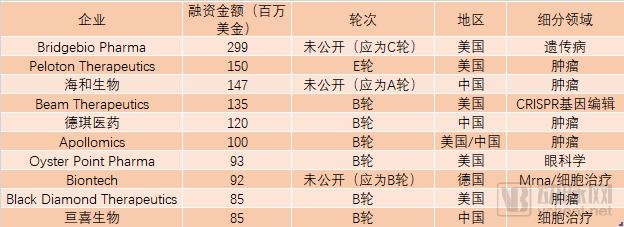
Evaluate Pharma Statistics: Top 10 Deals in the Biopharmaceutical Sector in Q1 2019
It is well known that Chinese companies have shown growing interest in cancer treatment research in recent years. Among them, Chinese cell therapy companies, including Gracell Biotechnologies, are attempting to develop low-cost CAR-T therapies. The experience of Chinese biopharmaceutical companies in the PD-(L)1 field has already demonstrated their ability to undermine competitors’ competitive advantages through lower product pricing. Although this has raised concerns among some that price wars may spread to the United States, many others view it as a new hope in the field of oncology. FDA officials have publicly stated that they welcome the launch of more affordable immunotherapy drugs from China in the U.S. market.
The only European company to make the TOP list is BioNTech, which focuses on mRNA and cell therapy research. To date, BioNTech has raised approximately $390 million in venture capital, a significant achievement in the capital markets for a biopharmaceutical company whose most advanced pipeline candidate is still in Phase II clinical trials. Meanwhile, rumors suggest that the German company is planning an IPO in the U.S. market at a valuation of up to $800 million. If confirmed, these rumors would value BioNTech at $4 billion. Previously, BioNTech’s biggest competitor, Moderna, had already gone public in the United States.
Beam Therapeutics, which ranks fourth on the list, has been even more active in the venture capital market than BioNTech. This company, focused on preclinical CRISPR gene editing, completed a $135 million financing round less than a year after announcing an $87 million funding raise.
The practices of BioNTech and Beam Therapeutics demonstrate that in the most capital-favored segments, biopharmaceutical companies can still attract substantial venture capital investment based on their clinical data, even before entering the product manufacturing stage.
In the public markets, the IPO trend in the biopharmaceutical industry has regained momentum since the end of the U.S. government shutdown turmoil. To date, companies that went public in 2019 have demonstrated strong performance, indicating that the industry as a whole remains healthy and bolstering venture capitalists’ confidence to invest despite the downward trend.
VCBeat: Financing Amounts Show Significant Increase
The above figures represent the financing trends in the biopharmaceutical sector as compiled by Evaluate Pharma from its database, with 97 global financing events totaling $3.5 billion. In contrast, VCBeat’s database recorded 131 financing events, with a total amount of $4.764 billion.
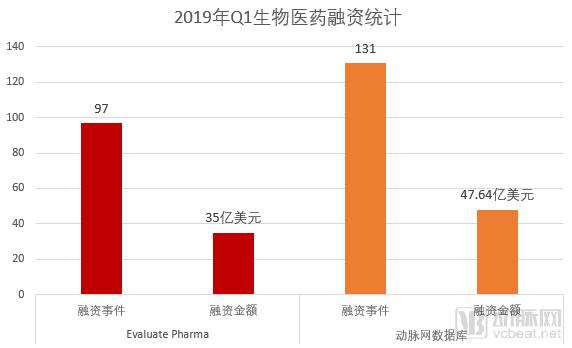
Evaluate has not published a detailed list of events for verification, but we can still confirm that the primary cause of the data discrepancy is partial omission in Evaluate Pharma’s statistics. In its TOP 10 list, the smallest financing amount is $85 million. There are eight additional biopharmaceutical financing events in the VCBeat database with amounts exceeding this threshold, none of which are included in Evaluate Pharma’s statistics.
Additionally, the discrepancy may stem from differences in statistical methodologies between our two organizations. Evaluate employs a narrower scope, whereas VBInsight adopts a broader definition encompassing biotechnology, biopharmaceuticals, and the pharmaceutical sector. The divergence likely arises in the gene sequencing and chemical drug segments, although these categories account for a relatively small proportion of the total value.
According to Evaluate Pharma’s statistics, the minimum amount among the top 10 financing deals in the biopharmaceutical sector in Q1 2019 was $85 million. VCBeat has supplemented this data with additional financing events exceeding $85 million, bringing the total to eight deals. Based on VCBeat’s data, the total financing amount increased significantly compared to Q3 and Q4 of 2018, indicating that the financing trend has not slowed down. Even when comparing with VCBeat’s own historical data, where the total financing in the biopharmaceutical sector amounted to $17.4 billion in 2018, the Q1 total already accounted for 27% of the previous year’s figure. If the level of activity in the remaining three quarters remains consistent with Q1, the annual total financing volume in the biopharmaceutical sector is expected to grow further.
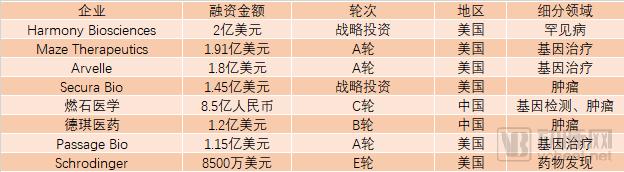
Supplementary Data on High-Value Financing Deals in the Biopharmaceutical Sector for Q1 2019 from the VCBeat Database
The companies with substantial financing highlighted in this section are primarily engaged in the research and development of drugs for genetic disorders and oncology. Harmony Biosciences, a biopharmaceutical company headquartered in Pennsylvania and founded in October 2017, is dedicated to providing new therapeutic options for patients with rare orphan diseases. The company’s key area of focus is central nervous system (CNS) disorders, and its flagship product is Pitolisant, a medication primarily used to treat narcolepsy. On March 14, 2019, Harmony Biosciences announced a $200 million debt financing agreement with CR Group LP, intended mainly to support the U.S. launch of this drug and fund ongoing development efforts.
Maze Therapeutics, founded in 2018 and headquartered in San Francisco, USA, has developed a proprietary technology specifically designed to identify modifier genes. This technology enables the analysis of how modifier genes influence the expression of disease-causing genes and facilitates the discovery of protective modifiers. Maze Therapeutics applies this approach to biopharmaceutical development, ultimately creating novel therapeutic interventions for genetic disorders. On February 28, Maze Therapeutics completed a $191 million financing round, led by Third Rock Ventures and ARCH Venture Partners.
The table also includes two Chinese companies. Burning Rock Biotech, founded in 2014, specializes in providing next-generation sequencing (NGS) products and services with the highest clinical value for precision oncology. On February 14, Burning Rock Biotech announced the completion of its Series C financing round, raising a total of RMB 850 million. The funds will primarily be used to increase investment in the research and development of early screening and detection products, as well as to expand the scale of testing for patient populations.
Antengene focuses on the development of innovative oncology drugs and combination therapies, with its current product pipeline covering three major therapeutic areas: solid tumors, hematologic malignancies, and viral infections. On January 2, Antengene announced the completion of a $120 million (approximately RMB 830 million) Series B financing round. The round was co-led by Boyu Capital and FountainVest Partners, with participation from Celgene, WuXi AppTec Venture Fund, and Taikang Insurance Group. Existing investors Qiming Venture Partners and Talfourd Capital continued to participate in the follow-on investment.
Our industry summaries and trend forecasts are all data-driven. VCBeat’s more comprehensive data indicate that the biomedical sector is ushering in a new wave of development opportunities. Investment enthusiasm in this field remains high, with capital flowing like a torrent into biomedical R&D, driving up valuations of biomedical companies. Against this backdrop, does a valuation bubble exist in the biomedical sector? How do investment institutions assess the valuations of biotech enterprises? VCBeat New Medicine addressed these questions in yesterday’s article.“Beyond the Bubble: What Lies Behind the High Valuations of Biopharmaceutical Companies? Major Institutions Discuss Investment Valuation Logic”, provides a more in-depth elaboration.