

Investment Costs and Operational Models of Rehabilitation Institutions at All Levels in China
Editor’s Note: This article is republished from Haiman Health, originally titled “A Ten-Minute Overview of the Current State of Rehabilitation in China (Types of Institutions).” Republished with permission by VCBeat.
Introduction
Since the concept of rehabilitation medicine was introduced to China in the 1980s, more than three decades of exploration and practice have seen Chinese rehabilitation institutions evolve from nonexistence to establishment, from small to large, and from weak to strong, with growing social attention.
Over the past decade, investment firms, insurance companies, and private enterprises have increasingly focused their investments on the rehabilitation industry, driving the enhancement of industry standards and the expansion of business models. Propelled by both traditional and emerging institutions, various forms of rehabilitation medical institutions now exist across China, offering a diverse range of rehabilitation medical services.
However, amid the rapid proliferation and widespread expansion of rehabilitation institutions, some investors, due to a lack of fundamental understanding of the rehabilitation sector, have seen their self-operated facilities gradually expose a series of interconnected problems. This has prompted the industry to pause and reflect. Based on the current landscape and objective definitions of the rehabilitation field, and drawing on personal experience and related insights, the author offers these preliminary observations for the reference of practitioners and enthusiasts alike.
Currently, the mainstream understanding within the investment community categorizes domestic rehabilitation institutions into six major types: hospital-based, department-based (rehabilitation departments), outpatient-based, sanatorium-based, incomplete rehabilitation, and group-based. To provide readers with an intuitive and clear understanding, this article lists these categories below based solely on China’s medical institution establishment standards and actual business models (without distinguishing between public institutions, private capital, or foreign capital):
1. Department of Rehabilitation in Tertiary Hospitals
Development Trace: In the early stages, most rehabilitation departments originated from departments such as Physical Therapy, Acupuncture and Tuina (Massage), or Physiotherapy. Initial teams were typically formed by medical professionals from Traditional Chinese Medicine, Neurology, and Orthopedics. Personnel were assigned to undergo specialized rehabilitation training, while professionals with expertise in rehabilitation practice (including teaching) were recruited, gradually evolving into rehabilitation departments and teams with distinct characteristics.
Current Status Overview: At present, the prevailing concepts for departments in tertiary general hospitals include “Rehabilitation Medicine Center” and “Department of Rehabilitation Medicine,” with specific naming largely determined by each hospital’s scale and strategic positioning. In recent years, driven by factors such as the inclusion of rehabilitation department establishment in the evaluation criteria for tertiary medical institutions, nearly all tertiary medical institutions have achieved full coverage of rehabilitation departments. Some renowned institutions have begun collaborating with relevant organizations or capital entities, leveraging rehabilitation medical consortia as a platform to establish “rehabilitation branch hospitals” and undertake related development initiatives.
Institutional Responsibilities: Rehabilitation Medicine, Rehabilitation Therapy, Rehabilitation Nursing, Rehabilitation Engineering, Teaching, and Scientific Research.
Scope of Services: Rehabilitation services for this ward (center), other wards, and outpatients; incubation and technical support for subordinate rehabilitation institutions; training and assessment of rehabilitation medical technicians; rehabilitation research, etc.
Construction Standards: Refer to the "Grade III Hospital Accreditation Standards" of each province and municipality directly under the Central Government, as well as the respective requirements of individual hospitals.
Typical Recommendations: Rehabilitation Medicine Center of Jiangsu Province Hospital, Department of Rehabilitation Medicine at Huashan Hospital Affiliated to Fudan University, Department of Rehabilitation Medicine at Tongji Hospital Affiliated to Tongji Medical College of Huazhong University of Science and Technology, etc.
Investment Scale: 5 million–40 million.
2. Tertiary Rehabilitation Hospital
Development Trace: Initially launched by local governments or relevant departments, these professional institutions are established around the initiating demands and target service populations, with rehabilitation as the core focus, and are approved through evaluation by relevant medical institutions.
Current Overview: In China, rehabilitation hospitals are broadly categorized into comprehensive and specialized facilities based on the types of patients served and the scope of services provided. In recent years, social capital and related enterprises have begun investing in the establishment of tertiary-level rehabilitation hospitals, accelerating the integration of “clinical care and rehabilitation” for certain conditions and services, while also offering surgical medical services.
Institutional Responsibilities: Clinical Medicine, Rehabilitation Medicine, Rehabilitation Therapy, Rehabilitation Nursing, Rehabilitation Engineering, Teaching, Scientific Research, Prevention, and Healthcare.
Scope of Services: Primarily focuses on rehabilitation services for conditions related to the nervous system, musculoskeletal system, and cardiopulmonary system; also provides specialized services for patients with work-related injuries. Some institutions offer specialty surgical procedures and related clinical medical services. Additional activities include training and assessment in rehabilitation medicine and technology, as well as rehabilitation research.
Construction Standards: Refer to the national "Construction Standards for Tertiary Rehabilitation Hospitals" and relevant local requirements.
Recommended: Beijing Bo'ai Hospital (China Rehabilitation Research Center), Guangdong Provincial Work Injury Rehabilitation Hospital, Wuxi Tongren (International) Rehabilitation Hospital, and Xiangya Bo'ai Rehabilitation Hospital.
Investment Scale: 150 million–600 million.
3. Department of Rehabilitation at Secondary Hospitals
Development Trajectory: Driven by regional co-construction partnerships with the rehabilitation departments of tertiary general hospitals, strong advocacy from hospital leadership, and institutional transformation, the rehabilitation department was gradually established, drawing on the historical development model of rehabilitation departments in tertiary general hospitals.
Current Situation Overview: At present, the development of rehabilitation institutions in this category is uneven. Some institutions have established medical alliances for rehabilitation with the rehabilitation departments of well-known tertiary hospitals, introducing advanced technologies and talent. Leveraging their own advantages, they have developed into "cooperative wards" for the rehabilitation departments of these tertiary hospitals. Meanwhile, other institutions have merely purchased simple equipment on the basis of their physical therapy or acupuncture and tuina departments to nominally establish a rehabilitation department, resulting in a formality without substantive content.
Institutional Responsibilities: Rehabilitation Medicine, Rehabilitation Therapy, and Rehabilitation Nursing.
Scope of Services: Rehabilitation services for this ward/center, other wards, and outpatients; rehabilitation education.
Construction Standards: Refer to the “Grade II Hospital Accreditation Standards” of each province and municipality directly under the Central Government, as well as the respective requirements of individual hospitals.
Typical Recommendations: Department of Rehabilitation, Nanjing Qixia District Hospital; Department of Rehabilitation, Shanghai Changning District Tianshan Traditional Chinese Medicine Hospital.
Investment Scale: 2–8 million.
4. Secondary Rehabilitation Hospital
Development Trajectory: Early development followed the model of tertiary rehabilitation specialty hospitals; some institutions also gained successful experience in building their own internal rehabilitation departments, which subsequently enabled a comprehensive transformation into rehabilitation specialty hospitals.
Current Situation Overview: Rehabilitation specialty hospitals that were initially established or transformed from public institutions are currently characterized by standardized infrastructure and streamlined services. Since 2005, social capital and private enterprises have gradually participated in the construction and operation of secondary rehabilitation hospitals. The overall investment scale and number of such facilities showed an accelerating trend in 2013, before cooling down starting in late 2016.
Institutional Responsibilities: Rehabilitation Medicine, Rehabilitation Therapy, and Rehabilitation Nursing.
Scope of Services: Primarily focused on rehabilitation services for conditions related to the nervous system and musculoskeletal system, with specialized services dedicated to work-related injury patients.
Construction Standards: Refer to the national "Construction Standards for Secondary Rehabilitation Hospitals" and relevant local requirements.
Typical Recommendations: Shanghai Yangzhi Rehabilitation Hospital (Shanghai Sunshine Rehabilitation Center), Wuxi Ziwang Rehabilitation Hospital.
Investment Scale: RMB 30 million – 80 million.
5. Rehabilitation Department of Primary Hospitals
Development Trajectory: This can be broadly categorized into two models. The first involves establishing rehabilitation medical consortia in collaboration with the rehabilitation departments of renowned general hospitals. Under this framework, existing physical therapy and traditional Chinese medicine (TCM) personnel are selected to form dedicated rehabilitation departments that provide relevant services, often supported by corresponding rehabilitation wards and large-scale rehabilitation treatment centers. The second model is more common among private hospitals, primarily driven by the structural optimization and adjustment of hospital revenue streams. These facilities typically feature basic staffing and equipment for TCM and physical therapy, with relatively modest requirements for standardization in technical operations and business processes.
Current Situation Overview: The rehabilitation departments of primary hospitals that joined the Rehabilitation Medical Consortium in its early stages have seen significant improvements in departmental scale and standardization. The professional proficiency and capabilities of some of these institutions are comparable to, or even exceed, those of rehabilitation departments in certain secondary general hospitals. Benefiting from the resources of the Rehabilitation Medical Consortium and their strategic positioning covering community-level services, these institutions have achieved a high level of growth and maturity.
Private institutions possess a high degree of autonomy and acumen regarding their business structures and operational realities, demonstrating an evolving understanding of the need to further develop rehabilitation services. However, constrained by challenges such as staffing shortages, technological limitations, payment structures, and management costs, the development of rehabilitation departments remains relatively slow and sluggish. Furthermore, amid the wave of reforms in primary healthcare institutions—particularly as community medical centers transition toward a “preventive care + rehabilitation medicine” model—rehabilitation units are being established within these grassroots facilities. Nevertheless, due to deficiencies in awareness, technology, personnel, and motivation, most of these efforts remain merely formalistic.
Institutional Responsibilities: Rehabilitation Medicine, Rehabilitation Therapy.
Scope of Services: Rehabilitation services for this ward (center), other wards, and outpatient clinics.
Construction Standards: Refer to the "Grade II Hospital Accreditation Standards" of each province and municipality directly under the central government, as well as local relevant requirements.
Typical Recommendation: Huashan Hospital Yonghe Branch, Fudan University (now transformed into Shanghai Third Rehabilitation Hospital).
Investment Scale: 2.5–8 million.
6. Rehabilitation Medical Center
Historical Evolution: Prior to 2017, the definition of a rehabilitation medical center was not clearly established. Various types of institutions commonly used the term “rehabilitation center,” particularly those supported by civil affairs departments, such as “Rehabilitation Centers for Persons with Disabilities” or “Work-Related Injury Rehabilitation Centers.” These facilities ranged from tertiary specialized rehabilitation hospitals to rehabilitation departments within primary care hospitals. Private rehabilitation institutions, often driven by marketing considerations, also frequently designated their rehabilitation or physiotherapy departments as “Rehabilitation Medical Centers” for external branding.
Current Situation: In 2017, the Chinese government issued requirements regarding the basic standards and management specifications for rehabilitation medical centers and nursing centers. This policy formally established the definition and standards for rehabilitation medical centers, confirming their status as independently established medical institutions.
Institutional Responsibilities: Rehabilitation Medicine, Rehabilitation Therapy, Rehabilitation Nursing, and Home-Based Care.
Scope of Business: Providing medical rehabilitation services for patients with chronic diseases, geriatric conditions, and those in the recovery or chronic phase following disease treatment.
Construction Standards: "Notice of the National Health and Family Planning Commission on Issuing the Basic Standards and Management Specifications (Trial) for Rehabilitation Medical Centers and Nursing Centers" (Guo Wei Yi Fa [2017] No. 51).
Typical Recommendations: None at present. Suggestions are welcome.
Investment Scale: 3–8 million.
7. Rehabilitation Medicine Specialist Outpatient Clinic (Department)
Historical Evolution: In the early stages, independent medical institutions established by foreign enterprises in China’s developed cities were the primary providers of specialized rehabilitation services. Later, public medical institutions began setting up rehabilitation outpatient departments (or clinics) to extend their service reach and meet grassroots healthcare demands; however, the services offered often diverged from professional rehabilitation standards, with many being merely nominal or formal in nature. Starting in 2015, private enterprises entered the specialized rehabilitation outpatient sector, establishing institutions, developing products, and building teams in accordance with international standards, giving rise to a number of high-quality institutions. In 2018, China issued its first license for a rehabilitation clinic.
Current Situation Overview: Since 2017, private capital has surged into the rehabilitation outpatient sector. By establishing rehabilitation or sports medicine outpatient departments as independent medical institutions, these entities have been conducting related businesses. The primary scope of services remains largely focused on musculoskeletal rehabilitation.
Institutional Responsibilities: Rehabilitation Medicine, Rehabilitation Therapy.
Scope of Services: Outpatient rehabilitation services, commonly seen in sports injury, musculoskeletal, and pain management rehabilitation; some institutions also offer cardiopulmonary rehabilitation or post-operative rehabilitation.
Construction Standards: National construction standards for "General Specialty Outpatient Clinics" and local requirements. In some regions, the establishment of independent specialty outpatient clinics (departments) for rehabilitation medicine has not yet been approved; communication and confirmation with local regulatory authorities are required.
Recommended: Shanghai Yundong Rehabilitation Medicine Specialty Outpatient Department, Hangzhou Youkan Sports Medicine Clinic, Beijing Hongdao Sports Medicine Clinic.
Investment Scale: 5–15 million.
8. Outpatient Rehabilitation Department
Development Trace: In the early stages, rehabilitation services were generally categorized into two types. The first type was more common in foreign-funded general outpatient clinics, where a rehabilitation department was established to enrich the institution’s business structure and service offerings. These services primarily focused on rehabilitation treatments for the musculoskeletal system or for neck, shoulder, lower back, and leg pain. The second type aimed to optimize the institution’s revenue structure and reduce the proportion of pharmaceutical sales; however, these efforts were often largely formalistic, typically limited to routine acupuncture, tuina (Chinese therapeutic massage), or physical therapy.
Current Status: The rehabilitation scale of such institutions is typically modest, with their role largely serving as a complement and adjunct to comprehensive services.
Institutional Responsibilities: Rehabilitation Therapy.
Scope of Services: Outpatient rehabilitation services, typically including acupuncture, tuina (Chinese therapeutic massage), and physical therapy.
Construction Standards: Reference the relevant requirements for the establishment of general outpatient departments and clinics, as well as local requirements.
Recommended: United Family Healthcare Clinic.
Investment Scale: 500,000–3,000,000.
9. Department of Rehabilitation, TCM Outpatient Clinic (Department)
Development Trace: Based on the inheritance and enhancement of non-pharmacological therapies in Traditional Chinese Medicine (TCM) outpatient clinics, it is generally convenient to further optimize and centralize the management of common conditions such as neck, shoulder, lower back, and leg pain.
Current Status: The rehabilitation scale of such institutions is typically limited, with minimal integration of modern rehabilitation concepts. Most primarily adopt and incorporate the operational models of "New TCM" institutions.
Institutional Responsibilities: Rehabilitation Therapy.
Scope of Business: Outpatient rehabilitation services, commonly including acupuncture, tuina (therapeutic massage), and physical therapy.
Construction Standards: Refer to the relevant requirements for the establishment of comprehensive outpatient departments and clinics, as well as local regulations.
Typical Recommendations: None at present; suggestions are welcome.
Investment Scale: 100,000–300,000.
10. Rehabilitation Department of Nursing Homes/Convalescent Hospitals
Development Trajectory: In the early stages, acupuncture, tuina massage, or physical therapy services were commonly introduced in nursing homes and convalescent facilities to meet the diverse needs and practical demands of resident patients. In recent years, driven by the concept of integrated medical and elderly care and the rapid development of rehabilitation services, these units have been upgraded into rehabilitation departments. Some institutions have adopted modern rehabilitation concepts, focusing on the stratification of nursing staff and the restoration of functional independence.
Current Overview: Since 2015, there has been a rapid increase in the number of healthcare institutions establishing rehabilitation departments. Particularly after medical insurance began covering certain rehabilitation services, some large-scale and chain-operated nursing homes have expanded and upgraded their rehabilitation departments. The scale and facilities of their rehabilitation therapy centers are comparable to those of rehabilitation departments in some secondary general hospitals. Other institutions have opted to co-locate with rehabilitation hospitals within the same area, providing differentiated services.
Institutional Responsibilities: Rehabilitation Medicine, Rehabilitation Therapy, and Rehabilitation Nursing.
Scope of Services: Providing medical rehabilitation services for patients with chronic diseases, geriatric conditions, and those in the recovery or chronic phases following disease treatment.
Construction Standards: Construction Standards for Sanatoriums and Nursing Homes, Basic Standards for Medical Rooms in Elderly Care Institutions (Trial), Basic Standards for Nursing Stations in Elderly Care Institutions (Trial), and Local Requirements.
Typical Recommendation: Nanjing Orpea Xianlin International Senior Care Center.
Investment Scale: 100,000–5 million.
11. Rehabilitation Services Studio
Development Trace: In the early stages, these facilities were predominantly established independently by rehabilitation practitioners (primarily physical therapists) without obtaining the necessary qualifications for medical institutions. They provided services covering neurological rehabilitation, orthopedic rehabilitation, and pelvic floor rehabilitation. Subsequently, they gradually expanded their offerings to include related services such as training and physical conditioning.
Current Status Overview: Overall, the development of institutions is uneven, and their personnel structures are complex. With the deregulation of applications for medical institution licenses and the influx of capital from the financial markets, practitioners who initially established studios are gradually moving toward standardization. Specifically, some are applying for qualifications as medical institutions to provide professional, medical-grade services, while others are registering as health management companies to offer health-related or non-invasive rehabilitation subspecialty services. Meanwhile, some institutions continue to operate in a “gray area.” Additionally, there are practitioners without backgrounds in formal medical institutions who, under the guise of rehabilitation, provide services such as pelvic floor therapy, spinal correction, and physical conditioning.
Institutional Responsibilities: Currently undefined; consumer-oriented services.
Scope of Business: Consumer-oriented services, commonly providing support for sports injuries, pain management, and physical fitness.
Construction Standards: None.
Recommended: Fujian Hanling Musculoskeletal Pain Management Center, Shanghai Jijin Wanmei Health Management Consulting Center.
Investment Scale: 100,000–3 million.
12. Home Care Service Center
Historical Development: Initially advocated and launched by government agencies, with the civil affairs departments taking the lead in management. In recent years, private enterprises have gradually participated, adopting various models such as publicly built and privately operated, as well as privately built and privately operated.
Current Situation Overview: There is a gradual increase in the number of chain institutions operated by private companies, as well as a rise in public institutions delegating operations to social organizations. Meanwhile, the distinction between fee-charging organizations and non-governmental charitable organizations is becoming increasingly clear. Service content and business models vary, offering services such as age-friendly home modifications, training in the use of daily living aids, and exercise interventions. Some institutions have obtained licenses for elderly care facilities, enabling them to establish rehabilitation departments and provide medical-grade rehabilitation services.
Institutional Responsibilities: Home-based Care.
Scope of Services: Rehabilitation services centered on functional restoration, with an emphasis on the application of physical therapy and occupational therapy.
Construction Standards: There is currently no unified official definition; some institutions refer to the construction standards for elderly care facilities.
Typical Recommendation: None.
Investment Scale: 100,000–3 million.
13. Review:
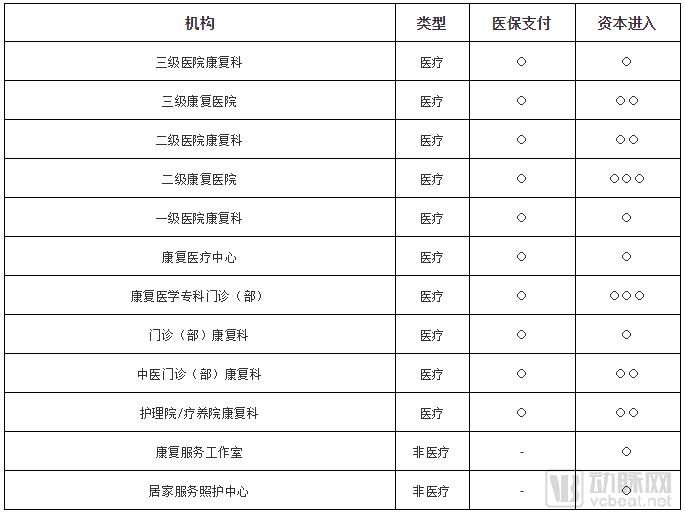
Furthermore, although some of the aforementioned rehabilitation institutions have obtained legal qualifications through approval by relevant authorities, they lack professionals holding a “Rehabilitation Physician” practice license to oversee genuine “rehabilitation medical” services.
Original Note:
1) The headings and content mentioned in this article, such as development history, current status overview, institutional responsibilities, construction standards, and investment scale, all focus on rehabilitation institutions (hospitals, departments, outpatient clinics, and studios), rather than referring to the overall institutions involved or associated.
2) For other non-medical institutions, such as postpartum recovery centers, dermatological rehabilitation centers, and sub-health recovery centers, the author has no understanding of their institutional nature, service models, or content, and thus will not elaborate on or discuss them.
*The views expressed in this article are solely those of the author and do not represent the position of VCBeat.
Author: Shi Yongjie, General Manager of Wuxi Haiman Health Medical Management Service Co., Ltd.
Author’s Biography: Graduated from Nanjing Medical University in 2008 with a major in Rehabilitation Therapy, and later obtained a Master’s degree in Supply Chain Management. The author has extensive experience in investment planning, operational management, infrastructure and landscaping, product research and development, and information architecture within the rehabilitation sector. In 2018, the author independently founded Haiman Health, advancing three core pillars: “directly operated chain of premium rehabilitation outpatient clinics,” “consulting for the establishment and entrusted operation of rehabilitation and elder care institutions,” and “research and translation of rehabilitation theories and technologies.” The company is committed to building China’s rehabilitation HMO (Health Maintenance Organization) model in the fields of rehabilitative medicine and home-based caregiving.
Served as a founding member of a health and wellness investment management company, leading investments and operations for a chain of rehabilitation facilities, the construction and operation of wellness centers, and the renovation of 4A-rated tourist attractions; later served as a Director of the company and General Manager of its medical management subsidiary.