

Tencent Cloud Partners with Over 100 Enterprises to Launch One-Stop 'Digital Capability Marketplace' for Healthcare Industry
From April 11 to 14, VCBeat (WeChat Official Account: vcbeat) learned that the 2019 China Hospital Information Network Conference (CHINC), hosted by the Hospital Management Institute of the National Health Commission, was held in Chongqing. Zhang Guodong, General Manager of Tencent Healthcare Cloud, attended the main forum and shared the six key areas of current development in healthcare informatization. He pointed out that Tencent Cloud would join hands with more than 100 ecosystem partners to build a one-stop “Digital Capability Supermarket” for the healthcare industry, aiming to facilitate innovative medical service models. During the conference, Tencent Security also launched its new-generation application security product—Tencent Cloud Shu Application-Level Intelligent Gateway—designed to safeguard smart healthcare initiatives.
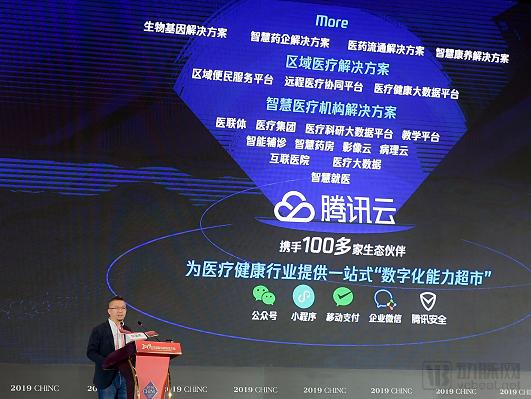
Share by Zhang Guodong, General Manager of Tencent Medical Cloud
Seizing the Six Key Development Priorities of Healthcare Informatics
From the “Outline of the ‘Healthy China 2030’ Planning Program” to the “Opinions of the General Office of the State Council on Promoting the Development of ‘Internet + Healthcare’,” and further to the Government Work Report delivered at this year’s Two Sessions, the healthcare industry is not only reaping policy dividends but also revealing key priorities for sectoral development.
Jiao Yahui, Deputy Director of the Medical Administration and Hospital Management Bureau under the National Health Commission, provided a detailed explanation of the models and evaluation criteria for smart hospital construction at the conference. She pointed out that there are three main models for building smart hospitals: digitalization of individual hospitals, digitalization within medical consortia, and intelligent transformation of the entire regional healthcare system. Furthermore, based on business functions, smart hospitals are categorized into four dimensions: smart services, smart medical care, smart nursing, and smart management. Previously, the National Health Commission issued the "Notice on Printing and Distributing the Graded Evaluation Standard System for Hospital Smart Services (Trial)," encouraging hospital informatization centered on electronic medical records. This framework covers three areas: clinical operations, patient services, and hospital management, with a particular focus on patient services, including pre-consultation, during-consultation, post-consultation, and safety aspects. This marks the establishment of a "national standard" in China for promoting smart hospital construction and improving medical services.
Zhang Guodong believes that national policies have charted the course for the development of healthcare. From the perspective of applying new internet technologies, six key areas will drive the informatization of healthcare: medical information platforms, internet hospitals, smart hospitals, regional healthcare informatization, health management, and medical AI. “As a critical infrastructure, cloud computing will enable us to leverage Tencent’s core competencies—such as WeChat Official Accounts, Mini Programs, mobile payments, WeCom, and security capabilities—to strengthen the informational foundation of the healthcare industry. Meanwhile, Tencent Cloud serves as a hub for an innovative ecosystem. In the healthcare sector, we will collaborate with over 100 ecosystem partners to integrate their respective healthcare informatization capabilities and provide customizable solutions. By establishing a one-stop ‘Digital Capability Supermarket’ for the healthcare industry, we aim to foster innovative models of medical services.”
Introducing Tencent Cloud Pivot: Addressing Hospital Information Security Challenges
During the conference, Tencent Security and WeCom jointly hosted a special session on “Tencent’s Healthcare Informatics and Security Construction,” themed “Co-building Smart Hospitals,” where they unveiled their next-generation application security product—the Tencent Cloud Shu Application-Level Intelligent Gateway.
According to reports, the newly released Tencent Cloud Hub, as a new generation of application-level intelligent gateway, helps medical institutions centrally manage, uniformly prevent and control, and uniformly audit enterprise-level applications and services. Meanwhile, Tencent Cloud Hub collaborates with WeCom to jointly create a new generation collaborative office environment for medical institutions, significantly improving the operational efficiency of healthcare systems. In addition, Tencent Cloud Hub integrates Tencent Security’s self-developed TAV anti-virus engine and HABO sandbox for advanced threat detection, effectively helping medical institutions defend against malicious attacks.
At the conference, Jiao Yahui pointed out that there are widespread security issues in medical informatization, with areas at risk including host security, network security, and application security. The next step will focus on promoting information security in hospitals. “These big data belong to our country; they not only involve national strategic security but also concern each patient’s personal privacy and information security. The importance of security cannot be overstated.”
Deng Zhenbo, Deputy General Manager of Tencent Security, stated that ransomware and cryptomining trojan attacks, Advanced Persistent Threat (APT) attacks, and data breaches have become the three major security threats facing the healthcare industry under the new landscape. Relevant reports indicate that in 2018 alone, ransomware was detected in 247 Grade A tertiary hospitals across China. Ma Jinsong, Head of the Tencent Security Anti-Virus Laboratory, emphasized that in addition to the increasingly severe external security situation, healthcare information systems also face internal security risks stemming from upgrades to the application ecosystem, including complex device management, blurred regulatory boundaries, difficulties in monitoring internal traffic, and increased challenges in threat surveillance.
In response, Tencent Security has leveraged its big data capabilities, the technological advantages of its seven major laboratories, and two decades of protection experience to build a “Security Brain” intelligent defense system for medical information security, which has been deployed in numerous healthcare institutions. Zhu Suisong, Director of the Network Technology Department at Shenzhen Nanshan Hospital, noted that by integrating Tencent Security’s situational awareness system, hospitals can more accurately forecast security trends, precisely issue alerts, and intercept malicious attacks, thereby maximizing the protection of critical security assets.
“Digital Capability Supermarket” Supplies Customized Solutions
According to the introduction, Tencent Cloud not only integrates Tencent’s internal resources—including WeChat Official Accounts, Mini Programs, mobile payment services, WeCom, and security capabilities—to strengthen the information technology infrastructure of the healthcare industry, but also incorporates vertical-domain products and services from external ecosystem partners, thereby providing hospitals with comprehensive smart upgrade solutions.
In the realm of smart hospital development, Tencent Cloud has assisted renowned institutions such as PLA General Hospital (301 Hospital), Fudan University Shanghai Cancer Center, West China Second University Hospital, and the Second Hospital of Hebei Medical University in implementing functionalities including electronic medical cards, appointment registration and payment processing, insurance-enabled cardless payments, and online consultation services.
At The First Affiliated Hospital of Sun Yat-sen University, the adoption of Tencent Video Cloud technology to build a telemedicine platform has enabled data interaction for telemedicine services and data sharing of patient diagnosis and treatment information. Beijing Chaoyang Hospital has leveraged Tencent’s proprietary cloud platform and database products to host its core in-hospital business systems on a private cloud, effectively enhancing the hospital’s informatization level, laying the foundation for big data analytics and rapid business growth, and significantly improving the security and scalability of its core physician order entry system. China Coal General Hospital has established a unified intelligent early-warning platform for occupational pneumoconiosis based on Tencent Cloud, reducing upfront investment costs, significantly shortening the construction cycle, and connecting China Coal General Hospital with specialized pneumoconiosis hospitals distributed across various provinces and cities nationwide.