

Jingfan Technology Files for IPO Amid Booming Wearable Market Driven by PPG-Based Health Monitoring
When Apple launched its new Apple Watch featuring advanced ECG technology, wearable devices were once again successfully promoted by a major brand. Chinese tech companies such as Huawei and Huami also began to intensify their efforts. Currently, the most critical functions in wearable products rely on ECG (electrocardiogram) and PPG (photoplethysmography) for real-time health monitoring.
In 2015, Zhang Jindong, who had accumulated years of experience in embedded systems and small-signal and video processing at Huawei, China Security & Surveillance Technology, and Tsinghua University’s laboratories, founded Jingfan Technology. Similar to the patent technology Apple had filed years earlier for monitoring physiological metrics via headphones, Jingfan Technology initially aimed to develop a consumer-facing wearable heart-rate monitoring headphone.
However, the team’s technical expertise attracted numerous B2B manufacturers seeking collaboration. As a result, Tianjin Jingfan Technology Co., Ltd. secured an upstream position in the wearable device market with its compact, low-cost chip products.
Behind the extensive foray of home furnishing and appliance manufacturers into the family health sector, the collection of human physiological data has become a gateway to health services, increasingly permeating people’s daily lives. As heart rate monitoring becomes a standard feature in smartwatches and fitness bands, only a few people understand the technical principles underlying the data measurement.
Traditional Chinese Medicine (TCM) employs pulse palpation, while Western medicine utilizes pulse wave analysis. TCM pulse diagnosis can identify a wide range of diseases by assessing pulses at specific points. Similarly, pulse waves vary across different anatomical locations, and networked analysis of these signals can yield extensive information on health status and disease conditions.
Zhang Jindong, founder of Tianjin Jingfan Technology Co., Ltd., which specializes in pulse wave analysis, revealed: “There are numerous capillaries beneath the skin. These capillaries undergo periodic contractions synchronized with cardiac systole, leading to changes in light absorption by the blood vessels. By capturing and analyzing these optical signals using light sensors, it is possible to measure capillary blood flow in real time, thereby further assessing vascular status and cardiac function.”
Pathological changes in organs seemingly unrelated to the cardiovascular system can, in fact, induce varying resistance alterations in different branching vessels. Consequently, joint analysis of pulse signals from various body locations may enable the diagnosis of a broader range of diseases in the future. This is the principle behind “pulse wave” technology.
The monitoring functions of wearable wristbands available on the market, such as those from Huawei, Huami, and Apple, are also commonly implemented using photoplethysmography (PPG). However, while PPG technology is widely used for heart rate monitoring, Zhang Jindong points out that this technology can actually measure data metrics across multiple additional dimensions.
Current pulse wave technologies on the market are merely limited to measuring heart rate, and simple heart rate analysis offers limited value for health assessment. In contrast, Tianjin Jingfan Technology Co., Ltd. has integrated pulse wave technology into a compact chip, enabling detailed analysis of each pulse and heartbeat. In addition to basic heart rate, the measured data includes blood oxygen saturation, vascular elasticity, blood pressure, heart rate variability (HRV), and pulse waveform display. The HRV information contained therein can be used for the diagnosis of cardiovascular and respiratory diseases, as well as for the assessment of mental stress and fatigue status.
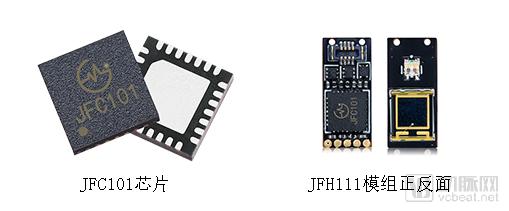
Two Products from Jingfan Technology (Source: Company-provided Image)
"Heart rate variability reflects the balance between the sympathetic and parasympathetic nervous systems, enabling the assessment of short-term mental states and providing early warnings for cardiac diseases. This specific metric represents a measurement dimension that many smart hardware devices fail to achieve. While multi-parameter measurement poses greater technical challenges, it offers far broader application prospects and higher value for health monitoring," Zhang Jindong told reporters.
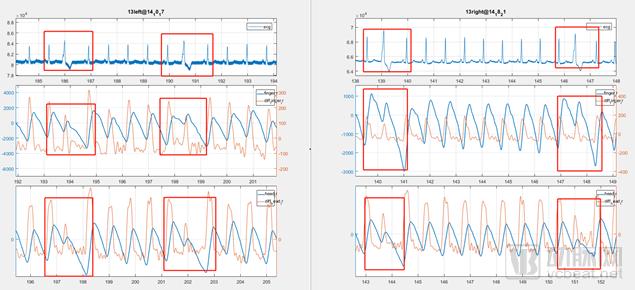
Comparison of ECG and Pulse Wave in Cerebral Infarction (Source: Provided by the company)
Currently, smart wearable devices applied in the health management sector are primarily positioned for individual and household-level consumption, with monitoring activities focusing on exercise, sleep, chronic disease management, and daily life among middle-aged and elderly individuals. As the populations of older adults and individuals with chronic diseases continue to grow, wearable devices that rely on data monitoring as their primary means are poised for significant opportunities.
Among chronic diseases, cardiovascular and cerebrovascular diseases—affecting over 290 million people and ranking first in mortality—have naturally become one of the first health industry sectors to be implemented and made widely accessible under the health management model.
Real-time, continuous monitoring of a series of data parameters—including heart rate, blood oxygen saturation, microcirculation, and blood pressure—in this population not only facilitates effective observation and improvement of their clinical condition but also holds greater significance for disease prevention, control, and health guidance through the cross-referencing of multidimensional data, as opposed to relying on single indicators. The pulse wave monitoring technology employed is designed to achieve the first step in health management—physiological parameter monitoring—while simultaneously collecting user data.
However, amidst the bubble of consumer-grade wearable devices, health wearables have become trapped in a predicament of homogenization and superficial data collection.
In Zhang Jindong’s observation, although most wristbands also use photoplethysmography (PPG) technology, currently, most of them only achieve heart rate measurement. “Everyone treats PPG as an analytical method, but true analysis is conducted on the backend using different algorithms, with entirely different requirements for signal quality and precision. Products currently available on the market basically only handle the data collection stage.”
He noted that current pulse wave technology for human monitoring remains at a relatively basic stage, with data not yet mature enough for genuine application in disease prevention. This is why most wearable devices on the market are categorized as “consumer electronics” rather than truly penetrating the core of healthcare.
The heart rate measurement principles of smart wearable devices on the market are mainly ECG (electrocardiogram) and PPG (photoplethysmography). The latter has strong advantages in anti-motion interference and anti-electromagnetic interference, but its disadvantage is that many manufacturers are limited by technology and cannot guarantee accuracy under different scenarios, and the data value of more indicators has not yet been reflected.
In the medical device market, only a few products from major manufacturers such as Apple and Huami have implemented heart rate monitoring functions primarily based on ECG technology, enabling wearable devices to monitor atrial fibrillation and other hard-to-detect arrhythmias. ECG detection relies on bioelectrical signals; by capturing these signals and processing them digitally, accurate and detailed cardiac health information can be generated. Both types of devices have successfully obtained FDA and NMPA (formerly CFDA) certifications.
Compared with the ECG technology that is widely used in clinical practice, Zhang Jindong admitted that although pulse wave technology can measure a wider range of physiological parameters, it is more technically challenging to implement. The difficulties lie in:
1. Signal Precision: The analysis of pulse wave details imposes varying requirements on the sophistication of chips and acquisition circuits. If only heart rate measurement is required, it suffices to count the number of heartbeats per minute. However, if health indicators such as vascular elasticity and heart rate variability (HRV) are to be analyzed, precise capture of the waveform details of each individual heartbeat is necessary. This results in fundamentally different requirements for the acquisition accuracy of raw signals by the chip.
2. Signal Analysis: How to interpret signals after acquisition and extract health- and disease-related information for users. This task requires extensive collection of clinical data, support from medical theories, and collaboration with numerous experiments.
3. How to effectively leverage pulse waves and translate them into viable commercial products.
Currently, Jingfan Technology’s measurements of routine indicators such as heart rate and blood oxygen saturation have achieved medical-grade accuracy. Meanwhile, data on parameters like vascular elasticity have demonstrated a high degree of concordance in real-world user settings, as validated through clinical studies.
“Cloud computing has indeed been a very hot topic in recent years, but to achieve the most valuable health monitoring, it is essential to have data connectivity and real-time tracking with new technologies. On one hand, it relies on edge devices, but on the other hand, it absolutely cannot do without the cloud.”
Zhang Jindong believes that only the “device + cloud” approach can achieve optimal real-time signal acquisition and obtain precise signal sources. “Leveraging the capabilities of the cloud, we can enable real-time remote monitoring. This model ensures the maximization of the effectiveness of pulse wave technology applications, or alternatively, the maximization of its service coverage, while simultaneously guaranteeing the validity of the measurements.”
In addition to chip modules that can be integrated into edge devices, Jingfan Technology innovatively provides cloud services. Beyond measuring basic data metrics such as heart rate and blood oxygen saturation, Zhang Jindong told reporters, “Cloud-based services can analyze the various types of measured data to generate analytical results similar to a physical examination report, informing users how to improve their health status and which indicators are abnormal.”
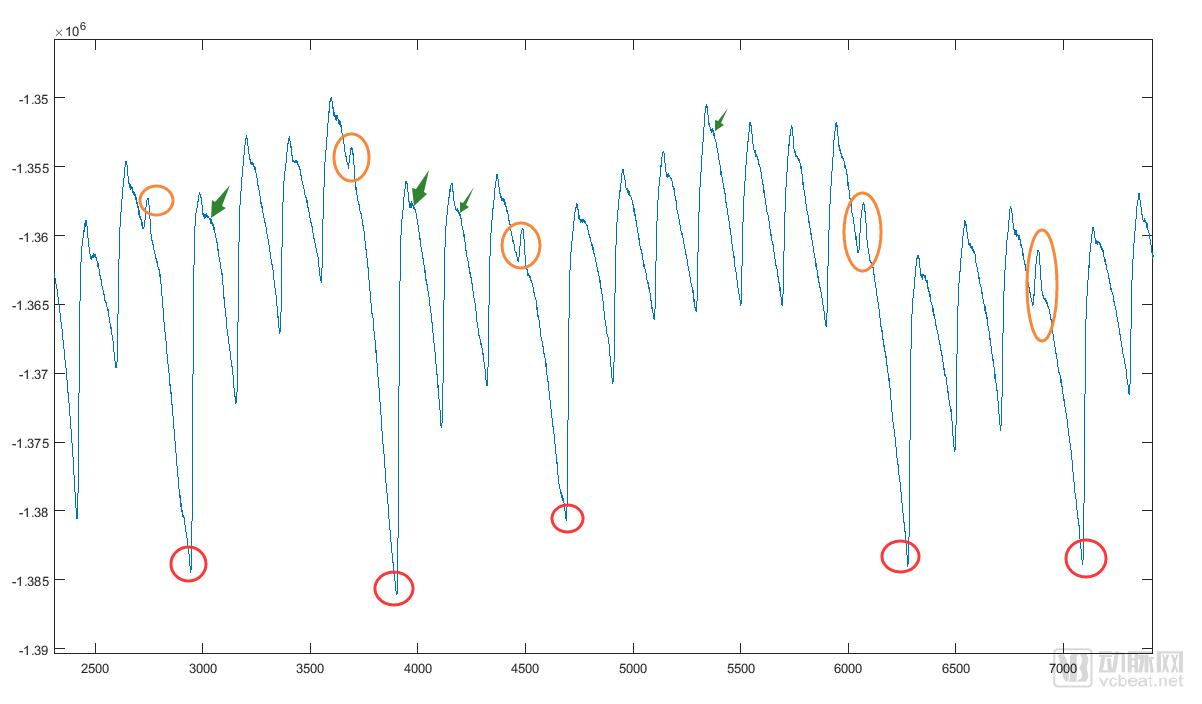
Abnormal Pulse Wave Illustration (Source: Image provided by the company)
For traditional enterprises, chip and hardware manufacturers generally lack the technical expertise in cloud development and management. Cloud computing capabilities are typically provided by cloud service providers, while major cloud platforms do not offer services such as data access and analysis. Consequently, if manufacturers of smart home devices, health-monitoring wearables, and similar products wish to build their own cloud computing systems, they face long development cycles, substantial investments, and significant technical challenges. Moreover, health monitoring requires medical analysis and artificial intelligence processing—“soft capabilities” that most hardware manufacturers do not possess.
To this end, Jingfan Technology has transferred its packaged “device + cloud” integrated solution to various manufacturers. Hardware manufacturers need only simply integrate Jingfan Technology’s chip modules and connect the interfaces, thereby enabling all users to access cloud-based health data analytics services. In this ecosystem, hardware manufacturers essentially serve as data collectors.
Regarding cloud data security, Zhang Jindong told reporters that Tianjin Jingfan Technology Co., Ltd. prevents user data leaks by employing program encryption algorithms, customized sensors, and binding service IDs.
In Zhang Jindong’s view, the rationale for using pulse wave technology as an entry point for health monitoring lies in three aspects: First, pulse wave data is simple in form, essentially a one-dimensional continuous signal, which is suitable for AI algorithms. Its small data volume facilitates low-bandwidth real-time transmission, thereby promoting internet-based data integration. Second, pulse waves carry rich information, extending far beyond heart rate analysis. Pulse waves vary across different measurement sites, and networked analysis can yield extensive health and disease-related insights, representing significant yet largely untapped value. Third, the product is easy to promote, as the 4mm x 4mm chip module offers advantages of low cost, compact size, and ease of integration.
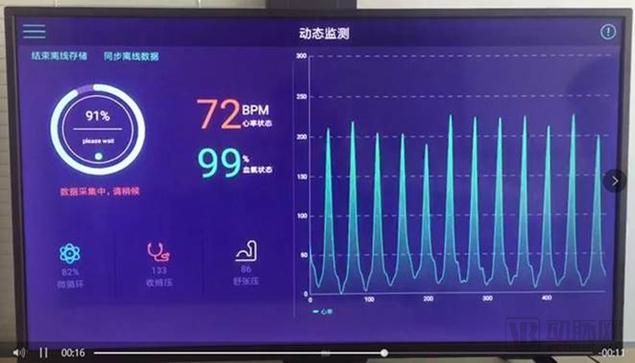
Health Monitoring TV (Source: Provided by the company)
In terms of its business model, Jingfan Technology targets hardware equipment suppliers and health management institutions as its primary customers, generating revenue mainly through the sale of pulse wave monitoring components. Its key application scenarios include smart home systems and wearable devices. To date, Jingfan Technology has signed orders with more than 50 companies across categories such as smartwatches, fitness bands, health-focused apparel, and smart home products. In the future, the company will share profits with partner manufacturers by offering cloud-based data analysis services billed directly to end users.
According to IDC’s “China Wearable Device Market Quarterly Tracker Report, Q4 2018,” shipments in China’s wearable device market reached 73.21 million units in 2018, a year-on-year increase of 28.5%, and are projected to reach 120 million units by 2023. Among these, shipments of fitness bands in China totaled 26.32 million units, representing a 4.8% year-on-year growth. In terms of form factor, smart devices dominated by earphones exhibited the fastest growth.
Zhang Jindong stated, “The pulse wave is essentially our primary channel, forming a complete vertical pathway that spans from front-end signal acquisition to intelligent analysis and cloud-based data analytics and services. Once this pulse wave application matures, the same channel can be extended to acquire and analyze other physiological signals. Therefore, Tianjin Jingfan Technology Co., Ltd. will continue to focus on overcoming challenges in the continuous acquisition of subtle, weak cardiac physiological signals and their cloud-based analysis, thereby establishing a comprehensive vertical channel for health management.”
If the analysis is limited to heart rate, the barriers for general-purpose chip manufacturers will continue to lower, and in an increasingly homogeneous competitive landscape, larger brands will gradually phase out smaller ones. Therefore, Tianjin Jingfan Technology Co., Ltd. will continuously delve deeper into the value of pulse wave data, rapidly integrating it into various manufacturers’ products through diverse experimental productizations, thereby establishing core competitiveness and brand advantages.
It is reported that the core team of Jingfan Technology comprises professionals from Huawei, Foxconn, Tsinghua University, and the Chinese Academy of Medical Sciences, with over a decade of research experience. Previously, Jingfan completed its angel round of financing led by CAS Star, Maker Headquarters, and Peking University Mingde Investment. The team is currently seeking Pre-A series financing, aiming to raise RMB 10 million.