HealthEase: Empowering Tiered Diagnosis and Treatment through Family Doctor Contracts – A Grassroots Healthcare Case Study
If you visit a community hospital for medical care, the doctor will clearly inform you of the appropriate department when a referral to a larger hospital is needed for further diagnosis and treatment. They will provide you with an appointment verification code. With this code, you can bypass procedures such as queuing for registration and payment at tertiary hospitals, proceed directly to the essential consultations, and ensure that all required diagnostic and therapeutic services are completed on the same day. Would you be willing to use this service?
Tiered diagnosis and treatment has been the core topic of healthcare system reform in recent years, and empowering primary healthcare is the foundation for implementing the tiered diagnosis and treatment system.
The 13th Five-Year Plan (2016) proposed to prioritize the improvement of primary healthcare services, use tiered diagnosis and treatment for common diseases, frequently occurring diseases, and chronic diseases as a breakthrough point, establish a scientific and rational medical consultation order, and achieve basic universal coverage of the family doctor contract service system.
As the “gatekeepers” and “health managers” of the tiered diagnosis and treatment system, the importance of primary healthcare is self-evident. How can we empower primary healthcare services, link medical resources across different levels of care, and encourage patients to seek care in their communities while motivating specialists to provide services at the grassroots level? Jiangsu Health Worry offers its own insights.
A Startup with a 30-Year “Foundation”
Before analyzing Health Worry, it is necessary to mention its “past and present.”
Health Worry was established in 2014 as a subsidiary of the listed company Focus Technology, set up to focus on the internet healthcare industry and based on the informatization construction of the medical and health sector. In 2017, it merged with another company funded by Focus Technology—Jiangsu Jieshida University Technology Co., Ltd. (hereinafter referred to as Jiangsu Jieshida)—and the combined entity is collectively known as Jiangsu Health Worry Network Technology Co., Ltd.
Jiangsu Jieshida was established in 1989 as a state-owned joint venture initially funded by thirty universities and colleges, including Nanjing University, Southeast University, and Nanjing Medical University. In 2003, it was restructured into a limited liability company. It is one of the earliest specialized enterprises in China engaged in the research and development, system integration, and technical services of hospital information systems.
The integration of Jiangsu Jieshida, which has been deeply rooted in the local market for three decades, has undoubtedly given Health Worry a powerful boost. Currently, Health Worry’s products and services primarily revolve around a tiered diagnosis and treatment service platform based on family doctors, smart patient healthcare services enabled by internet-based medical care, a public health service platform leveraging big health data, and an operational service platform centered on the broader health industry.
The focus of this article is Health Worry’s tiered diagnosis and treatment service based on family doctors.
From 0 to 1: Over 930,000 Family Doctor Contracts Signed in Three Years
Jiangsu Health Worry’s tiered diagnosis and treatment system, based on family doctor contracts, aims to establish a community appointment resource allocation mechanism that favors primary care settings. By implementing services such as family doctor contracting, the system incentivizes and guides residents to seek initial consultations at the community level, gradually cultivating the habit of “primary care first,” thereby ensuring the effective implementation of tiered diagnosis and treatment.
Currently, the system has been integrated into 100 community hospitals across 11 districts in Nanjing, with 7,558 family doctors and 1,031 family doctor teams registered, and a total of 930,000 contract signings.
“Although the state has been vigorously promoting the tiered diagnosis and treatment system in recent years, truly implementing it—going from 0 to 1—is no easy task,” said Jiang Bo, current product manager at Health Worry, in an interview with VCBeat (WeChat ID: vcbeat).
In 2016, when China’s tiered diagnosis and treatment policy was just beginning to take shape, many companies were still in the exploratory phase, including Jiangsu Health Worry Network Technology Co., Ltd. (“Health Worry”). Jiang Bo joined the company at that time, taking charge of a tiered diagnosis and treatment system based on family doctor contracting arrangements. In his words, there were no precedents to reference and no experience to draw upon; no one knew what the final outcome would look like.
“Initially, the concepts of the tiered diagnosis and treatment system and family doctors were separate. Family doctors focused more on contract signing and follow-up visits, while tiered diagnosis and treatment targeted the connection of resources between higher-level and lower-level hospitals. Therefore, we initially developed two different systems,” said Jiang Bo. “However, after more than six months of implementation, we discovered that so-called tiered diagnosis and treatment is inextricably linked to family doctor contracting. In fact, when providing services to patients, family doctors also need to leverage resources and assistance from higher-level hospitals.”
Recognizing this, Health Worry began to integrate and adjust its existing operations, merging two systems into a single tiered diagnosis and treatment system based on family doctors. The logic behind the integration mainly has two points: first, how to facilitate doctors' work and reduce their burden; second, what benefits residents can gain from this system.
Regional Tertiary Hospitals to Prioritize Allocating 30% of Outpatient Appointment Slots to Community Health Centers
The integrated system comprises several components, including the physician’s PC client, the platform portal, the mobile app for physicians, the mobile app for residents, and the WeChat interface. Its core functionalities encompass contract management, appointment and referral services, mobile follow-up visits, health assessment management, online prescription renewal, and data analytics.
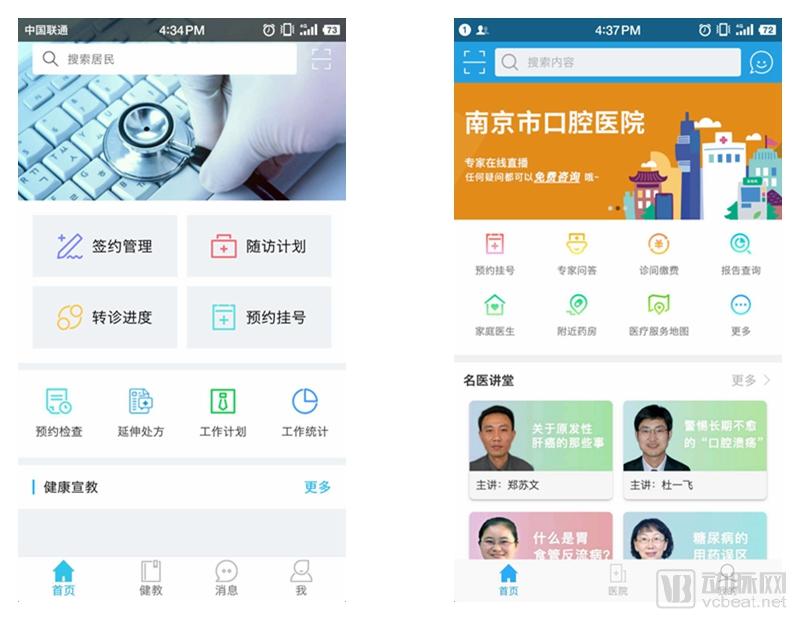
The left side shows the doctor’s interface, and the right side shows the patient’s interface (image provided by the interviewee)
Jiang Bo concluded that the system’s application and promotion in Nanjing are now relatively mature, with the following key features:
1. Establishing a Green Channel for Referrals from Community Hospitals to Tertiary Hospitals. This system is integrated with the Nanjing Appointment Registration Platform, through which tertiary hospitals release specialist appointment slots to community family doctors 1–2 weeks in advance. Furthermore, Jiangsu Health Worry Network Technology Co., Ltd. has signed cooperation agreements with over 50 medical institutions, including Jiangsu Province People’s Hospital, Nanjing Drum Tower Hospital, Nanjing Luhe People’s Hospital, and Nanjing Qixia Hospital, prioritizing the allocation of 30% of outpatient appointment slots to community hospitals via this system. Community physicians can directly schedule diagnostic and treatment orders at tertiary hospitals; patients need only present their consultation code to bypass queuing for registration and payment, thereby streamlining access to medical consultations and examinations.
2. Specialized Customized Contracted Service Packages for the Elderly and Patients with Chronic Diseases. It is well known that “signed but not fulfilled” contracts currently represent the primary challenge facing family doctor contracting services. To address this issue, Jiangsu Health Worry Network Technology Co., Ltd. has launched personalized customized contracted service packages. During the family doctor contracting process, users may choose either a basic service package or a personalized customized service package based on their individual conditions. The latter is primarily targeted at the elderly and patients with chronic diseases such as hypertension, diabetes, and chronic obstructive pulmonary disease (COPD). After contracting, community hospitals will develop specialized, personalized follow-up, examination, and diagnosis and treatment plans tailored to each user’s specific circumstances.
3. Online prescription renewal and home delivery of medications. The system enables family doctors to review patients’ historical consultation and medication records, and facilitates direct delivery of prescribed drugs to residents’ homes through pharmaceutical logistics channels. Furthermore, this channel supports medical insurance reimbursement settlement at community (township) hospitals, allowing patients to benefit from preferential coverage.
4. Interconnection and interoperability with Nanjing municipal and district-level platforms. Upon accessing the system, tertiary hospitals can view patients’ medical visits and examination records from lower-tier healthcare institutions.
Jiang Bo told VCBeat that Nanjing was the first stop, and Zhenjiang has also begun to adopt this model under the construction of Jiangsu Health Worry Network Technology Co., Ltd. Yangzhou, Nantong, and other cities are following suit. In combination with health poverty alleviation and family doctor services, projects have already been implemented in Xiping County, Henan Province, and the Ningxia Hui Autonomous Region.
He also stated that, in the next phase of system optimization and upgrades, Health Worry will focus on developing AI-powered intelligent follow-ups and the precise delivery of online health education, including video-based tutorials.
In 2019, New Opportunities and Challenges Coexist!
VCBeat, in collaboration with“Deep Divers,” Focused on the “Ocean” of Grassroots Medical Innovation
How to in the vast“Deep Waters”: Survival of the Fittest, Diving Deeper?
If you are also in primary healthcare“Deep Diving Enthusiasts”
Welcome to sign up and join us in conquering the vast landscape of primary healthcare.“The Ocean”