

HUTCHMED Files for Hong Kong IPO, Highlighting Innovative Oncology and Immunology Pipeline
Today, Hutchmed (China) Limited filed an application for listing on the Main Board of the Hong Kong Stock Exchange. Hutchmed (China) Limited is a commercial-stage innovative biopharmaceutical company headquartered in China, aiming to become a global leader in the discovery, development, and commercialization of targeted therapies and immuno-oncology drugs for the treatment of cancer and immune diseases. The company conducts its business through two platforms: the R&D innovation platform and the commercial platform.
Hutchmed’s prospectus reveals that its R&D innovation platform comprises a team of more than 420 scientists and employees, focusing on global innovation and the Chinese cancer market. Over the past 17 years, this team has established an outstanding track record in efficient drug development. Currently, there are eight self-developed candidate drugs undergoing clinical trials, five of which have already initiated or are about to initiate global clinical development.
Among these achievements, the company’s independently developed innovation platform has reached a significant milestone. Fruquintinib (brand name: Elunate), a drug for the treatment of metastatic colorectal cancer, was officially launched and marketed in late November 2018. Fruquintinib is the first targeted cancer therapy developed in China to receive unconditional approval and subsequent commercialization.
HUTCHMED’s R&D Pipeline
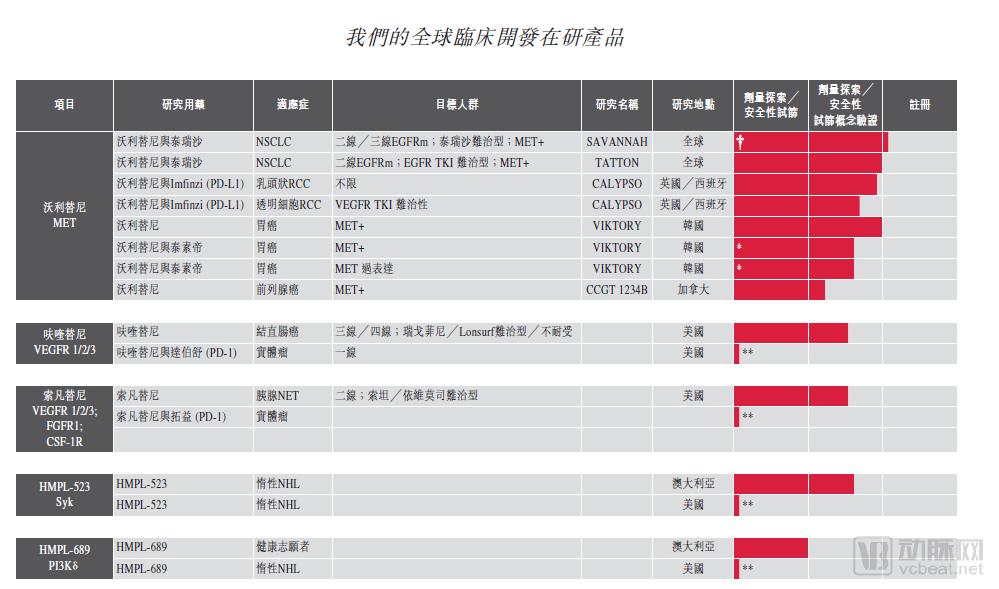
Hutchmed’s global clinical drug development pipeline also includes savolitinib, fruquintinib, surufatinib, HMPL-523, and HMPL-689, which have the potential to become first-in-class or best-in-class therapies.
Savolitinib, co-developed by Hutchmed and AstraZeneca, is a novel small-molecule targeted therapeutic agent. It acts as a highly selective inhibitor of the mesenchymal-epithelial transition factor (MET) receptor tyrosine kinase and is used in cancer treatment. Abnormal MET expression has been confirmed in various solid tumors. Hutchmed has addressed the nephrotoxicity associated with savolitinib, which has been the primary reason for the discontinuation of other selective MET inhibitors. To date, more than 900 patients have received savolitinib in clinical trials, demonstrating significant efficacy in patients with lung, renal, gastric, and prostate cancers harboring MET gene mutations.
Fruquintinib is a highly selective and potent small-molecule inhibitor of the three vascular endothelial growth factor receptors (VEGFR-1, -2, and -3), independently developed by Hutchison Medipharma with full intellectual property rights. It is also China’s first approved Class 1.1 new drug. Based on current preclinical and clinical data, fruquintinib’s kinase selectivity has been confirmed to reduce off-target toxicity, facilitating adequate dosing to achieve complete inhibition of VEGFR. Fruquintinib has been approved in China for the treatment of third-line metastatic colorectal cancer.
Surufatinib (HMPL-012) is a novel small-molecule chemical compound with global patents, independently developed by Hutchison MediPharma.
Surufatinib is a selective tyrosine kinase inhibitor targeting vascular endothelial growth factor receptors (VEGFR) and fibroblast growth factor receptors (FGFR). Preclinical studies have demonstrated its efficacy in inhibiting tumor angiogenesis. Currently, inhibition of tumor angiogenesis represents one of the important therapeutic strategies for cancer treatment. Preclinical results not only indicate that surufatinib potently inhibits angiogenesis, but also show good tolerability in animal models, suggesting a favorable therapeutic safety window.
HMPL-523 is a highly selective, oral inhibitor targeting spleen tyrosine kinase (Syk), indicated for the treatment of hematologic malignancies and certain chronic immune diseases, such as rheumatoid arthritis. HMPL-523 exhibits unique pharmacokinetic properties, with higher drug exposure levels in tissues affected by rheumatoid arthritis and hematologic malignancies compared to whole blood.
Hutchmed is conducting multiple clinical trials of HMPL-523. Based on its Phase I/Ib proof-of-concept clinical data from China and Australia, Hutchmed plans to simultaneously initiate clinical development in the United States and Europe in 2019, focusing on the treatment of various subtypes of indolent non-Hodgkin lymphoma.
HMPL-689 is a novel, highly selective, and potent small-molecule inhibitor targeting the PI3Kδ isoform. Designed by Hutchmed, HMPL-689 exhibits higher selectivity for the PI3Kδ isoform with no inhibition of other kinases, thereby minimizing the risk of severe infections associated with immunosuppression. Its selectivity also makes it well-suited for potential combination therapies. The high potency of HMPL-689, particularly its performance in whole blood assays, allows for reduced daily dosing to minimize compound-related toxicity.
Hutchmed is conducting early-stage clinical trials of HMPL-689. Based on its Phase I/Ib proof-of-concept clinical data from China and Australia, Hutchmed plans to simultaneously initiate the development of this candidate drug in the United States and Europe in 2019, focusing on the treatment of multiple subtypes of indolent non-Hodgkin lymphoma.
HUTCHMED Financial Data
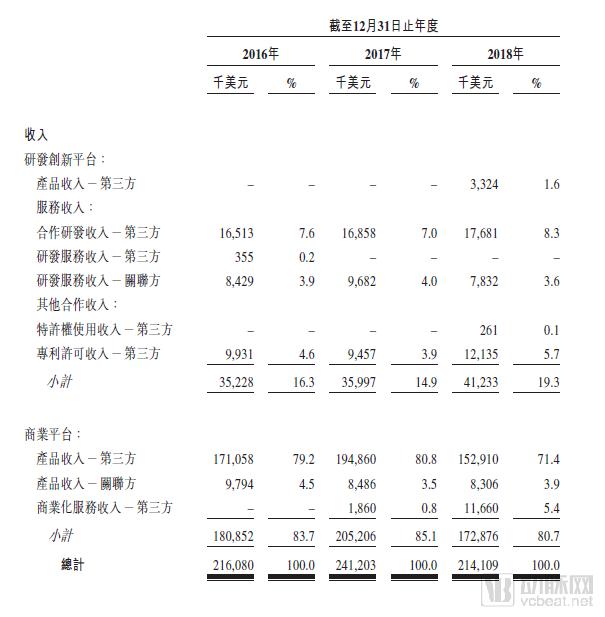
From 2016 to 2018, Hutchison China MediTech (HCM) reported revenues of $216 million, $241 million, and $214 million, respectively; operating losses of $46.7 million, $53.42 million, and $92.64 million, respectively; and net profits attributable to parent company shareholders of $11.698 million, -$26.737 million, and -$74.805 million, respectively. R&D expenditures in 2019 ranged from $160 million to $200 million; compared with the company’s revenue in 2018, these elevated R&D costs were the primary driver of the losses.
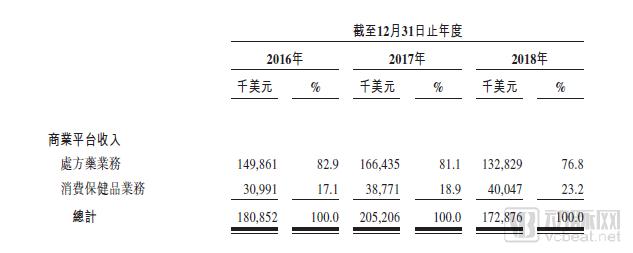
In addition to its R&D and innovation platform, the company has established a profitable commercial platform in China. Many of the pharmaceutical products sold through this commercial platform are well-known household brands or hold significant market share. The platform focuses on the marketing and distribution of prescription drugs and consumer health products, which together constitute the company’s commercial platform.
As of December 31, 2018, the Company’s prescription drug joint ventures with Shanghai Pharmaceuticals and Sinopharm Group Co., Ltd. jointly operated a network comprising approximately 2,500 prescription drug sales representatives, covering more than 24,900 hospitals in over 320 cities across China. Leveraging this extensive network, the joint ventures—Shanghai Hutchison Pharmaceuticals and Sinopharm Huanghe—held distribution rights for several key prescription drugs in China, including Shexiang Baoxin Pills (a well-known domestic oral vasodilator and pro-angiogenic agent), Seroquel (a leading antipsychotic medication), and Concor (one of the leading cardiac β-1 blockers in China). For the years ended December 31, 2016, 2017, and 2018, the commercial platform generated revenues of US$180 million, US$210 million, and US$170 million, respectively.
As indicated in the list of the Company’s principal shareholders and controlling shareholders, Cheung Kong Holdings holds interests in 60.2% of the issued shares through CK Hutchison Global Investments Limited, Hutchison Whampoa China, and HHHL. Ultimately, Cheung Kong Holdings indirectly controls 60.2% of the Company’s equity.
The proceeds will be used to advance the late-stage clinical programs of savolitinib, fruquintinib, and surufatinib through registration trials and potential submission of New Drug Applications; to advance the Company’s clinical programs into registration studies in both global markets and China; to support further proof-of-concept studies; to support research on combination therapies of fruquintinib and surufatinib with checkpoint inhibitors, including pursuant to various collaboration agreements entered into by the Company in November 2018; to fund the continuous expansion of the Company’s oncology and immunology product portfolio through internal research; and to further build a sales team focused on oncology, in order to commercialize drugs developed on the Company’s R&D innovation platform upon their approval for sale in China.