

Major Pharma Giants and Biotech Startups Converge on Biomolecular Condensates as a Novel Therapeutic Frontier
In our previous articles, we provided a detailed overview of the developments in the field of membraneless organelles over the past decade. Since the first report on the fluid-like properties of membraneless organelles was published in 2009, an increasing number of their biophysical characteristics have been uncovered. Meanwhile, extensive literature has demonstrated that the formation and disassembly of membraneless organelles are closely linked to neurodegenerative diseases, cancer, and other pathological conditions.
Driven by the unique properties of membraneless organelles, startups have begun to enter this field, while major multinational pharmaceutical companies are closely monitoring its progress. However, as the field advances, the complex underlying mechanisms of membraneless organelles make it difficult for researchers to reach definitive conclusions. Investigating these intricate mechanisms requires more advanced and sophisticated technical approaches.
Drug developers have begun to take note of this. Dewpoint Therapeutics, founded in January, is the first company to publicly bet on this field. Other startups have yet to go public. Large pharmaceutical companies are also keeping a close watch. “This is a very interesting area of fundamental biology. We hope to gain a deeper understanding of the role these structures play in disease and how they can be leveraged for therapeutic intervention,” said Jason Imbriglio, a researcher at Merck & Co. Merck recently co-hosted a New York Academy of Sciences workshop focused specifically on membraneless organelles.
Mark Murcko, CSO of Dewpoint, added that there are enormous opportunities lurking in this field. “As we gain an understanding of how these condensates function, we can revisit previously targeted molecules that garnered significant attention but failed to yield approved drugs. We can ask ourselves, ‘Now that we have this entirely new perspective, can we approach the target differently to make it more tractable?’”
Many unresolved issues remain for researchers to consider. What happens if potential drug targets are sequestered within biomolecular condensates? Can drugs diffuse into these membraneless organelles and exert their intended effects? Furthermore, could small molecules cause unintended detrimental effects on the formation and disassembly of condensates?
“It’s not as profound as cosmology, but there are still many unknowns,” said Cliff Brangwynne, a biophysical engineer at Princeton University. It was his work that sparked interest in liquid-liquid phase separation and membraneless organelles.
“You don’t want to turn your back on these things and ignore them, because they will likely continue to lurk quietly behind you,” added Derek Lowe, a medicinal chemist at the Novartis Institutes for BioMedical Research, who is also closely monitoring this field.
In terms of drug development programs, oncology offers the most direct pathway for application. While medicinal chemists may struggle to restore the delicate balance of condensate formation in neurodegenerative conditions, they can instead focus on disrupting this system to kill cancer cells. “To be honest, as a medicinal chemist, I’m not particularly proud of this. But it is indeed easier to destroy something than to make it better. If you simply want to throw a monkey with a wrench into the condensate system to wreak havoc, then oncology is exactly where you want to be,” said Lowe.
Taylor noted that, in addition to neurodegenerative diseases and cancer, infectious diseases and autoimmune disorders also warrant attention. For instance, pathogens causing infectious diseases can exploit biomolecular condensates to facilitate their replication cycles, and phase transitions appear to influence signal transduction processes that regulate innate immunity. He stated, “Although the evidence in these areas is not yet as robust as that for neurodegenerative diseases and cancer, I believe it is gradually emerging.”
Some researchers still have questions. Can studies conducted with purified condensates in in vitro systems also be replicated in in vivo models? Is there a direct causal relationship between these condensates and disease? Furthermore, could condensates merely be a biophysical phenomenon without genuine functional significance, rather than important cellular structures?
Hyman and Rosen in2017In a review article on membraneless organelles, the authors cautiously described the research findings to date: “In most cases, we do not yet understand what unique biochemical or cellular functions such structures actually perform,” they wrote with their colleagues. “The phenotypes resulting from disruption of these condensates are quite subtle. We have also not yet discovered that these structures play an essential role in the survival of cells or organisms.” In other words, this field is still in its infancy.
Yet Taylor is convinced of the pathological significance of condensates, although he also acknowledges that drug development based on this new model remains fraught with difficulties: “We are in an awkward position where the concepts and principles are clear, but the precise targets remain ill-defined.”
Meanwhile, he outlined two major directions for future research. On one hand, researchers can capture small molecules that bind directly to the proteins constituting biomolecular condensates. These small molecules may influence the ability of these proteins to form condensates by affecting their stability. However, there have long been few studies on small-molecule binding to intrinsically disordered regions (IDRs) of proteins.
On the other hand, researchers can start with the upstream regulatory mechanisms of condensates. ATPases, helicases, and ubiquitin ligases—proteins that control post-translational modifications of condensate component proteins—seem to be crucial for liquid-liquid phase dynamics. However, whether there is a target that only affects disease-related components remains debatable. It is also unclear whether redundant regulatory mechanisms will complicate the issue.
Dewpoint has been striving to keep an open mind. “Given that only specific condensates targeting specific molecules can address specific therapeutic contexts, pursuing a comprehensive development strategy is the most valuable option for us,” said Murcko.
He added that, in fact, everything related to IDRs—from kinases to transcription factors—was already laid out on his desk. Murcko has maintained a folder on his computer containing literature on IDR-containing disordered proteins for over 15 years. “Every time I came across a paper on this topic, I would read it and then feel frustrated, because I truly couldn’t figure out what these proteins were actually doing,” said Murcko, who has leveraged protein structure to design better drugs throughout his career. “Now, for the first time, we have gained some clarity regarding the actual functions of these IDRs.”
Efforts to identify small molecules that can bind to intrinsically disordered regions (IDRs) are still progressing slowly. “It’s incredibly difficult,” said Lowe, “so challenging that it can make a man tremble with fear.” Nevertheless, Murcko noted that there is still some data to remain optimistic about. For instance, in 2016, researchers identified a small-molecule candidate capable of binding to the IDR of the androgen receptor.
Regardless of the direction drug researchers choose to pursue, they require a diverse array of tools to accomplish these tasks. They must not only be able to investigate the protein components and biophysical properties of condensates individually but also employ advanced imaging techniques to capture small molecules within relevant cells that regulate these processes.
“Unless you have truly and carefully considered the various technical approaches to addressing these issues, you will find yourself in a world rife with harm, plagued by erroneous readings, counterfeits, and outright failures,” said Murcko.
New technologies such as cross-linking mass spectrometry have been employed to investigate how variations in individual amino acids within condensate components affect protein structure. High-resolution imaging can also be utilized to visualize the formation of membraneless organelles and to capture small molecules that perturb these dynamics. Nevertheless, this field still requires more advanced and robust technologies.
Hyman pointed out that more work needs to be done using the Bouillon microscope to evaluate the material properties of intracellular condensates, such as determining whether the condensates are liquid-like or gel-like.
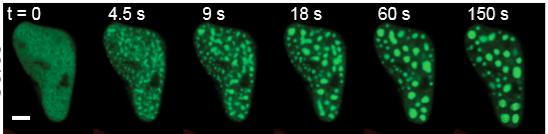
Figure 1: Formation process of membraneless organelles induced by blue light
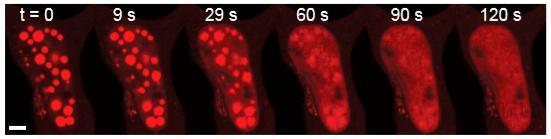
Figure 2: Disassembly process of membraneless organelles after cessation of blue light irradiation
Image source: Dan Bracha, Mackenzie T. Walls, et al. Mapping Local and Global Liquid Phase Behavior in Living Cells Using Photo-Oligomerizable Seeds. Cell 175, 1467–1480 (2018).
Brangwynne is now focused on developing optogenetic tools that can control the formation of intracellular condensates. In his research, he fuses the intrinsically disordered regions (IDRs) of condensate components with light-dependent oligomerization domains from other proteins to create fusion proteins. By illuminating cells expressing these fusion proteins, researchers can force the fusion proteins to cluster, thereby inducing condensate formation (Figure 1). After illumination ceases, the formed condensates gradually disassemble (Figure 2). Building on Brangwynne’s work, Taylor developed another technique, an alternative method for inducing the assembly of membraneless organelles.
“No one is truly quantifying the rules that govern the internal organization of our cells. They simply observe small droplets and label it as phase separation. I find this quite dangerous,” said Brangwynne. “The power of this technique lies in its ability to quantitatively map phase diagrams in living cells.”
These tools should help researchers elucidate the functions of biomolecular condensates. For drug developers seeking small-molecule therapeutics capable of modulating condensates, these tools can facilitate the assessment of whether such molecules affect phase separation processes within cells.
Brangwynne is commercializing its tools for applications in therapeutics and drug discovery. He noted that both investors and biotechnology companies have shown strong interest. In this context, he quoted the late Nobel laureate Sydney Brenner to underscore the importance of tool development: “Scientific progress depends on new technology, new discoveries, and new ideas—and in that order.”
Drug developers have never definitively known the precise intracellular localization of a small molecule after it enters a cell, nor how it locates its freely floating targets within the chaotic cytoplasm. These new insights into the principles of cellular organization now suggest that the process may be more complex than previously anticipated.
“You not only need to track your compounds within cells, but you must also trace them to such minute locations that you require the most advanced imaging techniques to convince yourself they truly exist,” said Lowe.
While conducting their work, researchers have been contemplating the implications of these findings for drug discovery. Which therapeutic targets can be identified within membraneless organelles? If feasible, how do biomolecular condensates directly or indirectly modulate the activity of various signaling pathways? Do small molecules permeate these structures, and does this influence their efficacy? Can small molecules effectively regulate the formation and function of condensates? Given the transient nature and minute size of membraneless organelles, these questions are not easily answered.
In addition, this new field may also pave the way for a novel approach to toxicity testing. “My personal view is that as the field matures, no candidate drug should enter clinical trials lightly unless pharmaceutical companies have fully elucidated the impact of the candidate drug on cellular condensates,” said Murcko.
Like many emerging fields, this industry presents drug developers with a precarious situation where opportunity and risk coexist. “It’s like trying to catch a falling knife,” said Lowe. “Before you pick it up, you might want to let it hit the floor and vibrate for a second. But you don’t want to sit around for too long, watching others snap up all the best opportunities.”
Original article link:https://www.nature.com/articles/d41573-019-00069-w
Cover image source: Susanne Wegmann, Bahareh Eftekharzadeh, et al. Tau protein liquid–liquid phase separation can initiate tau aggregation.The EMBO Journal(2018).