

Billion-Dollar Rehabilitation Medical Device Market Survey: Department Revenue Constraints Limit Industry Growth, IoT-Enabled Equipment Emerges as Key Direction
Core Viewpoints
1. The market size of medical rehabilitation equipment and ward nursing equipment in China ranges from RMB 20 billion to RMB 30 billion, with an annual growth rate of 15–20%.
2. Reimbursement capacity under medical insurance is the primary driver behind the expansion of the rehabilitation industry market, and the overall development of the rehabilitation equipment sector is closely tied to this factor. Specifically, for rehabilitation hospitals or rehabilitation departments, their performance depends on the operators rather than the departments themselves.
3. Rehabilitation equipment manufacturers have weak brand awareness, and the industry has not yet formed a situation where one company dominates.
4. The IoT integration of rehabilitation robots and rehabilitation equipment has become a key R&D direction for future products. Many companies are complacent with the status quo, investing minimally in R&D funding and personnel.
5. The product sales model is not suitable for the Chinese rehabilitation market; providing holistic solutions and appropriate personnel training for rehabilitation departments better meets their needs.
Compared with medical devices, the industrialization of rehabilitation equipment has progressed at a much slower pace. Characterized by “broad product categories but niche markets,” the rehabilitation equipment sector exhibits generally low industry concentration, and no publicly listed company currently derives its primary business from rehabilitation equipment.
With a market size in the tens of billions, the sector still lacks a dominant leader. According to VCBeat, top manufacturers whose core business is rehabilitation equipment report annual revenues between RMB 100 million and RMB 500 million, significantly lagging behind larger medical device companies. What challenges have hindered the growth of rehabilitation equipment firms? Why has no industry giant emerged yet? Is the sector truly on the verge of explosive growth? VCBeat seeks to answer these questions.
Rehabilitation Department Construction Drives the Development of Rehabilitation Equipment
In recent years, guided by national policies, the development of rehabilitation hospitals and rehabilitation departments has entered a fast track. Policies encourage secondary hospitals to rationally layout medical institutions such as rehabilitation hospitals, geriatric hospitals, nursing homes, and hospice care through transformation or new construction, while increasing policy and financial support for the development of related industrial chains. At the same time, it is emphasized that hospitals at the secondary level and above must establish rehabilitation departments.
Meanwhile, the demand for rehabilitation equipment is closely tied to hospital investment.Establishing a rehabilitation department in a secondary hospital requires approximately RMB 3 million to 5 million, while a tertiary hospital requires RMB 10 million.. Hospitals at the secondary level and above are required to establish rehabilitation departments. Considering the untapped market and the need for certain hospitals with existing rehabilitation departments to strengthen their capabilities, it is estimated that approximately 5,500 hospitals across China need to build or improve their rehabilitation departments (in 2018, there were 2,433 tertiary hospitals and 8,056 secondary hospitals in China; calculating based on 50% of these requiring department construction yields approximately 5,500 hospitals). With an average investment of RMB 4 million per hospital, the market size for rehabilitation equipment ranges from RMB 20 billion to RMB 30 billion.
According to calculations by multiple medical device industry practitioners based on the revenue scales of various companies, the rehabilitation equipment industry is indeed valued between RMB 20 billion and RMB 30 billion.
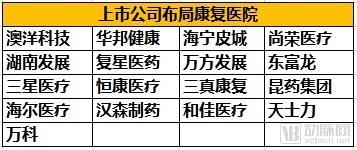
In addition to public hospitals, private capital is also establishing rehabilitation hospitals.According to VCBeat, a total of 17 listed companies have invested in rehabilitation hospitals with varying levels of capital commitment, and the construction of these hospitals has driven an increase in medical device sales.。
With the growing public awareness of rehabilitation, speech therapy centers, postpartum recovery centers, and community-based rehabilitation facilities are increasingly emerging alongside traditional medical institutions, driving a continuous rise in demand for related supporting equipment.
Support from Local Governments and Disabled Persons' Federations
Just as it prioritizes financial assistance for critical illnesses, the government has also begun to support rehabilitative medical care and its consumption through health insurance and specialized policies.
Beijing has included 20 rehabilitation items, such as “comprehensive rehabilitation assessment,” in its medical insurance coverage; Shanghai’s Human Resources and Social Security Bureau has added 20 new rehabilitation items to the basic medical insurance scheme; and Tianjin has incorporated 67 rehabilitation medical services into its medical insurance program.Since 2016, when various regions began incorporating selected medical rehabilitation services into the coverage of basic medical insurance, rehabilitation has become increasingly widespread, indicating substantial room for growth in China’s rehabilitation medical device industry.
The “Localization of Medical Equipment” initiative proposed by the central government undoubtedly carries significant strategic and tactical implications for the research and development, manufacturing, and market sales of domestically produced medical equipment.。
Revenue in the rehabilitation sector limits the overall development of the rehabilitation industry
Traditional rehabilitation techniques, such as neurological rehabilitation, orthopedic rehabilitation, sports rehabilitation, and speech therapy, have reached a plateau, with no breakthrough technologies driving rapid advancements in these specialties in recent years. However, thanks to the expansion of rehabilitation departments, cardiac rehabilitation centers, stroke centers, and speech therapy clinics in recent years, many hospitals have established rehabilitation departments from scratch, leading to sustained growth in the sales of related equipment.
However, the establishment of rehabilitation departments under many policy mandates is not initiated by hospitals themselves; consequently, financial investment in equipment procurement and talent development remains limited.Therefore, most of the equipment in rehabilitation departments consists of simple and affordable devices. A rehabilitation physician who has long worked at a county-level people’s hospital told VCBeat that the approval process for introducing a set of rehabilitation equipment costing more than RMB 500,000 is extremely lengthy and not guaranteed to be approved.
In addition, regarding investment in rehabilitation equipment, establishing a rehabilitation department in a secondary hospital requires approximately RMB 3–5 million, while a tertiary hospital requires RMB 10 million. Substantial space is also needed, leading to significant variations in the willingness and approach of different hospitals toward developing their rehabilitation departments.
Xu Changjun, founder of Julu Medical, stated that although rehabilitation is referred to as one of the “Four Major Medicines” alongside prevention, medical treatment, and healthcare, inIn China’s medical philosophy and healthcare system, rehabilitation has not received the attention it deserves. On one hand, patients often lack awareness of rehabilitation or have limited financial capacity; on the other, insurance coverage for rehabilitation falls far short of that provided to clinical specialties. Although 29 rehabilitation services were included in the national medical insurance scheme in 2016, this represents only an initial step. Many domestic medical concepts remain focused on saving lives rather than restoring patients’ ability to live and work.。
The above two reasons lead toRehabilitation departments and centers generate low revenue, often lacking income streams and receiving insufficient attention. Consequently, most hospitals lack the financial capacity to purchase expensive rehabilitation equipment. With buyers unable to afford high-cost devices, manufacturers cater to market demand by offering products that appear more “entry-level.” These “entry-level” rehabilitation devices find significant market acceptance during the initial stages of rehabilitation department development.。
Furthermore, the quality of rehabilitation services largely depends on the competence and experience of rehabilitation physicians. A significant portion of the funds and efforts of rehabilitation-related departments and rehabilitation centers must be allocated to personnel training, which in turn consumes part of the budget earmarked for rehabilitation infrastructure development.
Fortunately, in recent years, the state has introduced policies and funding to develop rehabilitation-related departments and centers. In particular, the gradual tilt of medical insurance coverage toward rehabilitation has significantly accelerated the growth of the rehabilitation industry. We must recognize that Rome was not built in a day; the state cannot shift medical insurance resources to rehabilitation on a large scale all at once, but must proceed step by step, as diagnosis and treatment, prevention, and healthcare services must also be maintained.
In recent years, as physicians have received increasing training in rehabilitation medicine, greater emphasis has been placed on rehabilitative care. Since patients primarily follow medical advice during their healthcare journey, patient awareness of rehabilitation has gradually strengthened. Even in the absence of comprehensive insurance coverage, patients with sufficient financial means continue to adhere to medical recommendations and undergo necessary rehabilitation training.
Only with increased payment amounts can the relevant industrial chains, including rehabilitation equipment, achieve more sustainable long-term development.
Rehabilitation Market Landscape
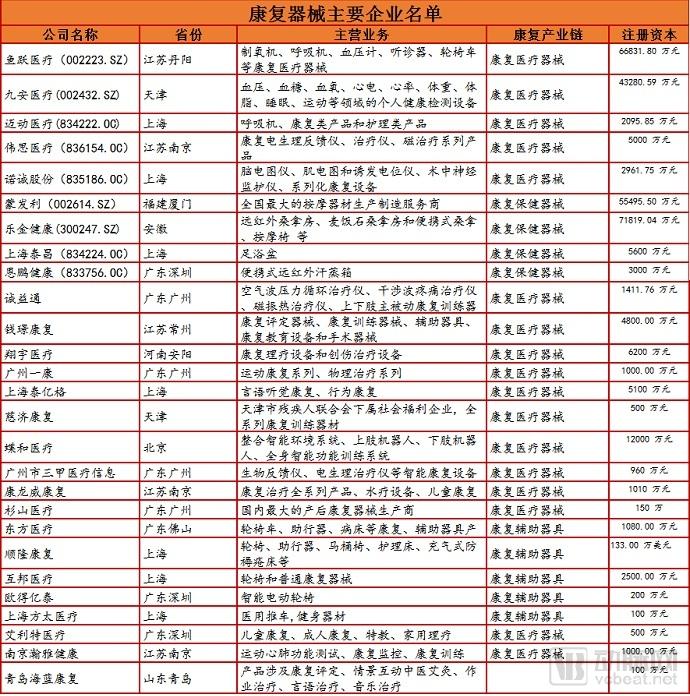
Chuancai Securities once released a report stating that rehabilitation equipment products require substantial financial investment and extended incubation periods during the research and development, market launch, and promotion stages. Given the industry’s characteristic of offering diverse product varieties in small batches, achieving economies of scale typically necessitates a prolonged accumulation process. Industry leaders benefit from advantages such as established economic scale and integrated upstream and downstream supply chain support.
Data Source: Chuancai Securities, VCBeat Database
Agency companies for high-end products from foreign manufacturers can be provided.
Although rehabilitation equipment has largely achieved domestic production, some devices still need to be imported.
The research and development (R&D) of medical devices requires substantial capital investment. However, the annual revenues of leading domestic rehabilitation device enterprises mostly range between RMB 100 million and RMB 500 million. Some of these manufacturers can survive and achieve sustained growth by merely producing equipment that meets the basic needs of hospital construction, resulting in insufficient capability and willingness to develop high-end rehabilitation devices. Consequently, Chinese rehabilitation device companies have limited involvement in the high-end rehabilitation equipment sector.
The absence of domestic manufacturing does not imply a lack of demand within Chinese hospitals. Although China’s overall rehabilitation industry lags behind, it is home to top-tier rehabilitation institutions such as the China Rehabilitation Research Center, Guangdong Provincial Work-Related Injury Rehabilitation Hospital, The First Affiliated Hospital of Chongqing Medical University (Rehabilitation Hospital), and Xiangya Bo’ai Rehabilitation Hospital. These institutions have a strong demand for high-end rehabilitation equipment.
It is precisely due to this demand that many agencies representing foreign brands have emerged in China, such as Diehe Medical, which is responsible for introducing advanced rehabilitation equipment from abroad.
Two Directions for Rehabilitation Equipment Products
According to VCBeat, most leading domestic rehabilitation equipment companies have annual revenues ranging from RMB 100 million to RMB 500 million. Ambitious enterprises invest more than 10% of their revenue in product research and development.In addition to the R&D of entry-level products, the IoT integration of rehabilitation robots and rehabilitation devices has emerged as two major strategic directions.。
First:Digitalization and IoT Integration of Medical Devices. The speed and quality of rehabilitation outcomes depend critically on the role of rehabilitation therapists, who are responsible not only for conducting assessments but also for developing rehabilitation plans, guiding patients through training, and adjusting the plans based on therapeutic progress.
These roles place high demands on rehabilitation therapists, particularly in technically demanding areas such as cardiopulmonary rehabilitation.The IoT connectivity and digitalization of medical devices enable rehabilitation therapists to more accurately monitor patients' physical conditions and deliver more precise rehabilitation plans.
Ma Yong, founder of Elite, told VCBeat,Applying IoT Technology to the Medical Field: Enabling Broader Sharing of Limited Healthcare Resources Through Digitalization and Visualization。
IoT-Based Rehabilitation Information Management System: Ushering in the Era of Rehabilitation Cloud. The rehabilitation information management system creates a closed-loop cloud platform connecting comprehensive hospitals, rehabilitation hospitals, communities, and households, enabling rehabilitation training data sharing among rehabilitation institutions at all levels. This further improves the two-way referral system and stepwise technical guidance between tertiary hospitals, rehabilitation hospitals, and community institutions, achieving integration of assessment, training, and monitoring.
The application of Internet of Things (IoT) technology has also created new opportunities and therapeutic approaches for rehabilitation treatment. It can create a more engaging environment for rehabilitation training, thereby enhancing patients’ enthusiasm and initiative in participating in training, while achieving quantitative rehabilitation assessment, visualized training, and intelligent management.
Additionally,Following the IoT integration of rehabilitation equipment, rapid warranty services and swift software updates can be achieved. Meanwhile, IoT connectivity enables the tracking of product usage frequency, thereby facilitating the assessment of equipment suitability for specific departments and assisting enterprises in upgrading and iterating their device portfolios.。
Second:R&D of Rehabilitation RobotsIn its article titled “Billions in Rehabilitation Market Await Activation, Hundreds of Thousands of Talent Gap Call for ‘Iron Man’: When Will Exoskeleton Robots Become a Reality?” VCBeat pointed out that China’s rehabilitation medical industry is still in its early stages of development, facing substantial and urgent market demand from neurodegenerative diseases that impair mobility, such as stroke, cerebral palsy, and Parkinson’s disease.
Currently, there are 16 enterprises in China engaged in the research and development of rehabilitation robots, with most products being exoskeleton robots. Most of these companies collaborate with universities and hospitals, and many of their products have reached final design stages and are undergoing certification by the China Food and Drug Administration (CFDA).
Liu Lu, Product Manager at Qianjing Medical, told VCBeat that since 2008, Qianjing Rehabilitation has collaborated with multiple domestic universities and institutions, investing RMB 10 million in the research and development of a multi-position intelligent rehabilitation training robot. After five years of development and five iterations, the company successfully launched the Flexbot multi-position intelligent rehabilitation training robot, breaking the market monopoly previously held by foreign companies. The pediatric lower-limb robotic system can customize training programs of varying intensities based on patient needs, offering modes such as gait training, swing mode, and cycling mode.
TCM Physiotherapy and Rehabilitation Equipment
Rehabilitation and physiotherapy represent the integration of traditional Chinese medicine with modern healthcare technologies. It is a novel therapeutic approach that combines consultation, prevention, health maintenance, treatment, and rehabilitation for individuals in a sub-health state. By employing methods such as Traditional Chinese Medicine (TCM) tuina massage, acupuncture, cupping, gua sha, and physical therapy, it plays a pivotal role in health restoration for those with sub-health conditions and in post-chronic disease rehabilitation.
Driven by this market demand and national support for Traditional Chinese Medicine (TCM), sales of TCM rehabilitation and physiotherapy equipment remain substantial. To better preserve TCM heritage and introduce Western rehabilitation concepts to China, many hospitals have established rehabilitation departments and conducted research under the banner of integrated TCM-Western medicine specialty units.
New Sales Models for Rehabilitation Equipment
The traditional sales model, primarily based on product trading, faces certain challenges in the current rehabilitation sector.Many rehabilitation centers have been established, yet rehabilitation services have failed to take off despite significant investment in equipment, primarily due to insufficient emphasis on rehabilitation and a shortage of rehabilitation professionals.。
Currently, most rehabilitation therapists have considerable experience in neurological and orthopedic rehabilitation. However, there is a severe shortage of qualified professionals in fields such as cardiac rehabilitation and speech therapy, and the professional competencies of existing personnel urgently need improvement. Consequently, even when medical institutions acquire rehabilitation equipment, the implementation of rehabilitation programs proceeds very slowly. The pace at which these programs are implemented significantly influences healthcare institutions’ willingness to purchase rehabilitation devices.
From the perspective of industry development trends,The development of rehabilitation equipment suppliers in China has evolved from single products to product lines, and further to the provision of comprehensive solutions.,Comprehensive solutions that align with clear clinical needs and integrate closely with clinical departments have become a new profit growth driver for hospitals.。
While meeting the one-time procurement needs of hospitals, disabled persons’ federations, and other institutions to enhance customer stickiness, companies have also significantly improved their product sales efficiency. As a result, overall solution providers will become the mainstream in the industry in the future.。
For example, Julu Medical has independently developed management systems and products that address clinical needs, while also possessing the capability to deliver medical technical services and establish rehabilitation departments. By collaborating with professional societies, academic leaders, and top-tier tertiary hospitals in the field of cardiopulmonary rehabilitation, Julu Medical has established model cardiopulmonary rehabilitation programs that serve as training bases. It provides comprehensive solutions—including talent acquisition, systematic management pathways for cardiopulmonary rehabilitation, equipment, hardware facilities, operational plans, and staffing—to assist in the establishment of cardiopulmonary rehabilitation departments.
Talent development is the core of rehabilitation department construction. Therefore, rehabilitation equipment manufacturers enhance customer stickiness and drive sales by assisting in talent training and departmental development for rehabilitation departments.
Four Key Factors That Make Rehabilitation Equipment Stand Out
Xu Baoguo, Vice President of the Chinese Greater Bay Area Rehabilitation Medicine Association and Deputy General Manager of Zhuhai Heima Medical Instrument Co., Ltd., told VCBeat that against the backdrop of serious homogenization in current rehabilitation products, companies must have their own unique features to stand out.
1、Shaping Brand CompetitivenessCurrently, rehabilitation equipment manufacturers suffer from severe product homogenization and lack core competitiveness, with disparities largely manifested in distribution channels. While ensuring product quality, companies should intensify promotional efforts and develop products tailored to customers’ specific needs. By addressing diverse psychological demands through tangible aspects such as composition, performance, naming, trademarks, packaging, and pricing, they can demonstrate uniqueness and innovation, thereby gradually establishing their corporate brand in the market.
2、Customization Capabilities to Meet Customer Needs. R&D innovation has always been the driving force for the long-term development of enterprises. Only by continuously increasing investment in R&D talent, accumulating a pool of experienced, highly innovative, and design- and application-oriented technical professionals, and developing products with strong market competitiveness can companies sustain rapid growth and secure a favorable position in market competition. Among these factors, the ability to meet customers’ customized needs is particularly crucial.
3、Clear Judgments on the Future of Rehabilitation Medicine and Healthcare Reform. For instance, the previous reimbursement model in the rehabilitation department was fee-for-service, whereas the future reform direction will shift toward value-based payment tied to rehabilitation outcomes. A thorough grasp of this future trajectory can help enterprises maintain a solid footing amidst upcoming changes.
4、Improve the Marketing Service Network. Domestic enterprises can leverage mature marketing and service networks to rapidly capture market share and promote new products. A comprehensive marketing and service network is a powerful means for enterprises to seize target markets, expand market share, and enhance regional influence, helping to realize economies of scale in product sales, market promotion, and customer service.
In addition, Xu Baoguo also told VCBeat that the marketing of rehabilitation equipment has entered a customer-centric customization era, namely the 4.0 era of rehabilitation marketing.
In the 1.0 era of rehabilitation marketing, which was product-centric, products were the determining factor due to the prevailing scarcity of offerings at that time;
In the 2.0 era of rehabilitation marketing, products are relatively abundant, with pricing as the core focus and the decisive factor;
In the 3.0 era of rehabilitation marketing, products and prices have become severely homogenized; academic excellence is the key to corporate differentiation, making it the decisive factor.
In the 4.0 era of rehabilitation marketing, products, pricing, and academic content have become severely homogenized; therefore, customer-centric customized services are key, making customization the critical factor.
Enterprises must create new value for customers in line with the progress of the times to achieve sustainable development.