

Gilead Invests $1 Billion to Accelerate NASH Drug Development, Aiming for First-to-Market Therapy
Author: VCBeat New Medicine
VCBeat (biobeat1) has learned that on April 16, 2019, Gilead and insitro announced a strategic collaboration to develop therapeutic solutions for patients with non-alcoholic steatohepatitis (NASH).
The two companies signed a three-year, $1 billion collaboration agreement. Under this agreement, Gilead will leverage insitro’s artificial intelligence platform to create disease models for non-alcoholic steatohepatitis (NASH), develop therapeutic regimens, and identify targets that facilitate clinical progression and disease regression. As part of this collaboration, Gilead will gain access to up to five newly identified targets and retain the rights to conduct further research and development on these targets.
“Through this collaboration, we will gain a deeper understanding of the biological basis and clinical spectrum of NASH, with the ultimate goal of accelerating the development of highly effective treatments for patients with NASH,” said Dr. John McHutchison, Chief Scientific Officer and Head of Research and Development at Gilead.
Insitro is an artificial intelligence company dedicated to building predictive models that accelerate target screening and drive therapeutic design by generating high-throughput functional genomics datasets consistent with patient data and interpreting these data through novel machine learning methods. Gilead’s move clearly aims to harness the power of machine learning to accelerate its research processes and reduce the risk of clinical trial failures.
From the perspective of the transaction price, it must be said that Gilead has made a significant investment. Gilead will pay an upfront fee of $15 million and up to $35 million in near-term milestone payments. For the five targets mentioned above, Gilead has also agreed to pay Insitro up to $200 million per target for preclinical, development, regulatory, and commercialization milestones. In addition, Insitro will be eligible to receive tiered royalties of up to double-digit percentages on net sales of the corresponding products. For projects in which Insitro elects to participate, it will have the right to co-develop in the United States, share in profits in China, and receive milestone payments and license fees from sales in countries other than the United States.
This is not Gilead’s first transaction in the NASH field. Between 2015 and 2018, Gilead expanded its NASH pipeline through the acquisitions of Phenex, Nimbus Therapeutics, and Scholar Rock. Not counting clinical trials, Gilead has already invested over $4 billion solely in acquiring NASH pipeline assets.
In less than 40 years since its founding, the company has risen to become one of the top 10 pharmaceutical companies globally, a feat largely attributable to its blockbuster hepatitis C drug, Sovaldi (sofosbuvir). Launched in the U.S. in December 2013, the drug generated an astonishing $5.8 billion in sales during the first half of 2014. This success rapidly solidified Gilead’s position as a leader in the field of liver disease.
However, after enjoying short-term benefits, Gilead quickly realized that matters were not so simple. Upon its market launch, Sovaldi became the focus of the industry, and its pricing of $84,000 per course of treatment ($1,000 per tablet) sparked widespread controversy. Furthermore, as Sovaldi can cure hepatitis C, the target patient population continued to shrink, leading to a decline in Sovaldi’s sales.
In 2017, Gilead’s total revenue from its hepatitis C business was $9.137 billion, a decrease of $5.697 billion compared to 2016. In 2018, sales revenue from the hepatitis C business amounted to $3.584 billion, slightly surpassed by AbbVie ($3.516 billion). The once-blockbuster drug Sovaldi has fallen to the point where its sales figures are no longer disclosed separately (reported together with Cayston and Hepsera at a combined $320 million), nearing its exit from the spotlight.
Wall Street and Gilead Sciences shareholders have long hoped that the company would leverage its cash reserves to pursue large-scale acquisitions, thereby injecting new vitality into the business and revitalizing sales growth. In 2017, Gilead’s $11.9 billion acquisition of Kite Pharma was likewise aimed at diversifying its revenue streams beyond its liver disease franchise.
Judging from Gilead’s series of mergers, acquisitions, and transactions in recent years, the company has placed greater bets on the treatment of non-alcoholic steatohepatitis (NASH).
Non-alcoholic steatohepatitis (NASH) is a common chronic liver disease; however, if left untreated, it can progress to severe hepatic fibrosis, ultimately leading to cirrhosis or cancer. Data from the U.S. National Center for Health Statistics indicate that approximately 2–5% of Americans have non-alcoholic steatohepatitis (NASH), while an additional 10–20% exhibit fat accumulation in the liver (hepatic steatosis). It was projected that by 2020, NASH would surpass hepatitis C as the leading indication for liver transplantation. Furthermore, no drugs have been approved globally for the treatment of NASH.
ResearchAndMarkets predicts that the global market share for NASH will reach $20.676 billion in 2025, with a staggering compound annual growth rate (CAGR) of 46.1% from 2017 to 2025. In recent years, numerous pharmaceutical giants have engaged in fierce competition in the field of NASH therapies. Facing a NASH market valued at up to $40 billion, Gilead Sciences naturally cannot afford to miss this opportunity.
Gilead has successively acquired three companies—Phenex, Nimbus Apollo, and Scholar Rock—and entered into an $800 million licensing agreement with the South Korean company Yuhan. Following this acquisition spree, Gilead now boasts the most comprehensive product pipeline in the NASH market, including exclusive priority rights to acquire global rights for three TGF-beta antibodies, one ASK-1 inhibitor, one ACC inhibitor, and one FXR agonist, while also developing multiple combination therapies based on these assets.
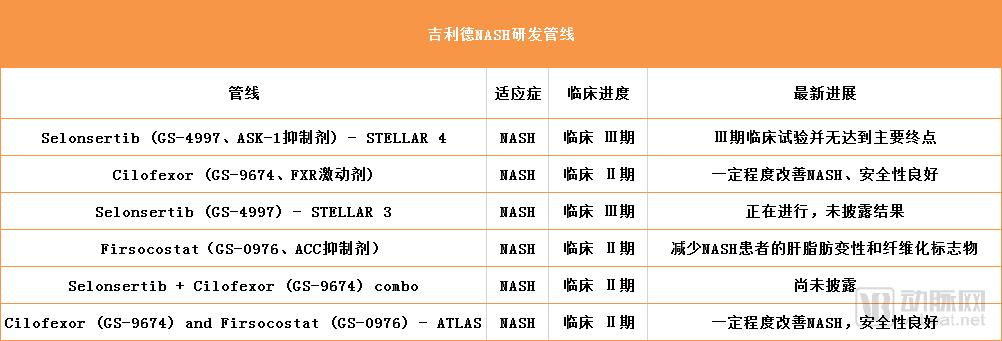
Among them, in patients receiving 20 mg of Firsocostat (GS-0976, an ACC inhibitor), 48% achieved a reduction in liver fat content of more than 30%. The combination therapy of “Cilofexor + Firsocostat” has entered Phase II clinical trials. Gilead presented multiple study datasets on the combined use of the non-steroidal FXR agonist Cilofexor and the ACC inhibitor Firsocostat at the annual meeting of the European Association for the Study of the Liver (EASL). The results showed that 74% of patients experienced a reduction in liver fat content of at least 30% from baseline after oral administration. Furthermore, after 12 weeks of combination therapy, the median levels of serum alanine aminotransferase and glutamyl transferase were relatively reduced by 37%, and bile acid synthesis was also decreased.
Another combination therapy product, combo (“Selonsertib + Cilofexor”), also announced its Phase II clinical trial progress at the Liver Meeting in San Francisco in November 2018. The results showed that, compared with placebo, 39% of patients experienced a reduction in liver fat content of more than 30%, along with significant decreases in serum γ-glutamyl transferase and pharmacodynamic markers of FXR activation. The drug was well tolerated by patients.
Of course, Gilead’s path in NASH has not been smooth either; the failure of its first NASH drug candidate in Phase III clinical trials dealt a significant blow to the company. On February 12, 2019, Gilead announced that selonsertib (GS-4997), an ASK1 inhibitor, had missed its primary endpoint in the first Phase III trial. In response to this news, Gilead’s stock fell 3.5% at market close on the same day.
Moreover, the intense competition in the NASH drug development market has placed significant pressure on companies, with the entry of competitors such as Novartis, BMS, and Pfizer making the market landscape increasingly unpredictable. According to BioMedTracker statistics, there are 48 NASH drugs currently in clinical trials worldwide, including 14 in Phase I, 30 in Phase II, and 4 in Phase III.
Gilead has assembled its NASH pipeline through multiple major acquisitions, including clinical-stage assets, and is now investing another $1 billion to equip itself with an “accelerator.” To some extent, the company is determined to secure the first-mover advantage in NASH therapeutics.