

Huazhuo Tech Emerges as a Rising Star in HIT with Android-like Hospital IT Platform, Files IPO Prospectus
In recent years, clinical systems centered on electronic medical records (EMR) have become a key focus of construction for tertiary hospitals in China. Against this backdrop, support systems related to clinical medical services, hospital management, and patient healthcare experience have become increasingly numerous and complex. Due to the lack of data interoperability among them, these systems stand like isolated “silos” within hospitals.
These “chimney projects” have made information silos the norm. To conduct scientific research and management, hospitals need to integrate and analyze data, forcing them to rely on vendors to open up “spider web”-style interfaces. Ultimately, the user experience for physicians can only be described as out of control.
In light of this situation, some leading enterprises in healthcare informatization have begun to explore next-generation hospital information systems. However, faced with established business models, these companies find it difficult to completely abandon their original system architectures. Internet giants have also attempted to disrupt the healthcare industry’s information systems through entirely new underlying technologies. Yet, as the saying goes, “interloping industries are worlds apart.” Such companies consistently lack experience in collaborating with medical institutions, leaving them no choice but to pin their hopes on partnerships with traditional healthcare informatization firms.
In 2018, a mysterious company named Huazhuo Technology emerged rapidly, gradually becoming the system builder and supplier for some of China’s top hospital groups by leveraging a new generation of hospital information systems based on hybrid cloud architecture. At the 2019 CHINC conference, the company was frequently praised by experts from hospital information departments.
In response, VCBeat conducted an exclusive interview with Li Tanwei, founder of Huazhuo Technology, to share insights on the development strategy and process of next-generation hospital informatization.
From Carriages to Automobiles
“To be honest, we have built a completely new technology architecture and restructured the hospital’s information systems,” Li Tanwei told VCBeat.
According to reports, building upon foundational technologies such as cloud computing, Huazhuo Technology has developed a healthcare business application marketplace. If hybrid cloud technology architecture transforms the way applications are developed and services are integrated, then the healthcare business application marketplace primarily changes how application systems are acquired. The combination of these two elements constitutes the final application layer, which directly impacts user experience—the aspect of greatest concern to hospitals.
“To use an analogy, both horse-drawn carriages and automobiles are means of transportation capable of traveling from Chongqing to Beijing. However, traveling by carriage would be significantly slower and offer a vastly different experience compared to driving a car. The most significant difference between them lies in their underlying technologies, which result in dramatically different user experiences. Although both serve as modes of transport, one belongs to the livestock industry, while the other is a product of industrial manufacturing,” said Li Tanwei.
According to his view, the current informatization in some hospitals has mostly addressed the paperless process of medical services, and there is still a long way to go to achieve true intelligence and smart capabilities.
“This can be seen as the stage of transitioning from walking to horse-drawn carriages. In light of current industry demands and development, we have been compelled to advance into an era where only automobiles, or even aircraft, can truly resolve the issues,” said Li Tanwei.
Next-Generation Hospital Information Architecture: Hybrid Cloud + Healthcare Microservices Marketplace
The service scenarios of healthcare institutions are undergoing significant changes. New service models, such as regional healthcare, medical consortia, and medical communities, have made cross-institutional collaboration among hospitals a future development trend. As hospital equipment becomes increasingly powerful and emerging technologies like genetic testing become more accessible to patients, the storage and computing environments in hospitals will face new challenges.
For hospitals, there are typically three solutions: one is to directly adopt public cloud managed services; another is to deploy a private cloud within the hospital; and the last is to place some core business operations on a private cloud while hosting customer-facing services on a public cloud, which is the hybrid cloud model currently adopted by Huazhuo Technology. Hybrid cloud enables hospitals to achieve nearly borderless storage and computing environments.
Li Tanwei stated that traditional cloud computing companies typically require around 100 devices to build a hybrid cloud environment for hospitals, entailing substantial investment.
Huazhuo Technology’s approach involves deploying a compact environment based on the hardware resources of a small cluster, enabling the establishment of a minimal operational setup with just eight servers in approximately ten minutes. With this hospital computing model, hospital IT departments no longer need to focus on traditional IT equipment and computer operations and maintenance, allowing them to redirect their attention to core business operations.
Is there a PaaS layer in the healthcare industry? The answer is: No!
Li Tanwei introduced that Huazhuo Technology’s medical hybrid cloud PaaS service is a first-of-its-kind innovation in China. It primarily encompasses foundational services such as databases and caching, driving innovations in computing and storage methodologies.
Furthermore, Huazhuo Technology has creatively proposed the concept of a medical microservices market. Similar to developer platforms like Facebook and WeCom, it enables application development based on numerous mature business modules.
For example, a company may have diverse business lines, each of which involves the finance and human resources (HR) departments. One approach is for each team to establish its own HR management model and financial standards, implementing distinct systems for recruitment, personnel management, and other related functions. An alternative approach is for the company to build a centralized HR center that empowers every business team. The company needs only to ensure that this center remains robust, continuously enhancing and upgrading its capabilities to meet the multifaceted needs of different business units. Huazhuo Technology’s microservices platform is built upon this very concept.
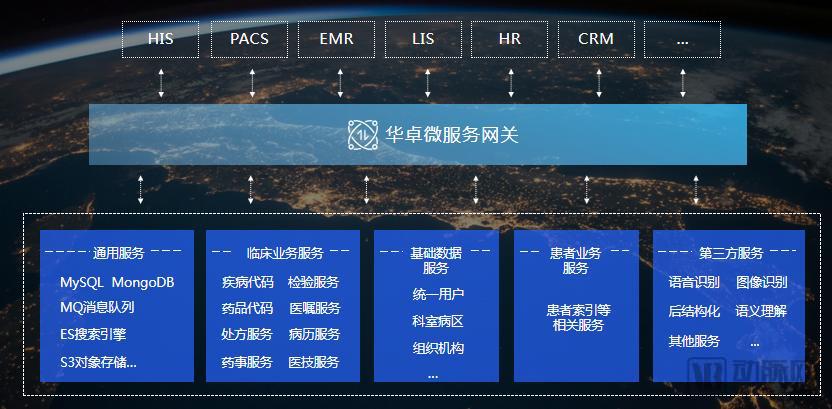
Currently, Huazhuo Technology has transformed the majority of general business modules in hospitals into microservices, such as Patient Master Index (PMI), disease codes, drug codes, medical records, and physician order services. In the future, if a hospital wishes to establish new business systems, such as a Disease Archive Management System, the process will be straightforward and clear. This is because Huazhuo Technology has already standardized information modules involving patients, departments, and medications as readily callable services. For any component of this information, Huazhuo Technology can provide assembly and secondary development according to specific requirements.
Leveraging microservices not only transforms development practices but also reshapes integration approaches.
In the past, interoperability between systems relied on open interfaces or data views, enabling only data exchange without interaction of business capabilities. The invocation of information interfaces among different hospital business systems represented a unidirectional empowerment from System A to System B. Due to the isolation among various clinical and operational systems within hospitals—such as laboratory, imaging, nursing, intensive care, electrocardiography, and anesthesia information systems—the implementation of any new system would inevitably create additional information silos.
By leveraging a microservices marketplace, all systems can be integrated through a unified underlying infrastructure, allowing them to utilize shared computational services without the need for redeploying environments. Microservices enable mutual empowerment across multiple systems by decentralizing capabilities from different platforms. This is akin to how iFlytek can simultaneously empower various applications—including browsers, shopping apps, and ride-hailing services—with its voice input module.
“The microservices marketplace enables R&D teams to better develop and launch their services, while providing customers with more channels to acquire and deploy them into their computing environments. What we are changing is the way the entire ecosystem operates,” said Li Tanwei.
Integrated Platform: The Fulcrum of Huazhuo Technology
How to attract other companies to develop and launch their own products in the microservices market, similar to Apple or Taobao?
Huazhuo Technology’s logic is that, first and foremost, you must have a disruptive value proposition capable of truly engaging and attracting users. Much like Apple’s first-generation buttonless smartphone and Taobao’s online shopping model—both pioneering concepts that no company had previously implemented or even envisioned—such innovation draws in consumer-end users to adopt and purchase, thereby encouraging more software developers and retailers to join the platform and offer their services.
Huazhuo Technology’s advantages span two fronts: the technology front and the application front.
Superior computational methods, development approaches, integration strategies, and acquisition channels constitute the technological advantages. However, these are not the aspects most perceptible to users. Take Apple’s iPhone as an example: what users perceive are the elimination of physical buttons, multi-touch capability, screen rotation, and gaming functionality. They do not directly perceive the underlying technologies, such as capacitive touchscreens, gyroscopes, and NFC.
Therefore, what truly enables Huazhuo Technology to attract users is the specific business applications at the SaaS layer.
To refactor the most fundamental business systems in hospitals, Huazhuo Technology has categorized all medical services into three types: the “Integrated Medical and Nursing Platform” for healthcare professionals, the “Integrated Operations and Management Platform” for hospital administrators, and the “Internet Hospital Platform” for patient services and cross-institutional services.
“Often, hospitals implement outpatient, inpatient, and nursing systems as separate entities. In reality, however, the work of physicians and nurses constitutes an integrated clinical workflow that cannot and should not be completely siloed; both are part of a patient-centered service loop. It is akin to online shopping, where one would have to use one system to browse products, another to place orders, and yet others for payment and logistics. This certainly fails to deliver a good user experience; the entire process should be seamless,” said Li Tanwei.
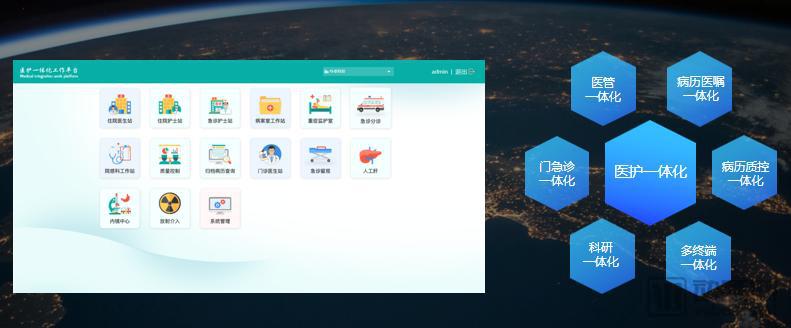
In response, Huazhuo Technology has integrated traditionally separate systems—such as outpatient, emergency, electronic medical records (EMR), and nursing—into a unified framework termed “integrated medical and nursing care.” This integration operates on two levels. First is business integration: Huazhuo Technology has thoroughly consolidated all physician- and nurse-related workflows into a single platform. While different clinical scenarios may have specialized front-end interfaces, the underlying data and business processes are fully unified. Second is terminal integration: whether accessed via mobile phones, computers, or tablets, all devices run on the same underlying system, effectively operating as a single cohesive system.
Integrated medical and nursing care covers all aspects of clinical medical work, optimizes clinical workflows, enhances system usability, and maximizes the quality of healthcare in hospitals.
Huazhuo Technology has integrated hospital-wide PACS services related to medical imaging—such as ultrasound, radiology, and endoscopy—along with external imaging consultation and patient access to their own images, into a single platform called the Integrated Medical Imaging Platform. Built on a hybrid cloud architecture, the platform utilizes distributed storage technology for its imaging cloud storage, enabling PC servers to replace traditional disk arrays and significantly reducing hospitals’ costs for imaging storage equipment. The cloud diagnosis and imaging consultation system within the platform facilitates image sharing and collaboration among medical consortiums, promoting the decentralization of high-end medical resources. Additionally, the platform’s cloud film service directly reaches consumers, allowing patients to view electronic reports and images anytime and anywhere, thereby reducing film usage and alleviating the burden on patients.
In the course of modern hospital development, how to enable hospitals to operate in a more standardized and efficient manner, comprehensively enhancing operational management levels and service capabilities, has become an increasingly important topic within the industry. The needs of medical institutions in areas such as human resources, materials, equipment, cost, efficiency, and communication of affairs are, in fact, not purely isolated business modules or requirements; these aspects of work are closely related to many tasks performed by medical professionals, often serving as either the outcomes or prerequisites of their work.
Huazhuo Hospital’s Integrated Operations and Management Platform rethinks and redesigns hospital management through a platform- and service-oriented approach. Leveraging hybrid cloud technology, it connects diverse stakeholders—including medical staff, patients, hospitals, and suppliers—integrates various business functions such as finance, office administration, and logistics, and spans multiple environments including intranet, extranet, PC, and mobile devices. This provides healthcare institutions with a more consistent work platform and standardized management practices, while also ensuring security for end-to-end closed-loop tracking throughout the medical care process.
Huazhuo Internet Hospital, backed by physical hospitals, leverages internet technology and mobile terminals to provide 24/7 online outpatient services.
The platform offers online diagnosis and treatment services for patients from other regions and postoperative patients. The product supports doctors in conducting online video consultations and cross-hospital collaborative consultations. It seamlessly integrates and displays in-hospital patient data, providing services such as appointment registration, disease diagnosis, electronic prescriptions, medication delivery, and post-discharge follow-up. By integrating internet-based services with offline medical care, the platform covers the entire patient journey—pre-diagnosis, during diagnosis, and post-diagnosis—helping hospitals build innovative service models, expand their service scope, and enhance their brand image.
Huazhuo differs from many of its peers in its approach to the conceptualization and application of artificial intelligence. Huazhuo Technology treats intelligent services as a standalone capability, specifically as a microservice within a microservices platform. This microservice is then integrated into specific business systems. Furthermore, Huazhuo’s concept of intelligence refers to the intelligence of business systems themselves, where intelligent services are fully embedded into clinical workflows—such as traditional PACS, RIS, and EMR systems—rather than being implemented as an external, add-on module for intelligent verification.
Currently, the vast majority of AI systems developed by artificial intelligence enterprises are integrated with hospital information systems via external plug-ins. For instance, a lung nodule detection tool from a certain AI company can automatically identify lung nodules with an accuracy rate of approximately 90%. After a hospital adopts this system, medical images must first pass through the Picture Archiving and Communication System (PACS) and the Radiology Information System (RIS) before being imported into the AI system. This workflow adds an extra operational step for radiologists. Such externally plugged-in systems undoubtedly dampen physicians’ willingness to adopt and use them.
For instance, Huazhuo’s AI imaging solution integrates image recognition capabilities into the PACS system. After a patient undergoes imaging, when the physician opens the PACS system, the AI automatically flags the specific locations of any suspected pulmonary nodules. The physician then makes a diagnosis and writes the report based on these AI-assisted findings.
This is akin to a company inventing a parking system that requires users to manually activate the system, shift into reverse, and then park. In contrast, Huazhuo Technology’s system automatically initiates and operates as soon as the user shifts into reverse. This mirrors Huazhuo Technology’s Clinical Decision Support System (CDSS), which integrates deeply into physicians’ entire workflow systems and seamlessly embeds itself within existing operational processes.
Currently, Huazhuo AI’s microservices include not only pulmonary nodule detection but also models for bone marrow cell recognition, post-structuring of electronic medical records (EMR), voice-based triage guidance, ICU mortality prediction, and safe medication management. Meanwhile, Huazhuo’s medical artificial intelligence service operates as an open platform, enabling other providers with relevant capabilities to list their services on the marketplace, thereby allowing all healthcare applications to access diverse intelligent services.
The Unique DNA of Huazhuo Technology
"Regarding the originality of Huazhuo Technology, Li Tanwei told VCBeat: 'When we proposed a cloud computing-based hospital system architecture in 2014, there were voices in the industry questioning the technology and its practicality. Now, we prove it with the actual application experience of large comprehensive hospitals such as Shulan Healthcare.'"
Huazhuo Technology and Shulan Healthcare Group are closely aligned, with Shulan’s physicians serving as product managers for Huazhuo. They propose new requirements on a daily basis, which Huazhuo translates into code and software through continuous trial-and-error iteration.
Since its inception in 2014, Huazhuo Technology has spent more than three years developing its underlying architecture and nearly one year deploying and successfully operating the new-generation medical cloud computing business system across the entire Shulan Healthcare Group.
“Traditional IT R&D vendors maintain a commercial partnership with hospitals, whereas our relationship with hospitals is akin to the two sides of the same coin—complementary and mutually reinforcing. This represents an entirely new collaborative model, offering significant uniqueness and advantages throughout the entire project lifecycle, from initiation and R&D to delivery,” said Li Tanwei.
In his view, Huazhuo Technology is essentially part of the growth trajectory of Shulan Medical’s technological evolution. Simply put, it is akin to Alibaba Cloud and Amazon’s cloud services, which initially served to support their respective e-commerce platforms but, through continuous upgrades and iterations, have gradually evolved into the massive capabilities they possess today.
With its proprietary genes, Huazhuo Technology is poised to spark a wave of hospital system replacements.