

Q1 2019 Evaluate Biotech IPO Report: IPO Activity Slowed by U.S. Government Shutdown
On April 16, 2019, Evaluate published an analytical report on biotech IPOs on Western exchanges in Q1 2019. Overall, the biotech IPO landscape at the beginning of 2019 was relatively optimistic, but the path to going public was not without challenges; some companies remained on the sidelines, while others achieved significant success in their IPOs. VCBeat New Medicine (WeChat ID: biobeat1) has compiled and translated the report, with the full text provided below:
2018 was a bumper year for initial public offerings (IPOs) by biopharmaceutical companies, whereas performance in 2019 was relatively lackluster. Affected by the U.S. government shutdown in January, IPO activity among biopharmaceutical firms declined in early 2019. Nevertheless, the overall IPO landscape remained optimistic. It is difficult to determine whether the decline in IPOs during the first quarter of 2019 warrants further investigation or was merely a lingering effect of the U.S. government shutdown.
Encouragingly, despite the U.S. government shutdown lasting for much of January, 10 companies still made their public market debuts in the first quarter. Compared with years other than 2018, these figures appear quite impressive, even markedly anomalous.
It should be noted that the analysis in the figure below includes only biotechnology companies listed on the Western Stock Exchange, excludes medical technology companies, and covers only firms undergoing their initial public offering. Therefore, it does not include Genfit, a French company that was previously listed on the Paris Exchange and subsequently listed on NASDAQ.
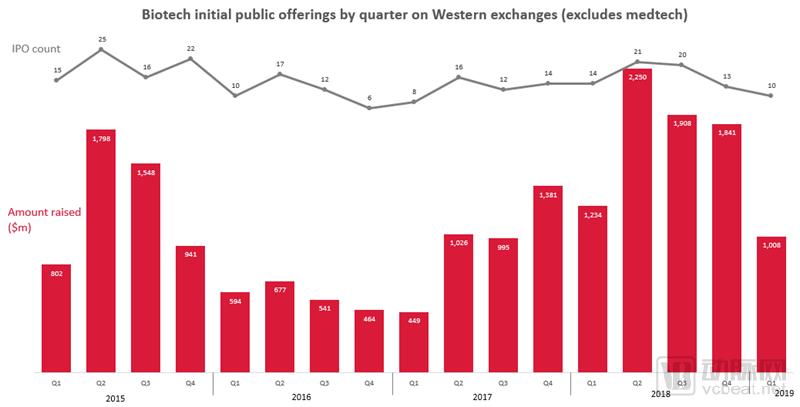
IPOs of Biotech Companies (2015–2019)
Generally, the first quarter sees the most stable IPO activity of the year. In particular, during Q1 2019, biotech IPOs were notably lackluster due to the U.S. government shutdown. However, in the subsequent quarters, we expect IPO activity to have ample room for growth.
Following the stock market turmoil in late 2018, the Global Biotechnology Index initially rebounded, signaling a positive trend for the recovery of the IPO market in 2019.
However, signs indicate that biotech companies have not had an easy ride in the IPO market. In the first three months of 2019, none of the 10 companies that went public managed to achieve a premium over their initial offering price range; in fact, four companies had to issue shares at a discount.
Overall, however, the average discount in 2019 was relatively acceptable compared with data from the first quarters of other years.
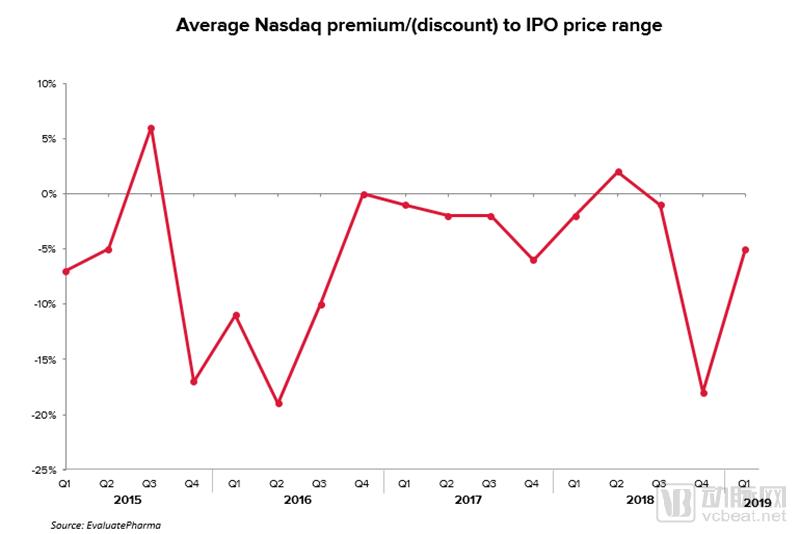
Changes in IPO Issue Prices of Biotechnology Companies, 2015–2019
Another sign is worrying for emerging companies hoping to go public. So far, the overall performance of biotech firms that went public in the first quarter of 2019 has been underwhelming.
Nevertheless, a small number of newly listed companies posted profits in the first quarter, including two cell therapy firms, TCR2 and Precision Biosciences. This indicates that despite the disappointing commercial performance of first-generation CAR-T therapies to date, demand for emerging companies in this sector remains strong in the IPO market.
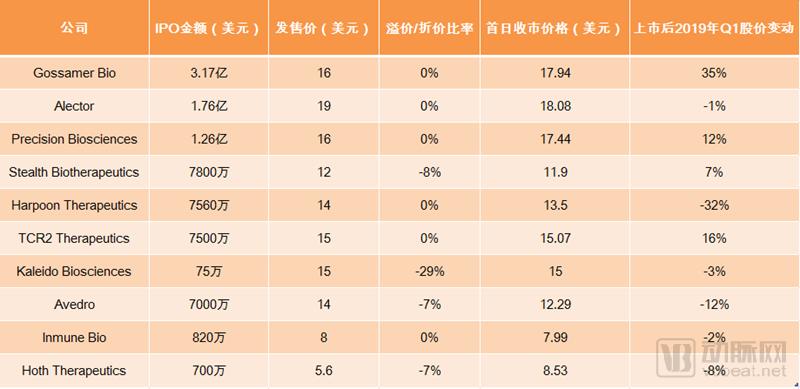
Top 10 Biotech IPOs on Western Stock Exchanges in Q1 2019
The figures listed above only reflect the situation in Q1 2019. In fact, Precision’s current stock price is 20% lower than its IPO price, while another publicly listed company, Gossamer Bio, also saw its share price begin to decline in April.
To date, Poseida Therapeutics, a peer of cell therapy companies TCR2 and Precision BioSciences, has shown no signs of an initial public offering (IPO). Poseida had previously announced plans to go public in January but subsequently fell silent. Meanwhile, Cirius Therapeutics, a company focused on developing treatments for non-alcoholic steatohepatitis (NASH), has also temporarily shelved its IPO plans. Last week, drug formulation developer Cure Pharmaceutical withdrew its $12 million IPO.
Other companies going public in April have observed more signs of an economic slowdown. The queue for IPOs in April included Turning Point Therapeutics, a developer of targeted cancer therapies, and Hookipa Pharma; both companies aim to treat cancer and infectious diseases by stimulating patients’ immune systems.
Of course, we have also seen positive developments. Another NASH-focused company, NGM Biopharmaceuticals, brought good news with its IPO. NGM went public in early April, raising $107 million in its initial public offering. Rumors suggest that BioNTech, a German biotechnology company specializing in mRNA therapy research and development, plans to go public in late 2019 or early 2020, with an expected IPO size of $800 million. Whether BioNTech proceeds with its listing will depend on whether the slowdown in IPO activity affects corporate valuation standards. Although the valuation bubble of 2018 appears to have dissipated, new opportunities may emerge in 2019.
For investors, a major gamble on whether to bet on the entirely new frontier of mRNA therapies is imminent.