

Is the Brain-Computer Interface Hype Overblown? Why Acting Now Is Critical

BrainCo
Non-invasive brain-computer interface technology solution provider
The technology venture capital in 2026 starts with a climax.
On January 6, news emerged that BrainCo, a non-invasive brain-computer interface company, had completed a 2 billion yuan financing round, adding fuel to the fire for brain-computer interface-related stocks. Relevant personnel from BrainCo responded, stating: "The financing has indeed been completed; for specific details, please refer to the official information released by the company. The funds raised will be used to accelerate core technology R&D in brain-computer interfaces, achieve breakthroughs in extreme engineering, and scale up product development and mass production."
On January 7th and 8th, the brain-computer interface sector continued to strengthen, with companies like Innovation Medical, Nanjing Panda, and Yanshan Technology continuing to hit the daily limit. However, individual companies have also drawn regulatory attention.
The most important stimulating factor in this wave of market activity is Elon Musk's bombshell announcement on social media: Neuralink plans to initiate "large-scale mass production" of brain-computer interface devices by 2026 and advance the surgical process to a "fully automated" phase; indications will also expand from brain-controlled peripherals for ALS patients to visual reconstruction for the blind, among others.
In addition to the "opportune time," there is also the "geographical advantage" set by China's top-level policy design. In the "15th Five-Year Plan," brain-computer interface was listed as one of the six future industries; cities such as Shanghai and Shenzhen have directly established special funds for brain-computer interface and brain science with a scale of billions of yuan.
Indeed, at present, both non-invasive and invasive brain-computer interfaces face significant uncertainties in large-scale practical applications.Many people question, "It's costly and cannot generate returns in the short term." Moreover, the primary users are critically ill patients, which is far removed from the daily lives of ordinary people. So why invest heavily in it?
An investor who invested in BrainCo in 2018 once pointed out to 36Kr: "In the field of brain-computer interface, once a company or team gains a leading advantage, it is very difficult for others to catch up and surpass. Analogous to innovative drugs, if switching from Target A to Target B has a difficulty level of 50, then for latecomers trying to copy the homework of a brain-computer interface company, the difficulty could be as high as 90. This is because an entire disciplinary ecosystem must be rebuilt, with a cross-disciplinary team aligning with the business."
As a cutting-edge interdisciplinary field, brain-computer interface requires time to build up technological and systematic barriers. A detailed review reveals that the companies with faster progress in clinical trials and product implementation have been established for quite some time and are backed by well-known investment institutions.
In addition, Sequoia China, IDG, CDH, Baidu Ventures and other VCs have invested in multiple brain-computer interface companies with different technical routes.
In 2026, the brain-computer interface track is expected to usher in a year of substantial financing. Leading players such as BrainCo and Boyi Kang will also aim for the STAR Market and the Hong Kong Stock Exchange. Investment institutions are expanding from primarily medical investors to include technology and consumer track investment firms. After all, the most imaginative application scenarios for brain-computer interfaces lie in consumer healthcare, especially when combined with the concept of embodied intelligence.
Despite the bustling secondary market, the companies with the highest "brain content" in the brain-computer interface sector are still predominantly unlisted enterprises. What are the differences in prospects among various technical approaches? How capable are these high "brain content" companies in terms of technical ability and implementation?
Non-invasive: Broad applications in embodied AI, healthcare, entertainment......
In the non-invasive brain-computer interface track, BrainCo is a firm and significant "flag-bearer." Additionally, there is Roulin Technology, which just announced on January 5th that it received investment from Chunxiao Fund, Zero One Thought invested by MiHoYo in its early years, and Yansi Brain-like, a wholly-owned subsidiary of Yanshan Technology.
In fact, non-invasive brain-computer technology is not a new concept. As early as the previous wave of financing from 2019 to 2021, this field had already gained significant attention, with primary applications focusing on sleep monitoring and intervention, attention monitoring, and the diagnosis and treatment of mental illnesses.
However, the capabilities of many sleep devices, headbands and other products are relatively homogeneous. The user education costs for the 2C market are also high. Several companies failed to meet their performance commitments made during financing, causing the sector to cool down for a period.
Although non-invasive methods have advantages such as short development cycles and a wide range of suitable users, the technical bottlenecks at that time were also clear, with the core issue being the insufficient quality of signal reading and writing.
The skull of the human brain is not only a sturdy shield protecting the brain, but also an "insulating wall" for electrical signals. Capturing potential changes generated by neuronal activity on the scalp surface through electroencephalogram (EEG) technology often leads to issues such as signal attenuation and blurring, as well as low spatial resolution.
Musk has also publicly discussed his understanding of the ceiling for non-invasive methods on multiple occasions. In June 2025, during Neuralink’s summer update conference, he pointed out: “Non-invasive brain-computer interfaces like electroencephalograms (EEGs) are akin to trying to transmit information through a straw, with transmission rates stuck below one bit per second. To achieve true brain-machine symbiosis, bandwidth must be increased to the level of millions or even billions of bits per second.”
He once compared non-invasive brain-computer interfaces to "listening to a game outside the stadium," where you can hear the roaring cheers from inside but cannot distinguish a particular player's voice or make out the details of the game. In contrast, the signal quality of invasive brain-computer interfaces is more like placing a microphone directly in front of a player’s mouth.
Therefore, most of the current non-invasive brain-computer interface companies are no longer solely focused on pure brain intention control but instead on applications such as smart bionic hands and bionic legs. Signal acquisition mainly relies on electromyography (EMG), supplemented by neural electrical signals and AI algorithms, to more accurately identify human movement intentions and control hardware.
Essentially, these products are similar to the equally popular "exoskeletons" of 2025, leaning more towards the concept of embodied intelligence. This is vastly different from the logic of conventional medical devices undergoing clinical trials on humans and hospital registration for access.
In medical scenarios, although it is difficult to achieve "human-computer symbiosis" with non-invasive brain-computer interfaces, with technological advancements, a company in China has achieved a 10-fold increase in the transmission rate of non-invasive brain signals. Pu Muming, an academician of the Chinese Academy of Sciences and a brain science expert, recently stated in an interview that the industrial prospects of non-invasive brain-computer interfaces are greater than those of invasive ones.
He pointed out that there are already mature applications of non-invasive brain-computer interfaces in China. For example, personalized brain region localization technology can effectively improve patients' sleep by providing targeted electrical stimulation; precise transcranial magnetic stimulation also shows great potential in treating depression and aiding stroke rehabilitation. Of course, the key to such products is to "have objective data support."
Invasive: The "Craniotomy" Race for Hardcore Players
If non-invasive is the logic of "searching for a hit product" in AI + hardware, then the first step of invasive brain-computer interfaces is to climb the "Mount Everest" of medicine. Despite the capital winter in the medical track of the primary market during 2022-2024, invasive brain-computer interfaces still experienced a wave of financing "mini-spring" due to their high technical barriers and clinical value.
Unlike the rapid iteration of consumer products, invasive brain-computer interfaces must confront three formidable challenges: long-term implant safety, stability of signal reading and writing, and compliance with medical device registration.
The current capital market's evaluation of brain-computer interface companies has shifted from single-point technological strengths to the implementation of full-stack capabilities. As a result, the progress of human clinical trials and data performance have become the hardest indicators to validate each company's technical abilities.
In China, there are only a few teams with full-system development capabilities in electrodes, algorithms, and neural chips, and the industrial landscape is concentrated in cities such as Shanghai, Beijing, and Shenzhen. Particularly in the dual cities of Beijing and Shanghai: Shanghai leads with its clinical resources and industrialization speed, while Beijing closely follows with original innovations from top-tier scientific research institutions.
Representative companies in Shanghai include BrainRobotics, Jieti Medical, and Neutronic Technology, among others.
BrainCo
Founded in 2011, BrainRobotics' chairman Xu Honglai and general manager Huang Xiaoshan both graduated from the Department of Biomedical Engineering at Tsinghua University under the tutelage of Professor Hong Bo. The team’s style carries a strong "Tsinghua" characteristic of being low-key and pragmatic, rarely accepting media interviews. In 2026, BrainRobotics will strive to be listed on the STAR Market.
In the first ten years after its establishment, Neuracle mainly focused on the domestic substitution of non-invasive EEG devices, such as wireless EEG acquisition systems and high-frequency EEG machines. These product lines not only provided cash flow to support its continuous research and development of invasive brain-computer interfaces during the medical capital winter but also honed its engineering and industrialization capabilities.
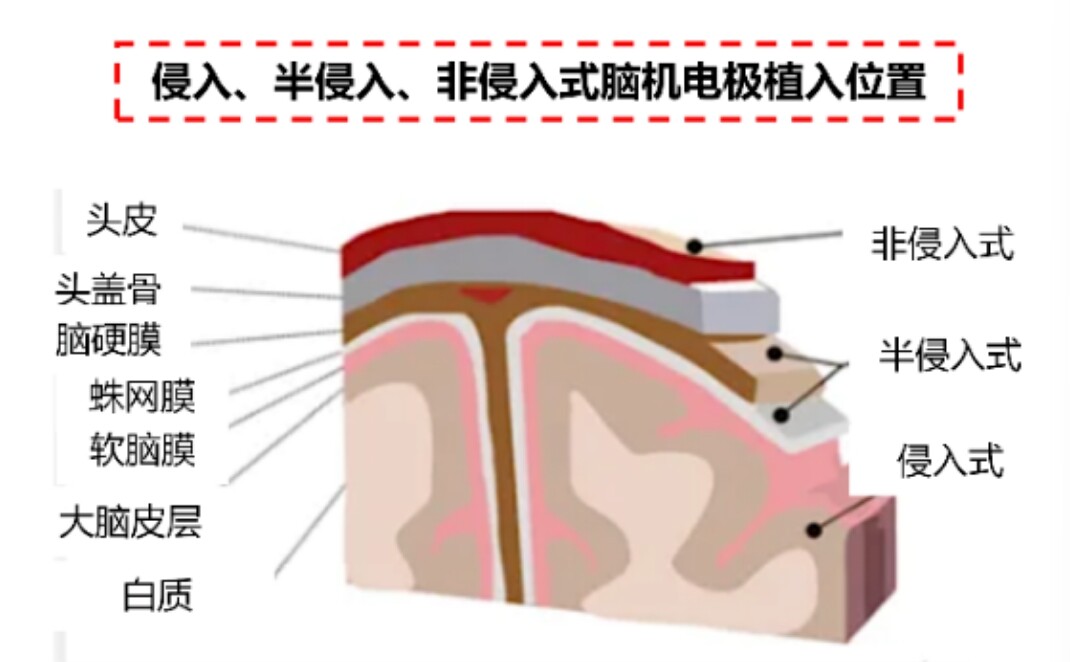
BrainRobotics' brain-computer interface system Neo is also referred to by many in the industry as "semi-invasive." Compared to Neuralink, which directly penetrates deep into the cerebral cortex, BrainRobotics' electrodes are attached to the dura mater.
If the cerebral cortex is regarded as a box of soft tofu, then the dura mater can be understood as the outer packaging film protecting the tofu. To avoid issues such as scarring and displacement caused by electrodes piercing into the "tofu," and to strike a balance between high signal intensity and minimal implantation injury, BrainCo has chosen the epidural minimally invasive technical route.
In terms of clinical trials, by the end of 2025, BrainRobotics has completed the implantation and follow-up of 32 patients with cervical spinal cord injury and paralysis. According to their disclosure: 100% of patients have achieved home-based brain-controlled grasping assistance and rehabilitation training, with an average improvement of 8-9 points in grasping scores. Currently, the company is advancing the application for the registration and market approval of Class III medical devices.
Source: CITIC Securities Research Report
Tiered Healthcare
The core barrier of Stepped Medical lies in the "ultra-flexible neural electrode" technology. In early 2025, it secured a B-round financing of 350 million RMB, with investors including Qiming Venture Partners, Orbimed, Lilly Asia Ventures, and others.
The two founders, Li Xue and Zhao Zhengtuo, are both post-90s scientists who were introduced to the Center for Excellence in Brain Science and Intelligence Technology at the Chinese Academy of Sciences by Academician Mu-ming Poo. To address issues such as electrode displacement during human movement, StepMed has reduced the size of its flexible electrodes to 1% of a hair's thickness, ensuring stable signal acquisition from the same location.
By the end of December 2025, Stepped Medical announced the success of the second clinical trial of an invasive brain-computer interface, with the participant being a patient with high-level paralysis caused by spinal cord injury; the third clinical trial was also successfully implanted.
It is reported that the first-generation implant system has 64 electrode channels, and the second-generation 256-channel system (WRS02) is planned for its first prospective clinical trial in the near future. The application areas of the second-generation system have expanded from motor control for patients to language reconstruction for those who have lost the ability to speak. It is expected that brain-controlled peripherals will be upgraded to include "smooth control of a five-axis robotic arm and preliminary control of embodied intelligent robots," among others.
Li Xue once told 36Kr that healthcare is a necessary path, but the goal of BrainCo is to push brain-computer interfaces into broader consumer-level human-computer interaction scenarios through technological iteration. It’s not just about restoring patients' motor abilities or sensory perceptions, but also about helping them explore the boundaries of human control.
BrainTiger Technology
NeuroTiger Technology is one of the companies in China that clearly benchmarks against Neuralink. Professor Tao Hu, the founder, formerly served as the deputy director of the Shanghai Institute of Microsystem and Information Technology at the Chinese Academy of Sciences and resigned from this position at the end of 2024 to fully commit to industrialization.
NeuroX Technology also possesses exclusive differentiated technology in flexible electrodes, utilizing silk protein as the electrode encapsulation material. This biomaterial has controllable degradability, providing hardness assistance during implantation and then degrading and disappearing after implantation, reducing long-term damage to brain tissue.
In terms of signal acquisition strategy, unlike Neuralink's deep single-point sampling method, BrainCo has opted for "wide-area multi-point sampling," where 64 acquisition points are distributed across different functional areas on the surface of the cerebral cortex, achieving broader "surface coverage" to simultaneously capture diverse signals from various functional regions.
In December 2025, NeuraLink Technology announced the completion of an implant surgery on a高位截瘫 patient (with an 8-year medical history). The surgery utilized a minimally invasive implant method similar to DBS (Deep Brain Stimulation). After systematic training, the patient achieved a brain-controlled decoding rate of 5.2 bits per second in standard tests. According to reports, this data ranks among the best internationally.
Representative companies in Beijing include Xinzhide, Zhiran Technology, Heze Technology, and Mingshi Brain-Computer, among others.
Xinzhide
In Beijing's brain-computer interface landscape, Xinzhide, as a key incubated enterprise of the Beijing Institute for Brain Science and the Zhongguancun Development Group, occupies a unique ecological niche, shouldering the important task of transforming scientific research achievements from Luo Minmin's team at the Beijing Institute for Brain Science and multiple PIs (Principal Investigators) within the institute.
According to industry sources, CoreMind may initiate mixed reforms, introduce social capital, and operate under a market-oriented system.
It is reported that "BeiNao No.1" has chosen the semi-invasive technical route, featuring a 128-channel wireless fully implanted brain-computer system placed epidurally. In terms of trials, it has entered the investigator-initiated trial (IIT) phase, with six human implants completed by 2025, assisting patients with spinal cord injuries, stroke, and ALS in achieving substitution and rehabilitation of motor and speech functions.
"BeiNao II" has chosen a fully invasive approach similar to Neuralink, with a 1024-channel wired version already released. It is expected to be upgraded to a 512-channel wireless version by 2026, completing the engineering prototype; it will then enter the clinical IIT verification stage.
Zhiran Medical
Founded in 2022, completed over 300 million yuan in Series A financing by mid-2025, co-founded by Dr. Fang Ying and Dr. Song Qi, belonging to a startup with strong PI and CEO configurations.
Chief Scientist Fang Ying is a researcher/Ph.D. supervisor at the Beijing Institute of Brain Science and Brain-like Intelligence, and has long been engaged in research on flexible high-throughput electrodes and neural recording and modulation. CEO Song Qi is a serial entrepreneur who previously served as the CEO of Keya Medical and has extensive experience in the clinical translation and registration of Class III medical device certificates.
High-throughput flexible electrodes are also the core technology of Zhiran Medical. According to reports, each channel of its electrodes can collect more than one active neuron on average, while adopting a "stretchable design" to prevent relative movement between the electrode and brain tissue, reducing immune inflammatory responses and overcoming the bottleneck of long-term unstable data collection.
In terms of clinical trials, by the end of 2024, Zhiran completed implant surgeries at the Second Affiliated Hospital of Zhejiang University, capturing various neuronal signals from deep brain regions. By the end of 2025, a wireless signal acquisition system will be implanted in a glioma patient at the China-Japan Union Hospital of Jilin University. Based on available information, this leans more towards intraoperative functional mapping for tumor patients to validate system safety and signal acquisition effectiveness.
Heze Technology
BrainCo's chief scientist, Dr. Xiaochuan Dai, and CTO, Dr. Teng Gao, both hail from the Charles M. Lieber Laboratory at Harvard University.
One of the core technologies is the tissue-like scaffold neural electrode, "which has been verified through multi-species experiments including rodents, canines, and primates. It offers advantages such as integration with biological neural tissues and avoidance of immune rejection responses, enabling lifelong stable acquisition of single-neuron signals."
Sino Brain Science, a listed company, invested in Heze Technology in 2025, and the two parties also established a strategic partnership. The main focus of the collaboration is to accelerate the clinical transformation of brain-computer interfaces in scenarios such as motor function reconstruction for paralyzed patients and language interaction for ALS patients.
2026 will be a watershed year for brain-computer interfaces. As technology and systems are implemented, on the payment front, in 2025 the National Healthcare Security Administration issued the "Guidelines for the Establishment of Price Items for Neurological Medical Services (Trial)," which established several services related to brain-computer interfaces as independently chargeable items. This also reflects the determination of various parties to support the implementation of the brain-computer interface industry.
For relevant companies and investors, occupying the frontier of brain-computer interface is more likely to gain the dominance of related technologies, products, and standards, and grasp the right to speak in the future.