

2019 Medtronic China Fund & BV Healthcare Robotics Competition Opens for Submissions
The healthcare market offers immense potential,
As an emerging business model, medical robots are being propelled by capital, technology, and policy support,
Rapidly penetrate the healthcare market,
The Next Big Trend in Healthcare Entrepreneurship,
It will also drive the entire upstream and downstream industries into a period of rapid development.
Guided by the Science and Technology Commission of Minhang District, Shanghai,
Hosted by the Medtronic China Fund and BV Baidu Ventures,
Strategic support from Shanghai Lingang Pujiang International Science and Technology City, Shanghai Jiao Tong University Medical Robot Research Institute, Med-Engineering Integration Alliance, Suzhou Collaborative Innovation Institute for Medical Robots, and Beihang University’s High-Precision Innovation Center for Biomedical Engineering.
Hosted by VCBeat,
The 2019 Medtronic China Fund - BV Baidu Ventures Medical Robot Competition is officially launched.
A Truly High-Profile, Low-Barrier Robotics Competition,
A robotics competition covering business, application, and technology dimensions.
A Premier Industry Event for Cross-Disciplinary Exchange Between Healthcare and Robotics
An excellent opportunity for financing matchmaking and direct entry into the 2019 Global AI Competition.
7 competition categories are underway simultaneously,
Two months of intense competition,
30+ industry leaders, experts, and scholars participated in the competition,
50+ top-tier investment experts serve as competition judges,
1M+ media impressions.
Competition Project Recruitment Channel Is Now Open,
Inviting You to Co-Create the Future of Medical Robotics.
Scan the QR code for details and download the registration form.

Recruitment Deadline: May 17
A Powerful Alliance to Build the Premier Accelerator for Medical Robotics
2019 Medtronic China Fund-BV Baidu Ventures Medical Robot Competition, guided by the Shanghai Minhang District Science and Technology Commission, hosted by Medtronic China Fund and BV Baidu Ventures, with strategic support from Shanghai Lingang Pujiang International Science and Technology City, Shanghai Jiao Tong University Institute of Medical Robotics, Medical-Engineering Integration Alliance, Suzhou Collaborative Innovation Institute for Medical Robots, and Beihang University’s High-Precision Innovation Center for Biomedical Engineering, and organized by VCBeat.The competition focuses on medical robots and related fields, targeting startups, teams, universities, and research institutions. It seeks innovative application solutions for medical robots in specific scenarios, promoting the integrated development of "technology + capital + talent + applications" in the medical robotics sector, while providing high-quality projects with strong industrial collaboration opportunities and financial support.
As an innovative leader in the global medical technology sector, Medtronic boasts nearly 70 years of experience in healthcare, with operations spanning 150 countries worldwide and covering more than 70 disease areas, thereby possessing extensive expertise and unique insights into the healthcare market. Medical robotics represents a key strategic direction for Medtronic’s research and development and innovation efforts. Globally, Medtronic is actively expanding its presence in the fields of surgical and orthopedic robotic systems. In China, Medtronic has undertaken numerous local R&D initiatives in recent years focused on surgical robots and artificial intelligence, while also promoting the application and commercialization of these technologies through joint university R&D projects and medical accelerator platforms.
BV is an independent venture capital firm initiated by Baidu and managed by a professional team, currently managing three USD and RMB funds with a total scale of $500 million. Biomedical technology has always been one of the key areas for BV’s in-depth investment layout. From AI-driven drug discovery to next-generation surgical robots, and from single-cell sequencing to in-body sensors, BV has visited countless laboratories across China and the United States in its two years since establishment, investing in more than 30 cutting-edge biomedical companies. This strong collaboration between the two parties will host a medical robot competition, serving as another powerful accelerator in the field of medical robotics.
Three Key Recruitment Targets: Innovative Enterprises, University Teams, and Research Institutes
The competition consists of three stages: preliminary round, semi-final, and final. There are two competition zones, Beijing and Shanghai, with the final to be held in Shanghai.

The recruitment period runs from April 16 to May 17, during which the competition will accept applications nationwide from startups, teams, universities, and research institutions.We welcome your application if you are engaged in applying artificial intelligence to the medical field and can propose innovative, breakthrough solutions that better address challenges in healthcare scenarios.
Your business scope may include, but is not limited to: surgical robots (for ophthalmology, orthopedics, otology, etc.), rehabilitation robots, and advanced sensors. Application areas may include, but are not limited to: early risk warning, preoperative planning, flexible intraoperative execution, medication management and postoperative monitoring, as well as rehabilitation and nursing care. Technical directions may include, but are not limited to: advanced research technologies such as in vivo sensing technology, delivery systems (navigation and carriers), feedback systems, operational systems, and ex vivo monitoring technology.
Focusing on Seven Key Areas, Competition Entries May Consist Solely of a Design and Concept
The goal of this competition is to discover innovative solutions with breakthrough creativity that can better address challenges in healthcare scenarios by leveraging technologies such as AI, sensors, robotics, and 3D imaging.The solutions you provide may include mature products, or even innovative designs and concepts backed by a certain level of technical reserves.The optional solution themes cover seven major areas, including surgery, rehabilitation, medical assistance, and related intelligent hardware and software, as described in detail below.
● Micro-robots: centimeter-, micron-, and nanoscale, used for monitoring, diagnosis, treatment, etc.
● Soft-tissue surgical robots: lung, prostate, heart, stomach, hepatobiliary system, eye, ear, nose, throat, and cardiovascular and cerebrovascular systems
● Hard-tissue surgical robots: knee, spine, craniocerebral, etc.
● Surgical assistance technologies and equipment: preoperative planning, intraoperative guidance, intelligent assistance devices, etc.
● Rehabilitation Robots/Intelligent Postoperative Rehabilitation: Medical training, daily living assistance, surgical rehabilitation, medication regimens, etc.
● Medical Assistance Robots: Robotic video medical systems, patient navigation guides, hospital logistics and transport, training, medication dispensing, etc.
● Other software/devices: feedback systems (mechanical, visual, etc.), in vitro monitoring technologies (wireless sensing, wearable sensing), control and imaging systems, AI analysis systems, AR/VR, intraoperative data collection and analysis technologies, etc.
Lucrative returns, seamless financing connections, and direct access to global AI competitions
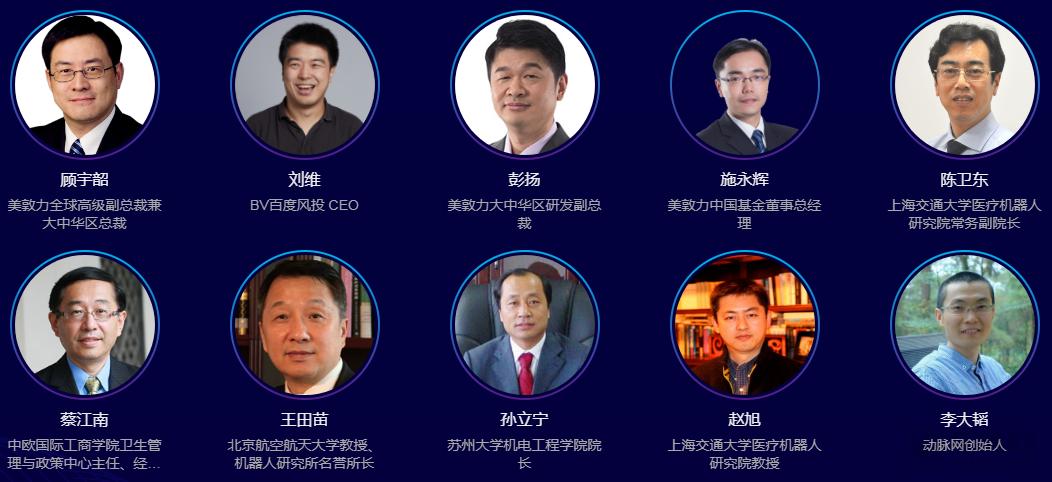
The competition will invite R&D experts, executives of listed companies, renowned investors, and media professionals to serve as the expert jury, conducting multi-dimensional evaluations of the participating projects to ultimately select the most innovative medical robot solutions in China.
For projects advancing to the semi-finals and finals, the organizers will also provideDirect access to the 2019 Global AI Entrepreneurship and Innovation Competition, investment opportunities, high-quality resources, and other substantial rewards. Specifically as follows:
1. Projects that reach the finals and secure the top three positions will receive:Direct Access to the Finals of the Medical Track at the 2019 Global AI Startup Innovation Competition, Hosted by BV Baidu Ventures, compete with global medical robotics solutions and have the chance to win substantial cash prizes.
2. Finalist projects are expected to receive:
● Investment opportunities with BV Baidu Ventures and the Medtronic China Fund;
● Priority incubation opportunities through the Medtronic Healthcare Innovation Accelerator;
● Collaboration and engagement opportunities with Medtronic China’s core business divisions.
3. Enterprises or Projects Advancing to the Semi-FinalsShortlisted for the “Top 100 Future Healthcare Companies” Watch ListVCBeat closely monitors companies’ team transitions, product evolution, market expansion, and financing progress; outstanding projects have the opportunity to be included in the “Top 100 Future Healthcare Companies” list.
Registration Methods for Participation
The 2019 Medtronic China Fund – BV Baidu Ventures Medical Robotics Competition is now officially open for registration. Startups, teams, universities, and research institutions that meet the above criteria are invited to scan the QR code below to register immediately. Spaces are limited, so early registration is encouraged. The deadline for case submissions is May 17.

About BV Baidu Ventures
BV is an independent venture capital firm initiated by Baidu and managed by a professional team, with investors including Baidu and other leading industrial and financial institutions. BV currently manages three U.S. dollar and RMB funds totaling $500 million, operating simultaneously in Beijing and San Francisco, and is committed to becoming a world-class VC in the AI era.
BV is investing to build a more efficient intelligent world: finer-grained perception, more precise decision-making, reduced labor costs, and improved efficiency models. BV has invested in over 100 AI companies—spanning from chips to sensors, from human data acquisition to space-based observation networks, and from smart industry to smart cities—backing both the underlying technologies behind AI and the various industry transformations driven by AI. In the frontier field of medical biology, BV has currently invested in more than 30 companies, covering areas such as gene editing, AI-driven drug discovery, single-cell sequencing, and innovative health insurance.
About Medtronic China
Founded in Minnesota, USA, in 1949, Medtronic is currently the world’s leading medical technology company. Its products and therapies cover more than 70 disease areas, with operations in over 150 countries worldwide. In fiscal year 2018, Medtronic reported revenue of nearly $30 billion. Medtronic is dedicated to alleviating pain, restoring health, and extending life for patients through collaborative innovation. Every second, more than two patients around the globe benefit from Medtronic’s medical technologies or therapies.
In 1989, Medtronic established its first representative office in China. Currently, it maintains offices in 14 Chinese cities, with one R&D center, one medical innovation center, four major production bases, and over 5,000 employees. Founded in 2012, the China R&D Center houses 20 research laboratories and nearly 300 employees, making it Medtronic’s largest R&D center globally outside the United States.
In 2016, the Medtronic China Fund was established, dedicated to investing in pharmaceutical and medical technology enterprises. It focuses on companies that provide innovative technologies or novel therapeutic approaches within the Greater China region, enhance local value propositions, or deliver technology-driven services.
In March 2019, Medtronic Greater China officially launched the “Medtronic Medical Innovation Accelerator,” an innovation incubation and acceleration platform, in Shanghai. The platform is dedicated to empowering early-stage medical technology startups with clinical and market potential, facilitating the rapid translation of their technological achievements into valuable medical products and services. Leveraging the platform’s investment, incubation, and acceleration capabilities, Medtronic has further enhanced its medical technology innovation value chain in China.