How Maixing Medical Leverages AI and Big Data to Reduce ICU Diagnostic Errors: A Grassroots Healthcare Case Study
ICU (Intensive Care Unit) is a specialized department dedicated to admitting critically ill patients, providing them with meticulous monitoring and precise treatment; it serves as the “battlefield” where patients and physicians fight for life.
On this “battlefield,” healthcare professionals spare no effort and race against time, managing various patient-related matters under numerous clinical indicators.
However, due to the urgency of time, diagnostic and treatment errors are inevitable.
According to data from Yubo Zhiye’s “ICU Industry Market Survey and Analysis Report,” the incidence rate of ICU errors in the United States reached as high as 1,497 per 10,000 patients in 2005, with 13% posing life-threatening risks. On average, 1.7 medical errors occurred per patient per day, and approximately 98,000 ICU patients died annually due to medical errors.
However, positive data indicate that 28%–84% of these medical errors are preventable; hospitals simply need to identify effective approaches to address them.
What solutions can bring change to such a complex ICU environment? Professor Fei-Fei Li, Director of the Stanford AI Lab and former Chief Scientist of Google Cloud, stated at the inauguration ceremony of the Tsinghua University Institute for Artificial Intelligence in June 2018 that earlier detection of diagnostic and treatment issues would lead to better patient outcomes. She emphasized that applying artificial intelligence in ICUs could provide significant assistance in patient care and medical management.
In early March this year, the paper “A computer vision system for deep learning-based detection of patient mobilization activities in the ICU” by Serena Yeung, Fei-Fei Li, and colleagues was accepted by Nature Digital Medicine, a Nature portfolio journal, signaling that the surge in artificial intelligence applications in the ICU has arrived.
To address the critical challenges faced in intensive care units (ICUs), Maixing Medical has established a multi-parameter intelligent medical big data platform for ICUs. This platform provides the data foundation for medical big data research and AI product development. By leveraging clinical guidelines, academic literature, and clinical data through techniques such as natural language processing (NLP), knowledge graphs, machine learning, and deep learning, the company has developed a clinically applicable ICU intelligent clinical decision support system.
Maixing Medical’s primary focus is addressing the impact of improper ventilator use on patients.
In the ICU, ventilators are the most frequently used medical devices, with over 50% of ICU patients requiring ventilatory support. They play a critical role in preventing and treating respiratory failure, reducing complications, and saving and prolonging patients' lives.
However, in clinical practice, the use of ventilators faces numerous challenges.
In hospital settings, according to the "2011 Blue Book: Annual Report on China's Healthcare Industry," 60%–70% of adverse events involving medical devices are caused by "use errors" and "operational mistakes." Professor Yan Hanmin, a doctoral supervisor at Xuanwu Hospital of Capital Medical University, believes that among medical devices associated with "use errors," ventilators account for the largest proportion.
For patients, long-term use of invasive ventilators increases the risk of pneumonia. Furthermore, prolonged ventilator use strengthens patient dependence on the device, making weaning difficult.
“To address this pain point, Maixing Medical has integrated comprehensive clinical big data and employed algorithmic modeling to develop an Intelligent Management and Decision-Support System for Clinical Ventilators,” introduced Huang Kezhi, CEO of Maixing Medical. By monitoring relevant data from critically ill patients in real time and across all dimensions, the system provides intelligent, ventilator-specific decision-support recommendations, effectively mitigating risks associated with ventilator use. Its features include:
Intelligent Respiratory Support Mode: In the early stages of disease, the intelligent ventilator management system provides optimal ventilator mode recommendations and personalized parameter settings tailored to individual patients, aiming to maintain and improve their respiratory and physiological status, thereby extending valuable treatment time for managing the primary condition.
Weaning Mode: When the patient's condition improves, the intelligent ventilator management system will guide physicians to reduce respiratory support as needed, allowing the patient to gradually resume spontaneous breathing, shorten the duration of ventilator use, decrease dependence on mechanical ventilation, and improve disease prognosis.
In Huang Kezhi’s view, the intelligent decision-support system for invasive ventilators will contribute to the industry in two ways:
1. Reduce the failure rate of weaning; according to relevant U.S. literature, the cost associated with mechanical ventilation is approximately $2,000 per day, and patients with delayed weaning (accounting for 6% of cases) consume about 37% of ICU resources. Intelligent ventilator-assisted decision-making can reduce the failure rate of weaning and decrease the incidence of delayed weaning.
2. Reduce the duration of mechanical ventilation, alleviate patient suffering, and lower costs (the daily cost associated with invasive mechanical ventilation in China is approximately RMB 3,000–5,000 or more), shorten hospital stays, enable primary-care ICU physicians to rapidly improve their ventilator management skills, reduce error rates, and minimize infection risks, thereby allowing more critically ill patients to remain treated at primary-care hospitals and enhancing the economic efficiency of these facilities.
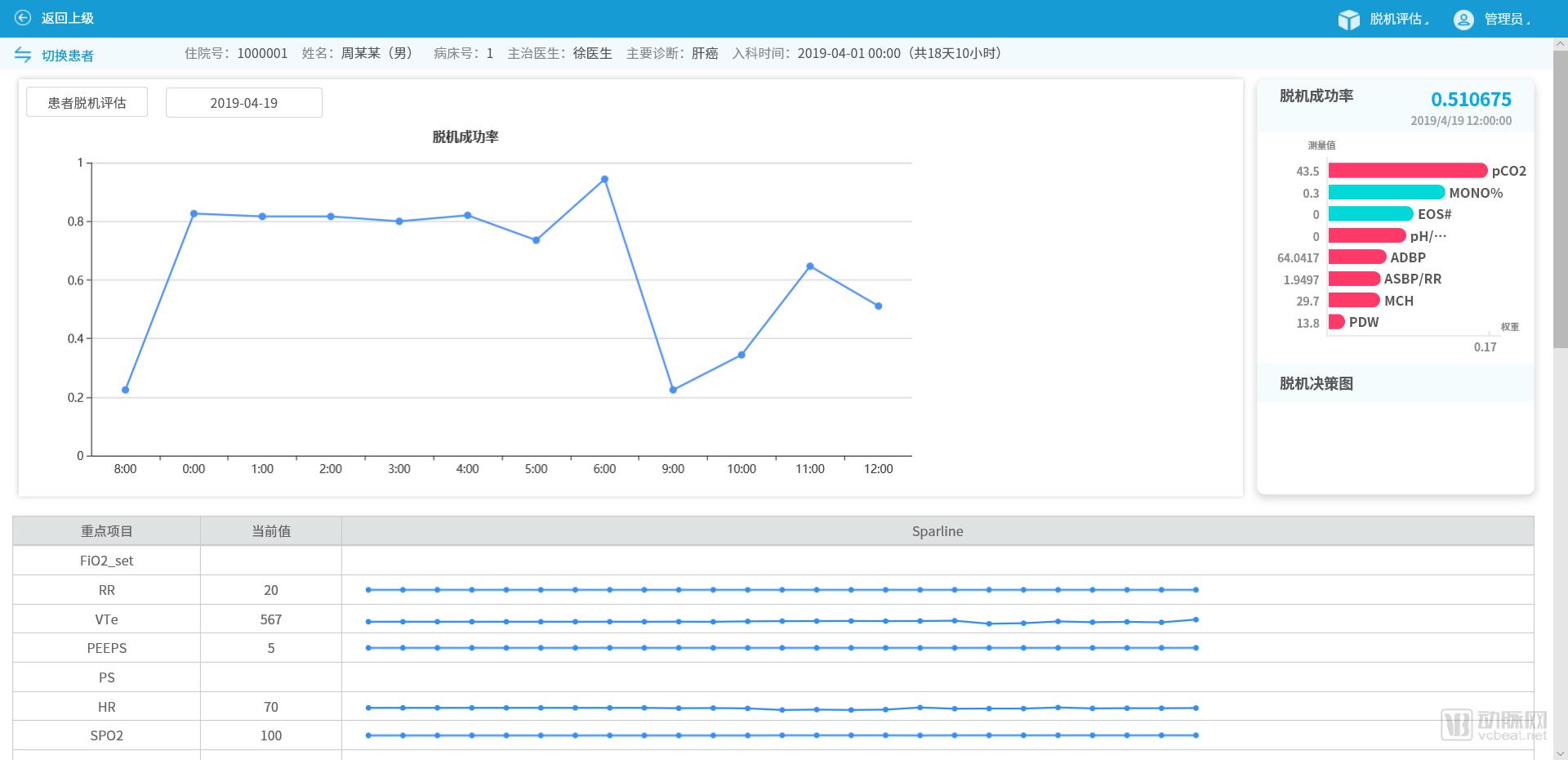
Image source: Provided by the interviewee (the data shown is simulated and for reference only)
Due to the high barriers to entry in the industry, the ICU market has kept many companies at bay. According to Huang Kezhi, the reason Maixing Medical dares to delve deeply into this market lies in the strong “technical DNA” possessed by its core team members: R&D personnel account for 80% of the entire team, and more than 50% hold master’s or doctoral degrees.
Among them, Dr. Zheng Yi, the Chief Technology Officer, earned his bachelor’s degree in Computer Science from Tsinghua University and his Ph.D. in Artificial Intelligence from Fudan University. With many years of experience in the AI field, he specializes in the research and development of various AI technologies, including Natural Language Processing (NLP), machine learning, and deep learning. Chen Weiren, the Medical Director, is a former attending physician in the Department of Critical Care Respiratory Medicine at a Grade 3A hospital. He possesses extensive clinical experience and has participated in the research and development of multiple medical AI projects.
“Our R&D team is highly innovative. In addition to the intelligent decision-support system for invasive ventilators, we have also developed a criticality assessment system for ICU patients. This system can predict the probability of mortality from the second to the seventh day after admission, with an accuracy rate of 94%. In the future, we will apply this technology to the prediction, early warning, and auxiliary diagnostic and therapeutic recommendations for various critical and common diseases.”
With talent and technology in place, the next step is product commercialization. Huang Kezhi introduced that Maixing Medical has currently established collaborations with renowned domestic Grade A tertiary hospitals, including Peking Union Medical College Hospital, the Second Xiangya Hospital of Central South University, the First Affiliated Hospital of Zhejiang University School of Medicine, Zhejiang Provincial Women’s and Children’s Hospital, and Zhejiang Hospital, as well as leading domestic healthcare IT enterprises such as Ali Health.
Taking Peking Union Medical College Hospital (PUMCH) as an example, Maixing Medical has collaborated with the Department of Internal Medicine’s ICU at PUMCH to jointly develop an intelligent decision-support system for invasive mechanical ventilation. “PUMCH possesses extensive clinical data, which has significantly benefited the training of this system. Through continuous improvement and refinement, the AUROC (Area Under the Receiver Operating Characteristic Curve) of the intelligent decision-support system for invasive mechanical ventilation has exceeded 0.88, substantially outperforming traditional metrics such as the RSBI (Rapid Shallow Breathing Index, 0.69) and MV (Minute Ventilation, 0.68). This system is now capable of effectively assisting ICU clinical staff in making ventilator-related decisions. In the near future, we plan to promote this product to other hospitals and are also exploring collaborations with ventilator manufacturers.”
“In addition to the collaboration on the intelligent decision-support system for invasive ventilators, Maixing Medical’s assistance in securing project approval for the Beijing Critical Care Medicine Dataset Standard, applied for by the Department of Internal Medicine ICU at Peking Union Medical College Hospital, has been approved by the Beijing Municipal Health Commission.”
According to the Guidelines for the Construction and Management of Critical Care Medicine Departments, hospitals at Grade II and above must establish intensive care units (ICUs). In tertiary general hospitals, there should, in principle, be one ventilator per bed in the critical care medicine department. There remains substantial room for development and improvement in ICUs across China. Enhancing the capabilities of county-level hospitals has been a key area of national policy and financial support in recent years. China has launched the second phase of the County Hospital Capability Enhancement Project (2018–2020), covering 500 county hospitals, with a focus on strengthening critical care treatment capacities. This presents a significant opportunity for Maixing Medical.
Looking ahead, Huang Kezhi stated that Maixing Medical will leverage technologies such as NLP (Natural Language Processing) and deep learning to construct an ICU knowledge graph. By adopting a dual-driven approach combining knowledge and data, the company will learn from top-tier domestic and international medical literature, clinical guidelines, and expert experience. It aims to empower primary-care ICUs with leading AI and big data technologies from both China and abroad, rapidly enhancing clinical diagnosis and treatment capabilities, and working together with ICU healthcare and informatics professionals to drive industry development and progress.
2019: New Opportunities and Challenges Coexist!
VCBeat Partners with “Deep Divers” to Focus on the “Ocean” of Grassroots Medical Innovation
How to Survive and Thrive in the Vast “Deep-Water Zone” by Diving Deeper?
If you are also a “deep-dive enthusiast” of primary healthcare,
We welcome you to sign up and join us in conquering the vast “ocean” of primary healthcare.