

BioMérieux: Building a Global IVD Empire Through $1.7 Billion in Acquisitions and Four Generations of Family Leadership
BioMerieux
Medical Clinical Diagnosis Product R&D and Production Manufacturer

Mindray
Medical Device R&D Manufacturer
This is a family-owned business, with the Mérieux family as its successors.
In 1897, Institut Mérieux, the predecessor of BioMérieux, was established. Since then, successive generations have carried forward the legacy, transforming this family-owned enterprise, which originated as a research institute, into a globally renowned leader under their stewardship.
By the time BioMerieux passed into the hands of its fourth-generation successor, the current leader, it was already 2014. More than half a century had elapsed since the company’s founding.
BioMerieux leverages its technological innovations and industrial manufacturing capabilities to develop in vitro diagnostic products for medical and industrial applications. Its diagnostic systems, comprising reagents, instruments, and software, primarily focus on four key areas: infectious diseases, cardiovascular diseases, oncology, and industrial microbiological control, aiming to improve patient health and detect pathogens and contamination sources in food and beverages.
Today, with 43 subsidiaries and an extensive distributor network operating in more than 160 countries and regions worldwide, BioMerieux’s position as an industry giant remains virtually unshakable.
The first founder of BioMerieux was Marcel Mérieux, a student of the renowned French biologist, microbiologist, and chemist Louis Pasteur. Influenced by Louis Pasteur’s ideas, Marcel Mérieux established the Institut Mérieux (Mérieux Institute) in Lyon in 1887, dedicating it to biological research and clinical diagnostics. There, he developed the first anti-tetanus serum.
The Mérieux Biological Institute was later renamed the Mérieux Institute. In 1937, Charles Mérieux, son of Marcel Mérieux, took over the Mérieux Institute. In the 1940s, Charles Mérieux introduced the in vitro culture technique pioneered by Dutch Professor Frenkel, successfully developing a foot-and-mouth disease vaccine. This breakthrough sparked a revolution in vaccine manufacturing and led to the development of reagents for in vitro diagnostic testing. Since then, vaccinology has been applied to human medicine and the industrialized production of vaccines.
In 1963, Alain Mérieux, the son of Charles Mérieux, co-founded BD Mérieux (Mérieux Diagnostics) with Becton Dickinson, focusing on the research, development, and production of standardized reagents for bacteriology, serology, clinical biochemistry, and coagulation testing.
In 1967, Alain Mérieux took over the Mérieux Institute from his father. After acquiring the majority stake in the company in 1973, Alain Mérieux spun off from BD Mérieux and founded BioMérieux, which he then merged into the Mérieux Institute.
Under the leadership and impetus of Alain Mérieux, the Institut Mérieux was transformed into bioMérieux, gradually expanding its international presence to become a global leader in applied immunology. This evolution also gave rise to companies such as Sanofi Pasteur and Merial, which now hold prominent positions in the field of public health.
In 1994, Alain Mérieux shifted the company’s focus from vaccines to diagnostics, immunotherapy, and biomedicine, further expanding its business lines.
In July 2004, BioMerieux was listed on the Euronext Paris stock exchange in France under the ticker symbol BIM. Following its IPO, the company embarked on an aggressive global expansion strategy, acquiring numerous companies in the in vitro diagnostics sector.
In 2014, Alexandre Mérieux, the great-grandson of founder Marcel Mérieux, took up the mantle and became the new head of BioMerieux. Thus, the company has now passed through four generations of leadership.
Four Generations of Legacy, Undiminished Corporate Strength. The reason lies in the Mérieux family’s unwavering adherence to a single philosophy throughout the company’s succession: open innovation, defined as independent R&D combined with open collaboration.
As Alexandre Merieux, current Chairman and CEO of BioMerieux, stated: “For us, innovation is a mindset passed down through generations. By combining boldness with open-mindedness, we remain committed to serving global public health.”
As one of the top ten giants in the global in vitro diagnostics (IVD) sector, BioMerieux has continuously expanded its services and products over the past half-century through independent research and development, as well as targeted acquisitions and strategic partnerships.
According to financial reports from previous years, in order to achieve continuous innovation, BioMerieux has established 19 production bases and 20 R&D centers worldwide. Among its 11,200 employees globally, more than 1,600 are engaged in research and development. The company has consistently invested over 10% of its sales revenue in R&D for many consecutive years. In 2017, the investment amounted to €304 million, accounting for 13.3% of that year's sales; in 2018, it reached €327 million, representing 13.5% of the annual sales revenue. These substantial investments have yielded significant returns: according to the company’s official website, BioMerieux files approximately 30 patent applications each year.
In addition to its commitment to internal innovation, strategic acquisitions and partnerships have been pivotal measures for BioMerieux in implementing its open innovation strategy. According to incomplete statistics from VCBeat (WeChat ID: vcbeat), since 1986, BioMerieux has spent at least $1.7 billion acquiring 21 companies, with at least four of these acquisitions involving amounts exceeding $100 million each.
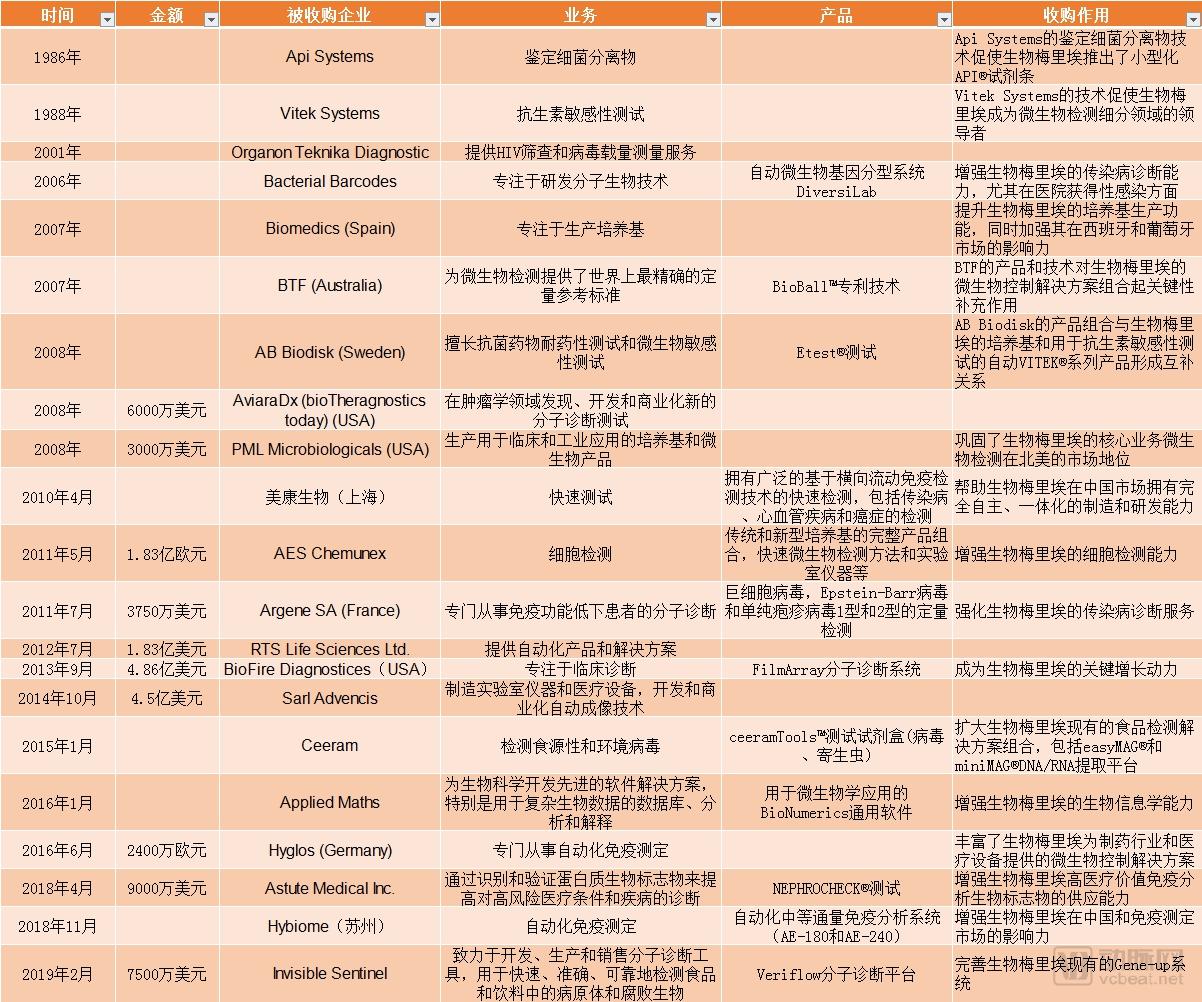
A review of BioMerieux’s acquisition history by VCBeat reveals that the company initially focused more on technology-driven enterprises. In particular, several acquisitions in the 1980s, such as Api Systems and Vitek Systems, laid the technological foundation for its future development.
Notably, the bacterial isolate identification technology from Api Systems prompted BioMerieux to launch the miniaturized API® test strips. With API® test strips, the identification of bacteria and fungi has become simpler, faster, and more reliable. Today, API® has become the reference technology for identifying bacterial and fungal species worldwide. Furthermore, the VITEK® series of testing instruments, derived from Vitek Systems, has become a flagship product for BioMerieux in the field of microbiological testing, even establishing the company as a leader in this niche sector.
According to official website information, BioMerieux carried out as many as 10 acquisition transactions between 2006 and 2008. Regrettably, due to incomplete data, VCBeat was unable to collect information on all of these transactions. However, based on the known acquisitions, VCBeat found that, unlike its early focus on building a technological foundation, BioMerieux’s acquisitions during this period were primarily aimed at expanding its product portfolio and boosting market confidence. In the announcement of one such acquisition, BioMerieux’s senior management stated that the acquisition of new technologies and products was intended to stimulate the market and thereby break through the company’s development bottlenecks.
The largest acquisition by transaction value occurred in 2013. To acquire the FilmArray molecular diagnostic system from U.S. clinical diagnostics company BioFire Diagnostics, BioMerieux spared no expense, purchasing the company for as much as $486 million.
The hefty acquisition has proven to be worthwhile. Since then, the FilmArray product series has driven overall sales growth for BioMerieux. In its 2018 financial report, BioMerieux stated that sales growth in North America, Europe, and the Asia-Pacific region was primarily attributable to the BioFire® FilmArray® molecular diagnostics product line.
Multidisciplinary, international collaborations with academic research institutions, the medical and scientific communities, and cutting-edge biotechnology companies are also a crucial component of BioMerieux’s open innovation strategy. Particularly in terms of corporate partnerships, BioMerieux has established strategic alliances with companies such as GlaxoSmithKline (UK), Royal Philips (Netherlands), Knome (US), Biocartis (Switzerland), and Ipsen (France).
In November 2009, BioMerieux and GlaxoSmithKline entered into a collaborative agreement to leverage their complementary expertise in the joint development of predictive tests, assisting clinicians in selecting the most appropriate treatment regimens for individual breast cancer patients. The following year, the two parties furthered their collaboration by jointly developing a novel molecular diagnostic assay for cancer, aimed at helping oncologists determine optimal therapeutic strategies for metastatic melanoma.
In January 2010, BioMerieux entered into a partnership with Philips. By combining Philips’ Magnotech biosensor platform with BioMerieux’s diagnostic technologies, the two companies jointly developed fully automated, handheld diagnostic testing solutions for hospital use, aiming to improve the diagnosis and management of diseases in intensive care units within hospitals.
In April 2010, BioMerieux and the U.S.-based Knome entered into a strategic agreement to jointly develop next-generation sequencing-based in vitro diagnostic technologies. Under the agreement, BioMerieux holds exclusive rights to license Knome’s proprietary genomic analysis platform for the in vitro diagnostics market, while Knome gains access to BioMerieux’s intellectual property in DNA extraction and sample preparation.
In November 2010, BioMerieux established a strategic partnership in molecular diagnostics with Biocartis of Switzerland. Under the agreement, BioMerieux would develop and commercialize microbiological testing products on Biocartis’s fully integrated molecular diagnostic platform, Idylla™. In the third year of the collaboration, BioMerieux announced the termination of its agreement with Biocartis to focus on advancing its infectious disease testing solutions.
In February 2011, BioMerieux and the French company Ipsen established a partnership in the field of personalized medicine. Leveraging Ipsen’s portfolio of innovative compounds and BioMerieux’s diagnostic tests, the two parties jointly developed therapeutic and companion diagnostic projects for the prevention and treatment of prostate cancer, breast cancer, neuroendocrine tumors (NETs), and pituitary tumors.
Recently, BioMerieux entered into a partnership with Baxter to jointly develop biomarkers aimed at rapidly identifying acute kidney injury (AKI) and providing accurate diagnostic information for treatment.
In retrospect, nearly every acquisition and partnership undertaken by BioMerieux—whether to lay the technological groundwork in its early stages or to consolidate its market position in the middle phase—has provided a significant impetus to the company’s development.
The implementation of a series of strategic initiatives, including independent research and development, acquisitions, and collaborations, has yielded favorable results. As a result, BioMerieux has established a comprehensive diagnostic system encompassing reagents, instruments, software, and laboratory services. Focusing on infectious diseases, healthcare-associated antimicrobial-resistant infections, and cardiovascular emergencies, BioMerieux leverages microbiological testing, molecular diagnostics, immunoassay technologies, and laboratory performance optimization services to assist healthcare institutions in diagnosing patient conditions and rapidly delivering high-value diagnostic information.
[Microbial Testing]
Microbial detection technology is a critical technique for identifying microorganisms present in biological samples and determining their susceptibility to tested antibiotics. As a leader in the field of microbial diagnostics, BioMerieux offers both handheld and fully automated solutions, encompassing blood culture, detection, bacterial identification, and antibiotic susceptibility testing.
Among them, the BACT/ALERT® VIRTUO® microbial detection system is a new-generation blood culture system featuring functions such as blood volume measurement and automated bottle loading/unloading. The BACT/ALERT® 3D automated microbial detection system provides innovative sepsis diagnostic technology for laboratories of any scale and is currently the most compact, modular, and flexible system available. This system enables rapid, automated detection of positive blood cultures, diagnosis of bacterial and fungal infections, and detection of tuberculosis infections.
In addition, the VITEK® automated identification and antimicrobial susceptibility testing system, the VITEK® MS microbial mass spectrometry identification system, the API® reagent strips, the Previ® Isola automated plate inoculation system, and the Previ® Color Gram automated Gram staining instrument are also part of BioMerieux’s microbiology product portfolio.
[Molecular Diagnostics]
BioMerieux’s molecular diagnostics solutions encompass extraction, amplification, and detection, with its main products including Argene®, NucliSENS® easyMag, NucliSENS® easyQ, DiversiLab®, and the FilmArray™ system.
Among these, the FilmArray™ system, which makes a significant contribution to BioMerieux’s sales, is a multiplex PCR instrument certified by the FDA, CE-IVD, and TGA. This system integrates sample preparation, amplification, detection, and analysis functions, enabling the simultaneous detection of bacteria, viruses, fungi, parasites, or antibiotic resistance genes.
The FilmArray™ system delivers results within 45 to 65 minutes, providing physicians with rapid and accurate information to accelerate clinical decision-making and improve patient care. The FilmArray™ system can diagnose four major syndromes: respiratory infections (including pneumonia), gastrointestinal infections, meningitis/encephalitis, and sepsis.
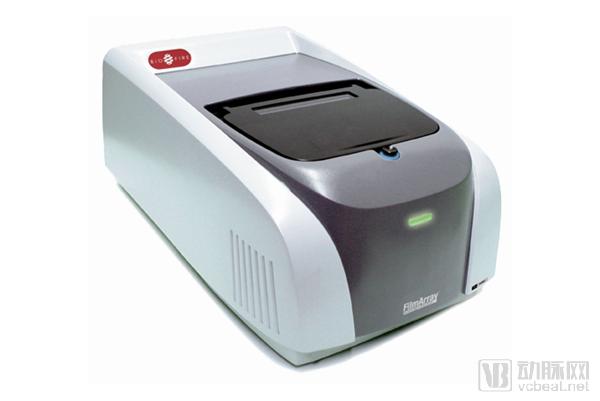
FilmArray™ Multiplex PCR System for Rapid, Simple, and Comprehensive Testing (Image from the official website of BioMerieux China)
[Immunoassay]
Immunoassays are used to diagnose, screen for, monitor, or predict diseases (e.g., viral infections, cardiovascular diseases, cancer, or hormonal disorders). This test primarily examines the patient’s immune response to identify or quantify antigen-antibody reactions in samples such as serum, plasma, or blood.
BioMerieux’s immunology brands mainly include VIDAS®, bioNexia®, and VIKIA®. The VIDAS® series of fully automated fluorescent immunoassay analyzers comprises three models: MINI-VIDAS®, VIDAS®, and VIDAS®3. All three instruments support a full test menu, require no warm-up time, entail minimal maintenance, and are easy to use. Approximately 34,500 units of MINI-VIDAS® and VIDAS® have been sold worldwide.
[Laboratory Services]
Automation and integration of innovative technologies are key drivers in optimizing laboratory performance and enhancing patient care. To ensure maximum utilization of technology and improved laboratory efficiency, BioMerieux provides performance optimization and information management services for clinical and industrial laboratories, in addition to continuously developing new technologies and reagents and updating diagnostic systems.
Through process analysis, BioMerieux helps laboratories streamline workflows, boost productivity, reduce costs, and optimize quality, enabling laboratory staff to focus on high-value-added tasks. The company assists laboratory professionals in quality management by continuously improving its products and providing targeted services and solutions to support customers’ quality management efforts. Additionally, BioMerieux regularly conducts training courses for customers to ensure they have timely access to the latest professional expertise.
BioMerieux helps laboratories address challenges by providing fully automated, customized, and personalized solutions, such as WASP® (Walk Away Specimen Processor) and PREVI® COLORGRAM. The company’s automation solutions have halved the time required for laboratory testing, enabling microbiologists to obtain results within hours. Looking ahead, BioMerieux plans to further optimize its technologies to reduce testing times to just minutes.
According to BioMerieux’s financial reports in recent years, driven by its comprehensive suite of in vitro diagnostic solutions, the company has achieved continuous growth. From €1.341 billion in 2014 to €2.4 billion in 2018, BioMerieux realized an average annual growth rate of approximately 10%.
Currently, the major players in the global in vitro diagnostics (IVD) sector include BioMerieux, as well as industry leaders such as Siemens, Abbott, Danaher, Roche, and Thermo Fisher Scientific.
Roche, which started as a pharmaceutical company, initially focused on cancer. After acquiring Germany’s Boehringer Mannheim, Roche leveraged Boehringer Mannheim’s expertise in electrochemiluminescence technology to establish a unique advantage in the field of tumor immunodiagnostics (electrochemiluminescence).
In April 2014, Roche acquired molecular diagnostics company IQuum for $450 million, integrating IQuum’s Liat system into Roche’s molecular diagnostics portfolio to rapidly enter the point-of-care (POC) segment of the molecular diagnostics market.
The i-STAT system, developed based on microfluidics technology, has strengthened Abbott’s capabilities in infectious disease immunoassays. Following the acquisition of Alere, Abbott has emerged as the dominant player in the point-of-care testing (POCT) sector.
Siemens, with its origins in instrument development, boasts the most comprehensive product portfolio in the in vitro diagnostics industry. Meanwhile, it demonstrates strong capabilities in imaging software and IT diagnostic systems.
Danaher possesses world-class fully automated clinical chemistry analyzers. In September 2016, Danaher acquired the molecular diagnostics company Cepheid for $4 billion, thereby adding Cepheid’s flagship product, the GeneXpert quantitative PCR system, to its portfolio.
Without exception, these companies have increased their market share and enhanced their global market influence through market strategies such as mergers and acquisitions, partnerships, and new product development.
Major industry players are increasingly expanding into the in vitro diagnostics (IVD) sector, driven not only by their diverse business portfolios and strong market expansion capabilities, but also by the overall favorable development trends in the IVD landscape.
According to the Global In Vitro Diagnostics Market Research Report released by Grand View Research, a business consulting firm, the global in vitro diagnostics market was valued at USD 69.6 billion in 2018, with an estimated compound annual growth rate (CAGR) of 4.75% from 2019 to 2026.
Key factors such as the growing elderly population, rising prevalence of chronic and infectious diseases, and increased adoption of fully automated instruments by testing laboratories are driving the development of the in vitro diagnostics market. Furthermore, the launch of new products and advancements in new technologies, particularly in terms of cost-effectiveness, accuracy, and portability, will also propel market growth.
Currently, the products and market in China’s in vitro diagnostics (IVD) sector are still in the early stages of development, with foreign-made products holding a dominant position. However, judging from industry trends in recent years, domestic companies are catching up rapidly. A number of strong IVD players have emerged, such as Mindray, Kehua Bio-Engineering, and Da An Gene, which are primarily focused on the three major segments of clinical chemistry, immunoassay, and molecular diagnostics.
As domestic companies’ technologies and products continue to mature, bolstered by favorable policy support, it is believed that local enterprises in the in vitro diagnostics (IVD) sector will soon be able to join the ranks of global giants.
Reference Link:
https://www.grandviewresearch.com/industry-analysis/in-vitro-diagnostics-ivd-market
https://www.biomerieux.com.cn/
https://www.biomerieux.com/