

Medical Equipment Demand Surges in Grassroots Healthcare: 13 Institutions Procure Nearly RMB 20 Million in Six Months, with 930,000 Facilities Facing Urgent Needs
At 8:00 a.m., Wang Xiaowei (a pseudonym) began her workday. As a primary care physician at the Yonglong Community Health Clinic in Nanchuan District, Chongqing Municipality, she serves a jurisdiction of approximately 100 households. Being the sole physician at the clinic, Wang acts as the gatekeeper of community health. Her daily patient volume ranges from a high of ten to a low of one or two, with the majority being elderly residents and children within her catchment area. Across China, there are more than 60,000 medical institutions similar to the Yonglong Community Health Clinic.
In Wang Xiaowei’s diagnostic process, she typically relies on clinical experience and simple devices such as hearing aids, sphygmomanometers, and infrared thermometers. The treatments she can provide are limited to intravenous infusions, injections, and medication prescriptions.
China,According to the China Statistical Yearbook,As of the end of 2017, there were a total of 933,024 primary healthcare institutions, including 34,652 community health service centers, 36,551 township health centers, 632,057 village clinics, and 229,221 outpatient departments (clinics).
These 930,000 primary healthcare institutions play a role in the medical system by providing basic public health services to residents. This includes establishing and managing resident health records, conducting health education, assisting in the prevention and control of infectious diseases, endemic diseases, and parasitic diseases, as well as performing screening and case management for high-risk populations and patients with key chronic diseases.
However, issues such as a shortage of personnel and the inability to equip large- and medium-sized medical devices at primary healthcare institutions have made it difficult for most diagnostic and treatment services to be carried out at the grassroots level.
It is undeniable that enhancing the medical service capacity of primary healthcare institutions requires the rational allocation and updating of necessary facilities and equipment. After all, in some primary healthcare settings, the management of residents’ health records still relies on paper-based documentation.
To strengthen the service capacity of primary healthcare institutions, governments at all levels have issued numerous policies to promote tiered diagnosis and treatment and enhance primary care capabilities. In terms of financial investment, local governments have allocated hundreds of millions of yuan to bolster primary healthcare. For example, the Implementation Plan for Deepening Comprehensive Reform of the Medical and Healthcare System in Guangdong Province, promulgated in 2018, explicitly stated that fiscal authorities at all levels in Guangdong Province planned to allocate RMB 50 billion over three years to increase support for primary medical and health services.
In the medical device industry, the primary care market has not garnered the same level of attention as top-tier tertiary hospitals, primarily due to limited procurement capacity and a constrained market size. However, driven by the policy of tiered diagnosis and treatment, the medical device market at the primary care level is beginning to expand significantly. So, just how large is the medical device market in primary care settings?
From the perspective of the primary healthcare market scope, hospitals in China are classified into three tiers based on accreditation criteria such as hospital size, research focus, technical expertise and talent strength, and medical hardware equipment. Each tier is further subdivided into Grade A, Grade B, and Grade C, with an additional Special Grade category introduced for Tier-3 hospitals.
Among these, primary hospitals are grassroots hospitals that directly provide comprehensive medical, preventive, rehabilitative, and healthcare services to the community. According to the China Statistical Yearbook, grassroots health institutions include five categories: community health service centers, village clinics, township health centers, and outpatient departments (clinics). Therefore, the scope of primary healthcare should encompass primary hospitals as well as grassroots health institutions such as community health service centers and village clinics.
VCBeat reviewed tender announcements for primary healthcare institutions over the past six months and found that 13 such institutions spent approximately RMB 18.94 million on medical device procurement during this period. Procurement expenditures at Tier-1 hospitals generally ranged from RMB 1 million to RMB 3 million, while community health service centers demonstrated weaker purchasing capacity.
Furthermore, driven by the poverty alleviation campaign, the procurement volume of medical devices in village clinics has gradually increased. Even without precise estimates, it is evident that the entire grassroots medical device market is substantial and cannot be underestimated.
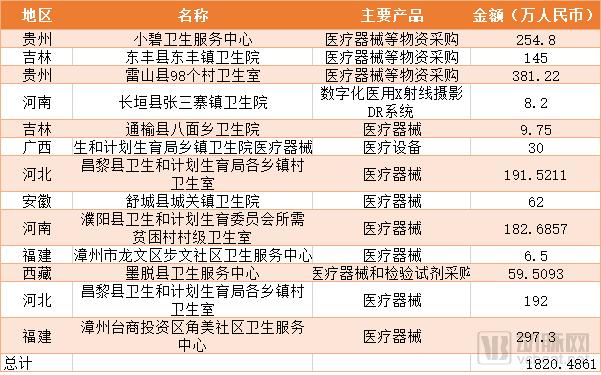
Data sourced from the China Government Procurement Network (data not published in certain regions; thus, it does not encompass all primary healthcare procurement data from the past six months).
This market will continue to expand in volume, driven by policy support. Taking diagnostics as an example, one of the biggest challenges for primary healthcare institutions in purchasing large-scale equipment was the low diagnostic volume; costs such as ongoing equipment maintenance and reagent shelf-life constraints often led to operational deficits. With the deepening implementation of the tiered diagnosis and treatment policy, patients are increasingly returning to primary care facilities.
As early as 2015, the State Council issued guiding opinions to improve primary healthcare service capacity, focusing on common diseases, frequently occurring diseases, and chronic diseases, with tiered diagnosis and treatment as the breakthrough point to refine the tiered diagnosis and treatment system.
At the 2017 Two Sessions, it was reiterated that an 85% coverage rate must be achieved by the end of 2017. Since then, tiered diagnosis and treatment has been included in the Government Work Report every year.
A doctor at a village clinic stated, “The role of medical insurance in patient triage is significant. Under the New Rural Cooperative Medical Scheme reimbursement system, residents receive a higher reimbursement rate for treatments at village clinics, which encourages many patients to seek care here.”
In other words, health insurance leverage serves as a crucial tool for promoting tiered diagnosis and treatment, driving greater patient volume to primary care institutions and facilitating the downward allocation of resources. In certain provinces, more advanced pilot programs are evident, which not only stimulate demand from the patient perspective but also balance medical resources within medical consortia.
In Zhejiang Province, medical insurance payments are bundled and allocated to county-level medical communities, incentivizing them to proactively optimize rational diagnosis and treatment, preventive care, and health management. This approach strengthens the oversight of appropriate testing and medication use, thereby reducing out-of-pocket healthcare costs for patients. Reforms such as the Diagnosis-Intervention Packet (DIP) point-based payment system for inpatient services and capitation payments linked to family doctor contracts for outpatient services are being promoted. These measures guide medical communities to achieve the dual objectives of curbing waste in medical insurance funds and enhancing the quality of medical services, while also enabling residents to access healthcare services conveniently within their local communities.
The primary healthcare market will continue to expand, but another challenge facing this sector is the scarcity of professional talent. Data released by the National Health Commission on April 21, 2019, showed that physicians in China are overly concentrated in large tertiary hospitals in major cities, while the number of physicians in urban and rural primary care settings—particularly in rural areas and remote mountainous regions—is very limited. Specifically, the number of physicians per 1,000 people in rural areas is 1.8, only 45% of the figure in urban areas. Consequently, the shortage of professionals skilled in operating medical equipment is also one of the obstacles hindering the deployment of medical devices in primary healthcare settings.
What Types of Medical Devices Are Needed in Primary Healthcare?
In addition to market and talent, it is essential to clarify which types of medical devices are truly needed in primary healthcare.
The National Health Commission released the “Guidelines for Evaluating Service Capacity of Township Health Centers (2019 Edition)” and the “Guidelines for Evaluating Service Capacity of Community Health Service Centers (2019 Edition),” which set forth the latest standards for medical equipment configuration for China’s 36,000 township health centers and 35,000 community health service centers.
It specifies that community health service centers and township health centers should be equipped with devices such as digital radiography (DR) systems, color Doppler ultrasound scanners, fully automated biochemical analyzers, coagulation analyzers, 12-lead electrocardiographs, ECG monitors, remote ECG monitoring devices, air disinfectors, ventilators, ambulatory ECG monitors, and ambulatory blood pressure monitors.
The most fundamental role of primary healthcare is to provide basic public health services at the grassroots level, such as establishing and managing residents’ health records, conducting health education, assisting in the prevention and control of infectious diseases, endemic diseases, and parasitic diseases, and performing screening and case management for high-risk populations and patients with key chronic diseases.
According to the National Health Commission’s plan, each community health service center is designed to serve a population of 8,000–20,000. However, data from the National Health Commission also show that by the end of 2018, China had 2.59 physicians per 1,000 people (compared with more than 4 in developed countries such as Germany and Austria). Of these, rural areas had 1.8 physicians per 1,000 people, only 45% of the urban level.
By this standard, the number of physicians providing primary public health services is far from sufficient. To address this gap, all-in-one health kiosks capable of performing integrated health indicator testing have become an essential necessity.
All-in-One Health Kiosk refers to a device that integrates seven basic diagnostic functions—electrocardiogram (ECG), heart rate, blood glucose, blood pressure, blood oxygen saturation, routine urinalysis, and body temperature. It is capable of data acquisition, storage, processing, and transmission for medical examinations, featuring high integration, ease of operation, portability, as well as stability and precision.
Currently, most suppliers of all-in-one health kiosks also provide cloud-based services on the backend. By leveraging cloud computing and other technologies to analyze the collected big data, they assist physicians in health management.
Taking "Yifu Tianxia" as an example, the Yifu Tianxia platform consists of components such as the Kangshang Health All-in-One Machine and a mobile client. Family doctors can use this platform to provide services including electronic contract signing, remote contract signing, in-home contract signing, and doctor-patient management.
The Kangshang Health All-in-One Machine features an integrated hardware-software system with medical measurement tools capable of detecting 37 key physiological parameters, including electrocardiogram (ECG), blood pressure, blood oxygen saturation, blood lipids, cholesterol, blood glucose, fetal heart rate, and urinalysis. These devices are deployed in community health clinics and township health centers.
By leveraging this platform, family physicians and primary healthcare workers can simultaneously conduct public health measurements and carry out family physician service tasks, thereby genuinely enhancing the work efficiency of public health services, including public health management, public health examinations, public health follow-ups, disease screening, disease surveillance, and management of key populations.
Many companies have entered this field and currently hold a certain market share. However, the technical barriers for products in this sector are not high. The key challenge lies in penetrating lower-tier markets to secure a significant market size.
For the grassroots market, integrated solutions that include equipment have also emerged. Taking the National Basic Public Health Integrated Platform established by Guoan Guangchuan as an example, it provides a “Family Doctor Comprehensive Service Management System + Smart Workstation””, which can provide a range of services including family physician contract management, health education, performance evaluation, and consultation management, with the devices serving as an integral component of the solution.
A comparison based on the National Health Commission’s evaluation standards for primary healthcare reveals that, in addition to all-in-one health kiosks, laboratory testing and medical imaging represent two major shortcomings at the primary care level.
Two Major Trends in Addressing the Challenges of Diagnostic Equipment in Primary Healthcare:
First, innovate the business model to develop third-party clinical laboratories;
Second, promote POCT (point-of-care testing) products through technological innovation.
In the first major model, taking KuaiYiJian as an example, it connects thousands of clinics, village health rooms, and health stations on one end with third-party medical laboratories on the other, using logistics as a bridge to help them address the lack of effective diagnostic support tools in the clinical process.
As of July 2018, the number of clinics using KuaiYiJian services reached 20,000, enabling same-day delivery of specimens to laboratories and allowing over 90% of test reports to be available the next day.
The second solution involves replacing large-scale equipment with POCT products that are lower in cost and easier to operate, thereby penetrating the primary care sector. Diagnostic products are categorized into highly automated large-scale diagnostic instruments (such as large biochemistry analyzers and chemiluminescence immunoassay systems) and small, convenient, and cost-effective diagnostic devices (including hematology analyzers and POCT devices). The primary care demand generated by the tiered diagnosis and treatment system originates primarily from small-scale diagnostic devices.
In hospitals below the secondary level, clinical laboratories not only handle a small volume of samples and have limited technical capabilities, but also exhibit low utilization rates of large-scale equipment. The implementation of tiered diagnosis and treatment can increase outpatient visits at primary care institutions, facilitate triage between acute and chronic conditions, and ultimately promote the widespread adoption of point-of-care testing (POCT) across hospitals and departments at all levels, such as emergency departments, outpatient clinics, and community health centers.
For projects with low sample volumes, single-sample, single-run testing is fast and convenient, requires minimal operator expertise, and facilitates storage and infrequent use.It eliminates processes such as specimen collection and submission for testing, shortens report turnaround time, and reduces human error."Ideal for primary healthcare institutions."
Based on the current level of market saturation and primary demand in grassroots markets,In the immunodiagnostic market, domestic companies have primarily focused on hospitals below Tier II, achieving significant import substitution in the overall low- to mid-end segment of these facilities.Routine blood analysis (hematology) is currently available in primary hospitals, and routine protein and enzymatic tests (biochemistry) have also been decentralized to these facilities. However, immunoassays have not yet achieved widespread adoption at the grassroots level.
“Regarding immunoassays, hospitals below Tier II have less stringent requirements for testing accuracy compared to Tier III Grade A hospitals. Since immunoassays generally involve the detection of major diseases, patients would still need to seek treatment at large hospitals even if a condition is detected. Therefore, these hospitals place greater emphasis on cost-effectiveness when selecting products,” an industry insider told VCBeat.
For village clinics, community health centers, and outpatient clinics below the level of primary hospitals, data from KuaiYiJian indicates that the demand is primarily for routine tests, such as complete blood count (CBC), liver function tests, renal function tests, and hepatitis B serological markers.
Most companies, recognizing that primary care institutions prioritize cost-effectiveness, apply more advanced technologies to tertiary hospitals while deploying lower-end products at the primary care level. However, there are also diagnostic products specifically customized for the primary healthcare market.
Wondfo, a leading domestic in vitro diagnostics company, has launched the Flying Test immunofluorescence rapid diagnostic solution for the primary care market. This solution can be applied to the detection of infections and inflammation, cardiac infarction markers, long-term blood glucose control indicators, pregnancy identification and abnormal pregnancies, early-stage diabetic nephropathy, and exclusion testing for deep vein thrombosis and pulmonary embolism.
Addressing the primary need for routine testing at the grassroots level, Chuanghuai Medical has launched a POCT hematology analyzer. Zhuang Bin, founder of Chuanghuai Medical, stated, “Grassroots healthcare facilities should focus on meeting routine diagnostic needs. As the most fundamental of the three major routine tests, complete blood count (CBC) analysis can effectively fulfill these requirements. In terms of cost, POCT devices offer significantly higher cost-effectiveness than traditional large-scale instruments, particularly regarding ongoing maintenance, servicing, and reagent consumption.”
For primary care institutions, there is also a shortage of diagnostic imaging equipment. Similar to the challenges in diagnosis, these grassroots healthcare facilities face the dual problems of insufficient equipment and a lack of specialized personnel. Patients often need to transfer between multiple hospitals and undergo repeated imaging examinations. Furthermore, due to the high patient volume at secondary-level hospitals and above, waiting times for imaging procedures are excessively long.
There are likewise three solutions. First, deploy large-scale imaging equipment to select primary care hospitals. Second, establish regional imaging centers to address equipment shortages and leverage artificial intelligence to mitigate the shortage of diagnostic radiologists. Third, miniaturize and mobilize large-scale imaging devices.
First, the widespread adoption of large-scale medical equipment at the primary care level is primarily aimed at addressing unmet medical imaging needs in China’s fourth- and fifth-tier cities. Compared with imported products, domestically produced equipment can reduce procurement costs for healthcare institutions by 30%–50%.
In addition, third-party imaging diagnostic centers and remote cloud platforms offer another viable solution. Third-party imaging centers can not only provide patients with imaging services comparable to those offered by public hospitals, but also reduce patients’ costs for imaging examinations and shorten waiting times for appointments.
Meanwhile, remote cloud platforms can connect tertiary hospitals with primary care institutions or third-party imaging centers, enabling patients to receive consultations and treatment from specialists at Grade 3A hospitals from the comfort of their homes. Artificial intelligence technology can address challenges such as suboptimal image quality at the primary care level and shortages of medical professionals.
Regarding solutions for primary care imaging, it remains highly challenging to fully deploy large-scale medical equipment to the grassroots level. An alternative approach is to miniaturize such equipment, as seen with handheld ultrasound devices and smartphone-based fundus screening instruments.
Taking the Chinese handheld ultrasound manufacturer Siduoke as an example, its handheld ultrasound devices utilize physical channels typically reserved for large-scale equipment, enabling simultaneous dual-screen transmission. Siduoke plans to introduce additional functional modules tailored to the needs of primary care settings. Currently, Siduoke has established extensive collaborations within primary healthcare institutions.
For large-scale ultrasound equipment, even medical master’s degree holders require training and practical experience to achieve proficiency. Although handheld ultrasound devices still necessitate a period of user education, physician training is considerably easier compared to that for large-scale ultrasound systems.
The primary healthcare market, characterized by low entry barriers and significant growth potential, is poised for explosive growth driven by continuous policy support. With concurrent innovations in business models and products, this trend will create greater possibilities for the equipment of medical devices at the primary care level.