Four Years into Tiered Diagnosis and Treatment Reform: Public Retreats, Private Advances — Insights from Grassroots Physicians on the Current Landscape of Public and Private Primary Care Institutions
Core Viewpoints:
1. Public and private primary healthcare institutions can be optimized by referencing the reform model of state-owned enterprises;
2. Public health tasks consume a significant amount of energy for public primary care physicians, so improving efficiency is crucial;
3. Private medical institutions have taken deeper root at the grassroots level;
4. Grassroots training and the deployment of experts to lower-tier institutions should be tailored to actual conditions;
5. Health insurance should transition its payment methods to support the transformation of primary healthcare institutions.
Recently, the program “Focus Interview” aired an episode titled “Community Hospitals at Our Doorstep,” which recounted how the Tiexinqiao Community Health Service Center in Yuhuatai District, Nanjing, added a “Community Hospital” designation to enhance the medical service capabilities of grassroots community health centers.
To better serve residents, the Tiexinqiao Community Health Service Center has focused on improvements in staffing, equipment, and protocols to meet patient needs. By prioritizing key areas, it has enhanced its capacity for diagnosing and treating common and frequently occurring conditions in outpatient settings, providing comprehensive services including diagnosis, treatment, rehabilitation, and nursing care for general diseases.
This marks another pilot initiative to implement the tiered diagnosis and treatment policy. In May 2015, the General Office of the State Council issued the "Guiding Opinions on Pilot Comprehensive Reform of Urban Public Hospitals," which for the first time elevated "tiered diagnosis and treatment" to an institutional level, aiming to establish a tiered service delivery model and improve medical insurance policies aligned with this system. Since then, China has embarked on large-scale implementation of tiered diagnosis and treatment.
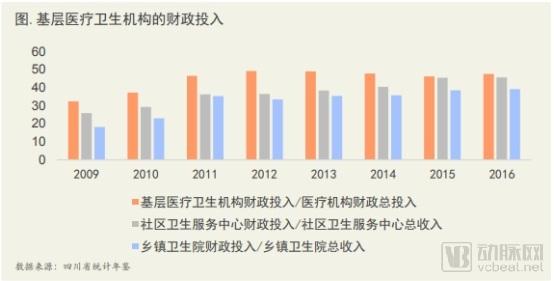
As shown in the chart, the proportion of fiscal investment in primary healthcare institutions to total fiscal investment in medical institutions increased from 32.40% in 2009 to 49.29% in 2012. It then gradually declined, reaching 47.59% in 2016.
The ratio of fiscal investment to total revenue in community health service centers increased steadily from 2009 to 2016, rising from 25.91% to 45.67%.
Fiscal Investment in Township Health Centers / Total Revenue of Township Health Centers has also been increasing, rising from 18.14% to 39.21% between 2009 and 2016. These figures demonstrate that the Sichuan Provincial Government has effectively implemented healthcare reform measures.
As of today, the tiered diagnosis and treatment system has been implemented for four years. What changes have taken place in primary healthcare institutions? VCBeat (WeChat ID: vcbeat) interviewed staff members at several primary healthcare facilities to hear their perspectives.
Public Health Affairs Consume Significant Physician Energy, Necessitating the Establishment of Sound Incentive Mechanisms
Under existing policy regulations, community health centers are required not only to provide medical services but also to oversee public health affairs at the primary care level.
Primary public health services encompass twelve major categories, including the management of residents’ health records, health education, maternal and child health management, immunization, health management for the elderly, health management for patients with diabetes and hypertension, and the handling of infectious diseases and public health emergencies.
Especially with the advancement of family doctor contract services, public health work occupies a significant amount of time for primary care physicians.
Wu Yuxiong, Executive Vice President of the Guangdong Family Doctors Association, told VCBeat,Due to the multitude and complexity of public health tasks, doctors in public community health centers are unable to devote more time and energy to medical services, resulting in a significant decline in the clinical proficiency of most physicians.。
A decline in clinical service capacity can damage the reputation of community health service centers among patients, thereby affecting their outpatient volumes.
Dr. Guo Xinglin of the Xiqi Village Clinic in Nangong City also stated that she had previously been responsible for managing residents’ health records for a period, but due to the large patient volume, she was simply overwhelmed. Over the past two years, she has devoted all her efforts to clinical care.
Basic public health services are non-profit public health interventions primarily aimed at disease prevention and control. These services will not be abolished due to the time and energy they consume from individual physicians. To address this conflict, primary care physicians have offered their perspectives.
Shi Huaqiang, from the Jinpan No. 1 Community Health Service Station in Longhua District, Haikou City, and former president of the Haikou Community Health Service Association, stated that the fundamental principles of healthcare reform are “establishing mechanisms, strengthening primary care, and ensuring basic coverage.” He emphasized that what primary healthcare lacks most is a sound benefit incentive mechanism, which can integrate the interests of all stakeholders, including medical insurance providers, healthcare suppliers, residents, and suppliers of medical products such as pharmaceuticals and devices. This would enable primary healthcare to move beyond the traditional disease-centered model and truly return to a health-centered model.
Shi Huaqiang candidly stated that the original intention of the family doctor contract system was good,However, the current incentive mechanism remains disease-centered, with primary care institutions deriving their revenue primarily from disease treatment; consequently, a higher patient volume translates into higher income. This framework creates a paradox: the more effectively primary care institutions manage the health of residents in their catchment areas, the fewer patients they will have, and the lower their physicians’ income will be.。
Thus, if the healthcare system is structured from this perspective, reforms in primary care—including certain family doctor contract services—may not be entirely appropriate and risk becoming merely formalistic.
Proprietary Clinics Have a Deeper Grassroots Presence; Retaining Talent Is Key to Effective Primary Care at the Grassroots Level
Strengthening primary care has always been the top priority of tiered diagnosis and treatment.
Wu Yuxiong stated that, to strengthen grassroots healthcare, the association has made efforts in three areas:
First, introduce the world-renowned BMJ Clinical Knowledge Base and the Traditional Chinese Medicine (TCM) Clinical Knowledge Base, and embed them in a structured manner into physicians’ diagnostic and treatment workflows to provide clinical decision support.
Second, introduce the BMJ General Practice Competency Training Platform to provide online and offline training for physicians, thereby enhancing the diagnostic and treatment capabilities of primary care doctors;
Third, by introducing third-party services, such as remote dynamic ECG monitoring and genetic screening, clinics can enhance their service capabilities. The improvement in both diagnostic and treatment capabilities and service capabilities can help clinics retain patients, thereby increasing revenue.
However, some things have not gone as planned. According to VCBeat,To strengthen primary healthcare service capacity, some regions previously selected young primary care medical personnel for specialized general practitioner training, with the hope that they would benefit local communities. However, after completing the training, very few remained at their original workplaces; most moved on to better platforms for career development.。
Primary healthcare institutions all face the issue of talent drain, as compensation and career development opportunities in primary care are inferior to those in large hospitals. However, such issues are rare in private individual clinics and publicly owned but privately operated health stations.
Guo Xinglin from the Xiqi Village Clinic in Nangong City told VCBeat that the tiered diagnosis and treatment system has provided the greatest benefit to private primary care institutions by significantly increasing the number of physician training programs in recent years, available both online and offline. Through repeated training and years of accumulated clinical experience, their medical skills have improved markedly, enabling them to manage common diseases effectively. Additionally, with the expanding variety of available medications, the operating revenue of private clinics has seen significant growth.
"As technology advances, will personnel from private institutions move to larger platforms? Guo Xinglin stated that they would not."Because she owns the clinic and retains its income, her earnings have grown in tandem with the increasing patient volume driven by improvements in her medical expertise. She is more motivated to work for herself, and with her family nearby, she is even less likely to leave.。
Wu Yuxiong alsoThis reflects a common phenomenon among physicians at private primary-care clinics: as their technical skills improve, they become more deeply rooted in the grassroots setting. With enhanced expertise and greater clinic visibility, their income rises, making them even less inclined to seek opportunities elsewhere.
In contrast, public community health centers are grappling with the loss of talented professionals. As their clinical competencies improve, physicians at these centers often seek personal career development by moving to higher-tier platforms, given that community health centers lag behind secondary and tertiary hospitals in terms of income and career prospects.。
To improve this situation, public community health centers need to reform the current system of separate management of revenues and expenditures and redesign their performance appraisal mechanisms. Alternatively, they could follow the example of the Tiexinqiao Community Health Service Center in Yuhuatai District, Nanjing, by transforming into a hospital; only with increased patient volumes, revenue, and opportunities can they retain physicians.
Primary care needs standardized diagnosis and treatment, not just an increased frequency of specialist consultations.
“Focus Interview”’s episode “Community Hospitals at Your Doorstep” also pointed out that the National Health Commission decided to launch pilot programs in 20 provinces (autonomous regions and municipalities), including Hebei and Sichuan, in 2019, and to steadily advance the initiative in 2020 based on summary evaluations. Jiangsu Province pioneered the pilot program while simultaneously promoting the development of medical consortia, enabling physician mobility and thereby strengthening the medical workforce at primary care hospitals.
At the Xigang Community Hospital in Nanjing, a rehabilitation center and inpatient wards have been established in response to community needs, with a total of 40 beds. Patients in the recovery phase after serious illnesses can now receive inpatient rehabilitation and follow-up care close to home, while also benefiting from regular outpatient consultations by specialists from tertiary hospitals.
Yang Daxing, Chief Physician of the Department of Respiratory Medicine at Nanjing Qixia District Hospital, said: “As experts visiting the grassroots level, we have two primary objectives: first, to train community physicians in the standardized diagnosis and treatment of these diseases; and second, to assist them in resolving complex clinical challenges.”
Under the leadership of Dr. Yang Daxing, this community hospital is now capable of admitting and treating patients with a wide range of respiratory diseases.
Guo Xinglin also stated that, from the perspectives of enhancing clinic visibility and improving the quality of primary healthcare, grassroots physicians hope that doctors from higher-level hospitals can provide consultations or guidance at primary care clinics.
Dr. Yang Daxing recognizes the importance of helping establish standardized diagnosis and treatment at the primary care level, but not all experts who go down to the grassroots level do so.
According to VCBeat,When some specialists provide consultations at the grassroots level, they often encounter only common conditions that fall outside their areas of expertise. As a result, few cases align with their specialized skills throughout the day, and their professional value remains underutilized. Without adequate preparation by grassroots healthcare institutions in advance, the deployment of specialists to lower-tier facilities undoubtedly constitutes a waste of resources.。
Healthcare Insurance Payment Bottleneck
While it is important for experts to help establish standardized diagnostic and treatment protocols at the primary care level, this has not yet addressed the core issue in the development of primary healthcare. The real problem is that health insurance reimbursement remains stuck in the fee-for-service stage. It treats public and private institutions equally and should broadly promote capitation-based payment models through pilot programs.
In the article “Dilemmas and Solutions for Primary Care Clinics (II): The Predicament and Way Forward for Primary Care Clinics,” Dingjun Capital points out that using health insurance policies to steer patients toward primary care institutions is one of the local models for promoting tiered diagnosis and treatment. However, private primary care medical institutions find it difficult to benefit from this policy.
Significant variations in medical insurance policies exist across different regions due to disparities in local conditions and economic development levels. However, a common practice is to increase the reimbursement rates for services provided by primary healthcare institutions. In some areas, patients are eligible for preferential reimbursement rates and other benefits when referred to higher-level hospitals only if they first receive initial diagnosis and treatment at designated primary healthcare institutions.
This has undoubtedly boosted the development of public medical institutions and large-scale private hospitals. However, the vast majority of primary care clinics are non-public entities and are entirely unable to benefit from such support.
From a policy perspective, there is no explicit regulation prohibiting private primary-care clinics from obtaining designated medical insurance provider status; however, excessively high thresholds, stringent approval processes, cumbersome procedures, and prolonged waiting times have effectively barred the majority of these clinics from participating in the medical insurance system.。
Both public and private institutions have made significant contributions to the development of primary healthcare. Policies should provide appropriate support to high-quality private clinics.
Supporting Private Clinics Can Also Strengthen Primary Healthcare
China’s healthcare policy has consistently adhered to the guiding principle of maintaining public medical institutions as the mainstay while promoting the concurrent development of non-public medical institutions, so as to accelerate the formation of a diversified landscape in healthcare provision. This constitutes the fundamental principle and direction of China’s healthcare system reform.
In strengthening primary healthcare service capacity, there are significant disparities in resource acquisition between public community health institutions and private community medical institutions.。
The former is established within the public system, with land use, facilities, equipment procurement, personnel training, and salaries all covered by the system. In contrast, private primary healthcare institutions must rely entirely on private capital and do not receive sufficient financial subsidies.
Since the implementation of the tiered diagnosis and treatment policy, public institutions have received increasing support; however, in terms of service capacity and outcomes, the inputs and outputs of public and private sectors are not necessarily proportional.
Shi Huaqiang told VCBeat that Haikou City has more than 120 community health centers (stations), fewer than 11 of which are publicly operated, with the rest established through private funding. Private institutions provide over 90% of primary healthcare services in Haikou. While Haikou may be somewhat unique, across China, private and public institutions bear similar responsibilities, both playing a crucial role in supporting primary healthcare services.
According to the latest data from the "Statistical Bulletin on National Economic and Social Development in 2018" released by the National Bureau of Statistics: By the end of 2018, there were a total of 950,000 primary medical and health institutions across China, including 36,000 township health centers, 35,000 community health service centers (stations), 248,000 outpatient departments (clinics), and 630,000 village clinics.
According to the data, compared with 2017, the total number of primary healthcare institutions increased by 10,000 in 2018, township health centers decreased by 1,000, outpatient departments (clinics) increased by 18,000, and village clinics decreased by 8,000.
Against the backdrop of “public sector retreat and private sector advance,” private primary healthcare institutions will play a more significant role in the delivery of primary healthcare services in the future.
At the grassroots level, many outstanding public institutions, such as the Tiexinqiao Community Health Service Center in Yuhuatai District, Nanjing, are continuously improving themselves to meet the health and hygiene needs of surrounding residents. Meanwhile, numerous private institutions, such as the Jinping No. 1 Community Health Service Station in Longhua District, Haikou, and the Xiqi Village Clinic in Nangong City, remain firmly rooted at the grassroots level.
Shi Huaqiang analyzed,In strengthening primary care, competent authorities have not provided private institutions with infrastructure and equipment investments comparable to those granted to public institutions, primarily due to concerns over the “loss of state-owned assets.” He suggested that relevant departments could adopt a “publicly owned, privately used” strategy to support the development of private institutions.
In terms of ultimate outcomes, both public and private institutions are addressing the health needs of the grassroots population. However, differences in their institutional status have led to certain disparities in resource allocation, somewhat akin to the historical issues between state-owned enterprises and private enterprises.
The issues between state-owned and private enterprises have been largely resolved as reforms deepen, and it is believed that better solutions can also be found for the challenges between public and private primary healthcare institutions.。