

Four IVD Companies File for STAR Market IPO Within One Month: Key Strengths and Product Portfolios

Bioperfectus Technologies
Molecular Diagnostics Product Developer

Hotgen
In Vitro Diagnostic Technology and Innovative Product R&D, Manufacturer
On the evening of April 22, the Shanghai Stock Exchange STAR Market updated its acceptance announcements, revealing that another IVD company—Jiangsu BioPerfectus Technologies Co., Ltd.—has applied for listing on the STAR Market.
As of April 23, four IVD companies have applied for listing on the STAR Market, including Jiangsu BioPerfectus Technologies Co., Ltd., HOB Biotech Group Corp., Ltd., Beijing Hotgen Biotech Co.,Ltd., and Shenzhen Lifotronic Technology Co., Ltd.
Within a single month, four in vitro diagnostic (IVD) companies rushed to list on the STAR Market, making the IVD sector one of the fastest-growing segments within China’s healthcare industry. The rapidly expanding IVD market and its high gross profit margins have attracted numerous domestic and international IVD manufacturers to enter the competitive landscape.
Among the four companies striving for a listing on the STAR Market, many of their products have successfully broken import monopolies and captured a certain market share. According to data disclosed in their prospectuses, their R&D expenditure accounts for approximately 10% of revenue, with annual operating revenues around RMB 200 million.Unlike the other three IVD companies,In addition to in vitro diagnostic solutions, Lifotronic also offers rehabilitation solutions. Its core products include not only the fully automated electrochemiluminescence immunoassay analyzer but also the phototherapy device.What are their flagship products, and what market positions do they hold? VCBeat has compiled an overview.
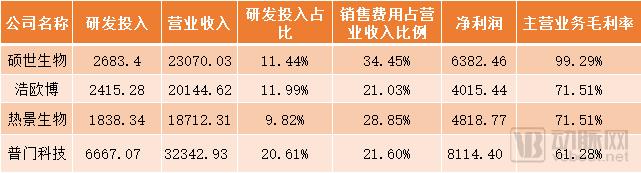
Comparison of Core Data for Four Companies Applying for Listing on the STAR Market (Unit: RMB 10,000)
According to the prospectus of Jiangsu BioPerfectus Technologies Co., Ltd., Bioperfectus Technologies’ main products include nucleic acid molecular diagnostic reagents, nucleic acid purification reagents, dry chemistry diagnostic reagents, and testing instruments.
In the field of nucleic acid molecular diagnostics, Bioperfectus Technologies primarily focuses on infectious disease testing, including the Influenza A Virus Nucleic Acid Detection Kit, as well as respiratory and diarrheal disease testing panels.
In the field of HPV testing, the company’s independently developed HPV genotyping and quantitative detection system has achieved an innovative breakthrough by enabling both “genotyping and quantification” of HPV. The Bioperfectus 21-HPV Genotyping and Quantitative Detection System is the first commercially available technology worldwide to achieve simultaneous HPV genotyping and standardized quantification.
In terms of market share, Bioperfectus Technologies has been a key supplier of HPV testing reagents for the "two-cancer screening" program in multiple regions—including Taizhou (Jiangsu), Zhengzhou (Henan), Xinjiang, Xi’an (Shaanxi), Shunde (Guangdong), and Ningxia—since 2016.
From a market-wide perspective, there are currently nearly 80 HPV molecular diagnostic reagents that have obtained medical device registration certificates from the CFDA, involving 43 companies. Representative multinational corporations in the current HPV testing market include Roche, Hologic, Qiagen, and BD; domestic companies include Daan Gene, Hybribio, Zhejiang Zhijiang Biotechnology, Yaneng Bioenergy, and Top Biological.
Notably, Jiangsu BioPerfectus Technologies Co., Ltd. is also optimistic about the field of female genital tract microecology testing. The company focuses on the research and development of innovative medical image diagnostic products, such as AI-based automated assessment of the lower female genital tract microecology and automated cytopathological analysis and diagnosis. Its self-developed vaginitis detection reagents, combined with an automated vaginitis detection workstation, form an intelligent vaginal microecology system. This system effectively addresses the limitations of traditional manual testing, which relies heavily on subjective experience and is prone to high rates of missed diagnoses and misjudgments. In this area, the company primarily collaborates with Dyingjia, a pathological AI company.
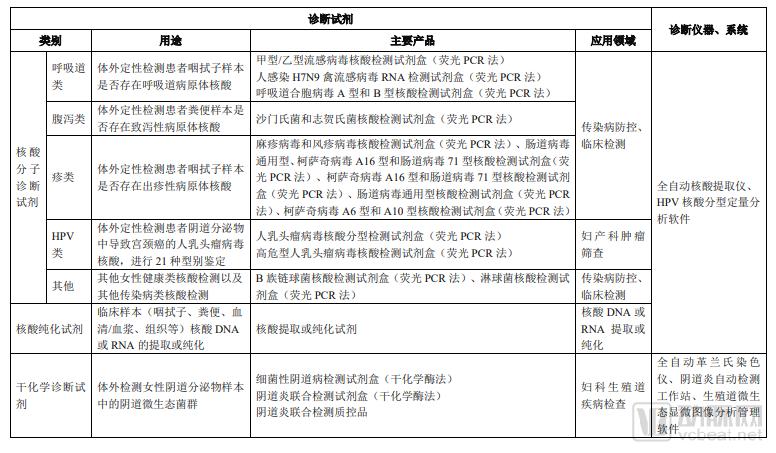
Bioperfectus Technologies Product List
Data disclosed in Bioperfectus Technologies’ prospectus shows that its total revenue from core business operations amounted to RMB 231 million in 2018, with reagents accounting for 94.75%, instruments for 3.03%, and testing services for 2.13% of the total.
In 2016, 2017, and 2018, the operating revenue reached RMB 129 million, RMB 187.2 million, and RMB 231 million, respectively.The gross profit margin of the core business reached as high as 99.29%.
HOB Biotech, founded by overseas returnees, specializes in allergy and autoimmune testing technologies. Its reagent products cover areas such as allergy testing and autoimmune testing. In addition to the second-generation (2G) and third-generation (3G) allergy and autoimmune products currently prevalent in the market, HOB Biotech possesses internationally advanced fourth-generation (4G) fully automated chemiluminescent immunoassay technology based on nano-magnetic microparticles, enabling automated, quantitative, precise, and personalized multi-dimensional testing.
In the field of allergy testing, HOB Biotech has three major product lines: Ouboke, Fuboke, and Naboke (currently undergoing domestic registration), which represent second-generation, third-generation, and fourth-generation technologies, respectively. These product lines are tailored for primary care hospitals, secondary hospitals, and tertiary Grade A hospitals, respectively.
Allergic diseases encompass a broad spectrum of conditions, such as allergic rhinitis, asthma, allergic dermatitis, urticaria, atopic dermatitis, and allergic conjunctivitis, with a prevalence rate as high as 22%.
In 2017, the domestic allergy market in China was valued at approximately RMB 400 million (based on manufacturer-to-distributor sales), with HOB Biotech accounting for over 30%. The remaining ~70% of the market was primarily held by imported brands, including Thermo Fisher Scientific (Phadia) from the United States, Euroimmun from Germany, and Mediwiss from Germany.
In another autoimmune disease segment, by the end of 2018, HOB Biotech had achieved mass production for 43 autoantibody assays, covering the detection of various conditions including systemic lupus erythematosus, Sjögren's syndrome, scleroderma, myositis, vasculitis, rheumatoid arthritis, antiphospholipid syndrome, and type 1 diabetes.
Autoimmune diseases include well-known conditions such as rheumatoid arthritis, systemic lupus erythematosus, and psoriasis; currently, more than 100 types of autoimmune diseases have been identified.
The development of autoimmune diagnostic reagents started relatively late, with a growth rate over the past five years exceeding that of the overall in vitro diagnostics (IVD) industry. The market size reached RMB 2–3 billion in 2018, with an estimated annual growth rate of approximately 25%. Autoimmune diseases remain underrecognized in certain regions of China, leading to substantial misdiagnosis and an underestimated prevalence. Tertiary hospitals account for 90% of the market share for autoimmune diagnostic reagents, secondary hospitals for only 10%, while primary hospitals represent a blank segment, resulting in a highly imbalanced market structure.
In this field, the traditional leader Euroimmun holds half of the market share, while domestic companies such as YHLO, HOB Biotech, and Kexin Biology are rapidly emerging, capturing approximately 30% of the market.
However, HOB Biotech Group Corp., Ltd. does not currently manufacture instruments in-house; instead, it meets its instrument needs by collaborating with manufacturers on joint R&D and procuring the resulting equipment.
Data from the prospectus shows that operating revenues reached RMB 112 million, RMB 146 million, and RMB 201 million in 2016, 2017, and 2018, respectively. In 2018, HOB Biotech’s allergy products achieved a gross profit margin of 79.92%, its autoimmune products a gross profit margin of 55.31%, and its core business an overall gross profit margin of 71.51%.
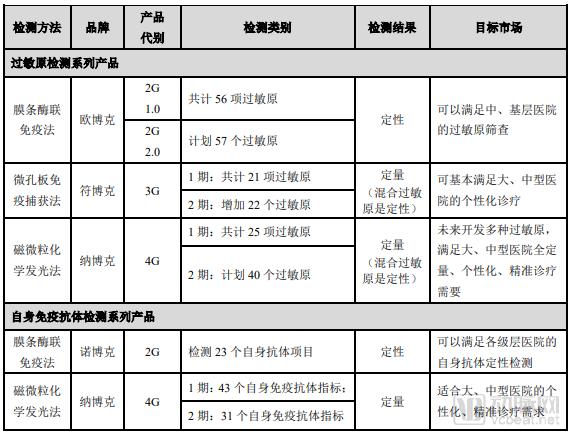
HOB Biotech's Main Product List
Hotgen, established in 2005, specializes in in vitro diagnostic (IVD) reagents and associated instruments. Its products are primarily applied in clinical fields such as liver cancer and hepatitis (16 types), cardiovascular and cerebrovascular diseases (18 types), inflammatory infections (8 types), kidney injury (3 types), preterm birth (2 types), rheumatoid arthritis (3 types), bone metabolism (1 type), and tumor/cancer early warning (6 types), as well as in public safety sectors including bioterrorism countermeasures, food safety, and disease control emergency response.
Currently, Hotgen has established an R&D technology platform centered on up-converting phosphor technology, magnetic particle chemiluminescence technology, glycan capture technology, and gene recombination and monoclonal antibody technologies.
In 2018, rapid diagnostic test reagents accounted for 85.62% of Hotgen’s revenue, rapid testing instruments accounted for 11.64%, and biological raw materials accounted for 2.74%.
Hotgen reported revenues of RMB 122 million, RMB 142 million, and RMB 187 million in 2016, 2017, and 2018, respectively, with corresponding net profits attributable to shareholders of the parent company amounting to RMB 28.7995 million, RMB 30.0723 million, and RMB 48.1877 million. Its diagnostic reagent business has maintained a growth rate exceeding 85% over the past three years.
Unlike the aforementioned three companies that focus exclusively on IVD, Shenzhen Lifotronic Technology Co., Ltd. is an enterprise that provides both treatment and rehabilitation solutions, as well as engages in the development and technological innovation of in vitro diagnostic product lines.
In the field of chemiluminescence detection, Shenzhen Lifotronic Technology Co., Ltd. has successfully developed a new generation of fully automated immunoassay platforms, including testing instruments and supporting reagents, based on the direct electrochemiluminescence immunoassay technology route using tris(bipyridine)ruthenium. This achievement has broken the global monopoly held by international industry giants in the field of electrochemiluminescence immunoassays, filled a gap in the domestic market, and made Lifotronic the first company in China to obtain registration certification for an electrochemiluminescence immunoassay system.
Shenzhen Lifotronic Technology Co., Ltd. has mastered core technologies based on four major testing platforms: electrochemiluminescence, immunoturbidimetry, liquid chromatography, and immunofluorescence. It has independently developed a specialized and professional product line of in vitro diagnostic instruments and supporting reagents, offering nearly 50 clinical test items. Its equipment is installed in more than 4,700 hospitals at various levels across China, serving hospital clinical laboratories and health examination centers.
From 2016 to 2018, Shenzhen Lifotronic Technology Co., Ltd. incurred annual R&D expenses of RMB 39.4381 million, RMB 49.9735 million, and RMB 66.6707 million, respectively, accounting for 22.60%, 19.92%, and 20.61% of its operating revenue.
In the field of in vitro diagnostics (IVD), the gross profit margin for equipment was 29.85% and that for reagents was 64.10% in 2018. With the continuous increase in the installed base of IVD equipment, the sales volume of IVD reagents grew rapidly, resulting in an annualized growth rate of 54.95% in the gross profit amount from reagents.
VCBeat has previously published a detailed report on Lifotronic Technology; for details, please see:With 2018 Revenue Exceeding RMB 320 Million, Medical Device Company Lifotronic Technology’s STAR Market Listing Application Accepted。
The aforementioned in vitro diagnostic companies were all established around 2008 and have currently secured a certain share of the market.
Previously, multinational corporations held a relatively monopolistic position in China’s high-end in vitro diagnostics (IVD) market, leveraging their advantages in products, technology, and services. While most domestic companies have primarily focused on manufacturing low- to mid-range diagnostic products, some leading Chinese firms are accelerating the implementation of product diversification strategies, actively aligning with the high-end segment and participating in both the domestic high-end and international markets. The IVD companies currently applying for listing on the STAR Market represent a vital new force in this trend. It is believed that more IVD enterprises will emerge and gain prominence on the STAR Market in the near future.