Home DP Technology Launches Deploy-Master on Bohrium Platform, Automating Deployment of Over 50,000 Agent-Ready Scientific Tools in a Single Day

DP Technology Launches Deploy-Master on Bohrium Platform, Automating Deployment of Over 50,000 Agent-Ready Scientific Tools in a Single Day

Jan 09, 2026 12:19 CST Updated 12:19
DP Technology

Simulation R&D Platform Developer



Image
Recently, DP TechnologyBohr (Bohrium) + SciMaster TeamResearch on the large-scale automated deployment of scientific research tools published on arXiv. The paper reports a scaled practice oriented towards real open-source ecosystems: from 500,000-levelStarting from the open-source candidate repository, the system retrieves, deduplicates, and screens.More than 50,000Candidate research tools incorporated into automated compilation and deployment processes, and generatedReproducible and VerifiableThe operating environment, forming a callable interface for researchers and research agents directly. Agent-Ready Tool Unit
Deploy-Master has been launched and is now available for use on the Bohr Platform., providing automated compilation and deployment services to the research community:
https://www.bohrium.com/apps/deploy-master
Paper Address:
https://arxiv.org/abs/2601.03513
Image

Scalable Practice:

Completed 52,550 build attempts in a single day,

Verified through 50,112 tools
According to the paper, during the tool discovery phase, the system started with 500,000 open-source candidate repositories, and after multiple rounds of deduplication and strict screening, ultimately identified 52,550 candidates with clear scientific research tool attributes that could enter the build process. Subsequently, the system initiated automated build attempts on these 52,550 repositories within a single day and performed minimal executable validation on the generated runtime environments. In the end, 50,112 tools passed the verification, achieving an overall success rate of 95.36%.
This means that these tools not only "exist in the repository" but also come with a reproducible runtime environment and inspectable execution entry points, enabling them to be genuinely utilized, reused, and automatically invoked.
Image
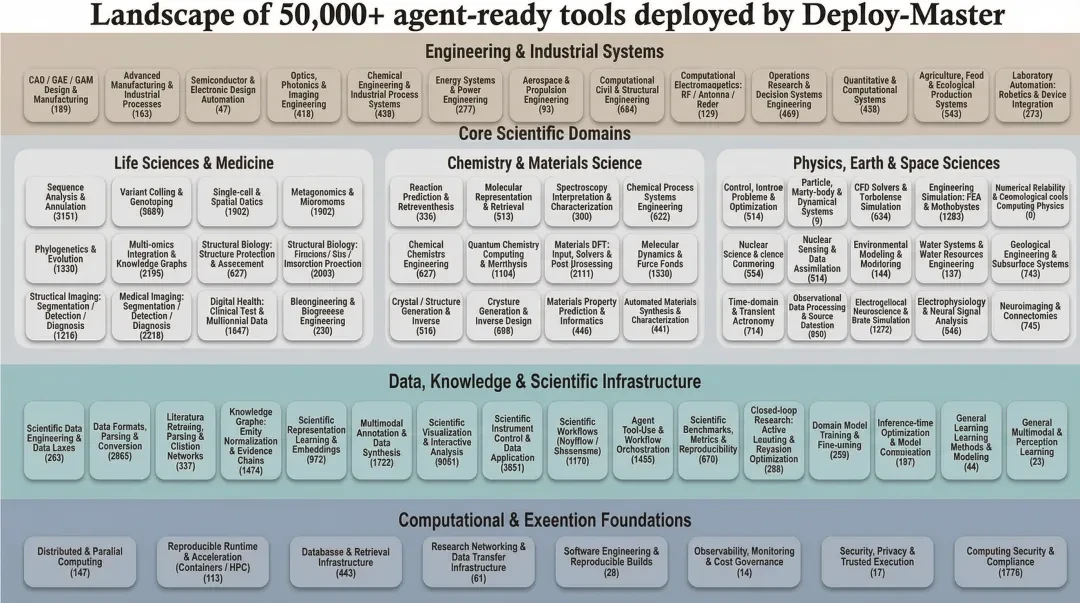
Illustration 1:50,000+ Agent-Ready ToolsCovering fields such as life sciences, chemistry and materials, physics, earth and space sciences, engineering systems, and scientific research infrastructure.
Image

How Deploy-Master Works:

Completed independently by the agent

Discovery, Construction, and Validation

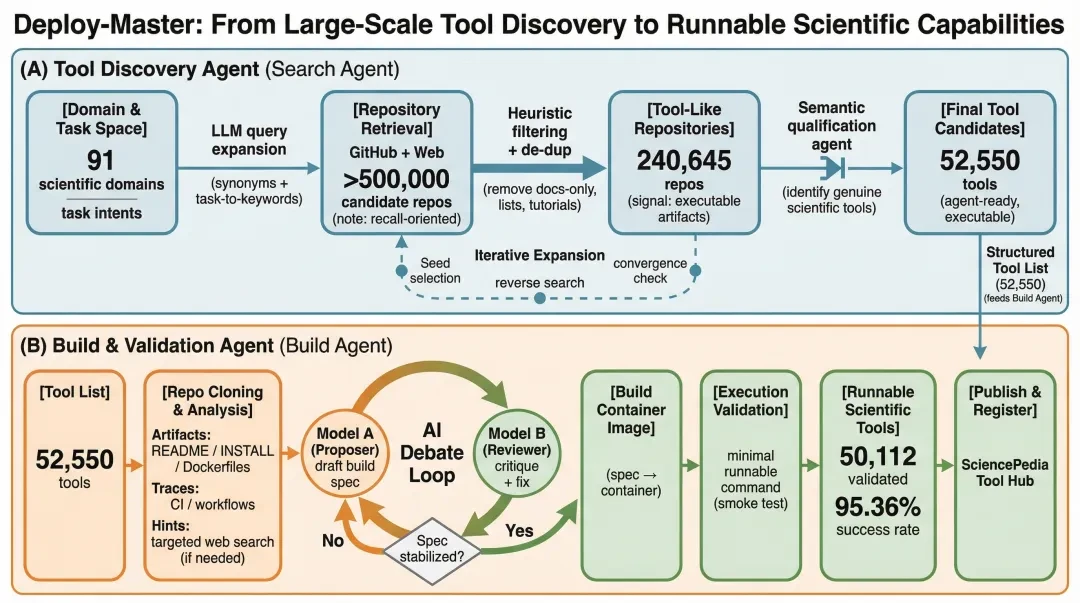
The core system supporting the above results isDeploy-MasterDeploy-Master adopts"Agent-Driven"Method,Automatically Transforming Research Tools from Open-source Repositories into Runnable and Verifiable Capability UnitsFormationDiscover—Build—Validate—ReleaseThe automatic deployment closed loop.

In this practice, Deploy-Master mainly completes tasks through the collaboration of two types of agents:

  • Tool Discovery Agent (Search Agent): For scientific and engineering tasks, systematically retrieve and iteratively expand large-scale open-source repositories, and complete deduplication and filtering based on clear criteria for admitting research tools, gradually converging to a candidate set that can enter the build validation phase;

  • Build and Validate Agent (Build Agent): Automatically infer the construction method and operation entry for the selected warehouse, complete environment encapsulation, compilation, and deployment, and proceed throughMinimum Executable CommandPerform execution verification on the tool; once verified, form reusable Agent-Ready Tool Unit, entering the unified publishing and retrieval system.

In this process, the core standard is"Reproducible Runtime Environment + Minimal Executable Validation"Rather than relying solely on documentation or manual judgment.
Image

Figure 2: Deploy-Master discovers agents through tools and collaborates with validation agents to transform the repository.Agent-Ready's Scientific Capabilities

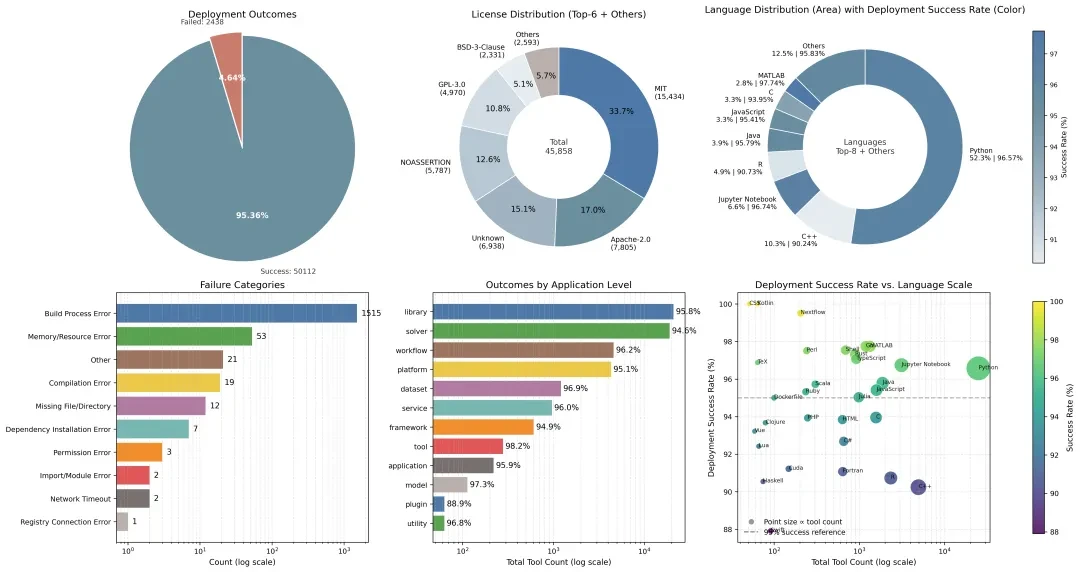
Under a unified automated process, the system is also able to systematically observe the large-scale deployment process itself. From the practical results, most tools can complete the process in approximately7 minutesCompleted construction within, but the overall distribution shows obviousLong-tail Characteristics: Some tools only contain lightweight scripts or interpreted code, while others involve complex compilation processes, deep dependencies, and system-level library configurations, resulting in significantly longer build times. This difference does not disrupt the overall process but directly determines the cost structure under large-scale deployment.

After successful deployment 50,112 unitsTools, Tool Coverage170+A programming language. Python accounts for the largest share (52.3%), and the overall deployment success rate of other languages remains at a relatively high level. A few cases with relatively lower success rates are mainly concentrated in scenarios that rely on complex compilation chains or system-level libraries, such asC/C++、Fortranand someRTool. This does not mean that these languages are "naturally more difficult to deploy," but rather reflects how their toolchains interact with the underlying environment.Higher degree of coupling, thereby amplifying the uncertainty in the construction specifications.

In 2,438 TimesIn failed build attempts, the causes of failure are not evenly distributed but highly concentrated.Build Process and Dependency/Compilation Chain MismatchThese failures, under scaled conditions, become important signals for the system to expose issues and continuously optimize scheduling strategies and isolation mechanisms, as opposed to problems caused by insufficient resources, network anomalies, or permission issues.
Image

Figure 3: Summary of Deployment Practices (Deployment Results, Licenses and Language Distribution, Failure Types, Application Levels, and the Relationship between "Language Scale - Success Rate")

Image

Deploy-Master is

Agentic Science at Scale 

Provide an executable tool base

For a long time, the scientific research field has never lacked high-quality open-source software. However, due to complex compilation, deep dependency chains, and strong environmental assumptions, many tools often can only be used stably within specific research groups or specific computing environments. As a result, the scale of scientific research tools that most platforms can maintain and deliver stably over the long term often remains limited.Hundreds level"The process of 'getting the tools up and running' itself becomes a hidden cost in the scientific research workflow."

The value demonstrated by Deploy-Master lies in: when the discovery, compilation, deployment, and verification of tools can be handled in an automated and systematic manner,Research tools have, for the first time, acquired the engineering foundation for continuous delivery and reuse on a large scale.For researchers, this lowers the barriers to reproduction and collaboration; for scientific research agents, it means that real tools can be invoked in a unified and reliable runtime environment, further organizing and validating scientific workflows.

Deploy-Master does not work in isolation. Together with the unified runtime environment of the Bohr Platform and the research intelligence system led by SciMaster, it forms a crucial infrastructure combination for future-oriented research paradigms: large-scale research tools can be executed stably, intelligent agents can invoke real tools and complete closed-loop verification, and only then can research automation and intelligent collaboration evolve from concept to a continuously advancing real system.

About DP Technology

DP Technology is a global pioneer and leader in AI for Science. Founded in 2018, the company has offices and research centers in Beijing, Shanghai, Shenzhen, and Yibin. With the mission of "accelerating scientific discovery and unleashing scientific value," DP Technology is committed to building AI Scientists and intelligent systems capable of conducting scientific discoveries autonomously.
Based on the Deep Potential·Universe® Scientific Discovery Intelligent Engine, DP Technology has built a series of intelligent scientific tools for "reading literature, performing calculations, and conducting experiments," as well as scientific AI agents in various fields, forming the Science as a Service intelligent research product and service matrix: Bohr·Scientific Navigation, Bohr·Lebesgue Intelligent Computing, and Hermite.®、Piloteye®And a series of R&D software, Bohr Cyber Lab, SciMaster Scientific Intelligence Agent, and "large-scale facilities" and R&D services for scientific discovery provide scientists and R&D organizations in the fields of basic research, life sciences, and material sciences with solutions that balance depth and breadth, offering flexible combinations.
As a national high-tech enterprise and a national specialized, refined, novel "little giant" enterprise, DP Technology's research and development team is led by an academician of the Chinese Academy of Sciences. It brings together more than a hundred outstanding young scientists and engineers from various fields such as mathematics, physics, chemistry, biology, materials, and computer science. Among them, PhDs and postdoctoral researchers account for over 35% of the company’s members. In 2020, core members of DP Technology received the "Gordon Bell Prize," the highest award in the field of global high-performance computing. Their related work was selected as one of China's top ten scientific advances in 2020 and one of the ten major technological breakthroughs in the global AI field.
Image