

Tianfu Software Park Firms Publish in World-Class Journals, Highlighting Chengdu's IP Innovation Momentum
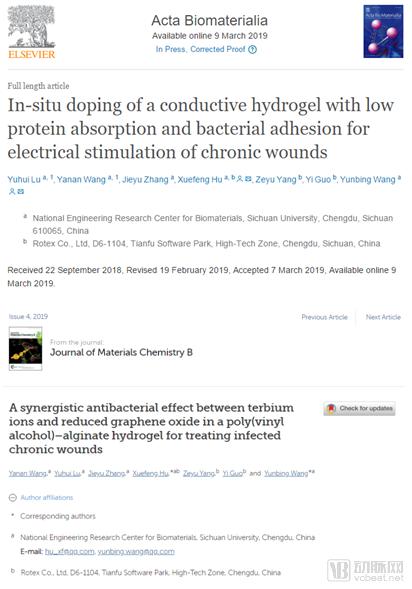
Recently, two new economy enterprises in Chengdu Tianfu Software Park published papers in world-class academic journals. First, Chengdu RouDian YunKe Technology Co., Ltd. and its partner, the National Center for Biomaterials, published academic papers on electrical stimulation for chronic wound healing based on flexible bioelectronic materials in the top-tier biomaterials journals Acta Biomaterialia and Journal of Materials Chemistry B, respectively. Second, Chengdu 23mofang Biotechnology Co., Ltd. published an academic paper in Scientific Reports, a Nature portfolio journal, presenting a genome-wide association study on the photic sneeze reflex in the Chinese population.
According to the 2017 Overview of China’s Scientific and Technical Papers released by the Institute of Scientific and Technical Information of China, the 100 high-impact international papers published by Chinese researchers in 2017 were affiliated with 69 institutions. Among these, 80 papers were from higher education institutions, 14 from research institutes, 5 from university-affiliated hospitals and other hospitals, and 1 from a company. The inclusion of a corporate paper among the top 100 high-impact publications indicates that the influence of papers published under the name of Chinese companies is steadily increasing.
According to statistics from *Angang Technology*, thirty years ago, few domestic enterprises published scientific and technical papers; on the rare occasions when they did, these were predominantly large-scale state-owned heavy industrial enterprises. Today, new-economy private enterprises, represented by RouDian YunKe and 23Mofang, are actively publishing international papers. This shift—from state-owned to private enterprises, from heavy industry to the new economy, and from the domestic arena to the international stage—highlights the remarkable transformations of the past three decades.

Although it is still relatively rare for enterprises to publish academic papers, the scientific research vitality of private enterprises in Chengdu is, in fact, far more dynamic than it appears on the surface. This is because, after achieving certain scientific and technological outcomes, companies tend to prioritize patent applications over paper publications. As one of the most active parks in terms of intellectual property activities, Tianfu Software Park has seen its enterprises file 22,000 patent applications (including PCT patents) and hold more than 19,500 software copyrights, according to incomplete statistics. Among these, companies with a significant number of patents include TD Tech, Jiuzhou Difei, XGIMI Technology, Sico Technology, Ideal Realm, PinGuo Technology, Xiplus Cloud Spruce, and China Mobile IoT, while those with substantial software copyrights include SuperMap Software, Jiaoda Guangmang, TD Tech, China Electronics Morningstar, Qinzhi Digital, and Zhongke Daqi. Notably, major patent and copyright holders such as IBM, Philips, Siemens, Ericsson, Dell, TCL, Alibaba, and Tencent, which have established R&D centers in Tianfu Software Park, are not included in these figures.
The international acclaim for the R&D achievements of enterprises in Tianfu Software Park is no accident. In recent years, Tianfu Software Park has adhered to a development strategy centered on specialization, platform-based operations, and internationalization. By focusing on frontier technologies, the integration of the new economy with traditional industries, and China’s “Belt and Road” Initiative, the park has further integrated industrial resources through platform building and connectivity, thereby fostering an industrial ecosystem and driving innovation. Currently, numerous renowned domestic and international companies, including IBM, SAP, Alibaba, and Tencent, have established their presence in the park. The park’s “5C” incubation program provides comprehensive support across five key dimensions: capital, talent, networks, market access, and entrepreneurial mentorship. It has successfully incubated many leading domestic and international enterprises and brands, such as Medlinker, XGIMI, and Codoon.
A well-developed industrial ecosystem provides a robust growth framework for tech talent. Whether entry-level or mid-to-senior professionals, individuals can find stable career development paths within Tianfu Software Park, creating a strong talent aggregation effect. This, in turn, encourages an increasing number of domestic and international enterprises to establish their national or even global R&D headquarters here, further attracting more talent and fostering a virtuous cycle. To date, the park has formed several major industrial clusters, including software product R&D, communications technology, IC design, mobile internet, digital entertainment, fintech, and shared service centers. It covers hot sectors such as cloud computing, big data, artificial intelligence, the Internet of Things (IoT), blockchain, and VR/AR, becoming a key strategic location for renowned domestic and foreign software and information service companies expanding in China, as well as a nationally recognized innovation landmark. Tianfu Software Park is evolving into a global hub for technological R&D and scientific innovation.
What Stories Lie Behind the Publication of These Two Papers by Tianfu Software Park Enterprises?
RouDian YunKe’s core technology is its electronic skin system. This system leverages nanofabrication processes to integrate metallic and organic materials, creating flexible electronic devices with tailored properties for diverse applications, thereby constituting a class of composite advanced materials. These materials are thin and soft, capable of undergoing deformation and stretching without compromising performance, making them well-suited for conformal attachment to the skin; hence, they are referred to as “electronic skin.”
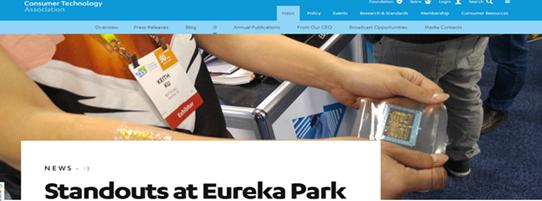
RouDian YunKe's Electronically Skin Material Featured on the CES 2017 Official Website Cover
New materials have inspired innovation among researchers. Guo Yi, Co-founder and COO of FlexElectronics Cloud Tech, pointed out that electrical stimulation for wound healing has long been used in clinical practice overseas. This treatment is highly expensive and typically involves discharging electricity to wounds using specialized metal rods. A research team affiliated with the National Center for Biomaterials has studied this therapeutic approach for many years. After learning about FlexElectronics Cloud Tech’s electronic skin technology, the team believed that the electronic skin could replace metal rods to deliver electrical stimulation. Moreover, the electronic skin material can be tailored to fully cover wounds, offering technical and cost advantages over existing solutions for treating large-area wounds. Therefore, the team recommended that FlexElectronics Cloud Tech develop electronically active electronic skin materials capable of delivering electrical stimulation.
This project was officially initiated two years ago. After the successful development of an electronically dischargeable electronic skin last year, the research team at the National Center for Biomaterials applied it in comparative experiments on mice, achieving promising results in chronic wound healing, and subsequently authored a paper based on these findings. Guo Yi revealed that RouDian YunKe is considering industrializing the technology for electronic skin discharge therapy; however, given the typically long development cycles of biomedical projects, commercialization may still be several years away.
Although the industrialization of electronic skin discharge therapy technology still has some way to go, other applications based on this composite new material are accelerating their path to mass production. For instance, FlexElectro Cloud Tech has secured orders from numerous medical institutions for its wirelessly enabled ECG acquisition sensors developed using electronic skin technology. The company expects to begin mass production of these wireless ECG sensors in mid-to-late April and plans to produce several million units this year.
Furthermore, transdermal drug delivery products based on electronic skin technology are scheduled to launch in the middle of this year, initially targeting the aesthetics sector. These products have already garnered strong interest from numerous commercial partners during the sampling phase, and production lines for mass manufacturing are currently under construction. Other electronic skin applications, such as motion-capture gloves used for toy drone control and VR interaction, are also progressing toward industrialization.
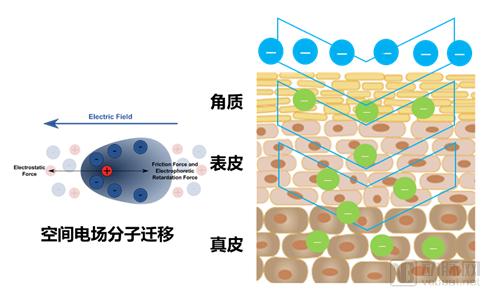
Principle of FlexElectroCloud’s Transdermal Drug Delivery Device
The wireless ECG acquisition sensor developed by FlexiCloud Tech seamlessly conforms to the human body, delivering excellent anti-interference performance while ensuring no noticeable foreign-body sensation for the user. The material in contact with the skin is non-allergenic. As a consumable for ECG monitoring, this sensor is compatible not only with professional medical devices but also with mobile apps. Guo Yi pointed out that FlexiCloud Tech is at the global forefront in the commercialization of such solutions.
After securing tens of millions in angel-round funding from Heli Capital in 2016 and participating in the U.S. CES twice, FlexCloud Tech has maintained a low profile with limited public communication. In retrospect, the company appears to have been strengthening its core capabilities, exploring various potential application scenarios, and preparing for the commercialization of its products.
Guo Yi believes that the slow pace of the project’s progress is related to the product attributes of Roudian Yunke. In his view, “Developing scientific research products is not the same as developing internet products. Internet products pursue rapid iteration and allow for extensive trial and error, whereas scientific research products require dedicated efforts to strengthen core capabilities internally. Only when the technology is solidified can it be confidently launched.”
As a life science technology that has emerged in recent years, genetic testing has become a hotbed for innovation and entrepreneurship, with 23Mofang standing out as one of the leading players in this field. Its relentless pursuit of the “Moore’s Law effect” in genetic testing—whereby the price of consumer-grade genetic tests halves periodically due to technological advancements—has enabled 23Mofang to accumulate genetic samples from over 300,000 Chinese individuals, placing it among the top companies in China in terms of data holdings in the consumer genetic testing sector.
Gene testing is closely linked to biotechnology. 23Mofang operates its own biological laboratory, capable of performing genetic tests for 400,000 individuals annually. Furthermore, the company is constructing a large-scale gene testing laboratory with an annual capacity of 4 million tests, which will rank second globally and first in Asia. In addition, 23Mofang collaborates with specialized medical institutions on research initiatives. The company’s first academic paper, published in *Scientific Reports*, a subsidiary journal of *Nature*, presents the findings of a collaborative study on the photic sneeze reflex with Professor Wang Mengqiao from the West China School of Public Health at Sichuan University.
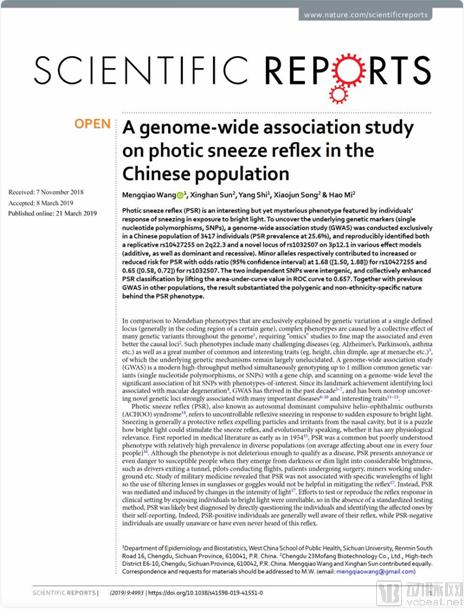
Photic Sneeze Reflex (PSR) is a genetic phenotype characterized by sneezing when an individual is exposed to bright light. A study by 23Mofang, the first genome-wide association study (GWAS) conducted on a large Chinese population sample, demonstrated the significant genetic association with photic sneezing. It also confirmed that this trait is polygenic and not exclusive to any specific race, but rather a genetic phenomenon present across diverse ethnic groups.
In the areas of statistical modeling and data visualization, this study benefited from the professional guidance and application of research outcomes provided by Professor Wang Mengqiao of the West China School of Public Health, while 23Mofang leveraged its strengths in data collection and computation. Through their collaborative efforts to overcome challenges, both parties achieved original scientific discoveries and published their findings in academic papers.
Not only has progress been made in academic research, but more impressively, 23Mofang has demonstrated the significance of online surveys in clinical research. The research team selected 3,519 individuals from a pool of volunteers who had signed informed consent forms. Data were collected via questionnaires and divided into case and control groups. Quality control was performed on the genetic data of individuals in each group. After verifying information such as sex and age—which can be validated through genetic data—using logistic regression, the team conducted an association analysis between genetic loci and the photic sneeze reflex. For a long time, the credibility of information obtained through online questionnaires has been widely questioned. This study by 23Mofang has dispelled such doubts, proving the feasibility of using online-collected data for academic research and opening up new avenues for researchers worldwide.
Professor Wang Mengqiao pointed out that the open model of user participation serves as a significant complement to and innovative development of traditional scientific research models. Rational questionnaire design is fundamental to ensuring data quality, while safeguarding the privacy and maintaining the enthusiasm of survey participants are also crucial. Solid foundational work alleviated the concerns of the participants; the gender selected by over 3,500 users in their questionnaire responses was entirely consistent with the gender inferred from biochip testing, with no instances of intentional misreporting. This rigor has sparked widespread interest and heated discussion among relevant academic institutions and industry organizations following the publication of this paper.
Wang Mengqiao stated, “Typified by 23andMe, U.S. consumer-grade genetic testing companies have published numerous academic papers on gene-related physiological phenotypes, whereas their Chinese counterparts are just embarking on original academic research, with promising prospects ahead.”
It is understood that, in addition to collaborative research with Sichuan University, 23Mofang also engages in academic collaborations with several universities and research institutions, including Fudan University, the Kunming Institute of Zoology of the Chinese Academy of Sciences, the Third Military Medical University, the Beijing Genomics Institute, and the University of Electronic Science and Technology of China. These collaborations primarily focus on studying the potential impact of genetics on the physiology, as well as economic and social behaviors, of the Chinese population.