62 Scientists Urge U.S. HHS to Support Global Moratorium on Heritable Human Genome Editing
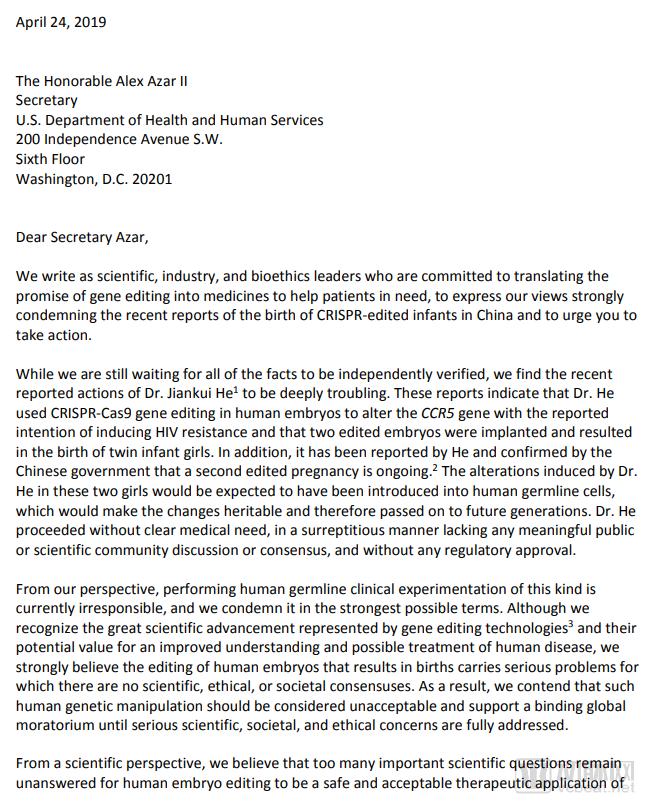
On April 24, 2019, following a joint appeal published in Nature by 18 prominent scientists and ethicists in the field of gene editing, 62 scientists wrote again to the U.S. Department of Health and Human Services, calling for a global moratorium on the clinical application of germline gene editing.
A total of 62 scientists jointly signed the letter, including leaders from the fields of science and technology, industry, and bioethics. They are Dr. Burt Adelman, Special Advisor at Novo Ventures; Dr. Charlie Albright, CSO of Editas Medicine; Cindy Collins, CEO of Editas Medicine; Usman Azam, President of Tmunity Therapeutics; Feng Zhang and David R. Liu from the Broad Institute; and Anthony Philippakis, Partner at Google Ventures, among others.
These leaders from the scientific community, industry, and bioethics are dedicated to transforming gene editing into therapeutic drugs for disease treatment. They condemned the CRISPR-edited babies incident and called for collective action.
Condemnation of Gene Editing on Human Embryos
The letter stated that although they were still awaiting further verification of the incident, He Jiankui’s actions had caused them considerable concern. At the 2nd International Summit on Human Genome Editing, He Jiankui presented how he used CRISPR-Cas9 to modify the CCR5 gene in human embryos, stating that his aim was to confer HIV immunity to two baby girls. According to He’s report, in addition to the two girls already born, there was one more edited infant who had not yet been born.
Scientists believe that the changes at these loci are heritable, and they have condemned He Jiankui for conducting clandestine experiments without a clear medical need or any regulatory approval. “This is a meaningless experiment that lacks scientific ethics,” the letter stated.
Scientists emphasize that conducting gene-editing trials on the human reproductive system at this stage is irresponsible. Such actions are also unacceptable to them. Although current research has demonstrated the value of gene-editing technology in disease treatment and understanding, allowing edited embryos to develop to term and be born would lead to serious problems. “Without scientific, ethical, and social consensus, this is unacceptable,” they stated.
Support for a Temporary Ban on Germline Gene Editing
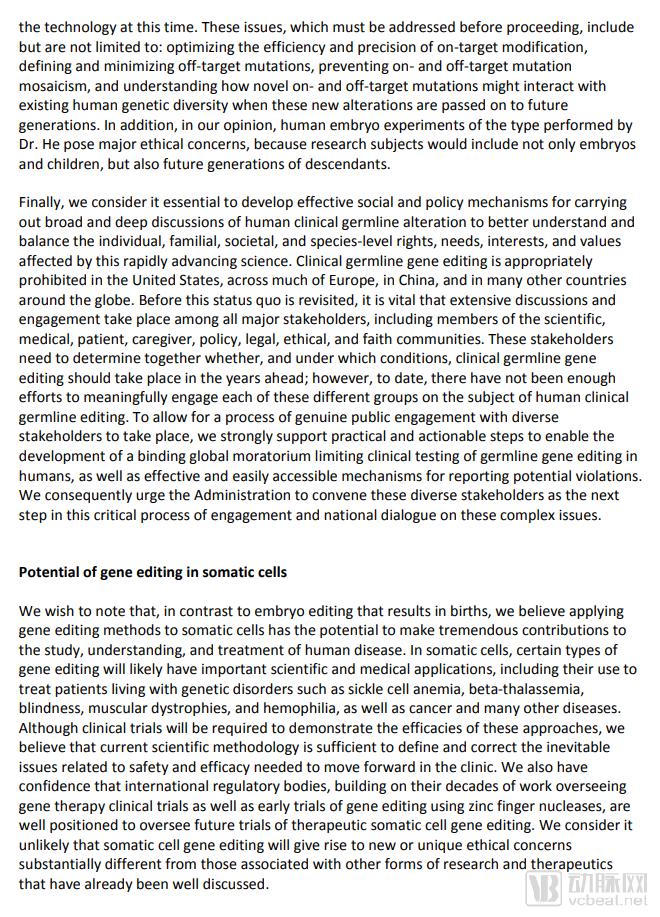
As scientists have pointed out in their commentaries, such adjustments could lead to other consequences, such as an increased risk of complications or death from infections like West Nile virus, influenza, and other viral pathogens. More troublingly, there is a broad consensus within the scientific community that the risks associated with clinical germline gene editing—specifically, the failure to achieve intended modifications or the introduction of unintended mutations (off-target effects)—remain unacceptably high. Therefore, it remains unclear exactly how germline gene editing will impact humanity.
From a scientific perspective, there are still too many unresolved scientific issues surrounding gene editing of human embryos for it to be considered a safe and effective therapeutic application. Scientists have called for the establishment of corresponding globally binding regulatory treaties, urging that gene editing targeting the human germline be halted until the scientific, ethical, and social issues posed by gene editing can be fully resolved.
“To balance the interests and values at the individual, family, social, and species levels brought about by technological advancements, effective social and policy constraints should be established,” they wrote. Currently, many countries and regions around the world, including China, the United States, and Europe, have long explicitly prohibited clinical trials involving gene editing of germ cells. Before the emergence of gene-edited babies, these critical discussions and constraints primarily revolved around key stakeholders, including members of the scientific community, healthcare professionals, patients, policymakers, legal experts, ethicists, and religious groups. However, to date, these agreements have failed to facilitate joint participation and discussion among these stakeholder groups.
“Considering genuine public engagement, we strongly support restricting current clinical trials of gene editing in human germ cells, while also actively urging government agencies to convene stakeholders for discussions on this complex issue—a critical step forward,” they stated.
Bullish on Somatic Cell Editing
Gene editing targeting cells is primarily categorized into germline and somatic cell editing. Scientists emphasize that, compared with heritable germline editing, they are more optimistic about the applications of gene editing in somatic cells.
“We believe that the application of gene editing in somatic cells can bring greater benefits to human health,” the letter stated. Indeed, gene editing targeting somatic cells has already shown promising results in the treatment of many genetic disorders, such as sickle cell anemia, beta-thalassemia, Leber congenital amaurosis, hemophilia, and cancer.
Although these studies require further clinical validation, scientists are confident that existing scientific methodologies can facilitate such validation under the premise of safety and efficacy. Decades of international regulatory experience, combined with current gene-editing clinical trials and early-stage trials of zinc-finger nuclease (ZFN) gene editing, provide robust guidance and regulatory frameworks for future somatic cell gene-editing clinical trials. “We are highly confident in the future of somatic cell gene editing.” Compared with germline gene editing, researchers consider somatic cell gene editing to be relatively safe and unlikely to raise novel or unique ethical concerns.
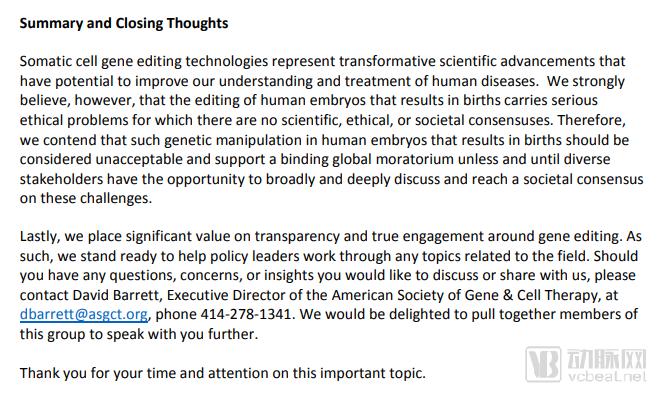
In their letter, they concluded that somatic cell gene editing technology represents a transformative scientific advancement with the potential to enhance our understanding and treatment of human diseases. However, editing human embryos would entail serious consequences, contravening both scientific consensus and social ethics. Therefore, scientists consider germline gene editing unacceptable and have expressed support for a global moratorium on such practices.
“Finally, we believe that greater attention should be paid to the transparency and genuine public engagement in gene editing. We stand ready to assist governments and relevant stakeholders in this field,” they wrote in conclusion. If you have any questions, concerns, or insights, please feel free to contact the scientists via email and phone.
Email: dbarrett@asgct.org
Phone: 414-278-1341
Below is the original text of the open letter: