

Miao Health: Building a Clear Insurance Blueprint with Nearly RMB 1 Billion Raised in 4 Years and 60 Million Users

RHC
Private Equity Fund Management Institution
The “Outline of the ‘Healthy China 2030’ Plan,” issued by the Central Committee of the Communist Party of China and the State Council in 2016, has provided a significant boost to the development of the domestic health industry and gradually instilled the concept of health management among the Chinese population.
In recent years, internet health has risen rapidly, yet mobile health management within this sector has consistently faced skepticism regarding whether it constitutes a fundamental necessity. If internet healthcare is seen as addressing the issue of accessibility to medical resources in the diagnosis and treatment process, then, based on various successful experiences abroad, mobile health management is regarded as solving the problem of "cost containment" arising from escalating medical expenses.
In this sector, Miao Health, with its user base of 60 million, has long been a “star project” in the health management space. As early as August 2015, VCBeat began tracking and reporting on Miao Health when it was still in its nascent stage; at that time, the team’s target was merely to accumulate 30 million users over three years. After completing nearly RMB 500 million in Series C financing by the end of 2018, how has Miao Health’s development changed compared to its initial trajectory? What drivers have propelled the company’s rapid growth? We attempt to deconstruct these questions by examining its business architecture.
“The absence of major players in this sector indicates that Miao Health has the opportunity to become the largest company.”
Health management is an industry involving numerous business organizations, including insurance institutions, physical examination centers, and pharmacies, all of which maintain the most direct contact with individuals engaged in health management. Therefore, cross-sector collaboration and connectivity capabilities are essential.
“Sometimes an industry always needs people from outside to come in, to think about unconstrained questions and dare to make some attempts when there are no burdens and opportunities arise.” This is one of the reasons why Kong Fei, CEO of Miao Health, transitioned from the gaming and telecommunications industries to the health sector. Currently, in his team, apart from medical professionals, most members have crossed over from internet companies such as Tencent and Baidu, as well as from gaming companies like Shanda and Sohu Changyou.
As a “gaming veteran” with ten years of experience, Kong Fei, CEO of Miao Health, has always described entrepreneurship as “leveling up by defeating monsters,” requiring one problem to be tackled after another.
“During the initial development phase, the primary challenge to address was customer acquisition.”
The figure below shows the trend in the number of registered users of Miao Health since 2015, as compiled by VCBeat. Over the past four years, Miao Health has grown from an initial base of 3 million users accumulated through internal incubation to nearly exponential growth in registered users. This rapid expansion was driven by direct consumer engagement via experiential “new health retail” at partner stores and a B2B2C model that achieved breakthroughs from broad coverage to precise targeting. The “modest goal” of reaching 30 million users within three years has long been achieved.
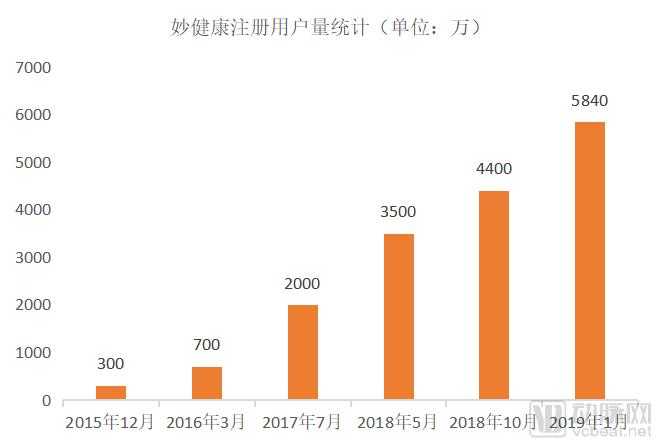
Statistics on Registered Users of Miao Health (Source: Public Reports; Chart by VCBeat)
The rapid development is reflected not only in the user base but also in the frequency of financing:
Series A, April 2016: RHC, under Sunshine Insurance Group, invested RMB 100 million;
Series B, April 2017: ABC Wuxi Equity Investment Fund and Citic Capital jointly invested RMB 250 million;
Series B+, September 2017: Jiangxi Jiangzhong Chinese Medicine Industry Investment And Development Fund Partnership (L.P.) invested RMB 100 million;
Series C, April 2019: CPIC Pension Industry Investment, CPIC Medical Health, and Xinran Capital jointly invested nearly RMB 500 million.
Since 2016, the company has raised nearly RMB 1 billion across four rounds of financing. Investors include RHC, Citic Capital, ABC Wuxi Equity Investment Fund, Jiangxi Jiangzhong Chinese Medicine Industry Investment and Development Fund, and assets under China Pacific Insurance (CPIC) that participated in the Series C round. Most backers of Miao Health are industrial funds, which means they can provide more practical business support in terms of resource alignment.
“Making mistakes while growing, but the pace cannot be slow.” This was a statement made by Kong Fei in a 2017 media interview. At that time, Miao Health’s benchmark was Welltok, a U.S.-based mobile health management platform. Today, however, Miao Health has transcended its identity as a mere mobile health management platform and achieved diversified business development.
Five Major Business Groups Highlight Data Value + Service Value
Since its inception, Kong Fei has set two major goals for the company: to build data integration capabilities (including smart wearable hardware, physical examination data, and user self-assessment data) and to develop artificial intelligence algorithms that can truly help users achieve health management.
From a scientific perspective, health management requires precise quantification and control; however, the reality is that the broader health industry, including health management, faces the phenomenon of “data silos” to varying degrees.
Prior to 2018, Miao Health consistently emphasized its three core business segments: “Miao+” is an open platform for health data and services developed by Miao Health, accessible to qualified industry users globally to facilitate the sharing and value extraction of health behavior data; “Miao Cloud” is an AI-driven health intervention platform equipped with capabilities for data storage, analysis, and intervention feedback, providing users with differentiated health management solutions; and the “Miao Health APP” is a platform that enables users to upload health data via “Miao+,” which is then subjected to big data analysis by “Miao Cloud,” thereby delivering reliable and secure personalized health behavior management.
As the power of the B2B2C model gradually became apparent, Miao Health began to expand its business landscape, evolving into five major business units: “Miao+,” “Miao Cloud,” “Miao Health APP,” “Miao Bao,” and “CWI.” These units focus respectively on connecting smart hardware, tracking out-of-hospital health big data, intervening in health behaviors, providing insurance services, and delivering offline health management.
“Health management is not about single-dimensional data analysis and management; rather, it requires comprehensive analysis and management of various health-related data types,” said Kong Fei. To help users import health data from different smart devices, Miao Health has built an open health data platform.
“Miao+,” “Miao Yun,” and the “Miao Health APP” form a combination that aligns perfectly with the objectives set by Kong Fei. By integrating data connectivity from smart wearable hardware, AI-driven intervention algorithms, and gamified operational strategies, this ecosystem delivers professional health management services to over 60 million corporate employees, insurance policyholders, bank members, and individual users.
If “Miao+,” “Miao Yun,” and the “Miao Health APP” embody the value of data, then “Miao Bao” and “CWI” primarily embody the value of services.
The partnership with CPIC marks another major move by Miao Health, as the insurance sector remains a highly coveted yet challenging market that every health management company seeks to penetrate.
On April 23, Pacific Health Management Co., Ltd. (hereinafter referred to as “Pacific Doctor”), a subsidiary of China Pacific Insurance, jointly launched the new mobile health management service brand “CPIC Miao Health” with Miao Health in Shanghai. Meanwhile, the first “Health Interaction Insurance Plan” in China, developed by Miao Health in assistance to Pacific Doctor, was officially launched.
The long-promoted interactive insurance policy has been officially launched, signaling that Miao Health’s insurance service segment is gradually taking shape.
According to Kong Fei, Miao Health’s current revenue is primarily derived from two main sources: corporate health benefit plans, which constitute the bulk of its conventional health management services, and bundled health solutions provided to insurers, with each accounting for 40% of total revenue. The remaining 20% comes from sales on the Miao Health e-commerce platform.
In terms of offline services, on March 19, 2018, Miao Health partnered with the Canadian Wellness Institute (CWI) to establish a joint venture in China, aiming to introduce the CWI model—which has already demonstrated effective health management outcomes in Canada—to the domestic market. The initiative seeks to leverage CWI’s extensive offline clinical expertise and Miao Health’s advanced internet-based health management tools to create a comprehensive online-to-offline (O2O) closed-loop health management system.
CWI’s first brick-and-mortar store in China is also on the verge of opening. Within the closed-loop health management ecosystem, CWI serves as a “high-engagement offline service,” providing effective health management solutions to insurance customers and individuals in need.
The Insurance Sector Comes into Focus: Integrating Health Services to Strengthen the Insurance Value Chain
Judging from the origins of health management development—specifically the experience in the United States—health management and insurance appear to be naturally linked. According to statistics from Johns Hopkins Medicine, the emergence of health management companies has reduced direct medical expenditures for health insurance companies by 30%. Health management companies indeed emerged in response to the growth of the insurance industry.
In the United States, health management companies serve the general public, while insurers are the payers. In other words, health management services for their customers are primarily provided by partner health management companies rather than directly by the insurers themselves.
Integration with insurance companies represents the ultimate form for domestic health management service enterprises and is a business segment that many companies must conquer. However, this characteristic also benefits from the critical period in which China’s insurance industry urgently needs to undergo transformation.
According to data from the China Banking and Insurance Regulatory Commission (CBIRC), the annual new premium volume in the health insurance market has grown rapidly in recent years. From 2013 to 2018, the compound annual growth rate (CAGR) of new health insurance premiums reached 35.95%. In January 2019, the original insurance premium income for health insurance business recorded the fastest growth, amounting to RMB 79.8 billion, a year-on-year increase of 49.8%.
Amid a gradually consolidating landscape, although premiums are rising, the overall market size remains small and penetration rates low, leading to unstable profitability for insurance companies. As early as in this year’s annual report address, Kong Qingwei, Chairman of China Pacific Insurance (Group) Co., Ltd. (CPIC), stated that health and elderly care services are becoming a new pillar for the expansion of the company’s service offerings. In this light, CPIC’s investment in More Health is clearly a deliberate strategic move.
At the press conference held on that day, Xu Jinghui, Chairman of China Pacific Life Insurance Co., Ltd. (CPIC Life), pointed out that in the current environment emphasizing health services, CPIC Life is actively implementing its “Product+” transformation model. The officially launched “CPIC Miao Health · Hui Plan” and “CPIC Miao Health · Xiang Plan” are interactive insurance policies incorporating technology and intelligent health management interventions.
The “Hui Plan” and the “Xiang Plan” mainly consist of three components: first, insurance products, which form the foundation of the interactive health insurance program; second, a health management program built upon these insurance products to effectively enhance customer adherence; and third, an incentive scheme for health management. Together, these three elements constitute an integrated “insurance + health management” solution.
It is reported that the “Hui Plan” and “Xiang Plan” will be piloted at seven branch companies of CPIC Life Insurance in the Yangtze River Delta region, and will be upgraded to the “You Plan” targeting individuals with chronic diseases after achieving certain results.
The launch of the “CPIC Miao Health” health-interactive insurance plan signifies a shift for insurers from risk bearers to risk preventers, moving from post-event claims settlement to pre-event prevention. Yu Hua, Deputy General Manager of China Pacific Life Insurance, believes that health-interactive insurance plans can achieve a win-win outcome for both customers and insurers. Health management services can help users improve their health status and reduce health risks, while also enhancing customer stickiness and extending the insurance business’s industrial chain. Data from mature foreign markets show that effective health management can increase average life expectancy by 10 years, reduce average hospitalization costs by 30%, and shorten average hospital stays by 25%.
“The emergence of interactive insurance products, designed by Miao Health in collaboration with insurance companies, aims to build a ‘bridge’ for health management between customers and insurers through technological means,” said Kong Fei.
Leveraging Three Core Competencies, Miao Health Has Partnered with Multiple Insurance Companies
According to Kong Fei, Miao Health has currently partnered with multiple domestic insurance companies to provide health services. For instance, it is jointly exploring interactive policy business with insurers such as Pacific Insurance, Sunshine Insurance, PICC Health, and Aeon Life Insurance, while tailoring comprehensive health management solutions for their insurance customers. For the insurers’ proprietary e-commerce channels, Miao Health also facilitates the sales of health hardware and health services. In addition, Tongren Insurance Brokerage, a subsidiary of Miao Health, supports insurance enterprises in product design by offering customized new products and policy services.
In 2018, the health insurance industry witnessed significant changes as John Hancock Life Insurance Company in the United States announced that it would exclusively sell “interactive” policies, which allow fitness and health data to be tracked via smart wearable devices and smartphones. John Hancock ceased underwriting traditional policies rather than launching a new line of business. Technology is disrupting the current competitive landscape of the insurance industry.
In China, from integrating health insurance claim channels to enabling mobile payments for medical services, and from establishing mobile healthcare platforms to setting up specialized healthcare management companies, the strategic health management initiatives of insurers such as Ping An and CPIC are gradually taking shape. Insurance companies are transitioning from “simply selling health insurance products” to providing “one-stop health risk management solutions.”
“Helping insurance companies achieve seemingly simple policyholder interactions actually involves several important underlying logics,” said Kong Fei. “Miao Health has spent three years focusing on building a health data connectivity platform and enhancing its capabilities in connectivity, artificial intelligence, and gamified operations. Once these three core elements reached relative maturity, we aimed to develop a comprehensive ‘Insurance + Health Management’ solution tailored to insurance scenarios.”
For insurance companies, the three core challenges they are exploring are how to acquire new customers, how to achieve high-frequency engagement with clients, and how to control costs. In response, Miao Health can address insurers’ pain points through its connectivity capabilities, AI technologies, and gamified operations. These constitute what Kong Fei frequently highlights at various events as Miao Health’s three core competencies.
First is the data tracking capability based on wearable device connectivity. Only by tracking and collecting out-of-hospital health data can the issue of health data continuity be resolved, enabling the development of differentiated solutions tailored to individual user data. This helps distinguish products from homogeneous competitors in the market and assists sales teams in customer acquisition.
Second, AI-driven interventions enable health management. “If every individual were assigned a personal health doctor for one-on-one management, effective control would certainly be achievable. However, it is impractical to assign a dedicated physician to each ordinary person. How, then, can we amplify physicians’ expertise and enhance efficiency? In fact, health interventions empowered by artificial intelligence represent an excellent solution for the Health 2.0 era,” Kong Fei told reporters.
In Miao Health’s interactive insurance policy practice, artificial intelligence technology leverages big data algorithms based on Miao Health’s data tracking capabilities to assign various tags to customers. During interactions, customer profiles are continuously redefined to generate more accurate user personas, enabling the recommendation of new health plans and delivering personalized, customized solutions that are continually refined with daily data inputs. This approach transforms insurance from “cold” compensation figures into quality-controlled health management services, thereby achieving cost containment.
Third is gamified operations. Kong Fei stated, “Only high-frequency scenarios can become entry-level applications, and this holds true for health services as well. If we aim to develop health-related scenarios, we must aggregate low-frequency scenarios into high-frequency ones. In this context, gamified operations address a key pain point in the health management industry—serving as a critical means to enhance user adherence.”
Health management is often perceived as tedious and monotonous by most users, making long-term adherence challenging. Miao Health has innovatively integrated gamification elements—such as “leveling systems,” “task collections,” and “instant feedback”—into health management to effectively stimulate user engagement. Through gamified operations, the platform enables users to effortlessly overcome inertia and improve their health while enjoying an entertaining experience.
Kong Fei told reporters that at the current juncture, the company’s strategy is mainly divided into a “three-step” approach:
First is the development of platform capabilities, which is also Miao Health's core competitiveness;
Second is product capability, targeting insurance companies, business owners, and others, to deliver products based on health management services;
Third, rapidly enhance marketing capabilities to quickly penetrate the insurance market and outpace competitors.
Miao Health has leveraged four years of deep expertise in connectivity, data, and gamified operations to acquire 60 million users and secure nearly RMB 1 billion in financing, demonstrating its rapid growth potential to the industry. From a broader perspective, no other player in the health management sector appears to match its performance.
These achievements also validate Kong Fei’s statement: “There are currently no major players in China’s health management industry. When we first entered the market, our initial thought was: since there are no dominant companies, Miao Health has the opportunity to become the largest.”