

Synyi Intelligence: AI-Powered Next-Generation Hospital Information Platform Empowering Smart Hospital Development

SYNYI AI
Provider of Comprehensive Solutions for Medical Big Data
“Smart Hospital” has emerged as a concept only in the past decade, yet it has undergone rapid iteration driven by advancements in artificial intelligence, the internet, and other technologies. Today, healthcare institutions have begun to establish an information infrastructure centered on electronic medical records (EMR) for clinical staff—known as “Smart Healthcare”—while hospital management rooted in Hospital Information Systems (HIS) is also witnessing diversified innovations.
On March 12, 2019, the concept of “Intelligence+” appeared in the Government Work Report for the first time. The report stated that the planning of hospital information platforms should keep pace with the times by incorporating considerations for big data and artificial intelligence. This marks a new stage in the development of hospital information platforms, oriented toward big data centers and AI applications. At the recently concluded 2019 CHINC conference, an increasing number of health IT vendors showcased various smart hospital products, with the use of artificial intelligence to drive hospitals toward digitalization and intelligent operations becoming a focal point of attention.
Seizing this opportunity, SYNYI·AI hosted a grand symposium titled “Smart Platforms: Practices and Reflections on Hospital Information Platform Construction in the AI Era.” During the conference, SYNYI·AI and CEC Data jointly released an AI-based next-generation hospital information platform solution.
The trajectory of the industry hints at the challenges currently facing hospitals. Information silos and data quality remain common challenges for the current hospital informatization systems. Data security is also becoming an increasingly hot topic, with the implied market opportunities being self-evident.
During the process of hospital informatization, information standards and interoperability have consistently been focal points for national regulatory bodies and hospital administrators. According to Li Yuefeng, Director of the Information Standards Division at the Statistical Information Center of the National Health Commission (NHC), since 2010, the NHC has initiated a total of 283 standardization projects. Among these, 33 were converted into group standards, resulting in 254 actual industry-standard projects. Of these, one national standard and 222 industry standards have been issued, along with 33 group standards. This year, more than 90 additional standards have been submitted for approval, progressively delving into the core of informatization within the health sector. Furthermore, the Health Standard Management Platform and the China Health Information Standard Management Platform have been established. The assessment of standardized maturity for medical and health interoperability has promoted the application of information standards and enhanced interoperability, continuously helping healthcare institutions address the problem of information silos.
Driven by the National Health Commission, informatization initiatives centered on electronic medical records (EMR), along with the interoperability between EMR and other systems such as imaging and laboratory information systems, have achieved rapid development. Xue Yanbo, Vice President of SYNYI·AI and a senior informatization expert, stated, “Information integration is an essential pathway for hospitals to break down data silos. In an environment shaped by the trends of artificial intelligence and big data, hospitals should select appropriate platform construction solutions tailored to their specific circumstances.”
He believes that the new generation of hospital information platforms is equivalent to the data middle platform of smart hospitals. By focusing on the full lifecycle management of data, a closed loop is formed from data governance to the data middle platform, and then to AI applications, making data truly "alive" and becoming the core business relied upon for daily hospital operations. In this way, data can achieve its maximum value.
According to Xue Yanbo, the foundation of a new-generation hospital information platform lies in implementing full-lifecycle information management and embedding governance processes within a data middle platform. However, many health IT enterprises, when addressing this issue, remain focused merely on breaking down existing physical barriers to enable data exchange. They have neither optimized their information systems in accordance with the data structures required for data governance nor established dedicated data middle platforms. As a result, although interoperability among hospitals has improved, the data remains unusable for further exploitation, let alone helping hospitals build high-value data assets.
Addressing this issue may require a novel approach. Dr. Zhang Shaodian, Founder and CEO of SYNYI·AI, stated, “Ultimately, the goal of healthcare informatization is to enhance hospital management efficiency, thereby making clinical practice more efficient and precise. Therefore, it is essential to achieve refinement and automation through data channels.”
To achieve data-driven and intelligent hospital operations, SYNYI·AI adopts a dual-pronged strategy. On one hand, it provides hospitals with data-driven solutions encompassing data integration and data governance to address issues such as data silos, system integration, and data availability. On the other hand, it delivers intelligent solutions tailored for physicians, including smart clinical research platforms, AI-assisted diagnosis and treatment, and lean clinical management tools. These innovations enhance physicians’ research efficiency, accelerate disciplinary development, and deeply optimize clinical diagnosis, treatment, and management processes.
By deeply governing clinical data from hospitals, effective data support is provided for the application of artificial intelligence (AI) products. As these AI products are deployed in specific scenarios, they can, based on actual usage, feed back into and promote the development of the hospital’s overall intelligent infrastructure. The entire system forms a complete closed loop supported by information technology and AI technologies, ultimately enhancing the value of data utilization quickly and effectively.
Specifically, SYNYI·AI’s AI-based hospital information platform solution encompasses all the functionalities of traditional hospital information platforms while implementing more advanced data governance capabilities. It not only meets the practical operational needs of hospitals but also ensures compliance with interoperability assessments, thereby laying a solid foundation for their future smart hospital development.
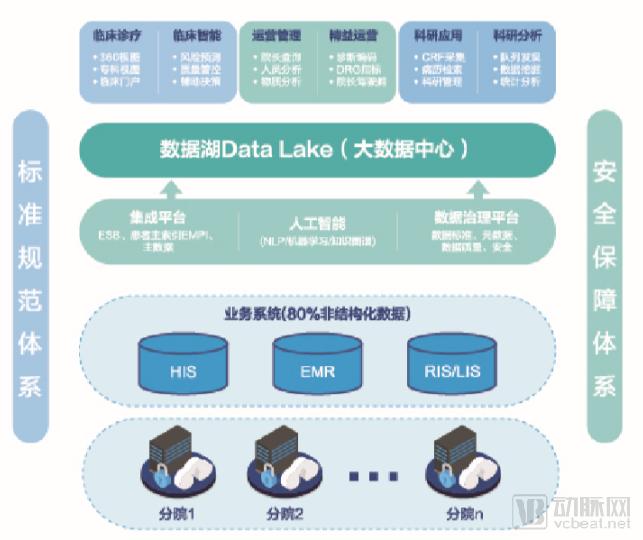
In terms of information standardization, SYNYI·AI collaborates with Orion, a third-party ESB vendor. Orion’s Rhapsody product features an information system that complies with international HL7 standards, offering high cost-effectiveness and ease of use.
In terms of system architecture, SYNYI·AI pioneered the application of an innovative container-based private cloud architecture in the HIT market to provide hospitals with intelligent information system solutions. Compared with traditional dual-machine and virtual machine information architectures, container-based private clouds offer advantages such as more efficient operational and maintenance management, faster architecture deployment, and more effective resource utilization. They also demonstrate significant improvements over virtualization in terms of memory footprint, startup speed, and partition size.
Compared with traditional CDR, ODR, and RDR solutions, SYNYI·AI integrates its self-developed artificial intelligence technologies across clinical, management, and research domains, fully addressing application scenarios such as refined hospital management, clinical decision support, and big data-driven research analysis. For the data generated in these processes, SYNYI·AI provides data governance capabilities—including standardization, alerts, completion, and deduplication—to create high-quality datasets, enhance data usability, and lay the foundation for further applications.
Leveraging these advantages, SYNYI·AI’s solutions not only help hospitals break down information “silos” and achieve hospital-wide data interoperability, but also comprehensively enhance refined hospital management and the quality of medical services. By empowering clinical applications with AI, the solution ensures that clinical operations across diverse scenarios are evidence-based, fostering co-evolution of AI products and hospital clinical workflows, thereby enabling smart hospital management and the iterative adoption of emerging technologies.
As hospital informatization advances rapidly, medical information security issues have become increasingly prevalent. Addressing this critical market challenge, SYNYI·AI and CEC Data jointly launched a next-generation AI-powered hospital information platform solution. Built on a private cloud architecture, this collaborative solution enables efficient utilization of hospital resources and establishes a comprehensive information security assurance system to safeguard data integrity, thereby empowering the development of smart hospitals in the era of big data.
Meanwhile, this solution leverages the HIT+AI multi-dimensional data governance platform to aggregate diverse medical data and establish a hospital-wide, multi-topic data center. It supports business applications such as clinical diagnosis and treatment services, lean operational management, and scientific research analysis and mining, thereby enabling effective AI-driven data exploration while ensuring data security. Furthermore, as a state-backed enterprise, China Electronics Data possesses an independently controlled cloud service platform capable of safeguarding hospitals that comply with Level 3 or higher of the Classified Protection of Cybersecurity standards. Consequently, through its partnership with SYNYI·AI, hospitals can rest assured against risks of data leakage or tampering, while SYNYI·AI will gain access to a broader network of partners within the China Electronics ecosystem.
In the field of computer-aided diagnosis, SYNYI·AI has been continuously exploring and innovating. It has successfully developed AI-powered diagnostic assistance solutions for scenarios including venous thromboembolism (VTE), atrial fibrillation, acute coronary syndrome, acute biliary tract infection, and pediatric pneumonia, which have been successfully implemented and deployed at Shanghai Tenth People’s Hospital.
Zhang Shaodian stated that, in the future, SYNYI·AI will continue to focus on the intelligent construction of medical information systems and AI-powered diagnostic products, expand its AI product portfolio, enhance hospitals’ data governance capabilities, and address the issue of information silos in healthcare institutions.
“The hallmark of a successful technology is that you use it without being aware of its presence, much like spring rain that nourishes all things silently and unobtrusively, arousing no surprise. I hope artificial intelligence can become similarly embedded in physicians’ workflows, just as internet technology has, truly serving as a partner to clinicians.”