

Blue Rainbow Unveils Full-Stack Incubation Model for Cutting-Edge Life Sciences in IPO Filing
As a life and health incubator initiated by BGI Group, the birth of Blue Rainbow carries a special mission: to leverage BGI Group’s advantages in infrastructure and industrial background, promote and incubate the expansion of downstream applications of life science technologies, and uncover more opportunities for industrialization.
Since its inception in 2016, Blue Rainbow has evolved from offering co-working space rentals to building an integrated ecosystem encompassing startup services, industry incubation, and early-stage venture capital. “Currently, most incubators focus primarily on space leasing and shared facilities. Leveraging our industrial background, we aim to deliver more specialized, higher-value-added services in the commercialization of technology,” said Guo Qiushan, Executive President of Blue Rainbow.
Today, Blue Rainbow has focused its primary efforts on building core incubation capabilities, aiming to establish a platform that supports scientist-led startups and lowers the entry barriers for entrepreneurship in the life sciences sector. “Most scientists have limited experience in translating technologies into commercial products and managing business operations,” he explained. In line with its corporate mission, Blue Rainbow seeks to leverage its industrial background to help entrepreneurs avoid common pitfalls and accelerate the translation of achievements from zero to one.
Blue Rainbow has maintained a sharp focus on frontier innovations in the life sciences sector. The continuous decline in sequencing costs has expanded the application of genomics across scientific research, clinical practice, and consumer markets, while also enabling the development of products and applications previously constrained by cost barriers. If BGI provides robust infrastructure for industrial development, Blue Rainbow aims to accelerate entrepreneurship among young scientists and facilitate the translation of scientific achievements into industry applications.
“We will closely follow the latest frontier advancements and development trends in life sciences, particularly focusing on the technological bottlenecks and industrial barriers currently present in the industry chain,” disclosed Guo Qiushan. In addition to genomics technologies, key areas of focus include research methodologies and diagnostic/therapeutic approaches across various omics disciplines—such as transcriptomics, proteomics, metabolomics, cytomics, and microbiomics—as well as bioinformatics, synthetic biology, and biological therapies. Blue Rainbow positions itself as an incubator and investor in cutting-edge biotechnologies, encompassing applications both within and beyond the healthcare sector.
Blue Rainbow is characterized by a dual-engine model of incubation plus investment, which encompasses full-cycle mentorship spanning from incubation and structured acceleration to investment.
The Accelerator Camp is a structured initiative within the incubator framework, where Blue Rainbow provides industry mentoring and entrepreneurship training to early-stage projects and teams. “We have meticulously designed numerous components, including discussions on niche-sector technologies, entrepreneurial diagnostics, and founder sharing sessions, aiming to stimulate project participation through diverse formats and deliver intensive training,” Guo Qiushan told VCBeat New Medicine. “We also exchange resources with the innovation centers of industry giants such as Fosun, Johnson & Johnson, and Philips, fostering an open and inclusive ecosystem.” They aim to make the platform more open.

Guo Qiushan, CEO of Blue Rainbow
Furthermore, for Blue Rainbow’s incubation business, the accelerator program has also broadened its channels for deal sourcing. Guo Qiushan candidly stated that the original intent behind the program’s design was to help the incubator engage with startups earlier through phased recruitment activities. In the inaugural cohort of the accelerator launched in 2018, Blue Rainbow received over 100 applications from around the world. With the launch of the new cohort in 2019, the number of project applications increased by more than 50%.
In addition to roadshow presentations, the Blue Rainbow Investment Fund is also a major source of projects for the accelerator program. Its affiliated fund, the Miracle Light Venture Capital Fund, focuses on early-stage projects in the life sciences sector. Leveraging BGI’s solid scientific research foundation and experience in industry incubation, and relying on the team’s professional and prudent industry research and technology assessments, the fund has invested in numerous outstanding startups. Like all investment institutions, the Miracle Light Fund encounters a large volume of life science startup projects each year.
Among these projects, some relatively mature startups will receive direct investment from Miracle Light, while others are at an earlier stage and not yet suitable for investment. In such cases, Miracle Light will recommend them to join its accelerator program for mentoring and industry resource matching.
“For very early-stage projects, we help them find startup mentors or even co-founders. If they have already reached the product stage, we assist in accelerating data accumulation, refining the product, and supporting clinical trial design and review, thereby helping them become investment-ready targets,” introduced Guo Qiushan.
In 2018, the accelerator program admitted a total of nine projects. By October of the same year, the aggregate valuation of these projects had exceeded RMB 800 million, creating more than 120 jobs.
Building on the foundation laid in 2018, the 2019 Accelerator Program further diversified its activities and content, extending its project sourcing reach to regions such as Europe. “In 2019, BGI is establishing its first high-throughput sequencing laboratory in Africa. We are also focusing on technological innovations in applications within these regions and will intensify our efforts to identify promising projects across Asia beyond the Greater China region,” disclosed Guo Qiushan. It is reported that the 2019 BGI Life Health Accelerator Program piloted collaborations with African incubation platforms and conducted project sourcing in the United Kingdom and Sweden. Through these international recruitment initiatives, the program not only broadened its channels for project acquisition but also demonstrated its capability to serve overseas projects.
“The accelerator program currently runs one cohort per year, with a six-month recruitment period followed by a six-month program cycle,” disclosed Guo Qiushan. However, the intake and incubation of new projects are ongoing throughout this process. “In fact, many projects that receive our incubation support or even investment are still keen to fully participate in the accelerator’s systematic training.” Since Blue Rainbow does not require companies to be physically housed in its own incubator, other industrial parks also welcome Blue Rainbow in providing value-added services to their tenant enterprises. “Many parks lack experience in incubating original innovations, so they are very receptive to our involvement,” he added.
“Of course, BGI Group’s own industrial resources have also provided significant support to Blue Rainbow throughout this process. On one hand, enterprises incubated in the accelerator can apply for support from BGI’s technology and data platforms; on the other hand, BGI itself is conducting research on many cutting-edge topics and has numerous research achievements ready for commercialization, which represents a high-quality internal channel for Blue Rainbow. ‘BGI Group has also launched the Bo Le Program internally, encouraging employees to recommend high-quality original technologies and projects,’ revealed Guo Qiushan. This constitutes an industrial advantage that other incubators cannot replicate for Blue Rainbow.”
Another important channel resource comes from universities and research institutes. The Gene Startup Competition, initiated by Blue Rainbow, has been held for many years and has now become a natural channel for them to establish connections with universities. "We hope to get involved at the stage of original innovation, earlier than general funds and incubators," said Guo Qiushan.
The model for translating scientific research outcomes from Chinese universities into practical applications is not yet mature, with the final output of most studies being merely academic papers. Guo Qiushan considers this a significant missed opportunity, as many university-led research projects hold substantial potential for commercialization. For younger faculty members, overseas study experiences have made them more proactive in considering the possibilities of industrial translation. However, this proactivity largely remains at the level of awareness; most are still uncertain about how to implement specific applications, design teams, or structure equity arrangements.
“Many people have this awareness and mindset, but they are relatively lacking in how to develop products that meet market demands, as well as in business logic and experience. However, this is our area of expertise,” he continued.
In 2019, the Accelerator Program further expanded its project sourcing from renowned universities and research institutes. Among the projects admitted to the program, 70% of the founders came from academic and research institutions, and 50% of the projects had overseas backgrounds. Compared with 2018, the projects admitted in 2019 were at an earlier stage, with 80% not yet having initiated their angel financing rounds. This has enabled Blue Rainbow to take another step toward realizing its vision of “facilitating the implementation of early-stage projects and accelerating technology commercialization.”
Beyond seeking industry opportunities in specialized sectors, Blue Rainbow even proactively organizes teams to launch startups. Jingliang Genetics, China’s first molecular diagnostic reference material company, is a prime example. “Most reference materials in China are imported; we believed the industry needed such a company,” Guo Qiushan told VCBeat New Medicine. Although the genetic testing industry has entered a stage of rapid industrialization, the domestic market for reference materials remained blank. After thorough evaluation, Blue Rainbow decided to co-incubate such a company with MGI Tech. They persuaded the R&D Director and Asia-Pacific Sales Director of a Cambridge-based molecular diagnostic reference material company to return to China to start their own venture, and assisted in establishing the early-stage experimental platform and team, laying the foundation for what is now Jingliang Genetics.
Jingliang Gene was officially established in March 2018, receiving joint investment from Blue Rainbow and MGI Tech. Within less than a year, the company achieved sales exceeding RMB 10 million.
Although technology transfer often originates from academia, the prevailing market perception is that there is a significant gap between academic research and technology commercialization. While most entrepreneurs with a scientific research background have achieved remarkable success in their fields, not all of them have a clear understanding of how to translate their findings into products, or what specific products their research can be developed into.
Guo Qiushan told VCBeat’s New Medicine that the incubator aims to help scientists and entrepreneurs navigate the “zero-to-one” process, which begins with initial technology assessments and assists them in exploring downstream applications and clinical possibilities. “This is mentorship that guides the journey from technology to product, and then to commercialization,” Guo stated. Blue Rainbow itself has conducted extensive industry and technological research. Leveraging its keen insight into market demands, it provides scientists with advice on technology translation while also helping them connect with industrial and commercial resources, thereby broadening their perspectives.
Of course, the journey “from 0 to 1” is far from simple, as the numerous detailed steps involved require varying resources. Scientists excel in technical research, but may fall short in technology commercialization and business operations—areas where Blue Rainbow plays a pivotal role.
If scientific discoveries require further validation or exploration, Blue Rainbow will connect scientists with joint research and development resources. If the technology has entered the translation phase, Blue Rainbow will strategically introduce industry resources such as clinical experts and industrial institutions. If the product is approaching the regulatory submission stage, Blue Rainbow will collaborate with third-party professional service agencies to provide robust support in review processes and clinical trials. Beyond technology and products, Blue Rainbow also assists scientists and entrepreneurs in building necessary teams and supplementing critical skills.
“In addition, early-stage projects generally lack a brand promotion department and often overlook these efforts. However, we recognize the need for such communication. By providing strategic brand building and communication services, we help these projects gain more comprehensive and in-depth recognition from the industry, investors, and clients,” said Guo Qiushan.
“Once scientists have finalized their startup concepts and strategic direction, Blue Rainbow provides comprehensive entrepreneurial services during the implementation phase. For instance, different regions and industrial parks exhibit varying preferences for projects with distinct characteristics, and government subsidies and support measures are also tilted differently. We help them identify the most suitable locations and platforms for establishment,” he stated. Blue Rainbow has established a dedicated operations department to provide specialized consulting services on company registration, legal affairs, and policy matters for startups.
Of course, whether for team building or clinical trial applications, companies require financial support during their growth. In addition to the Blue Rainbow Fund, they also proactively facilitate connections between resident enterprises and other investment institutions, including assistance with applications for government-supported funding.
Among the nine projects that joined the accelerator camp last year, Blue Rainbow ultimately invested in three, with participation from top-tier funds as co-investors. Each of these projects secured total financing exceeding RMB 20 million. Blue Rainbow maintains strict focus and clear boundaries in its investment strategy. “We pay less attention to areas such as chemical drugs and high-value consumables, as these are not fields where we possess first-hand evaluation advantages or a forward-looking perspective,” he explained. However, compared to the general pool of accelerator participants, the fund imposes clearer requirements on product application and technological pathways, seeking ventures with the commercial potential to dominate niche markets.
From technical validation to platform development, and from regulatory support to financing assistance, Artery New Medicine envisions that such a team should comprise at least 30 members. However, when asked about the current team size, Guo Qiushan revealed that they have only 17 employees: “We are a young team, with most members coming from life sciences backgrounds. Each individual must be capable of independently managing specific incubation elements.” This is a self-evolving incubation model; many methodologies have been developed through their own exploration during the process, and they continue to learn and improve through interactions with portfolio projects.
It is reported that the Blue Rainbow 2019 Accelerator Program was launched on April 27. Guo Qiushan stated that the applications received in 2019 reflected technological trends in hot fields such as liquid biopsy, cancer immunotherapy, antibody drug development, synthetic biology, POCT (Point-of-Care Testing), and intelligent manufacturing. For instance, Suochuang Bio, a participant in this year’s program, has developed novel immune checkpoint inhibitors based on the regulation and targeting of tumor immune checkpoints, providing new insights for subsequent drug development.
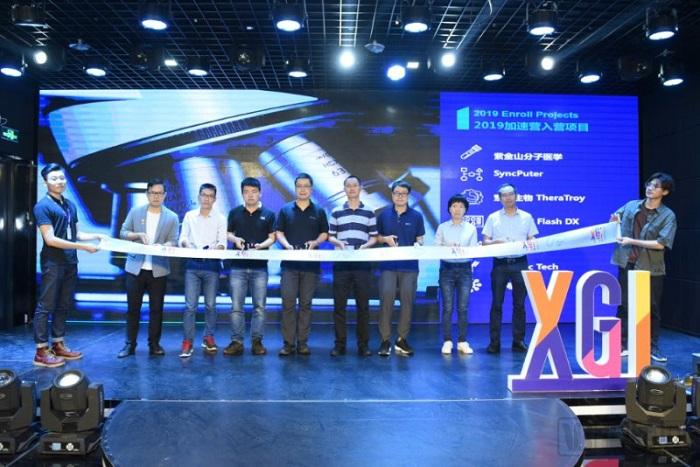
Blue Rainbow 2019 Accelerator Launch Ceremony
The difficulty in fund fundraising has spilled over to startup financing, with pessimists predicting that 2019 will be the toughest year for entrepreneurs. However, Guo Qiushan holds a different view. He believes that 2019 will also be a pivotal year for the development of life science technologies. While traditional gene sequencing companies are facing increasing challenges in securing funding, many industry players are seeking new breakthroughs: liquid biopsy is exploring new application scenarios and value propositions, while emerging hotspots such as gene therapy, neoantigens, and cellular immunotherapy are attracting significant attention.
“Profoundly impacted by the U.S.-China trade war, hard-core technologies driven by independent innovation are increasingly favored; however, this is not necessarily unfavorable for companies with core technological capabilities and funds with substantial capital reserves,” he continued. “This may not be the best year, but it certainly won’t be the worst.”
Appendix: Introduction to the Projects Selected for the 2019 BGI Life Health Accelerator Program
1. Zijinshan Molecular Medicine
Purple Mountain Molecular Medicine specializes in the field of exosomes within liquid biopsy and possesses proprietary technologies for identifying exosomal biomarkers. Its product portfolio includes automated exosome extraction instruments and compatible extraction reagents, ensuring reproducibility and convenience for future clinical applications. The project integrates high-sensitivity phosphoprotein detection technology with supporting reagents, filling a gap left by traditional blood tests.
2、SyncPuter
Given the high sensitivity of medical data privacy and the difficulty in acquiring large-scale, high-quality labeled datasets, SyncPuter provides a distributed collaborative deep learning platform tailored for the healthcare sector. Covering models for computer vision, natural language processing (NLP), and acoustics, the platform enables hospitals, research institutes, pharmaceutical companies, and other entities to jointly train target models without exchanging raw data. The platform’s technology ensures lossless model performance and maintains security and controllability throughout the entire collaborative learning process.
3. TheraTroy Biotech (Suochuang Biology)
Building on breakthrough advances in the regulation and targeting of tumor immune checkpoints, Suochuang Bio has developed novel immune checkpoint inhibitors. In the future, the project will further focus on key tumor-suppressor pathways to conduct R&D of new targeted drugs, spanning from target discovery through phenotypic analysis and mechanistic elucidation to the design, development, and functional validation of intervening molecules, thereby providing new insights for the subsequent development of novel immunotherapeutic agents.
4. Flash DX
FlashQuant is a provider of point-of-care molecular diagnostic solutions based on microfluidics technology. Leveraging its independently developed rapid molecular diagnostic platform, FLASH Dx, the company enables fully enclosed, one-touch sample-to-result processing. Its applications are extensive, including pathogen detection for infectious diseases (covering the upper respiratory tract, gastrointestinal tract, reproductive system, etc.), companion diagnostics, medication guidance, identity verification, environmental monitoring, and food safety.
5. BGI Intelligent Ultrasound
MGI Tech’s intelligent ultrasound platform integrates cutting-edge technologies, including robotics, artificial intelligence (AI), 5G, blockchain, cloud computing, machine vision, and 3D reconstruction. Aligned with national healthcare policies actively promoted in recent years—such as “Internet + Healthcare,” “tiered diagnosis and treatment,” and “health-focused poverty alleviation”—the platform helps alleviate the shortage and uneven distribution of medical resources, thereby effectively facilitating the decentralization of high-quality medical resources.
6、BioSpec Tech
BioSpec Tech has established a novel camelid single-domain antibody screening platform featuring diverse antibody library sources and large library capacity. Its nanobodies offer advantages such as low production costs, high affinity, high specificity, high stability, and genetic encodability. The team possesses over 10 years of experience in antibody research, development, and commercialization. The platform has successfully identified high-affinity antibodies against at least six targets, as well as four nanobodies (three of which are world-first innovations, and one has largely completed preclinical trials).
7. Linko Biotech
Beijing Linko Biotechnology Co., Ltd. focuses on the research and development of novel anti-tumor drugs, leveraging Coxsackievirus as a starting point to create a series of oncolytic virus-based products for cancer therapy.