

Jiahui Healthcare and NEJM Catalyst Launch Landmark Forum in Caohejing: A Global Dialogue on the Evolution of China's Healthcare System
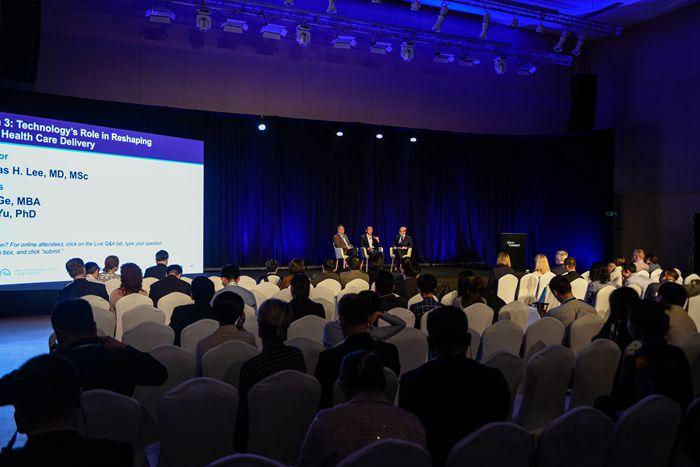
In addition to the on-site attendees, more than 4,000 people in China watched the global live broadcast.
Recently, the NEJM Catalyst team, a rising star within The New England Journal of Medicine family, together with health economists, healthcare administrators, and clinicians from Harvard University, Kaiser Permanente, Providence St. Joseph Health, Mayo Clinic, and Brigham and Women’s Hospital, visited China for the first time. Facilitated by Jiahui Health and the Shanghai Caohejing Hi-Tech Park, they held an academic exchange conference on healthcare titled “Development and Transformation of Healthcare in China: Global Experiences.” The conference aimed to explore hot topics such as practitioner training and incentives during the scaling up of primary care, AI-enabled support, and fiscal and regulatory innovations.
Initiated by Jiahui Health, the conference was led and curated by Professor Thomas H. Lee, Founder of NEJM Catalyst, Chief Medical Officer of Press Ganey, Professor of Health Policy and Management at the Harvard T.H. Chan School of Public Health, and Member of the Congressional Budget Office’s Health Advisory Panel. Numerous distinguished guest speakers attended the event to participate in discussions.
Connectivity Drives Efficiency: Investment by a Single Institution Leads to Systemic Reductions in Healthcare Costs
The unequal distribution of healthcare resources has led to patient concentration in large hospitals. For residents of small and medium-sized cities, many conditions cannot be treated locally, necessitating costly travel to distant major metropolitan areas for diagnosis and treatment—a challenge faced by both China and the United States. The goal of national healthcare service operations is to meet substantial demand with limited resources, ultimately delivering public benefits on a large scale.
In response, Professor Amy Compton-Phillips, who oversees 51 hospitals and 800 clinics across the United States, shared her exploratory initiatives at Providence St. Joseph Health: “The system comprises numerous healthcare entities and institutions, such as heart centers, rehabilitation physicians, women’s hospitals, cancer hospitals, and universities, located in diverse regions. I require each of them to report three key points at every stage: what services they can provide, how they can help reduce overall healthcare costs, and how they can improve patient care outcomes. Following an initial feasibility analysis, we provide these entities with hardware, management, and administrative support, allocating optimal resources to their respective locations. Meanwhile, the system mandates data feedback and analysis based on these three criteria. If an institution successfully implements these measures, the system will further allocate additional resources to support its next cycle, such as adding new equipment to operating rooms, introducing module tools in electronic health records to streamline care processes, or deploying simulation systems for remote education at universities.”
Professor Amy Compton-Phillips explained: “Through this approach, it is evident that the input costs for labor, pharmaceuticals, and consumables in specific areas of individual hospitals continue to rise. However, the actual outcome is that the integration of overall resources has expanded the patient population covered by the entire system, improved healthcare accessibility for the public, and reduced the overall cost of care. This represents a systemic transformation.”
Mr. Ge Feng, CEO of Jiahui Health and Managing Partner at Trustbridge Partners, added, “Many people ask: Given that private providers account for only 5% of China’s healthcare services, what can actually be achieved? In fact, there is substantial potential. The healthcare industry is global in nature—first, because medical science is a global endeavor; and second, because extensive global partnerships enable the genuine development of healthcare ventures.”
Transparent Clinical Outcomes: Incentivizing Healthcare Professionals Through “Sense of Honor” and “Competitive Excellence”
As is well known, expanding primary care resources so that people no longer rush to register with specialists at tertiary hospitals for minor ailments like coughs is key to improving overall healthcare efficiency. So, how can sufficient primary care resources be provided to meet the challenges of scaled-up demand? Professor Patrick T. Courneya, Executive Vice President and Chief Medical Officer of Kaiser Permanente Insurance and Hospitals, named one of the “100 Top Chief Medical Officers” by Becker’s Hospital Review, and a clinician with 25 years of practice experience, responded: “While expanding the workforce through standardized training, we must also incentivize continuous improvement among existing primary care practitioners.”

Guest Speakers, from left to right: Patrick T. Courneya, Amy Compton-Phillips, David J. Cook
According to projections from a certain unofficial U.S. physicians’ association in 2019, there will be a shortage of approximately 140,800 primary care physicians by 2030, while 78% of primary care physicians experience professional burnout during their careers.
Professor Patrick stated that within his organization, Kaiser Permanente, more nurses, pediatricians, and pharmacists are being incorporated into primary healthcare training. On the other hand, “we use transparency in practitioners’ clinical performance—specifically, treatment outcomes—as an incentive mechanism.” The management of primary care practitioners within the Kaiser system adopts a “loose-tight” model: it is “loose” in that physicians are not required to follow rigid, step-by-step protocols for every specific action; however, at the system level, standardized tools spanning education and service delivery are provided based on the ultimate goal of treatment outcomes. The modules required for completion and the questions posed within these tools compel practitioners to thoroughly consider what treatment outcomes patients need, as well as to promote and reflect the achievement of those outcomes. This approach ensures that attention is paid to, and analysis is conducted on, how a given medical procedure affects clinical outcome levels at both the individual physician and institutional levels, and determines the success or failure of treatment outcomes for individual patients.
This standardization enables a high degree of transparency in the quality and outcomes of diagnosis and treatment across healthcare systems, institutions, individuals, among physicians, and between patients and physicians. This makes it possible for the system to monitor and evaluate institutions and individuals, fosters healthy competition among physicians, and empowers patients to proactively select the most suitable physician or institution.
“I believe the most effective incentives for physicians do not come from financial bonuses, as amounts that are too low fail to motivate, while those that are too high may compromise patient interests. Effective incentives stem from their sense of professional accomplishment and self-esteem. Their performance should be linked to treatment outcomes—for example, how the outcomes of all patients under a physician’s care during a given period compare; whether it can be demonstrated that their clinical outcomes are superior to those of other physicians; whether they have achieved their self-set goals; what level of patient satisfaction has been attained; and whether empathy was demonstrated throughout the care process. These distinctive strategies and approaches have been proven to incentivize behavior, reflected in physicians’ willingness and habits of continuous improvement, as well as in the overall quality and reputation of the healthcare system.”
Artificial Intelligence Is Pioneering a Tripartite Dynamic Symbiosis Among Physicians, AI, and Patients
Faced with mounting pressure on healthcare, it is difficult to train a large number of excellent doctors in the short term to address the issue, but technology may offer a solution.
In recent years, artificial intelligence and natural language processing have developed rapidly in China, with the annual number of patent applications surpassing that of the United States. In February this year, Chinese and American researchers published a report in Nature stating that AI-driven learning applications have already established a database of 1.4 million pediatric patients, which they claim could help deliver large-scale basic medical services in the next phase.
Dr. Yu Zhong, a member of the Expert Committee for the Evaluation System of Health and Medical Big Data Application Standards under the National Health Commission of China, shared insights on an experiment conducted in Jingde County, Anhui Province—the first attempt to introduce artificial intelligence into primary healthcare in China. The initiative involved patients wearing vital signs monitors, AI technology, Jinglun’s Angel Robots, and village doctors. It spanned 10 towns and 68 villages, engaging a population of 150,000. Ultimately, the Angel Robots facilitated 15,000 primary care consultations, while over 1,800 patients received remote services through the Angel Robot system. Both the Jingde County Government and the World Bank recognized that this intelligent healthcare model significantly enhanced the accessibility and affordability of primary care, demonstrating high value and potential for application in other similar contexts globally.
Dr. Yu Zhong drew an analogy between birds removing parasites from their bodies and the tripartite, dynamic symbiotic system currently being applied among “physicians, AI, and patients”: “We leverage machines to collect vast amounts of patient data—including health metrics, behavioral patterns, and clinical outcomes—and feed this information back to physicians, who in turn provide feedback to the machines, creating a closed loop of continuous learning. Physicians act as executors, delivering intelligent services to patients, while machines serve as assistants, helping patients achieve better outcomes. Patients are also a critical source of feedback. Although machines are fast and accurate, they are naive; they lack consensus, self-awareness, or any form of consciousness, whereas humans possess wisdom. Therefore, our approach is to channel feedback to humans while integrating physicians with machines. When human learning, physician learning, and machine learning are interconnected, mutually supportive, and interactive, they can deliver intelligent medical services to patients.”
Regarding the question of “whether humans or machines are the ultimate decision-makers in healthcare,” Yu Zhong responded that we must return to the essence and fundamentals of learning. It is difficult to establish a principle at the outset and then adhere to it rigidly; learning must be a process of continuous evolution. As humans and machines interact with and enhance each other, certain systems and rules will emerge, which we can then modify and adjust.
Regarding the original intention behind Catalyst’s debut in Shanghai, Professor Leemore S. Dafny, a professor of business administration at Harvard Business School, a researcher at the National Bureau of Economic Research, a board member of the American Society of Health Economists, and a member of the Congressional Budget Office’s Health Advisers Panel, stated:
In every country around the world, including China and the United States, people are dissatisfied with their healthcare systems. Part of this dissatisfaction stems from the pursuit of a better life, as people aspire to live longer and enjoy a higher quality of life. According to the latest data from the World Health Organization, the expected number of years lived in good health in China is 68.7 years, compared to 68.5 years in the United States. In terms of overall life expectancy, the figure stands at 78.5 years in the United States and 76.4 years in China; however, the last decade of life for Americans is generally not spent in good health. As an economist, I appreciate data. I thrive on competition and comparison, believing that there is always something valuable to be learned from such analyses.