

Neusoft Launches New Clinical Specialty Systems Offensive Targeting High-Potential Markets

Neusoft
Provider of Connectivity and Software Products and Services

Product integration has always been Neusoft’s trump card in the medical IT market.
Taking Neusoft’s next-generation hospital core business platform, RealOne Suite, as an example, the system not only provides one-stop solutions for numerous medical institutions in terms of technical architecture, functional implementation, and specialty-specific specialization, but has also helped more than ten medical institutions pass national evaluations and ratings related to electronic medical records (EMR) and interoperability.
Over the past decade, integration has been the most significant trend in healthcare informatization. In terms of policy, the national government has vigorously promoted interoperability and electronic medical record (EMR) grading, substantially improving and resolving issues such as information silos and data chimneys. However, as hospital needs evolve, specialization is becoming another key trend in healthcare informatization, poised to enter a phase of rapid development. Neusoft, having secured market advantages through its integrated solutions, has proactively shifted its focus toward specialization.
In its 2018 annual report, Neusoft explicitly stated that the company continues to focus on its core healthcare business, vigorously promoting specialized and knowledge-intensive product and technological innovation to support the development of smart hospitals. In the field of clinical medicine, Neusoft is actively developing specialized products in oncology, hemodialysis, critical care, and medical imaging, and has established in-depth collaborations with more than ten provincial- and ministerial-level cancer hospital clients, including Sun Yat-sen University Cancer Center, Tianjin Medical University Cancer Institute and Hospital, and the Cancer Institute & Hospital of the Chinese Academy of Medical Sciences.
In its dialogue with Mr. Li Dong, General Manager of the Clinical Healthcare Division, VCBeat gained clear insights into this medical IT giant’s strategic thinking on specialization.

Li Dong, General Manager of the Clinical Medical Business Unit, Healthcare Solutions Business Group, Neusoft
Specialization: The Battle for the Future of Healthcare IT in the Next Decade
“Neusoft’s entire product ecosystem is like an aircraft carrier,” Li Dong described. The previous integrated strategy served as the platform and foundation for building this aircraft carrier. However, the individual performance of weapons equipped on the carrier—such as fighter jets, missiles, and torpedoes—ultimately determines the upper limit of its combat capability.
Li Dong believes that Neusoft’s competitiveness should encompass two aspects: first, integration, which is Neusoft’s traditional core advantage; second, on the basis of integration, Neusoft’s flagship products in specialized segments, namely department-level specialty systems and their IP portfolios across different scenarios.
In the coming decade, specialization will become another key strategic choice for Neusoft in the healthcare IT sector. To this end, Neusoft has established its Clinical Healthcare Business Unit. Guided by the mission to “focus on the challenges and pressures that matter most to our customers, deliver the most competitive smart clinical healthcare solutions, empower clinical staff to achieve precise diagnosis and safe treatment, and create maximum value for our customers,” the unit provides a series of department-level specialized products to healthcare institutions. Building on this product portfolio, it also offers scenario-based and disease-specific solutions, such as operating room solutions, solutions for the five major centers, third-party independent medical institution solutions, and regional specialty platform solutions.
Specialized Development: Neusoft Establishes Four Dimensions and Two Major Domains
Numerous clinical information systems have, in fact, existed for a long time. However, according to Neusoft’s perspective, next-generation specialty-specific systems must meet four dimensions:
First, key technologies. Each specialty product must be benchmarked against the technologies of “cloud computing, big data, IoT, mobile internet, and AI,” and identify corresponding points of integration.
Second, critical knowledge. This includes clinical guidelines and disease-specific databases. The depth of understanding and mining of these knowledge bases and their interrelationships, as well as their full integration into a specific disease area, determines whether a clinical specialty product possesses sufficient competitiveness.
Third, management models. With the reform and development of hospitals, hospital departments have increasingly in-depth management requirements for staffing, equipment utilization, and operational economic efficiency. If IT enterprises can provide departments with data-driven, mature management models and systems, they are more likely to achieve success.
Fourth, academic research. This is a key manifestation and pursuit of the capabilities of hospitals, departments, and physicians, and it serves as the core focus for every department head. A truly effective clinical specialty system can help hospitals and physicians enhance their academic and disciplinary influence.
Furthermore, Neusoft’s specialty products are scenario-oriented. For instance, they provide novel solutions tailored to settings such as hospital wards and operating rooms. Building on its existing portfolio of specialty products, Neusoft is developing scenario-based disease management solutions and has currently defined 12 scenarios, corresponding to 12 product lines.
Neusoft’s clinical healthcare business is divided into two major domains: the diagnostic domain, which includes laboratory medicine, radiology, ultrasound, pathology, endoscopy, nuclear medicine, and electrophysiology; and the therapeutic domain, which encompasses anesthesiology and perioperative medicine, critical care medicine, dialysis, and interventional procedures. Neusoft integrates key technologies, core knowledge, management models, and academic research to empower each product line within these two domains, thereby establishing its own unique core competitiveness.
Meanwhile, Neusoft integrates various clinical specialty systems through its ClinicalOne platform to deliver more competitive smart clinical solutions tailored to diverse scenarios. For instance, traditional operating rooms often relied solely on anesthesia information management systems (AIMS). However, there is a critical need for comprehensive integration and convergence with pathology, imaging, electrocardiogram (ECG), and other systems. This integration should extend beyond mere data exchange to achieve deep fusion across workflows, management, and other dimensions. For example, surgeons strongly desire real-time access to intraoperative pathology results to better prepare for subsequent surgical steps. Such high-level integration and convergence among systems will inevitably unlock new value propositions.
In the development of each product line, Neusoft analyzes the current stage of industry development for every line to adopt differentiated competitive strategies. Critical care is undoubtedly a highly significant segment within this portfolio. Li Dong asserts, “The ICU market has substantial capacity, and complex critical cases are a key focus area receiving special attention and significant investment from the state. However, ICU informatization remains inadequate and is still in its nascent stage. Over the next two to three years, the field of ICU informatization is poised to see the emergence of industry leaders.”
Neusoft Critical Care Information System is patient-centric, integrating critical care medical knowledge with key technologies such as the Internet of Things (IoT), artificial intelligence (AI), and big data across clinical scenarios including diagnosis, treatment, nursing, research, and management. It provides a leading smart critical care solution to assist medical staff in achieving precise diagnosis and safe treatment, while helping administrators improve departmental management efficiency.
The director of the ICU department at a Grade A tertiary hospital in Hebei Province told VCBeat that while domestic ICUs have rapidly advanced in terms of hardware equipment, staffing levels remain relatively insufficient. Implementing many quality control targets proves extremely challenging. Consequently, ICU departments need to leverage certain tools to assist with their workflows. Tasks such as clinical data collection, data recording, trend analysis, and workload statistics for medical staff all require the support of information technology and AI. The earlier, simplistic approach to paperless operations is no longer suitable for the current development needs of ICU departments.
The expert stated that Neusoft’s Smart ICU System assists medical staff on four levels:
First, the system's AI can reduce the workload of healthcare professionals to a certain extent;
Second, the system can improve the quality of nursing and medical care, particularly in monitoring, helping healthcare professionals perform better even under conditions of staff shortages;
Third, in terms of treatment, healthcare professionals can integrate certain treatment protocols into the system to provide clinical decision support for physicians;
Fourth, it can provide some assistance in evaluating doctors and nurses by measuring their workload to a certain extent through the system.
Neusoft’s Strengths: The Complementary Nature of Integration and Specialization
In the field of critical care specialty systems, Neusoft aims to surpass its competitors. Li Dong believes that it is a particularly interesting and valuable proposition to consider how to achieve “specialization” from the perspective of “integration,” and how to ensure better “integration” from the perspective of “specialization.” Only by achieving better integration can specialization be elevated to another level; conversely, only when specialization reaches a certain degree can integration advance to a more competitive level, an area where Neusoft possesses inherent advantages.
In the “Survey Report on the Status of Hospital Informatization in China (2017–2018)” released by the Professional Committee on Information Management of the Chinese Hospital Association, an investigation was conducted into the current application of clinical systems across hospitals of different tiers. According to the data, the adoption rates of pathology, anesthesia and perioperative management, and electrocardiogram (ECG) systems in tertiary hospitals in China did not exceed 40%. In hospitals below the tertiary level, the adoption rates were even lower, falling below 20%.
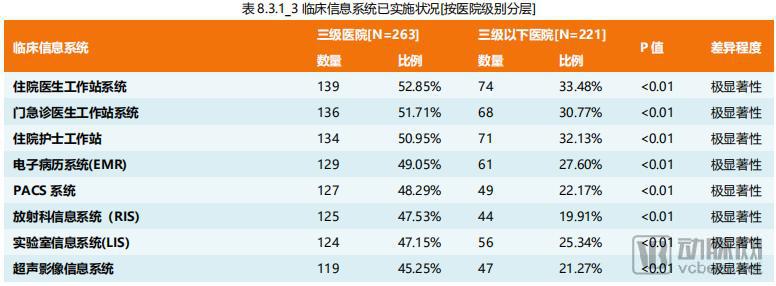
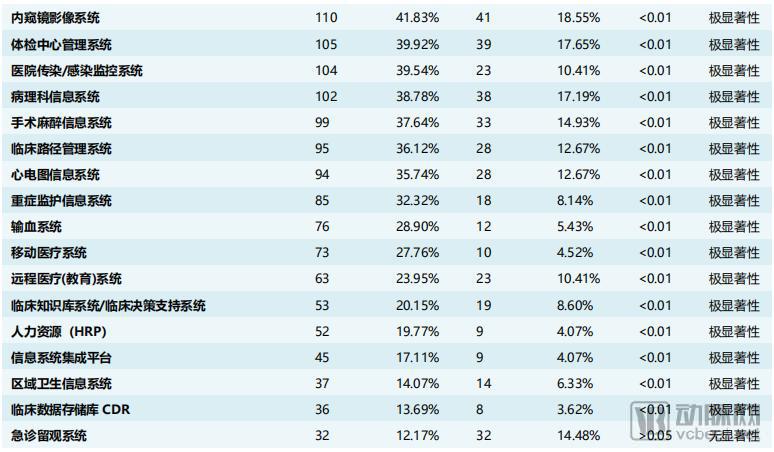
Data Source: "Survey Report on the Informatization Status of Chinese Hospitals (2017-2018)"
In the coming years, clinical medical informatics is expected to enter a period of rapid development. To respond to swift market changes, Li Dong stated that Neusoft will deeply focus on four dimensions: key technologies, critical knowledge, management models, and academic research. The company aims to build cutting-edge capabilities and core competitiveness for department-level clinical specialty products. By collaborating closely with industry peers, experts, customers, and ecosystem partners, Neusoft is committed to jointly creating a truly “Smart Clinical” environment.