

China's IVD Market Expansion in Grassroots Healthcare: Where Are the Top 8 Billion-Yuan Revenue Leaders Investing?

Wondfo Biotech
In Vitro Diagnostics (IVD) Product Development, Manufacturing, and Sales
2018 is often described as a watershed year for the IVD industry. Some argue that this year marked the dawn of a golden age in the field of in vitro diagnostics, while others contend that it signaled the beginning of industry consolidation. The emergence and maturation of new technologies may well reshape the entire sector.
Recently, leading domestic IVD companies have successively released their 2018 annual reports. These reports reveal that the concentration level in China’s in vitro diagnostics (IVD) industry remains relatively low. While there are nearly 400 manufacturers of IVD reagents, only about 20 of them achieve annual sales exceeding RMB 100 million. In response to this landscape, VCBeat has selected eight representative companies for analysis, focusing on aspects such as changes in product sales and R&D investment.(Note: Companies primarily engaged in sales or third-party testing services are not included.)
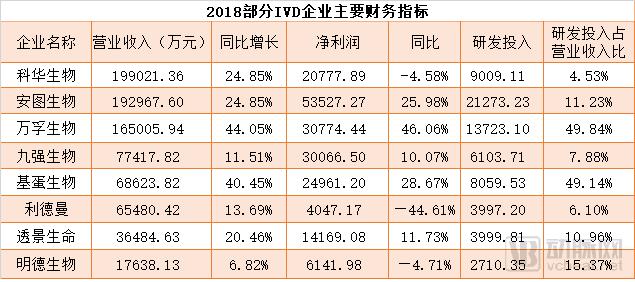
Overall, among the eight leading IVD companies, three reported revenues exceeding RMB 1 billion: Kehua Bio-engineering, Autobio Diagnostics, and Wondfo Biotech. Two companies achieved year-on-year revenue growth rates of over 40%: Wondfo Biotech and Getein Biotech.
Wondfo Biotech’s impressive performance was primarily driven by the rapid growth of its chronic disease management testing business. In 2018, this segment generated RMB 419 million in revenue for Wondfo Biotech, representing an 81.59% year-on-year increase.
Cardiovascular and cerebrovascular diseases within the chronic disease segment served as a key growth driver for Wondfo Biotech, generating RMB 30 million in revenue. This growth was propelled by policy initiatives, including the expansion of the primary healthcare market under the tiered diagnosis and treatment system, and the national push for the establishment of “Chest Pain Centers” and “Stroke Centers.”
It can be said that Wondfo Biotech has capitalized on the dividends released by policy initiatives. Meanwhile, its other product lines—inflammation markers and infectious disease testing—generated over RMB 400 million in revenue for the company, with sales from inflammation marker testing amounting to RMB 184.3449 million. The sales of inflammation marker testing products have generally benefited from the national “antibiotic restriction” policy and the rapid increase in relevant testing volumes at primary healthcare institutions driven by the tiered diagnosis and treatment system.
Based on these figures, China’s annual per capita diagnostic expenditure stands at approximately $5, significantly lower than the $25–$30 average in developed countries, indicating that the industry remains in its growth phase of the lifecycle. This also suggests substantial untapped potential in the primary care market.
Among the eight companies, Kehua Bio-Engineering, which had the highest revenue, derived 57.18% of its revenue from agency products.
Autobio Diagnostics achieved a gross profit margin of 67.82%, with its operating revenue primarily derived from immunodiagnostic products, followed by microbiology testing. These two sectors generated revenues of over RMB 1 billion and RMB 160 million for Autobio Diagnostics, respectively. Notably, in the highly competitive and nearly saturated clinical chemistry testing market, Autobio Diagnostics recorded a growth rate of 175.31%.
Some rejoice while others worry; three companies saw a decline in net profit, among which Mingde Bio’s gross margin decreased mainly due to a drop in the unit price of its products.
Leadman, whose net profit dropped directly by 44.61%, reported in its annual report that its subsidiary, Wuhan Leadman, incurred a loss of approximately RMB 940,000, while instrument sales also declined.
Although most companies achieved rapid growth in revenue and net profit, the gross profit margins of many enterprises declined to some extent for both reagents and instruments.
The IVD industry has long been criticized for its low entry barriers, high gross profit margins, heavy reliance on distributors, and dependence on imported upstream raw materials. These were once the industry’s weaknesses; according to the annual reports of eight companies, most are directing their R&D investments toward addressing these shortcomings.
Overall, these companies have directed their R&D funding into three areas: first, significantly expanding their product portfolios; second, developing high-end diagnostic reagents and instruments to achieve import substitution in the premium segment; and third, striving to achieve self-sufficiency in raw material production.
The current biochemical diagnostics market is highly mature, with both instruments and reagents achieving independent R&D and import substitution. In terms of instruments, several domestic manufacturers are now capable of producing fully automated biochemical analyzers; however, these products primarily serve the mid-to-low-end market, with future development directed toward large-scale automated assembly lines. Regarding biochemical reagents, the localization rate has exceeded two-thirds, and they have gained access to sales channels in Grade IIIA hospitals.
Therefore, in terms of expanding product portfolios to capture other niche segments, the major players are those with biochemical diagnostics as their core business, such as Kehua Bio-engineering and Jiuyuan Biology.
Kehua Bioengineering, with R&D investments exceeding RMB 90 million, has allocated its funds to enriching its product portfolio. The company’s R&D projects primarily focus on clinical chemistry diagnostic reagents and instruments, immunoassay instruments and reagents, and molecular diagnostics-related products.
Jiuqiang Biotech has launched its proprietary brand of biochemical analysis systems, closely following the trend toward closed systems in biochemical diagnostics. Furthermore, the company is actively expanding into other niche segments of the in vitro diagnostics (IVD) industry. Since November 2018, it has invested over RMB 200 million to enter the high-end coagulation testing market. Currently, the coagulation analysis market is predominantly dominated by three major international players: Instrumentation Laboratory (IL, part of the Werfen Group) from the United States, Sysmex Corporation from Japan, and Stago Group from France.
Autobio Diagnostics has invested in instrument R&D. In 2018, to enter the high-end immunoassay market dominated by international diagnostic giants such as Roche, Abbott, Beckman, and Siemens, Autobio Diagnostics made substantial investments in the development of its fully automated magnetic particle chemiluminescence immunoassay system and automated nucleic acid diagnostic system.
Based on current achievements, Autobio Diagnostics has developed a fully automated magnetic particle chemiluminescence immunoassay analyzer capable of performing up to 200 tests per hour under single-test management after years of R&D. The company has obtained 91 registration (filing) certificates for its magnetic particle chemiluminescence diagnostic products, providing clinicians with random-access, rapid automated immunoassay solutions.
Import substitution is an indispensable topic in the medical device sector; however, to date, China’s upstream raw materials for in vitro diagnostics (IVD) still rely heavily on imports. Bioactive materials (primarily including antigens, antibodies, etc.), as key raw materials for immunoassay-based IVD reagents, directly impact product quality. The identification and screening of bioactive materials represent one of the most challenging and critical stages in IVD product development. Once a specific bioactive material is selected and put into production, the related technologies and procurement sources become among the most closely guarded secrets of each IVD manufacturer. Consequently, this upstream raw material segment is a key area where domestic companies are investing heavily in R&D to achieve breakthroughs.
Leadman, Autobio Diagnostics, Wondfo Biotech, and Jiuzhou Bio are all laying out their R&D in raw materials for in vitro diagnostics (IVD) and have achieved certain results. Autobio Diagnostics has mastered a complete set of technologies including the design, expression, purification, labeling, screening, storage, and application of monoclonal antibodies, polyclonal antibodies, gene-recombinant antigens, and natural antigens.
In 2018, 2017, and 2016, the proportion of imported raw materials in Jiuziang Bio’s total raw material procurement amounted to 18.91%, 27.88%, and 33.60%, respectively. By increasing investment in raw material research and development and substituting imported materials with self-produced ones, the Company has reduced its dependence on key raw materials to a certain extent.
Leadman has achieved localization of key raw materials for some of its in vitro diagnostic reagents.
Notably, IVD companies with both manufacturing and distribution operations are beginning to strengthen channel control and expand into new channels, as the in vitro diagnostics industry embraces “new retail.”
In 2018, Kehua Bioengineering strengthened its control over distribution channels by acquiring controlling stakes in seven channel companies through mergers and acquisitions and the establishment of new entities.。
Kehua Bioengineering Begins to Explore Joint Establishment of Clinical Laboratories with Hospitals, in 2018, Kehua Bio-engineering had established professional collaborations with 13 end-user hospitals in Beijing, Shanghai, Jiangsu, Chongqing, Hebei, Shandong, and other regions, achieving an annual operating revenue of RMB 31.68 million.
In terms of marketing, Wondfo Biotech is attempting to establish a consumer-facing presence by building a smart, interconnected network for in vitro diagnostics. The company is leveraging intelligent connectivity to create an Internet of Things (IoT) ecosystem, while investing in and incubating business-to-consumer (B2C) products. These B2C offerings are primarily rolled out through eugenics and reproductive health products as well as infectious disease testing kits. The eugenics and reproductive health products are sold directly to individual consumers via over-the-counter (OTC) channels or e-commerce platforms.
Wondfo Biotech also aims to explore new business formats, such as high-end clinics for eugenics and optimal childbearing. By addressing users’ pain points during preconception preparation, the company plans to enrich its portfolio of nutritional and health-support products, establish premium preconception care clinics, and create an integrated O2O preconception solution.
Overall, the leading IVD companies adopted a strategy of “stockpiling resources and building high barriers” in 2018, striving to break through core technologies and penetrate the high-end market, while also boldly exploring new approaches.The golden decade for medical devices has just begun, and the spotlight on domestic IVD companies is only starting to shine.