

Online Pharmacy Growth Slows as B2B Takes the Lead: How Are Listed Pharma Companies' E-commerce Platforms Performing?
There has been considerable discussion within the industry recently regarding pharmaceutical e-commerce: the draft revision of the Drug Administration Law addresses the regulatory compliance of online prescription drug sales; announcements by pharmaceutical companies concerning B2B e-commerce highlight the conflict of interest between traditional and new distribution models; and several new pharmaceutical retail platforms have secured hundreds of millions in financing. These discussions not only reflect the need for further improvements in regulation and business processes but also demonstrate the growing influence of e-commerce and the gradual prosperity of its ecosystem.
Looking back, a series of policies promoting the development of “Internet + Healthcare” were released at this time last year. Business models such as internet hospitals, remote consultations, and electronic prescriptions gained recognition, bringing favorable conditions to the pharmaceutical e-commerce sector.
VCBeat (WeChat ID: vcbeat) has reviewed the e-commerce-related content in the 2018 annual reports of listed pharmaceutical companies, providing a systematic overview of the development of leading pharmaceutical e-commerce enterprises over the past year. The key findings are as follows:
1. The “Internet + Healthcare” series of policies has spurred the gradual diversification of innovative industry models, improved access to high-quality medical resources, and established a full-process service system encompassing online consultation, diagnosis, prescription, medication, and rehabilitation management;
2. The overall growth of online pharmacy businesses is slowing down, with sales of medications for common diseases, chronic conditions, and over-the-counter (OTC) drugs growing faster than non-therapeutic products; the number of online pharmaceutical wholesale platforms is increasing, and B2C platforms are also expanding into wholesale operations; B2B business is experiencing rapid growth, with transaction volumes on some platforms increasing by over 100%;
3. Significant synergy between online operations and offline resources, with traditional pharmaceutical manufacturers and distributors accelerating their “Internet + Healthcare” strategies: e-commerce platforms are establishing brick-and-mortar “hospital-adjacent stores” offline, while DTP (Direct-to-Patient) pharmacies are capturing outsourced prescriptions and collaborating with pharmaceutical logistics and warehousing enterprises;
4. Capital continues to maintain a high level of interest in the e-commerce industry, with some industrial investors bringing resources such as pharmaceutical supply chains, health products, and health insurance, thereby expanding the scope and business models of e-commerce.
There are more than 30 pharmaceutical e-commerce concept stocks among domestically listed pharmaceutical companies, including Baiyunshan, Shanghai Pharma, Lepu Medical, By-Health, and Jointown Pharmaceutical. Most of them have not disclosed the performance details of their specific segments.
Ping An Good Doctor, Alibaba Health, and 111 Group, listed on the Hong Kong and U.S. stock markets, derive their revenue primarily from e-commerce and can also be regarded as pharmaceutical e-commerce companies. The following are companies that have disclosed revenue from e-commerce-related businesses:
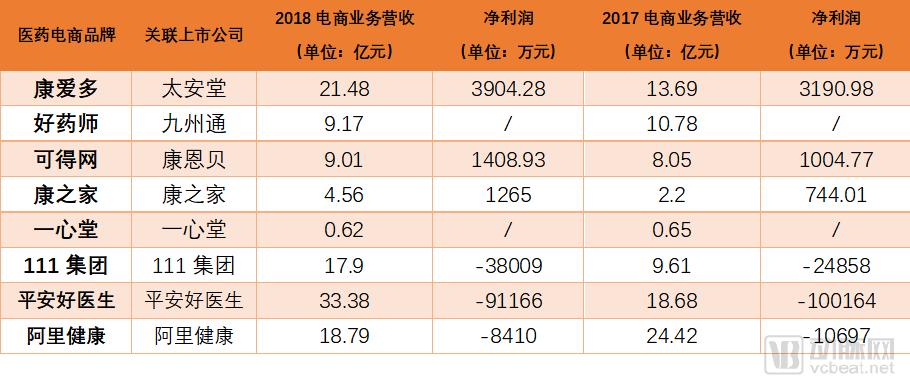
Data source: Annual reports of listed companies; Alibaba Health data is for the first half of 2018.
Among the e-commerce operations of domestically listed pharmaceutical companies, Kang Aiduo took the lead, with revenue reaching RMB 2.148 billion in 2018, a year-on-year increase of 57%. However, its net profit saw little change, rising by only about RMB 7 million. The growth in performance was primarily driven by its wholesale business to small and medium-sized chain pharmacies and independent pharmacies.
Haoyaoshi’s revenue declined slightly, primarily due to the optimization of its operational structure and product categories. Kede Wang, in which Conba Holding holds a 20% stake, is a typical example of a differentiated e-commerce platform specializing in contact lenses and related products, with its 2018 revenue exceeding RMB 900 million. Kangzhijia also achieved a significant increase in revenue by leveraging its B2B business, while its net profit remained relatively stable.
Other companies, such as Yixintang, Shanghai Pharma Cloud Health, and Nanjing Pharmaceutical, also described their “Internet + Healthcare” businesses in their annual reports. Yixintang noted that it launched its pharmaceutical e-commerce business in 2013 and established an E-commerce Business Group in 2016. This group comprises several e-commerce divisions, including B2C, O2O, CRM, and e-commerce technology. With CRM and big data at its core, the company is building a new pharmaceutical retail model that integrates online and offline operations.
Shanghai Pharma’s subsidiary, Shanghai Pharma Cloud Health, aims to be the leader and innovator in “Internet + prescription drug new retail.” Under the “Yi Yao” series brand, it supports government agencies in implementing the policy of separating prescribing from dispensing and facilitates healthcare reform by addressing multiple aspects of the prescription circulation process, including prescription acquisition and management, payment and rational use control, prescription fulfillment and drug delivery, and value-added patient services.
Nanjing Pharmaceutical adopts a self-operated model and leverages third-party platforms to promote and replicate its retail professional line through O2O and B2C e-commerce businesses. Meanwhile, the company is simultaneously advancing an “Internet + Traditional Chinese Medicine (TCM) Pharmacy Services” platform, anchored in TCM decoction services, as well as a B2B e-commerce platform for its wholesale sector to enable supply chain collaborative services. By capitalizing on its brand influence and regional resource advantages, the company is integrating existing capabilities and continuing to secure relevant e-commerce qualifications. It is actively exploring, developing, and implementing an online-to-offline integrated e-commerce marketing model that is customer-centric and characterized by health management services.
Below are excerpts from pharmaceutical companies' annual reports disclosing the performance and development of their e-commerce businesses:
Kangaiduo
The annual report shows that as of the end of the reporting period, Kangaiduo had a total of 47.43 million registered members and 40 million purchasing users, among which 8.26 million were registered on its self-built platform. During the reporting period, Kangaiduo achieved sales revenue of RMB 2.148 billion, of which RMB 608 million came from its self-built platform and RMB 1.137 billion from third-party platforms, primarily Tmall.
Kangaiduo has accumulated vast amounts of member data over the years, enabling precision marketing based on product characteristics and user needs. The company has also established a comprehensive CRM system to manage users’ health records, document medication purchase behaviors, and track and analyze medication usage data, thereby formulating personalized professional health services and marketing strategies for its members. In terms of expert resources, Kangaiduo has set up 15 expert committees and boasts more than 50,000 online physicians at the associate chief physician level or above.
In terms of supply chain, Kangaiduo has established stable strategic partnerships with over 3,000 industrial enterprises in China, encompassing direct product supply, marketing, and market resource support, while ensuring an online SKU count exceeding 28,000. Meanwhile, Kangaiduo has built a comprehensive omnichannel system integrating online and offline channels; in addition to collaborating with high-traffic platforms, it covers more than 30,000 independent pharmacies and clinics. Kangaiduo operates a professional warehousing and distribution base spanning over 70,000 square meters, utilizing electronic conveyor belt systems to process an average of more than 50,000 orders per day. The company has more than 10 offline stores, all of which are pharmacy locations adjacent to hospitals designed to capture outbound prescription flows.
Haoyaoshi
Jointown Pharmaceutical’s retail business is primarily divided into online and offline segments, generating total operating revenue of RMB 1.960 billion, a year-on-year increase of 4.46%. Among these, its 1,287 retail chain pharmacies across various regions (including franchise stores) achieved sales of RMB 1.043 billion, representing a year-on-year growth of 18.47%; meanwhile, its e-commerce business recorded revenue of RMB 917 million, a year-on-year decline of 14.93%.
According to the annual report, Haoyaoshi has adjusted its online business development strategy. Specifically, the operation of its flagship stores on JD.com and Tmall has shifted from a prior focus on scale expansion to a strategy centered on operational quality and customer experience. This approach aims to provide manufacturers with comprehensive value-added services, thereby safeguarding the mutual interests of manufacturers, Haoyaoshi, and the platform operators. Additionally, Haoyaoshi’s APP offers an O2O medicine delivery service featuring “24-hour delivery and guaranteed one-hour arrival.” It has established a nationwide three-dimensional delivery network comprising “5 warehouses + 20 cities,” adding eight new cities including Hefei, Xiamen, Ningbo, Suzhou, Hangzhou, Shenzhen, and Guangzhou.
Driven by policies promoting the outflow of prescriptions from hospitals, Haoyaoshi has established a specialized prescription drug division. By integrating Jointown’s R&D resources, it has built two prescription circulation systems: the Hao Deyi Prescription Review and Circulation Cloud Platform and the Haoyaoshi Cloud Prescription system. In collaboration with physical medical institutions, smart healthcare providers, and internet hospitals, it has formed a Prescription Circulation Ecosystem Alliance, enabling resource sharing among members to jointly construct a future-oriented prescription circulation ecosystem. Additionally, a professional pharmacist service center has been established to provide consumers with expert medication guidance and to offer specialized prescription review support for the circulation of prescription drugs.
KeDe.com
Kede.com is an e-commerce company in which Conba holds a stake, primarily engaged in the sale of eyewear and related products, including clear contact lenses, colored contact lenses, and lens care solutions. Conba holds a 20% equity interest in the company. In 2018, Kede.com reported operating revenue of RMB 901 million and net profit of RMB 14.0893 million.
In addition, Zhenshiming Pharmaceutical, a subsidiary of Conba, has opened flagship stores for the “Zhenshiming” brand on e-commerce platforms such as Tmall and JD.com. Through the B2C e-commerce model, it sells eye health products under the “Zhenshiming” brand, including eye patches, eye masks, and eye care items. Currently, its main e-commerce products rank first in the Home & Daily Use category on the Taobao and Tmall platforms.
Meanwhile, Conba has established partnerships with e-commerce platforms such as Alibaba Health and JD.com to promote its branded OTC products. By launching initiatives like the “Qianliekang Flagship Store,” the company has advanced its new retail operations for branded OTC products and achieved positive progress.
Guoda Pharmacy
As of the end of 2018, Guoda Drugstore operated 4,275 stores, covering 19 provinces, autonomous regions, and municipalities across China, with a presence in nearly 70 large and medium-sized cities. It has established a pharmacy network spanning the coastal city clusters of East, North, and South China, while progressively expanding into the Northwest, Central Plains, and inland city clusters. With a scale exceeding RMB 10 billion, it has maintained its position as the industry leader in sales volume.
Guoda Pharmacy’s business is primarily anchored in modern retail pharmacies, with a focus on developing a specialized service system that leverages medical resources as its core competitive advantage. It aims to establish a network of specialized stores integrating retail clinics and hospital partnerships, thereby merging medical services with health product sales. Meanwhile, Guoda Pharmacy is actively expanding innovative businesses, exploring and diversifying new business channels, and enhancing its professional service capabilities, committed to transforming from a traditional pharmaceutical retail enterprise into an innovative service-oriented company.
In terms of e-commerce operations, Sinopharm Consistency steadily advanced its online sales in 2018. While the overall growth rate of e-commerce revenue slowed down, the total gross merchandise value (GMV) on O2O platforms reached RMB 255 million, representing a year-on-year increase of 3.1%. Notably, home delivery services experienced rapid growth, achieving sales of RMB 14.04 million in 2018, a year-on-year surge of 167%.
Kangzhi Jia
Kangzhijia’s “Internet + Pharmaceuticals” business is also divided into wholesale and retail segments. The wholesale segment provides in-depth services to affiliated pharmacies through its proprietary SaaS platform and conducts B2B operations for core-category pharmaceuticals and medical devices via its owned B2B platform, Caiyao.com, which enables targeted and precise product recommendations to these affiliated pharmacies. The retail segment carries out B2C operations for pharmaceuticals and medical devices through its own platforms as well as third-party platforms (primarily JD.com Flagship Store, Tmall Flagship Store, etc.).
Specifically, Kangzhijia’s new retail (B2C) business generated RMB 105 million in revenue during the reporting period, with expanded market influence of its official website, a growing customer base, and an increased customer repurchase rate. Its B2B business for pharmaceuticals and medical devices achieved RMB 349 million in revenue.
VCBeat learned from the National People's Congress of China website that the draft amendment to the Drug Administration Law was submitted to the Standing Committee of the 13th National People's Congress for its second deliberation on April 20. Article 58, Paragraph 4 of the draft amendment stipulates that drug marketing authorization holders and drug distributors shall not directly sell prescription drugs through third-party online drug sales platforms.
The related content has sparked discussion within the industry. According to a report by Legal Daily, some members of the Standing Committee of the National People's Congress pointed out during group deliberations that online drug sales have become a trend in social development, greatly facilitating public access to medications. In terms of management approaches, regulatory oversight over the online sale of prescription drugs should be exercised through measures such as platform-based verification and enhanced government supervision, rather than imposing an outright ban.
According to relevant materials on the basic legislative procedures published on the website of the National People’s Congress of China, following the second reading, there is a third reading. This entails hearing the report of the Law Committee on the deliberation results of the draft law at a plenary meeting of the Standing Committee, followed by further in-depth deliberations on the revised draft law proposed by the Law Committee during group meetings.
Subsequently, there are institutional procedures for extensively soliciting opinions from various stakeholders, primarily including: written consultations, symposia, public hearings, expert deliberation meetings, and the public release of draft laws to solicit comments from society.
That is to say, the revision of the Drug Administration Law is still under consideration and has not yet been formally promulgated or implemented.
Viewed chronologically, from November to December 2018, the Drug Administration Law (Amendment Draft) was open for public comment and underwent its first reading by the Standing Committee. In April 2019, the revised draft of the Drug Administration Law proceeded to its second reading. The shift from “amendment” to “revision” signifies that the Drug Administration Law is undergoing systematic and structural changes, which will inevitably spur more vigorous discussion.
Laws and regulations should be aligned with industry development. In the context of promoting the “Internet + Healthcare” model, internet technologies should be utilized to provide safe and appropriate medical services, allowing online follow-up consultations for certain common and chronic diseases. Once physicians have reviewed patients’ medical records, they are permitted to issue online prescriptions for certain common and chronic conditions.
The “Internet Plus” trend remains unchanged; while regulation may tighten, it will not impose a blanket ban on online pharmaceutical businesses.
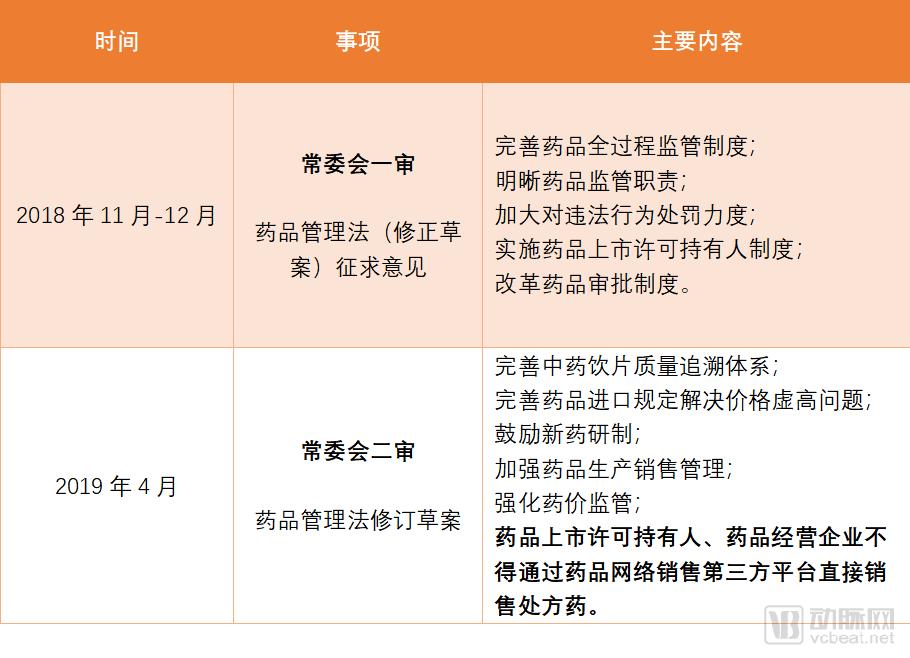
Timeline and Content of Amendments to the Drug Administration Law (Sources: National People's Congress of China Website, Legal Daily, Xinhua News Agency)
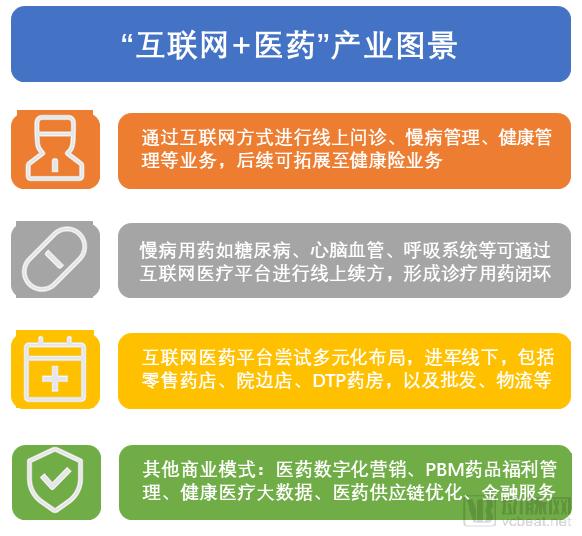
Compared to regulatory discussions, the development strategies of pharmaceutical e-commerce enterprises themselves deserve more attention. VCBeat has found that many B2C pharmaceutical e-commerce companies have already made in-depth layouts in B2B wholesale business, medical services, health insurance, and other areas.
Specifically, B2C enterprises that have ventured into B2B wholesale businesses include 111 Group, Kangaiduo, and Qilekang. The rapid volume growth of B2B operations, which can quickly boost overall performance scale, may be the reason attracting companies to lay out their strategies. However, the strong supply chain resources, mature supply chain management systems, and experience of B2C enterprises are also reasons for their confidence in entering the B2B sector.
Furthermore, we observe that medical services have become a standard offering for B2C enterprises, such as 111 Group’s “Yi Zhen,” Jianke’s “Jianke Doctor,” and Qilekang Internet Hospital, among others. The synergy between “medical care” and “pharmaceuticals” has become increasingly tight.
Additionally, the offline expansion strategies of e-commerce enterprises warrant attention, as they have evolved from isolated corporate cases into an industry-wide trend. For instance, B2C companies are establishing pharmacies near hospitals and DTP (Direct-to-Patient) pharmacies, while B2B players are acquiring small and medium-sized distributors and partnering with third-party logistics providers to build pharmaceutical warehousing and distribution centers.
In summary, both pharmaceutical distribution and retail are trending toward scale and digitalization. Influenced by policies such as the “Two-Invoice System” and the replacement of business tax with value-added tax (VAT), the number of pharmaceutical distribution enterprises in China—currently 13,000—is expected to shrink by more than half, while the market share of large distributors will gradually increase. The number of retail pharmacies has nearly reached its growth peak; consolidation of existing stores will outpace new store openings, the chain pharmacy rate will continue to rise, and refined management will accompany capital-driven market expansion. Information technology tools and concepts will evolve alongside industry development, serving as a key driver for industrial upgrading and transformation.
Regarding the future trajectory of the industry, the general assessment is as follows:
1. “Informatization” remains a trend, whether for online pharmacies or internet-based wholesale operations. In the case of online pharmacies,Due to regulatory reasons, prescription outflow will not be a high-certainty opportunity that is easy to scale up.;
2. Online wholesale businesses that merely provide information matching and transaction facilitation can no longer meet industry demands; digital marketing, smart supply chains, and derivative services present opportunities for differentiation;
3. Enterprises that take the lead in building a closed-loop service system are more likely to stand out; this is both the cause and the result of the integration of online pharmacy, online wholesale, and clinical consultation services, which can be achieved through mergers and acquisitions, investment partnerships, and other means;
4. The star effect of leading enterprises will become more pronounced, reflected in the capital returns generated from IPO exits and the improvement of industry operational standards driven by increased R&D investment following the opening of financing channels. More new competitors will enter the market and cluster around these leading enterprises.