Urine-Based Liquid Biopsy Emerges as a Non-Invasive Frontier for Detecting Non-Urological Cancers, Companies Accelerate Strategic Layout
Liquid biopsy, as a non-invasive detection method, provides a high-quality testing pathway for the increasingly mature genetic testing technology, while also attracting numerous companies to strategically position themselves in the field of blood-based liquid biopsy. In reality, however, the range of biofluids amenable to liquid biopsy is extensive. Beyond blood, cerebrospinal fluid, saliva, urine, and ascites all fall within the category of biofluids. These biofluids may contain reliable molecular information that can assist healthcare professionals in assessing the onset and progression of diseases.
Among these options, urine, as a completely non-invasive biofluid, stands out due to its ease of collection, large sample volume, and low background interference. Urine-based liquid biopsy has been widely applied in various urological diseases, and recent research findings indicate that ctDNA released by non-urological tumors can also be detected in urine. The academic community is currently further exploring the hidden information within urine, and companies both domestically and internationally have begun to strategize in this direction. Although still in its early stages, urine-based liquid biopsy is becoming one of the focal points in the molecular diagnostics industry.
Cancer is a disease that arises when genetic and epigenetic variations accumulate in the genome to a certain threshold. Over the past few decades, extensive research has been conducted on cancer to elucidate the gene mutations associated with tumorigenesis. Basic cancer research has revealed the high degree of heterogeneity and tumor evolution that develop over time, as well as the impact of therapies on these processes. These studies not only underscore the importance of tumor genetic testing in precision oncology but also enable patient stratification for targeted therapies. Early studies were limited to tissue specimens obtained through invasive biopsies, surgical resections, organ transplants, or autopsies. Emerging technologies now allow cancer genomic research to leverage minimally invasive liquid biopsies using blood samples, eliminating the reliance on tissue-based diagnostic tools. Moreover, these technological advances have led to the clinical adoption of various liquid biopsy assays for cancer management.
A portion of DNA enters the circulatory system due to apoptosis or necrosis. This DNA is collectively referred to as cell-free DNA (cfDNA). cfDNA derived from tumor cells is known as circulating tumor DNA (ctDNA). It can serve as a surrogate for the tumor genome, enabling the detection of gene mutations carried within the tumor genome. In the era of precision medicine, ctDNA is expected to play an increasingly significant role in diagnosis, targeted therapy/precision medicine, monitoring of tumor response and recurrence, and the progression of resistance to anticancer drugs.
Urine, as a source of reporter molecules for both urological and non-urological diseases, has played a significant role in clinical practice. In addition to urological disorders, conditions such as diabetes, hypertension, and even pregnancy can be monitored through urine testing. Advances in molecular biomarker research have demonstrated that circulating tumor DNA (ctDNA) can be detected in urine. This indicates that urine, as a biofluid alternative to blood, also holds the potential to aid in cancer diagnosis and treatment by detecting circulating tumor molecular markers. Recent findings have confirmed that cell-free DNA (cfDNA) released into the circulatory system can be filtered by the kidneys into urine. This urinary cfDNA contains ctDNA, which can provide reliable information on cancer-related DNA mutations and is likely to be valuable for cancer diagnosis and monitoring.
Extensive research has been conducted on the use of circulating tumor DNA (ctDNA) for cancer detection. Typically, liquid biopsy refers to assays that utilize blood as a minimally invasive bodily fluid source for ctDNA analysis. Currently, completely non-invasive urine sampling has emerged as a novel alternative. Due to the direct anatomical connection between urine and the urinary tract, numerous studies and reviews have focused on urine-based liquid biopsy for bladder cancer and other urological malignancies. In fact, urine liquid biopsy can also be employed for the detection of non-urological cancers.
Among available body fluids, blood is undoubtedly the most direct medium for detecting circulating tumor DNA (ctDNA), and consequently, it has been the subject of the most extensive research in liquid biopsy. However, urine testing, as a truly non-invasive form of liquid biopsy, offers unique advantages: it is easier to collect, store, process, and transport than blood. Unlike blood collection, urine sampling imposes no burden on patients and does not require professional medical personnel. Large-volume collections can be performed to address the issue of low ctDNA concentration in urine. Compared with serum or plasma, urine contains lower levels of other proteins, facilitating easier DNA isolation. Furthermore, urine-based liquid biopsy enables regular monitoring of high-risk populations, such as individuals infected with hepatitis B or C viruses or those with liver cirrhosis, allowing for the early detection of cancer signs. Most importantly, urine can be collected at home and subsequently shipped to specialized laboratories for testing, eliminating the need for face-to-face clinical visits and enabling more frequent monitoring. Overall, urine-based sample collection offers numerous advantages over blood, ultimately improving patient compliance with early cancer screening and allowing for more frequent monitoring to ensure better treatment and care outcomes.
Routine urinalysis, commonly performed during regular health check-ups, represents one medical application of urine testing. Its detection targets are limited to conventional indicators such as urinary protein and urine pH. In the context of the advancing precision medicine landscape, more molecular targets present in urine have been isolated and applied to more precise disease screening. Currently, urine-based liquid biopsy has been employed for screening urological tumors, particularly bladder cancer.
The American Cancer Society lists urine-based liquid biopsy as the preferred method for bladder cancer screening, encompassing three approaches: urinalysis, urinary cytology, and urinary tumor marker testing. In China’s “Standardized Diagnosis and Treatment of Bladder Cancer (2018 Edition),” urine-based liquid biopsy is also included as one of the diagnostic methods for bladder cancer. Urine-based liquid biopsy analyzes and diagnoses a patient’s condition through urinary cytology or tumor marker testing. However, due to their low specificity, current urinary tumor markers have not yet been widely adopted in clinical practice. Consequently, China’s “Standardized Diagnosis and Treatment Guidelines” still list imaging examinations as the primary screening method for bladder cancer.
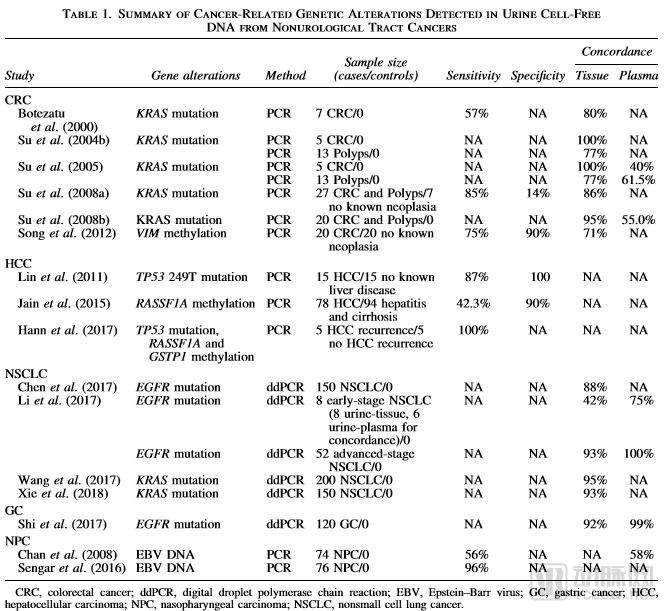
Image source: Surbhi Jain, Selena Y. Lin, et al. Urine-Based Liquid Biopsy for Nonurological Cancers. GENETIC TESTING AND MOLECULAR BIOMARKERS. 23,4(2019).
A review article published in *Genetic Testing and Molecular Biomarkers* in 2019 summarized the research findings to date on the use of urine liquid biopsy for detecting non-urological cancers. As shown in the table, numerous studies since 2000 have demonstrated that urine liquid biopsy using PCR or ddPCR techniques can detect gene mutations associated with non-urological cancers in urine samples. To date, most studies have reported favorable sensitivity, with concordance rates exceeding 70% when compared to tissue or stromal test results. However, the specificity of urine liquid biopsy remains insufficiently high, which may pose a bottleneck for its future development.

Figure: Information on select companies involved in urine-based liquid biopsy
TrovaGene
TrovaGene, based in California, USA, initiated research on urine-based liquid biopsy at an early stage. The company independently developed NextCollect, a device for urine collection and nucleic acid preservation. This device extends the storage time of urine samples and improves the efficiency of ctDNA isolation from these samples. In March 2017, TrovaGene launched the TrovaGene EGFR Test, which utilizes ctDNA isolated from urine to detect EGFR mutations in patients with non-small cell lung cancer (NSCLC). The related findings were published in Lung Cancer in 2017. In July 2017, Novogene reached an agreement with TrovaGene to purchase NextCollect for use in domestic product testing and research and development activities.
Beyond the field of liquid biopsy, TrovaGene is also engaged in drug development. In March 2017, TrovaGene obtained global development and commercialization rights for onvosertib, a compound developed by the Italian company Nerviano Medical Sciences. Onvosertib is a highly selective inhibitor of the cancer target PLK1 and is currently undergoing clinical trials across multiple cancer types. Notably, clinical studies focusing on acute myeloid leukemia and metastatic castration-resistant prostate cancer have advanced to Phase II.
ExosomeDX
ExosomeDX is a global leader in the exosome testing industry, with multiple exosome-based liquid biopsy products already on the market. In addition to its diagnostic offerings, ExosomeDX is actively developing exosome extraction kits and analytical instruments. The serum/plasma exosome RNA extraction kit, co-developed with Qiagen, has been widely used in exosome-related scientific research. Meanwhile, its independently developed Shakky exosome protein analysis platform is currently being offered for early trial access to select enterprises.
ExosomeDX launched its prostate cancer detection kit, ExoDX Prostate (IntelliScore) (EPI), as early as September 2016. This product analyzes three gene markers in exosomal RNA from urine samples and applies a proprietary algorithm to generate a score correlated with the risk of prostate cancer. This score assists physicians in determining whether a patient has prostate cancer. The use of urine offers significant advantages for this product. Urine-based prostate cancer screening effectively avoids complications associated with prostate biopsies, such as incontinence and infection.
Genetron Health
Some companies in China have also begun to establish a presence in the field of urine biopsy. Among domestic genetic testing firms, Genetron Health is one of the few enterprises engaged in urine biopsy. Genetron Health has already launched a genetic test for assessing the risk of urothelial tumors, providing auxiliary diagnostic evidence for patients presenting with symptoms such as hematuria who are suspected of having urothelial carcinoma (bladder cancer, ureteral cancer, or renal pelvis cancer). According to information on Genetron Health’s official website, this product can detect 17 gene mutations associated with urothelial carcinoma and methylation of one gene through urine biopsy, achieving a negative predictive value as high as 99% and a sensitivity of up to 95%.
OncoBio
Anke Biotechnology was established in 2010 and secured RMB 11 million in Series B financing from Dog Capital in 2016. The company’s flagship product is a urinary exosome detection kit designed for the diagnosis of chronic prostatitis. This kit detects prostate extracellular vesicle protein (PESP) in urine to determine whether a subject suffers from chronic prostatitis. Since PESP levels in the urine of patients are elevated compared to those in healthy individuals, the kit enables straightforward and accurate diagnosis of prostatitis.
In recent years, a substantial body of research has highlighted the promising prospects of urine-based liquid biopsy. Urine liquid biopsy has been demonstrated to be effective for early cancer screening, as well as for monitoring recurrence, metastasis, and treatment efficacy. Furthermore, urinary cell-free DNA (cfDNA) shows potential in prognostic assessment, an area where current clinical diagnostic methods fall short. Although urine-based liquid biopsy offers numerous advantages over blood-based counterparts, its application in non-urological tumors requires further investigation. Future developments will necessitate additional research and larger patient cohorts to establish more robust analytical algorithms. Overall, the non-invasive nature of urine biopsy provides significant room for growth, positioning it as a potentially equally efficient alternative to blood biopsy. Leading companies have already begun strategizing in this direction, suggesting that urine liquid biopsy will emerge as a new option, making the convenience of non-invasive screening accessible to a broader population.