

Addressing China's Elderly Care Gap: Strategies Following the Milestone of 4 Million Registered Nurses in 2018
“By the end of 2018, China had 249 million elderly people aged 60 and above, accounting for 17.9% of the population. The number of elderly people aged 65 and above was 166 million, representing 11.9%. Among them, 150 million elderly people suffered from chronic diseases, making up 65% of the total elderly population. There were 44 million elderly individuals with disabilities or partial disabilities. These figures indicate a high demand for long-term care among the elderly in China, which is a very severe practical issue we are facing—a rigid demand.”
This is the statement made by Jiao Yahui, Deputy Director of the Medical Administration and Hospital Management Bureau of the National Health Commission, at the regular press conference held at 10:00 a.m. on May 8 in the Press Conference Hall of Building No. 2 of the Commission’s headquarters, where she introduced the development of nursing care across China.
At 10:00 a.m. on May 8, 2019, the National Health Commission held its regular May press conference. The session was moderated by Liu Zhefeng, Director of the News Division of the Publicity Department of the National Health Commission. Jiao Yahui, Deputy Director of the Bureau of Medical Administration and Hospital Management of the National Health Commission; Yin Yanxiang, Spokesperson for the Shanxi Provincial Health Commission and Full-time Deputy Director of the Shanxi Provincial Patriotic Health Campaign Committee; and Xi Huan, Vice President of Beijing Hospital, participated in the press conference and delivered remarks.
In addition to presenting the fundamental achievements of nursing care in China, discussions centered on grassroots nursing capacity and elderly care services.
Since 2018, the state has issued policies such as the “Guiding Opinions on Promoting the Reform and Development of the Nursing Service Industry” and the “Notice on Launching Pilot Programs for ‘Internet + Nursing Services’,” aiming to increase the supply of nursing services and accelerate the rapid development of the nursing service industry.
Data Showcasing the Current Status of Nursing Development in China
Jiao Yahui revealed that by the end of 2018, the total number of registered nurses in China exceeded 4 million, with 3 nurses per 1,000 population; by the end of 2017, the total number of registered nurses in China had surpassed 3.8 million, with 2.74 nurses per 1,000 population.
In terms of the quality of the nursing workforce, registered nurses account for nearly 50% of all health professionals in China, with nearly 70% holding an associate degree or higher. The professional competence of nurses and their specialized nursing service capabilities continue to improve.
Faced with the gap in elderly care services, China’s prominent challenges are the insufficient professionalism of its caregiver workforce and the scarcity of trained nursing professionals.
Data from 2015 to the end of 2018 show that although the proportion of registered nurses in China increased year by year, the growth rates in the last three years were 8.2%, 8.3%, and 5.3%, respectively.
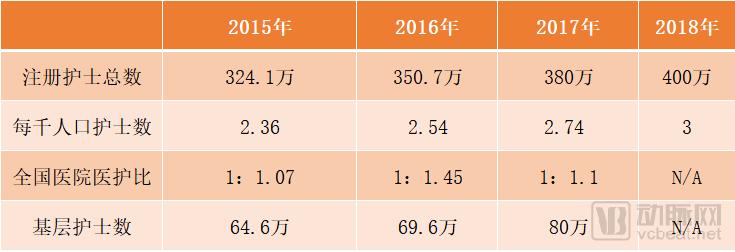
Data on the Nursing Workforce Released by the National Health Commission (Source: Public Information, Compiled by VCBeat)
Addressing the current challenges in nursing services, Jiao Yahui pointed out two major difficulties:
First, there is a shortage of human resource supply, which manifests in two aspects: one is the insufficient total quantity, and the other is the scarcity of high-quality nursing resources.
High-quality nursing resources refer to those that can precisely match and meet demands. The requirements for nurses are summarized as the “Three Closenesses”: close to patients, close to clinical practice, and close to society. Currently, high-quality nursing resources are mainly concentrated in hospitals at Level II and above, particularly tertiary hospitals, while grassroots levels face a relative shortage of nursing human resources.
The second challenge is how to enhance nurses’ professional pride and sense of occupational identity. “We hope to attract more individuals to pursue nursing as a career. Currently, the healthcare sector needs to mobilize the enthusiasm of all medical personnel and elevate their professional pride and social recognition. The issue of young nurses resigning from certain medical institutions stems from both subjective and objective factors. Among these, compensation-related concerns—such as whether the value of their labor is adequately reflected and whether remuneration aligns with their efforts—are significant factors affecting the stability of the nursing workforce.”
Within the broader framework of tiered diagnosis and treatment, nursing services are also evolving toward a tiered model. Jiao Yahui emphasized that, under this framework, nursing care should be provided in a corresponding tiered manner. The stratification of nursing services aligns with the overarching direction of healthcare reform and institutional development for tiered diagnosis and treatment. Currently, the organization of the medical service system aims to implement tiered diagnosis and treatment. Therefore, tertiary hospitals should primarily focus on developing specialized nursing, training specialist nurses, and enhancing the quality of nursing care through specialized skills.
The state encourages social forces to establish nursing homes (stations), nursing centers, rehabilitation hospitals, rehabilitation centers, and hospice care centers. By the end of 2018, there were nearly 800 nursing homes (stations) and over 800 rehabilitation hospitals in China. The workforce of elderly care practitioners has expanded, a training system for medical caregivers is being established, and elderly care services are gradually extending from institutions to communities and households, achieving rapid development.
Secondary hospitals, rehabilitation hospitals, nursing centers, and primary healthcare institutions should define their functional roles in a targeted manner based on demand. For instance, secondary hospitals may primarily assume the care of patients transferred down from tertiary hospitals during their rehabilitation phase, chronic disease recovery period, or post-operative stage. In line with this functional positioning, they should provide corresponding nursing services and cultivate the professional skills of nurses. Meanwhile, grassroots community service centers and township health centers mainly deliver nursing services such as elderly care, rehabilitation, hospice care, and palliative care.
Meanwhile, she pointed out that the key priorities for the National Health Commission in its next steps of nursing work include:
1. Vigorously strengthen the nursing workforce, adhere to job demand-oriented principles, enhance nurse training and development, and improve nursing service capabilities. Continuously refine the nurse practice management system and broaden career development pathways for nurses.
2. Accelerate the development of the nursing service industry. Launch pilot programs for “Internet + Nursing Services” and provide standardized guidance to ensure their healthy development. Promote reform and innovation in the nursing sector, improve relevant institutional mechanisms, and foster the sustained and healthy growth of the nursing service industry.
3. Strengthen elderly care services. Issue guiding documents on enhancing the development of elderly care, as well as on assessing needs for long-term care and standardizing service delivery for older adults, to further accelerate the development of long-term care and caregiving for the elderly. Priority should be given to increasing the supply of nursing services for disabled older adults, thereby enhancing their sense of well-being and fulfillment. Additionally, issue documents to strengthen the training and management of medical care assistants, increase the number of personnel providing elderly care services, improve the vocational skills of medical care assistants, and expand social employment opportunities.
4. Strengthen publicity and advocacy efforts. Increase the intensity of publicity for the nursing industry, fully promoting the development history, major achievements, and valuable experiences of nursing work. Utilize diverse formats, multiple channels, and comprehensive approaches to showcase emerging role models and exemplary deeds, promote positive energy in nursing, foster public understanding of nursing and respect for nurses, and create a favorable social atmosphere conducive to the development of the nursing profession and the nursing industry.
Elderly Care Needs Still Face a Gap: Broadening the Value of Nurses and Establishing a Training System for Caregivers
Compared with the data released during the same period last year, this year’s figures show an increase. However, in the face of 44 million elderly individuals suffering from disability and dementia, even if the target of 4.45 million registered nurses planned for the end of 2020 was achieved, the shortfall in elderly care would remain substantial.
At the National Health Commission’s regular press conference in May 2018, Jiao Yahui proposed that four key issues must be addressed to meet the long-term care needs of the elderly: who provides care, who receives care, where care is provided, and who pays for care.
“Who Will Provide Care?”
The state is developing training syllabi and service standards for medical caregivers. Following the promulgation of these documents, efforts across society will be intensified to accelerate the training and development of geriatric medical caregivers, establish a professional workforce of medical caregivers, and address the daily medical care needs of disabled and semi-disabled elderly individuals.
"Where to receive care"
The National Health Commission has issued the Basic Standards for Nursing Centers and Rehabilitation Centers. The guiding principle is to encourage government and social forces to establish group-based, chain-operated nursing centers and rehabilitation centers at the grassroots level.
Meanwhile, the National Health Commission is drafting a notice on strengthening elderly care services. It encourages leveraging community health service centers, nursing centers, and rehabilitation centers to provide nursing and inpatient bed services for elderly care institutions. Additionally, it promotes the establishment of home hospital beds through contracted services, delivering medical and nursing care directly to patients’ homes. Community health service centers with adequate resources are also encouraged to establish daytime elderly care centers.
"Who to Care For"
The 44 million elderly individuals with disabilities or partial disabilities are undoubtedly a key population for care. However, this raises the question of how to conduct assessments. Jiao Yahui pointed out that the National Health Commission is about to release standards for assessing the medical and nursing care needs of elderly people with disabilities or partial disabilities. These standards will address both medical and nursing care needs as well as psychological care needs, thereby providing a relatively comprehensive and holistic framework for graded assessment and care. Once implemented, these standards will enable more precise determination of who should receive care.
“Who Pays for Care”
The National Healthcare Security Administration is currently piloting the long-term care insurance system and is conducting nationwide research, follow-up, and evaluation of the pilot initiatives.
Regarding payment for elderly care services, the state has piloted long-term care insurance in cities such as Shanghai and Qingdao. However, under the current system where basic medical insurance serves as the primary coverage, long-term care insurance is not mandatory. Therefore, nursing care services still rely on supplemental commercial insurance.
Jiao Yahui emphasized, “In the field of nursing services, we believe that commercial insurance has broader prospects and greater potential in the social sector, particularly in meeting the demand for elderly care services. In addition to the state-established long-term care insurance system, commercial insurance should play a significant role as an important supplement. With the introduction of commercial insurance, aspects such as risk sharing and the establishment of financing mechanisms will be strengthened. This will promote healthier and more sustainable development of service models like ‘Internet + Nursing Services,’ which are currently provided in accordance with market principles and demands.”
To address issues such as the shortage of nursing staff, the country is currently exploring innovative service models to meet the demand for nursing care. This refers to the “Internet + Nursing” model, which has become a widespread focus of public concern.
Jiao Yahui emphasized, “We are advancing pilot programs in six provinces and municipalities across China. By leveraging internet-based approaches, we precisely align supply with demand to revitalize existing resources. Our long-term goal is to expand capacity by increasing the training of both registered nurses and medical care assistants. Through these measures, we aim to gradually meet the growing demand for elderly nursing care services.”
“Internet Plus” Nursing: Addressing Care Service Demands Through Innovative Service Models
“Internet + Nursing” essentially leverages internet-based platforms to enhance the utilization efficiency of limited nursing service resources and revitalize existing capacity, thereby addressing the overall shortage in nursing service supply.
Nearly three months have passed since the “Internet + Nursing” pilot program was launched in six provinces and municipalities. According to Jiao Yahui, the pilot has generally progressed well. On one hand, the service providers for “Internet + Nursing Services” have been clearly defined, and both national and local pilot schemes have refined and studied issues related to liability allocation, liability determination, medical safety, and the personal safety of nurses.
Second, supporting policies, such as those addressing pricing and reimbursement. Home-based nursing care is an essential need for elderly individuals with disabilities or partial disabilities; however, the affordability and accessibility of these services will be significant challenges in the future.
In the realm of home-based elderly care, “Internet + Nursing” services can help address the caregiving challenges faced by elderly individuals with disabilities and dementia at home. Meanwhile, the business model of home-based elderly care supported by community nursing stations not only provides enterprises with certain incentives in terms of subsidies, taxation, and venue costs, but also meets the varying levels of caregiving needs of elderly people receiving care at home.
Healthcare Institutions Must Shift Mindsets, Promote Concepts, and Build Teams
What are the current challenges in elderly care? When this question was posed to Xi Huan, Executive Vice President of Beijing Hospital, he stated, “For medical institutions, we still face three tasks: shifting mindsets, promoting concepts, and building teams.”
Shift in mindset: first, transition from the increasingly specialized model of the past to cultivating a full-cycle medical concept oriented toward the elderly population.
Promote the philosophy of geriatrics, including appropriate core technologies such as comprehensive geriatric assessment, as well as the application of measures and techniques for preventing various age-related diseases and maintaining health.
Team Building: Hospitals cannot wait for society to automatically provide them with personnel; they must also strengthen the development of their own talent pool. This is a responsibility that medical institutions and practitioners must fulfill.
Xi Huan stated, “From the past focus on specific diseases to the current field of geriatrics, in other words, this means viewing healthcare service models through a holistic lens while promoting personalized care.”
To precisely address the diverse and multi-level health needs of the elderly, Beijing Hospital spearheaded the establishment of the Geriatric Nursing Specialty Alliance in 2017. Members primarily include general hospitals with specialties in geriatrics, secondary medical institutions, and community health service centers. According to Xi Huan, the original intention behind establishing the alliance was to build a platform for the development of geriatric nursing specialties, drive the integration of regional medical resources, and enhance grassroots elderly care capabilities, thereby promoting the consolidation of medical resources and guiding their distribution toward primary care levels.