GE HealthCare Rejects Potemkin's Undervalued Mini-Tender Offer and Advises Shareholders to Avoid It

GE Healthcare
Digital Solution Provider

Medical Device Media Reporting Pioneer
Share Professional Medical Device Knowledge
Recently, GE Healthcare stated,The company received a notice from Potemkin Limited on January 5, 2026, which announced an unsolicited "mini-tender" offer to purchase up to 100,000 shares at a cash price of $54.20 per share.(or a higher amount as listed in the required documents)Purchase GE HealthCare common stock. Potemkin Limited's offering price is $54.20 per share.Compared to the closing price of GE Healthcare's common stock on December 8, 2025, at $83.09(i.e., the last trading day before the start of the small-scale acquisition offer)Approximately 34.77% lower.
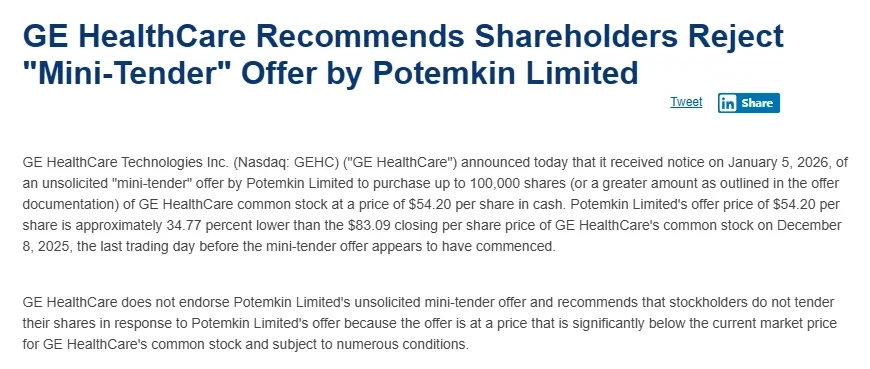
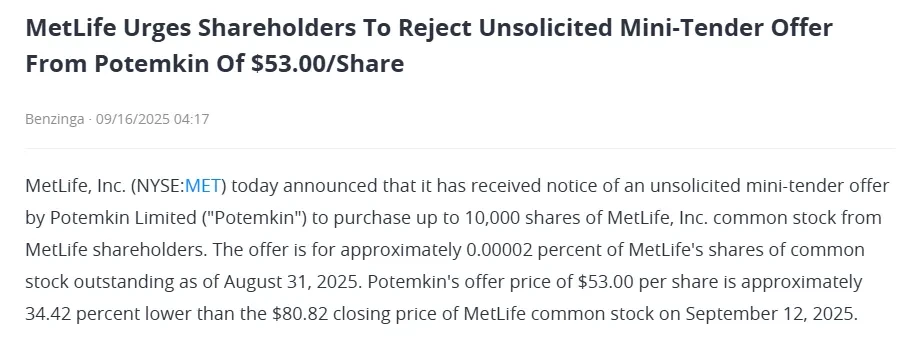
The core premise supporting all these operations is the "exploitation of regulatory loopholes."According to U.S. securities laws, offers to acquire less than 5% of shares are not required to disclose key information such as the source of funds or the purpose of the acquisition, allowing them to bypass more than a dozen compliance reviews required for large acquisitions.PotemkinThe 100,000 shares planned for acquisition this time account for only 0.022% of GE Healthcare's total outstanding shares, perfectly staying below the regulatory threshold, which not only reduces operational costs but also provides protection for its mysterious identity.
It is worth emphasizing that, in the face ofPotemkinIn response to the low-price encirclement, GE Healthcare firmly rejected.And this is precisely built upon its years of deep cultivation in the medical device industry, including its technical barriers, market position, and financial resilience. These core competencies form a solid shield against capital fluctuations.
Taking the "moat" of technology research and development as an example, as a long-standing giant in the global medical device field, GE Healthcare has built leading advantages in four core sectors: medical imaging, ultrasound, critical care, and pharmaceutical diagnostics. Among them, medical imaging is...The core business of GE Healthcare continues to lead the industry in innovative development.
In the CT field,The strong demand in the global diagnosis and treatment market has driven the comprehensive and vigorous development of CT business. WithAble to provide accurate diagnosis for patients in a short period of time,The advantages of CT are becoming increasingly evident.In the field of cardiology, for example, from early functionality to today's pre-intervention decision-making using virtual FFR and the widespread implementation of early screening, the market growth of CT has been extremely robust.
Driven by new therapeutic and diagnostic agents, the field of nuclear medicine is experiencing explosive growth. GE Healthcare's myocardial perfusion diagnostic agent, Flyrcado, has significant advantages.It can significantly reduce traditional SPECT examination time, requires no generator, offers convenient drug delivery, provides higher resolution, lower false positive rates, and reduced radiation doses, making it especially suitable for larger patients. Its CEOPeter ArduiniIt is believed that Flyrcado will change the "gold standard" for diagnosing myocardial perfusion and ischemic diseases, and in the future, it will also promote the adoption of dedicated systems in cardiology clinics.
MR imaging methods are also continuously evolving,As the "gold standard" for contrast and soft tissue imaging, it now offers superior resolution and is radiation-free.GE Healthcare Revolutionizes MR Image Generation with Air Recon DL Technology, Enhancing Image Quality and Reducing Most Scan Times to 20 Minutes, Doubling Healthcare Providers' Diagnostic Capacity.
In addition,GE Healthcare covers multiple fields in patient monitoring business, including anesthesia, global monitoring, prenatal care for infants, and diagnostic cardiology.And is in a leading position.
——
Currently, against the backdrop of the healthcare industry shifting from incremental competition to a contest for existing market share, GE Healthcare's decision to reject small acquisition offers essentially reflects its commitment to a long-term strategy. This seemingly "non-mainstream" small acquisition contest represents a brief collision between capital and the industry amid the rapid development of the medical device sector.
For GE Healthcare,With the triple confidence in technology, market, and finance, it successfully withstood this low-price encirclement, setting a benchmark for industry leaders in responding to unconventional capital fluctuations.But for the entire medical device industry, Potemkin's operations have exposed not only gaps in regulatory rules but also reminded companies to pay attention to shareholder education and equity risk monitoring.
The uniqueness of the medical device industry lies in the long-term nature of technological research and development, the professionalism of product iteration, and its connection to patient welfare, which determines that its development cannot be swayed by short-term capital arbitrage.In the future, as industry concentration continues to increase, similar small-scale acquisitions may occur more frequently. This requires not only regulatory authorities to accelerate the improvement of rules but also enterprises and investors to form a joint force, so that capital can truly become a booster for technological progress in the medical device sector. In this regard, DeviceHome will continue to follow and report.
More exciting content
Welcome to follow WeChat Video Channel


China's Leading Imaging Company, Pushing "Global Second" to Land on STAR Market
Johnson & Johnson Re-enters the Surgical Robot Arena
Stryker, Multiple Major Personnel Changes
Milestone Breakthrough! MicroPort Completes World's First Large-Model Autonomous Surgical Animal Experiment
GE Healthcare, Joining Hands with the King of Automotive Chips
China's Leading Medical Device Manufacturer Completes Major Acquisition Exceeding 8.5 Billion
Guangdong Disposable Endoscope Company, Planning IPO
Over 100 Units Awarded, Orthopedic Robot Sets Record
Price Difference Exceeds Tens of Millions: The Same Model CT Scanners Take Both the Highest and Lowest Prices
New China Medical, Investing 60 Million in This Field

BusinessBusiness cooperation email: qxzj@landianyiliao.com