

Policy-Backed Community Elderly Care Models Struggle to Achieve Profitability Despite Growth in Internet-Based Nursing, Daycare Centers, and Embedded Services
When it comes to the issue of population aging, the massive population base has become a cliché. Underlying the demographic shifts are the consequent healthcare challenges and the caregiving needs of disabled elderly individuals.
For the grassroots market, the medical needs of the elderly are undoubtedly an inelastic demand. As recent policy initiatives begin to take effect, have grassroots elderly care services developed their own distinct models? Furthermore, as “Internet + Nursing” becomes a frequent topic of discussion, what changes will it bring to the current elderly care market?
When Europe, the United States, and Japan entered an aging society, their per capita GDP was generally between $50,000 and $100,000. In contrast, China’s per capita GDP remains below $10,000, making it a typical case of “getting old before getting rich.” Meanwhile, due to the rapid development of industry and commerce and the one-child policy, the number of migrant workers has increased, leading to a large population of elderly people living alone or in “empty-nest” households. It is projected that over half of the elderly population will become empty-nesters in the next two decades.
Nursing care is a rigid demand, while elderly care represents a demand with certain elasticity. Against the backdrop of a society that is aging before becoming affluent, high-end elderly care services are difficult to popularize, and the market focuses on meeting the basic needs of the elderly. Medical services, nursing care, psychological counseling, and monitoring have become key market demands.
Against this backdrop, “reform” has become the central theme in the development of elderly care policies. The year 2018 marked both the 40th anniversary of China’s reform and opening-up and was widely regarded as the “Year of Reform” for elderly care. Across policies of varying scales, “reform” has served as the main axis guiding the advancement of the elderly care sector. In addition to the repeated emphasis in macro-level policies on promoting the integration of medical and elderly care services as well as home-based care, local governments have actively responded by exploring a model that is home-based, community-supported, institutionally supplemented, and integrates medical and elderly care services.
Among local policies, those in major elderly care hubs such as Wuhan and Shanghai are particularly notable. According to a seasoned practitioner in Wuhan’s elderly care market, “Since last year, the documents that have had the greatest impact at the grassroots level are Document No. 1 and Document No. 20 issued by the Wuhan Civil Affairs Bureau in 2018.” The two documents she referred to are respectively the Implementation Plan for Promoting the New “Internet + Home-Based Elderly Care” Model in Wuhan and the Construction Standards (Trial) for “Internet + Home-Based Elderly Care” Facilities in Wuhan. Their main content focuses on embedded and hub-and-spoke community elderly care institutions, establishing specifications for functions, site selection, and construction for specific services. These two documents have influenced many home-based elderly care service centers to begin transforming and gradually evolve into community nursing homes.
This year, the venue for the World Health Expo, co-hosted by Taikang Group and Jointown Pharmaceutical Group, is located in Wuhan—a choice closely tied to the city’s mature policy environment and fertile market conditions.
Although policy incentives have fostered new business models for community-based elderly care services, operators have seen little substantive change; instead, they face mounting pressures. The adoption of novel models such as “Internet Plus Nursing” has resulted in elderly care and nursing service offerings and pricing that far exceed current societal income levels.
In February 2019, the National Health Commission officially issued the "Notice on Launching Pilot Programs for 'Internet + Nursing Services'" and the accompanying pilot plan, designating Beijing, Tianjin, Shanghai, Jiangsu, Zhejiang, and Guangdong as pilot regions for "Internet + Nursing Services" from February to December of that year.
The plan specifies that institutions participating in the pilot program must be physical medical facilities that have obtained the necessary qualifications and already offer services such as home hospital beds and house calls. Registered nurses dispatched to provide these services must have at least five years of clinical nursing experience and hold a professional title of Nurse Practitioner or higher. The focus of “Internet + Nursing Services” is on individuals with limited mobility, including the elderly (particularly those of advanced age or with disabilities), patients in rehabilitation, and those in end-of-life care. Pilot medical institutions are required to conduct an initial consultation with applicants before providing “Internet + Nursing Services.”
As Jiao Yahui, Deputy Director of the Medical Administration and Hospital Management Bureau under the National Health Commission, recently stated, this represents a revitalization of existing resource stocks. By leveraging internet-based technology platforms, it aims to improve the utilization rate of limited nursing service resources in the context of insufficient overall supply.
In fact, prior to the policy recognition of the “on-demand nurse” model, home-based nursing services and internet-enabled elderly care startups experienced a surge in 2014, as reported in Analysys’ “Special Analysis Report on China’s Internet-Based Home Elderly Care Services, 2017,” which covered the period from 2012 to 2016.
This is due to the rise of “Internet Plus,” which triggered an explosion of entrepreneurship in elderly care projects. In the early years, the surge in demand for home-based services led to considerable irrational investment. At that time, this business model was commonly referred to as “O2O.” As the O2O wave subsided, the market for home-based elderly care entered a phase of rational development.
From a business model perspective, in-home elderly care services are essentially O2O (Online-to-Offline) services characterized by regional specificity and decentralization. While in-home nursing services will experience rapid growth in the short term, the standalone in-home model represents merely an intermediate form within the elderly care industry. In the future, it will collaborate with institutional and community-based care providers to expand service capabilities and maximize value realization.
At the National Health Commission’s regular press conference on nursing care held on May 8 this year, Jiao Yahui revealed that by the end of 2018, the total number of registered nurses in China had exceeded 4 million, up from 3.8 million at the end of 2017, with the number of nurses per 1,000 population rising to 2.74. However, in the face of 44 million elderly individuals suffering from disabilities and dementia, even if the target of 4.45 million registered nurses planned for the end of 2020 is achieved, the shortfall in elderly care will remain substantial.
Data show that by the end of 2018, there were nearly 800 nursing homes (stations) and over 800 rehabilitation hospitals. The workforce of elderly care practitioners has expanded, a training system for medical caregivers is being established, and elderly care services are gradually extending from institutions to communities and households. In line with healthcare reform, nursing services have begun to be tiered.
Long Pan, Deputy General Manager of Kangle Nianhua Elderly Care Industry Group, introduced that Kangle Nianhua entered the elderly care industry in 2006. Over the past 12 years, it has operated more than 30 medical and elderly care institutions in Hunan, Jiangsu, Shanghai, Shandong, Anhui, and other regions, providing nearly 6,000 beds and serving tens of thousands of elderly people. In October 2018, Kangle Nianhua and Chinese Care jointly issued a statement announcing their strategic merger. Half a year later, at the "Elderly Care Industry Lujiazui Summit," Long Pan once again disclosed to the public that the merged Kangle Nianhua Group had secured RMB 100 million in Series A funding from Ming’an Capital.
Long Pan believes that although institutional care currently dominates the elderly care service landscape, community- and home-based care needs will become increasingly prominent in the long-term supply structure. Therefore, Kangle Nianhua is actively exploring initiatives aligned with market trends and policy directions. “At present, there are few successful models for community- and home-based elderly care within the industry.”
“In addition to its institutional elderly care services, Kangle Nianhua Group has leveraged government support policies for community-based home care in recent years. By utilizing idle properties within communities, the group has developed the ‘Lingjia Care’ model—a embedded, micro-scale, and chain-operated service targeting semi-disabled seniors. ‘Lingjia Care’ integrates the advantages of traditional home-based care, community care, and institutional care, bridging the ‘last mile’ of elderly care services and truly creating a ‘nursing home at your doorstep.’”
The “community-based elderly care” referred to by Long Pan is what current policies encourage developing as “community daytime care centers for the elderly.” According to a senior practitioner in the elderly care sector, the primary needs of most seniors within their communities are meal services and recreational activities.
He also believes that, in terms of operating costs, the home- and community-based elderly care model incurs higher expenses compared to the centralized institutional care model. Although there is substantial potential demand for community- and home-based elderly care services, the demand side is highly fragmented, with needs being scattered, diverse, and irregular in frequency. This mismatch makes it difficult to align operating costs with revenue in community- and home-based elderly care. Long Pan told VCBeat, “You never know when a customer will request an in-home service, yet you must keep staff on duty every day. One day you might handle one case, the next day two. Even with government-procured services providing some support, overall operating costs remain high, making profitability challenging.”
Profitability is the most pressing concern for elderly care projects. Generally, for institutional providers, the key metric is whether bed occupancy rates can cover both upfront capital expenditures and operational costs, as cost structures and fee schedules vary across projects. In contrast, the operation of community-based care relies heavily on labor costs. According to the aforementioned industry practitioners, in pure community day-care services, apart from meal costs which are quantifiable, most other aspects currently operate at a loss.
Deloitte’s report points out that current home- and community-based elderly care services mainly include daily life assistance, respite care, psychological support, and cultural activities. Such services are not clearly differentiated from domestic housekeeping services, as many tasks can also be performed by traditional housekeepers. Consequently, individual paying customers have only moderate recognition of companies providing these services.
Previously, entrepreneurs in the elderly care industry have noted that although policies encourage the development of day-care centers and smart elderly care communities, community-embedded facilities have remained unpopular due to their lack of medical nursing services, offering only daily living assistance. Strangely, however, the most profitable segment has been “providing meals for the elderly.”
When it comes to meal assistance services, mention must be made of the policy document titled “Action Plan for Intensifying Efforts to Address Weak Links, Strengthen Deficiencies, and Improve Quality in Public Services within Social Sectors, Thereby Promoting the Formation of a Strong Domestic Market” (hereinafter referred to as the “Action Plan”), issued earlier this year by relevant authorities including the National Development and Reform Commission and the Ministry of Civil Affairs. The Action Plan emphasizes addressing shortcomings in public services, with elderly care occupying a substantial portion of its content. Among the four key tasks outlined in the Action Plan, one is the promotion of meal assistance services in urban and rural communities, with the primary objective being to resolve dining challenges faced by older adults.
In fact, this model inherits the concept of “adult day care for the elderly,” which first emerged in Japan. Similar to childcare services, it has already been piloted in certain cities across China. The primary providers are home-care agencies, whose responsibilities are limited to basic care such as meal provision, medication administration, and daily recreational activities. However, there remain concerns regarding payment mechanisms and service scope. As a result, such services continue to be niche within communities, with only limited policy support in the form of government-provided venues and operational subsidies.
Policies promoting home-based elderly care, community day care, and embedded elderly care institutions are continuously being introduced. The impact on enterprises is that they place greater emphasis on securing premium locations and facilities to deliver their services. Specific operational needs increasingly depend on upfront procurement, such as beds, age-friendly equipment, and other related supplies. Meanwhile, as free medical consultations become more prevalent, companies primarily serving communities must also consider how to balance activities within community home-care service centers.
Wu Danxing, a member of the Expert Committee on Elderly Care Services under the Ministry of Civil Affairs and holder of a Medical Doctorate, once proposed the following view: “The goals, direction, and logic underlying the construction of China’s three-tier elderly care service system are correct. This system prioritizes home-based care, supported by community services, with institutional care available when home-based care is insufficient. The three-tier elderly care service system encompasses the continuum from home-based care to community-based care and then to institutional care, as well as the transitional process from institutional care back to community-based and home-based care.”
According to Deloitte’s research, the business models for aging in place fall into two categories: B2B and B2C. Currently, most home- and community-based elderly care service providers primarily adopt a strategy of first securing market share and expanding their commercial footprint through B2B operations. After establishing a presence in a certain number of communities, they then proceed to launch B2C services within those regions, either to acquire new customers or to offer value-added services beyond government-procured packages to the elderly already under their care.
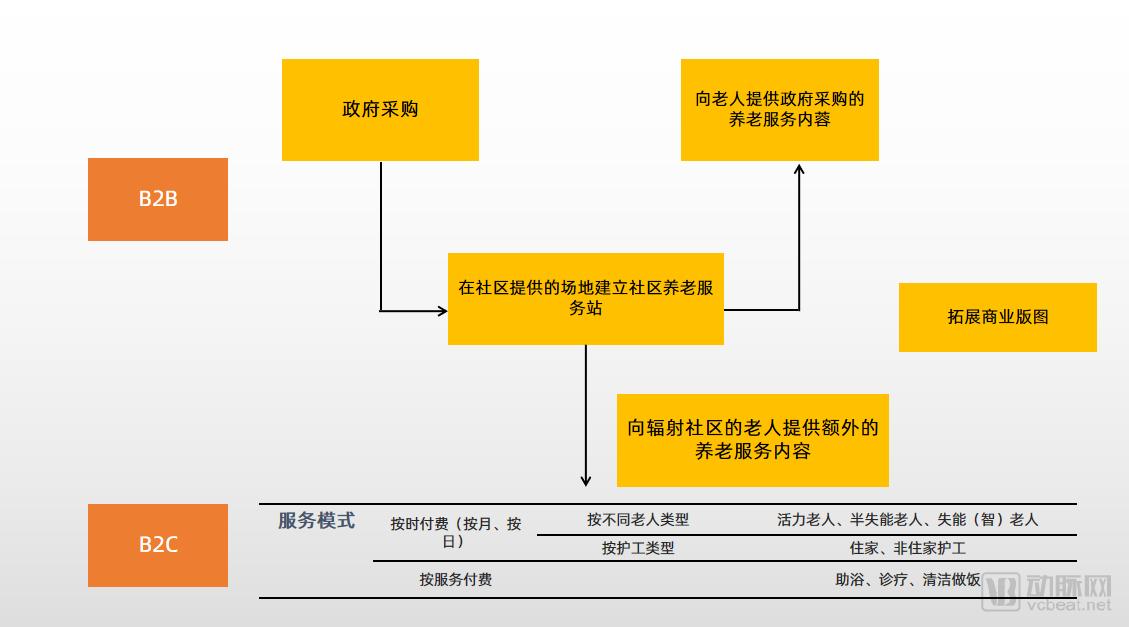
Business Models of Home- and Community-Based Elderly Care Service Enterprises, Source: Deloitte Research
Over the next three to five years, the government will remain the primary payer for home- and community-based elderly care services. The B2C segment is still in a phase of exploration and demand discovery, accounting for a relatively small share of the market. Market participants should therefore prioritize cultivating individual payment habits in the future.
From this perspective, establishing a “nursing station” first and then providing home visits is a viable business model. According to VCBeat’s engagement with Fushoukang and Gold Nurse, nursing stations and community service hubs serve as the foundation for their home-based care services.
In terms of its business model, Fushoukang adopts an integrated approach that combines community-based and home-based rehabilitation and nursing care. Notably, Fushoukang currently operates exclusively in Shanghai, where it is among the first designated service providers for the “Shanghai Medical Nursing Care Security Program for the Elderly” and the “Long-Term Care Insurance” scheme. The company has established 42 service sites, employs over 2,500 staff members, serves approximately 25,000 clients, and delivers more than 2.5 million service visits annually.
Although there is a certain gap between community- and home-based elderly care and institutional care in terms of market purchase rates for elderly care services, with the strong policy support in recent years, governments generally provide venue and operational subsidies to address elderly care issues at the grassroots level.
Long Pan told VCBeat that, taking day care centers as an example, the government provides direct subsidies based on the tier of each facility; additionally, institutions receive per-capita subsidy funds.
According to Wang Ranming, CEO of Jiujiu Integrated Care, traditional nursing homes have a fixed number of beds and provide services behind closed doors, serving only as many elderly individuals as they have beds. However, by breaking down these barriers and leveraging the medical expertise, professional teams, and logistical resources of nursing homes to support community-based outlets, services can be delivered from these community hubs to seniors living at home in the surrounding areas. This approach significantly expands the service radius, enabling more elderly individuals to receive specialized care.
Elderly individuals require different levels of care at various stages of life. To break away from the traditional model of single-caregiver elderly support and to bridge the fragmented, either-or divide among families, communities, institutions, and hospitals, Jiujiu Integrated Care focuses on individuals aged 75 and above. Centered on the elderly, with “elderly assessment” as the entry point, “hospital-institution-community-home” four-tier service integration as the core, and “case management” as the method, Jiujiu provides comprehensive, end-to-end services for seniors.
Wang Ranming stated, “The difference between integrated care elderly care institutions and traditional ones lies in the effective utilization of existing medical resources to support community-based home care for the elderly when opportunities arise; a facility with 300 beds may serve 800 or even more seniors.”
In terms of service model, differing from the direct outreach to communities and households, Hebei Care Aid Elderly Care Service Co., Ltd. (hereinafter referred to as “Care Aid”) has opted to undertake government-procured services. Wang Bo, founder of Care Aid, told VCBeat that the government purchases bulk services such as meal assistance and bathing aid from enterprises, distributing them to the elderly in the form of virtual currency. The elderly can then use this currency to directly “consume” services at the company’s service outlets. In essence, this is also part of the government’s support for home-based elderly care.
In previous interviews, some entrepreneurs told VCBeat that a significant portion of China’s elderly care problem stems from a lack of funding, with “neither the elderly nor enterprises having sufficient money.” As a result, many services aimed at safeguarding the health of older adults are actually funded by the government. Private capital, lacking viable and profitable business models, has seen its marketization efforts hindered. Consequently, within these business models, the government effectively serves as the “B-side” in a B2B framework.
From a business perspective, payment is the key issue. Without addressing payment, macro-level guidance serves merely as encouragement. The ultimate question remains clarifying the payers for elderly health care; for instance, the pilot programs for long-term care insurance represent tangible benefits.
This mirrors the challenges seen in chronic disease management and rehabilitation within healthcare; with demonstrable outcomes, addressing payment issues currently still relies on the widespread adoption of long-term care insurance.
China’s Long-Term Care Insurance (LTCI), initially piloted in 15 cities including Shanghai and Qingdao, has now been rolled out on a broader scale. The most critical challenge at present lies in the assessment of elderly individuals: Which seniors are eligible to benefit from LTCI? Which institutions can qualify as designated LTCI service providers? And how can limited LTCI funds be leveraged to deliver service packages that truly meet the individualized needs of elderly beneficiaries?
Wang Ranming stated that the assessment for long-term care insurance actually involves two aspects. One aspect, from the perspective of eligibility and funding, is to act as a gatekeeper for long-term care insurance through professional third-party assessments, ensuring that funds are allocated to the appropriate populations. The other aspect, from the perspective of efficiency and effectiveness, is to deliver the final critical impact for long-term care insurance through professional case management, ensuring that services are applied at key stages.
Based on the current market landscape and a synthesis of various perspectives, the issues facing the primary care market include:
Overlapping Responsibilities and Unclear Authority Between the Civil Affairs Bureau and the Health Commission
Daycare services are mostly undertaken as government-procured services.
Care Has Not Been Valued
Decentralized Home Care Increases Corporate Operating Costs
Strong Regional Characteristics
Shortage of Professional Caregivers
Consumer Mindset Has Not Yet Shifted
......
In the Action Plan for Intensifying Efforts to Address Shortcomings, Strengthen Weak Links, and Improve Quality in Public Services in the Social Sector to Foster a Strong Domestic Market (hereinafter referred to as the “Action Plan”), jointly issued by the National Development and Reform Commission and 17 other departments at the beginning of this year, it is explicitly stated: “By 2020, the elderly care service system—home-based, community-supported, institution-supplemented, and integrating medical and elderly care—shall be further improved, with nursing beds accounting for no less than 30% of total elderly care beds.”
Although the market has yet to chart a clear path forward, the intensity of policy implementation demonstrates the government’s committed efforts to support private sector participation in improving medical care and living environments for the elderly. Among these areas, community-based and home-care services present lower entry barriers, making them the primary focus for concentrated investment by social capital.
Amid favorable policies, enterprises must still focus on refining their own business models and avoid blindly chasing policy trends. They should identify market gaps and address the essential needs of their target audience, employing innovative approaches and methods to meet the substantial unmet medical demands of the elderly population.
In fact, as population aging becomes a burden on public welfare, it requires joint efforts from private capital, the government, and other stakeholders to resolve the industrial dilemmas arising from the contradiction between demographic structure and consumption levels. Given the current multitude of challenges, achieving basic elderly care remains a long and arduous task.