

Approval and Regulation Accelerate: Over 100 Internet Hospitals Launched, 200+ Companies Enter the Market [With Company List]
Since the new regulations on internet-based diagnosis and treatment were introduced in September 2018, the development of internet hospitals across China has surged. It seemed as if overnight, internet hospitals sprang up throughout the country.
In early April 2019, relevant leaders of the National Health Commission highlighted Shandong Province’s experience with “Internet + Healthcare.” The province not only issued local implementing policies for “Internet + Healthcare,” but also completed the construction of a provincial-level regulatory platform for internet medical services.
Currently, 35 hospitals, including Shandong Provincial Hospital, the Third Hospital of Shandong Province, and the Affiliated Hospital of Qingdao University, have completed their applications for internet hospital licenses and are providing internet-based medical services. By leveraging an internet healthcare service platform anchored to physical medical institutions and utilizing internet technologies, these hospitals will directly provide patients with follow-up consultations for common and chronic diseases, as well as family doctor contracting services. This initiative significantly facilitates access to medical care, enabling the public to enjoy high-quality healthcare services close to home.
At the Second Digital China Summit, which concluded in early May, the National Health Commission released the “Report on Promoting the Development of ‘Internet + Healthcare’.” The report indicated that there are currently 158 internet hospitals across China, the policy framework for “Internet + Healthcare” has been basically established, and the industry is demonstrating sound development momentum.
How should internet hospitals—the first in the healthcare industry to break through sectoral barriers and empower industrial upgrading with new technologies and new models—be developed? How can enterprises participate? What are the future trends? VCBeat (WeChat: vcbeat) has compiled and analyzed the development of the internet hospital industry.
First, it is essential to understand what services are included in an internet hospital. According toJointly Issued by the National Health Commission and the National Administration of Traditional Chinese MedicineBased on the content mentioned in the “Administrative Measures for Internet Hospitals (Trial),” we have summarized it into the following sections:
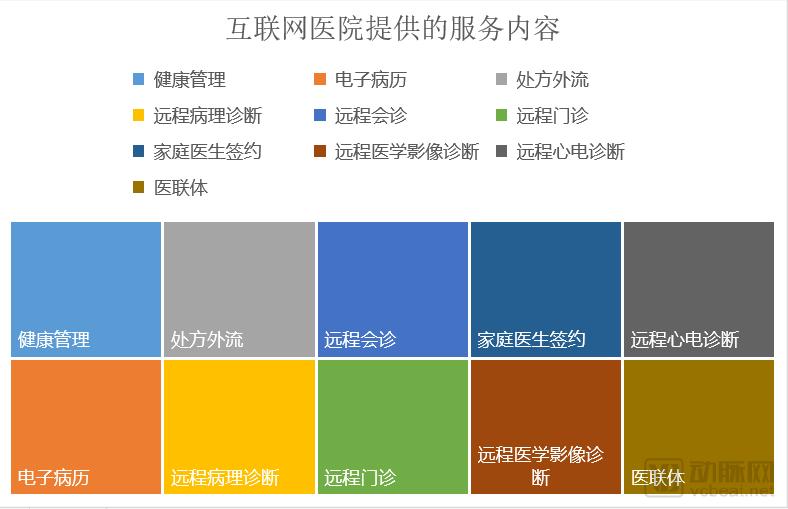
Last September, the first batch of detailed implementation rules for internet healthcare, including the “Administrative Measures for Internet Diagnosis and Treatment (Trial),” were released. The documents stipulate that internet hospitals shall be subject to access management. Prior to approval for access, provincial-level health administrative departments must first establish a provincial internet medical service regulatory platform, with medical institutions required to integrate with this platform and accept real-time supervision.
Key regulatory focuses include personnel, prescriptions, clinical practices, patient privacy protection, and information security in internet hospitals.This is the first and most critical step for any region to launch internet-based healthcare services. In other words, if a provincial-level regulatory platform for internet healthcare services has not been established in a given region, that region cannot provide such services.
In early April this year, at a press conference held at the Affiliated Hospital of Qingdao University and moderated by Liu Zhefeng, Director of the News and Network Division of the Publicity Department of the National Health Commission, Mao Qunan, Director of the Department of Planning, Development, and Informatization of the National Health Commission, stated thatSix provinces and regions, including Shandong Province, Zhejiang Province, Guangdong Province, Sichuan Province, Yunnan Province, and the Ningxia Hui Autonomous Region, have completed the construction of provincial-level regulatory platforms for internet healthcare services.
Taking Sichuan’s provincial internet medical service supervision platform as an example, it was announced to go live on December 20, 2018, merely one month apart from the release of detailed rules for internet healthcare. Reportedly, this marks the first official launch of a “provincial-level internet healthcare industry supervision platform” in China.
The overall design philosophy of the platform is as follows: By leveraging big data collection methods, required regulatory indicator data are collected from existing business systems in accordance with interface standards to establish corresponding data warehouses. Ultimately, the data are presented to administrative management departments at all levels based on regulatory entities, methods, and dimensions. This approach enhances the transparency of medical institutions and healthcare professionals, ensures more timely and efficient supervision of medical practices and processes, and ultimately provides dynamic regulatory oversight and decision-making support for management at all levels.
Currently, the Sichuan Provincial Internet Medical Service Supervision Platform has achieved integrated display capabilities across the regulatory terminal, service platform, and large-screen dashboard. On the dynamic monitoring dashboard, regulatory requirements from authorities at all levels can be analyzed through multi-dimensional chart visualizations. The system also displays all regulatory indicator values and historical trends for medical institutions within designated areas, while providing horizontal comparisons with peer institutions of the same type in the same region, enabling regulators to quickly grasp real-time operational status.
In terms of specific operational implementation, how does one apply to establish an internet hospital? According to the "Administrative Measures for Internet Hospitals (Trial)" issued by the state, we can see that:
To apply for the establishment of an Internet hospital, an application shall be submitted to the business registration authority of the physical medical institution on which it relies, along with the following materials:
(1)Application Form;
(2)Prepare a feasibility study report, with content appropriately simplified as circumstances warrant;
(3)Address of the affiliated physical medical institution;
(4)Agreement on the Joint Establishment of an Internet Hospital, Co-signed by the Applicant and the Physical Medical Institution.
Newly Applied-for Physical Medical InstitutionsEntities intending to adopt “Internet Hospital” as their secondary name shall indicate this in the application for establishment and provide details regarding the establishment of the Internet Hospital in the feasibility study report.If an internet hospital information platform is established in cooperation with a third-party institution, the cooperation agreement shall be submitted.
Upon accepting an application for the establishment of a medical institution, the health administrative department shall conduct a review in accordance with the relevant provisions of the Regulations on the Administration of Medical Institutions and the Detailed Rules for the Implementation of the Regulations on the Administration of Medical Institutions, and issue a written response indicating approval or disapproval within the prescribed time limit. If the establishment is approved and the applicant is permitted to use “Internet Hospital” as its secondary name, this shall be specified in the Approval Certificate for Establishment of Medical Institutions. For third-party institutions applying to establish an Internet Hospital, the Approval Certificate for Establishment of Medical Institutions shall be issued. The medical institution shall then apply for practice registration in accordance with relevant laws, regulations, and rules.
Meanwhile, physical medical institutions that have already obtained the "Medical Institution Practicing License" and intend to establish an internet hospital, using the internet hospital as their secondary name, shall submit an application to the issuing authority of the "Medical Institution Practicing License" to add the internet hospital as a secondary name, and provide the following materials:
(1)An application form signed and approved by the legal representative or principal person in charge of the medical institution, stating the reasons and rationale for applying to add “Internet Hospital” as a secondary name.
(2)Status of integration with the provincial-level internet medical services supervision platform;
(3)If an internet hospital is established in cooperation with a third-party institution, the cooperation agreement shall be submitted;
(4)Other materials required by the registration authority.
For an internet hospital established through cooperation, if there is a change in the cooperating party or other circumstances arise that render the cooperation agreement invalid, a new application for the establishment of the internet hospital must be submitted.
In the naming phase, we identified the following three requirements:
(1) Where a physical medical institution independently applies to establish an internet hospital as its secondary name, the name shall include “Name of the Institution + Internet Hospital”;
(2) When a physical medical institution applies to establish an Internet hospital as its secondary name in collaboration with a third-party institution, the name shall follow the format: “Name of the Institution + Identifying Name of the Partner + Internet Hospital”;
(3) The name of an independently established internet hospital shall include “Applicant’s Identifying Name + Internet Hospital”.
Taking Shandong Province as an example, in the process of approving and consenting to physical hospitals’ applications for internet hospital licenses, the first step isAgreed to allow Shandong Provincial Hospital, Shandong Provincial Third Hospital, and the Affiliated Hospital of Qingdao University to operate under the additional designation of “Internet Hospital”; secondly, agreed toNote that the aforementioned three hospitals provide internet-based medical services; finally, thisThree hospitals can provide follow-up consultation services for common and chronic diseases to patients via an internet medical service platform, leveraging physical medical institutions and internet technologies.
Based on the current models of internet hospitals, they are generally categorized into two types: one is the hospital-led model, and the other is the co-developed model involving enterprises and hospitals. According to existing publicly disclosed data, the majority of these models are still dominated by hospitals. We have compiled information on selected hospitals that have established internet hospitals, as shown in the figure below:
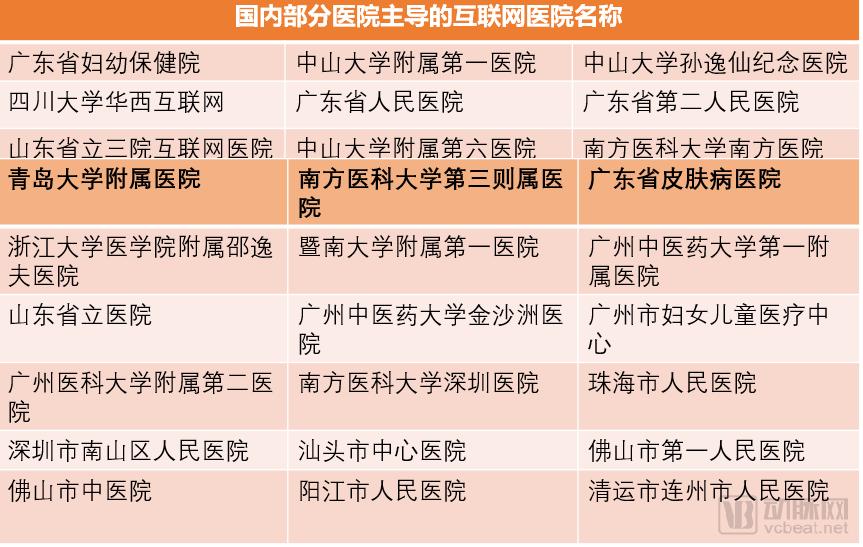
This model is characterized by three key features. First, it accelerates the free flow of physician resources. Physicians who have already registered for multi-site practice are exempt from additional registration when providing consultations via internet hospitals primarily established by hospitals. Second, it facilitates faster and easier integration of medical insurance coverage and sharing of outpatient prescriptions. For instance, Foshan Hospital of Traditional Chinese Medicine has successfully implemented prescription sharing. Third, enterprises participate in this model by providing the technical infrastructure for building internet hospitals.
Since 2017, Shandong Province has witnessed a surge in the development of internet hospitals, with public hospitals serving as the leading force in this initiative. In February 2017, the Internet Hospital of the Affiliated Hospital of Qingdao University was launched and began operations. In April 2018, the Third Provincial Hospital of Shandong became the first pilot unit for internet medical services in the province. Meanwhile, cities such as Binzhou and Zibo have also embarked on exploratory efforts to establish regional internet hospitals.
Since August 2018, the hospital has progressively launched online follow-up consultations and specialty membership services. Since the launch of these features, a total of 290 physicians across various specialties at Shandong Provincial Third Hospital have provided online consultation services, cumulatively serving 22,000 patient visits.
Upon the launch of the online follow-up consultation feature, the hospital established an operations team comprising the Smart Healthcare Department and WeDoctor. A vice president in charge was assigned to coordinate support and collaboration from other hospital departments. The operations team implemented differentiated strategies tailored to the specific workflows of various clinical departments and physicians with different levels of seniority. Furthermore, it provided feedback to the platform for product optimization based on operational needs, thereby creating a closed-loop system for continuous improvement across service delivery, operations, and platform development.
Regarding corporate participation in the development of internet hospitals, we collected publicly available data on more than 200 companies. The majority of these entities previously operated as digital health companies or pharmaceutical e-commerce platforms, with their establishment dates predominantly concentrated in 2018. The details are as follows:

From the list, we can see that many large companies have also applied for internet hospital licenses, such as Ping An Good Doctor, Tencent, and Jiuzhitang; there are also technology companies like LinkDoc and Anhan Medical.
Anhan Medical obtained the license for Anhan Internet Hospital in Yinchuan, thereby securing its practice permit. It is a comprehensive internet hospital led by gastroenterology with cross-specialty collaboration.
According to Huan Dandan, Vice President of Anhan Medical, Anhan Internet Hospital will engage in in-depth collaboration with medical institutions, health examination centers, and community hospitals to streamline the end-to-end care pathway for gastrointestinal patients from online consultations to offline treatments. It will also provide services such as remote gastroenterology care, multidisciplinary consultations, and chronic disease management, thereby achieving deep integration of high-tech medical devices, internet technology, and healthcare services.
Anhan Internet Hospital aims to achieve early and precise diagnosis by leveraging its internet hospital platform and telemedicine diagnostic technologies. This approach facilitates the rational allocation of high-quality medical resources, expands the coverage of gastrointestinal health screenings and large-scale population-based examinations, and reduces mortality rates from gastrointestinal diseases such as gastric cancer. It enables a broader population to benefit from advanced medical equipment, thereby enhancing the overall level of medical services and improving the equity and accessibility of the healthcare system. Furthermore, through extensive empowerment via the internet hospital and medical consortiums, Anhan accelerates the market penetration of magnetically controlled capsule gastroscopy, particularly in grassroots and remote areas.
As various regions relax the accreditation requirements for internet hospitals and regulatory measures are progressively implemented, an increasing number of internet hospitals will emerge. Internet technology will gradually integrate with physical medical institutions, eventually becoming inseparable. Whether in first- and second-tier cities or third- and fourth-tier cities, online appointment registration and payment via internet technology have become the norm.
In 2015, Huaihua First People's Hospital enabled patients to access a full spectrum of medical services—from outpatient care to hospitalization—simply by following its official WeChat account, without the need to download any third-party apps. These services include intelligent triage, appointment registration, point-of-care payment, retrieval of test reports, access to medical records, payment of hospitalization deposits, viewing of inpatient billing statements, submission of patient satisfaction feedback, and access to health information.
Wei Tiemin, President of Lishui Central Hospital, believes that the internet will certainly play a significant role in advancing the healthcare sector, particularly in optimizing medical service workflows. This not only brings considerable convenience to the public but also helps rectify issues in physicians’ diagnostic and treatment processes, thereby reducing errors.
As for whether the internet can replace the primary or a significant portion of healthcare professionals’ work in the future, the road ahead remains long. Disease diagnosis is highly intricate and requires direct face-to-face interaction between individuals. Wei Tiemin believes it is still premature to replace the entire diagnostic and treatment process with relatively mechanical or fragmented procedures.
In the realm of smart healthcare, Lishui Central Hospital has partnered with Tencent, primarily focusing on the collection of information and data to support future big data applications. In previous years, the hospital launched an Overseas Chinese Online Hospital, specifically designed to serve overseas Chinese. This initiative was developed in response to the local context as a prominent hometown of overseas Chinese, where approximately 400,000 to 500,000 overseas Chinese originate. The aim was to facilitate their access to medical care, marking the hospital’s earliest endeavor in smart healthcare.
“Although the development of internet hospitals is in full swing across China, we only need to follow suit in this field,” said Wei Tiemin.
Note: We will continue to track and report on the development of “Internet Hospitals,” launch special features, and jointly promote industry growth. Participation from all sectors is welcome.