NIPT Veteran Entrepreneurs Launch GenEdit-Based Automated Pathogen Detection Platform: Jieyi Bio Files IPO Prospectus

Matridx Biotechnology
In Vitro Molecular Diagnostic Reagents and Medical Device Developer
……
On December 28, my father-in-law began experiencing cold symptoms with a runny nose.
……
On January 3, my father-in-law acknowledged the deterioration of his condition and decided against enduring it any longer, opting to return to Hospital A for an X-ray examination.
……
On January 5, admitted to a Grade A tertiary hospital.
……
On January 8, the patient was directly admitted to the ICU.
……
On January 11, extubation was completed.
On January 12, the decision was made to initiate extracorporeal membrane oxygenation (ECMO) therapy.
……
On January 23, the latest tests indicated renal failure; consultation was sought regarding the need for dialysis.
On January 24, with all documents and information verified as matching, the cremation process was initiated.
——Excerpt from “A Beijing Middle-Aged Man’s Journey with Influenza”
In early 2018, author Li Ke employed a plain, sketch-like narrative style in his piece “A Beijing Middle-Aged Man’s Journey Through Influenza,” documenting the 29-day tragedy that led from his father-in-law’s initial “cold and runny nose” to his untimely death. This case once again reminded people that even with rapidly advancing medical capabilities, pathogenic microbial infections can indeed be life-threatening.
One detail mentioned in this article is deeply regrettable: Li Ke’s father-in-law was not diagnosed with the specific pathogen until the middle to late stages of his illness. From the initial empirical use of antibiotics to the eventual exhaustion of all available measures, including the use of an artificial lung (ECMO) to sustain life, the rapid progression of the disease ultimately proved fatal.
According to the 2018 China Health and Family Planning Statistical Yearbook, outpatient and emergency visits in general hospitals across China exceeded 3.3 billion in 2017, with 244 million hospitalizations; nearly one-third of these cases were infectious diseases, making them among the most prevalent conditions. Furthermore, the Institute for Health Metrics and Evaluation (IHME) report indicated that in the 2016 global ranking of disease burden, infectious diseases accounted for 17.99% of the total, surpassing cardiovascular diseases, which ranked first. This category includes diarrhea and common infections, HIV/AIDS, tuberculosis, malaria and other tropical infectious diseases, as well as other communicable diseases.
Due to the lack of accurate and efficient diagnostic methods for pathogenic microorganisms, medical institutions are forced to select antibiotics empirically, which has led to a global challenge—antibiotic misuse. On the other hand, clinical practice faces significant difficulties in identifying pathogens in cases of pneumonia, fever of unknown origin, sepsis, and central nervous system (CNS) infections. Notably, 40–60% of CNS infections remain etiologically undiagnosed. The inability to clearly identify pathogens imposes severe medical, economic, and social burdens.
Early diagnosis and precision treatment of pathogenic microorganisms are key measures to reduce patient mortality, complications, and sequelae. Currently, the primary methods for detecting pathogenic microorganisms include biochemical identification, mass spectrometry, and PCR. Traditional pathogen detection faces challenges such as difficulties in cultivation or prolonged culture periods, low positivity rates, the inability to routinely culture certain microorganisms (e.g., viruses) in laboratory settings, single-target detection, and cumbersome operational procedures. These issues can result in missed optimal treatment windows for patients and diminished therapeutic efficacy.
In Hangzhou, a city of innovation, Matridx Biotechnology, a technology-driven company founded on next-generation sequencing and gene-editing technologies, has emerged. The company was co-founded by Dr. Wang Jun, a specialist in cellular and molecular biology, and Zhong Jie, a seasoned investor in the health industry.
Dr. Wang Jun was a founding team member of Berry Genomics (SH:000710), China’s first publicly listed genetic testing company. She spearheaded the research, development, and industrialization of the Non-Invasive Prenatal Testing (NIPT) project, securing China’s first regulatory approval for an NGS-based product. As one of the pioneers in applying next-generation sequencing (NGS) technology in China, she boasts extensive entrepreneurial success.Zhong Jie is a partner at Zhejiang Grand Health Industry Fund. He was previously a core team member at Dian Diagnostics (SZ:300244), China’s first publicly listed independent clinical laboratory. He played a key role in building the country’s largest network of independent laboratories and its most extensive in vitro diagnostics (IVD) distribution system, and was instrumental in completing Dian Diagnostics’ IPO. His led investments in the IVD and genetic testing sectors have exceeded RMB 5 billion.

Dr. Wang Jun, Co-founder of Matridx Biotechnology Photo provided by the interviewee
Dr. Wang Jun told VCBeat New Medicine that since its inception, Matridx Biotechnology has established a clear mission: “To revolutionize the diagnosis of infectious diseases, address the global challenge of antibiotic misuse, and save as many patient lives as possible!” The company is committed to integrating pathogenic microbiology diagnostics with genomics and medical big data. By innovatively applying technologies such as CRISPR gene editing and metagenomic next-generation sequencing (mNGS) to analyze nucleic acids from pathogenic microorganisms, and leveraging its proprietary pathogen database alongside an artificial intelligence analytics system, Matridx provides clinicians with rapid, accurate, and comprehensive diagnostic reports, while also accelerating drug development within the industry.
Matridx Biotechnology’s pathogenic microorganism testing offers two distinctive advantages:
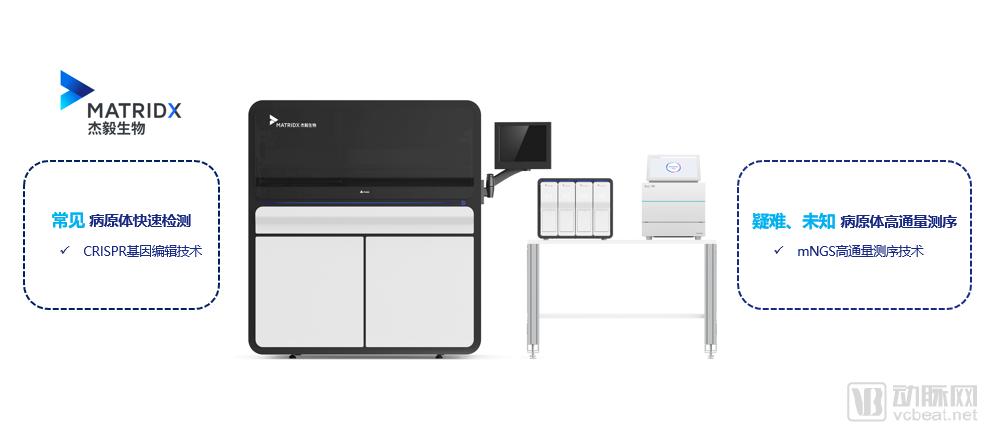
On one hand, for infections caused by common pathogens, CRISPR-based automated instruments can revolutionarily and rapidly identify the specific pathogen with high precision, providing instant results within just 1.5 hours to guide targeted medication.
On the other hand, for complex and refractory infections, testing of various samples—including blood and bronchoalveolar lavage fluid—can detect over 16,000 types of pathogenic microorganisms (including bacteria, viruses, fungi, and parasites). Utilizing a proprietary rapid detection system, test reports can be obtained within just one business day.
This will significantly revolutionize traditional infection detection technologies, overcoming their drawbacks of prolonged turnaround times and limited pathogen coverage, rapidly providing clinicians with accurate and comprehensive information on pathogenic microorganisms, and facilitating the transition from an “experience-driven diagnosis and treatment model” to a “data-driven precision medicine model.”
In recent years, with the continuous expansion of application areas for next-generation molecular diagnostic technologies, numerous high-throughput sequencing projects have flourished across China, led by prominent companies such as BGI Genomics. When asked about Matridx Biotechnology’s competitive advantages as a latecomer, Dr. Wang Jun highlighted timeliness and precision. He believes that, overall, molecular diagnostics is still in a relatively early stage of development, and the future market holds significant potential.
“Traditional molecular diagnostic reactions themselves do not take long, but experimental procedures and waiting for samples have become the rate-limiting steps and bottlenecks in clinical molecular testing,” pointed out Dr. Wang Jun. “Matridx Biotechnology strives to continuously improve the timeliness and automation level of molecular diagnostics.”
Matridx Biotechnology Business Process. Image provided by the interviewee
According to the introduction, Matridx Biotechnology has launched the Streamlined Molecular Automatic Platform (SMAP) targeting common outpatient and emergency infections such as influenza. The SMAP platform features three key characteristics:
First, it integrates modules for nucleic acid extraction, purification, amplification, and detection;
Second, it has achieved a "sample-in, result-out" workflow with on-demand testing upon arrival;
Third, each sample can be tested for 16 indicators, with results reported within 90 minutes and 400 samples processed in 8 hours, meeting the throughput demands of outpatient and emergency departments.
“On this testing instrument, we utilize our independently developed patented technology, CNAD (Crispr-mediated Nucleic Acid Detection), which combines isothermal nucleic acid amplification with gene editing technology (CRISPR/Cas). This enables qualitative or quantitative detection of target nucleic acids at the attomolar level (aM, 10⁻¹⁸ mol/L) within 30–60 minutes, thereby ensuring more precise test results.”
Dr. Wang Jun candidly stated that most high-throughput sequencing products currently on the market do not yet have regulatory approval certificates. They are striving to explore new application scenarios beyond oncology and genetics, noting, “I believe such efforts hold significant clinical value.”
He told VCBeat New Medicine that a 2014 paper in The New England Journal of Medicine reported the case of a boy with primary immunodeficiency syndrome. The boy experienced recurrent fever over four months, and tests for 38 pathogens all returned negative results. Metagenomic next-generation sequencing (mNGS) ultimately identified the pathogen as Leptospira santarosai. After switching to penicillin treatment, the child rapidly recovered and was discharged from the hospital.
“High-throughput sequencing is highly significant for the detection of infectious diseases with unknown etiologies,” pointed out Dr. Wang Jun. “However, mNGS requires nucleic acid extraction and library preparation from samples; the traditional workflow is complex and time-consuming. The typical turnaround time for mNGS reports is 72 hours, yet for critically ill patients, timeliness is a matter of life and death.”
Dr. Wang Jun stated that to address this pain point, Matridx Biotechnology has launched the Cubics automated library preparation system. Suitable for various types of clinical samples, it operates on a “sample-in, library-out” principle. Nucleic acid extraction, library preparation, and purification are completed within two hours, with each instrument capable of processing four samples simultaneously. Furthermore, Cubics offers flexible modular connectivity and scalability to accommodate varying throughput requirements. This enables immediate library preparation and sequencing upon sample acquisition, thereby maximizing the timeliness of mNGS results.
“Such projects are currently classified as specialized testing services; therefore, we will establish a third-party medical laboratory to provide outsourced testing solutions, delivering test reports across the widest possible geographic area within the shortest timeframe,” stated Dr. Wang Jun. “Matridx Biotechnology will center its operations in Hangzhou. In the first phase, we will deploy our service network in provinces and municipalities with high population density and advanced economies, including the Yangtze River Delta, the Pearl River Delta, the Bohai Rim, and Southwest China. We look forward to joining hands with more peers and partners in the medical diagnostics industry to collectively save the lives of patients with infections.”
According to Dr. Wang Jun, Matridx Biotechnology is launching a new round of financing, with the funds primarily allocated to building its third-party laboratory network and obtaining registration approvals for medical diagnostic instruments and their corresponding reagents.